The Blood on His Blessed Face
The taste of iron fills his mouth. Blood streams down both cheeks, soaking into his beard — and somewhere below, a voice is screaming that he is dead.
2-3 AH · 624 – 625 CE
The taste of iron fills his mouth. Blood streams down both cheeks, soaking into his beard, dripping onto the rings of his armor. The Prophet Muhammad (peace be upon him) raises a trembling hand to wipe his face, and the crimson keeps coming. Somewhere below, on the broken plain of Uhud, a voice is screaming that he is dead — and for a terrible, suspended moment, much of the Muslim army believes it.
This is the hour when everything nearly ends.
The Narrowest Passage
To understand how close the early Muslim community came to annihilation, we must return to the mountainside. The archers have abandoned their post. Khalid ibn al-Walid’s cavalry has swept around the Muslim flank. The disciplined lines that routed the Quraysh at dawn have dissolved into chaos, and the Prophet is retreating uphill with a dwindling circle of defenders — nine men, then fewer, then fewer still.
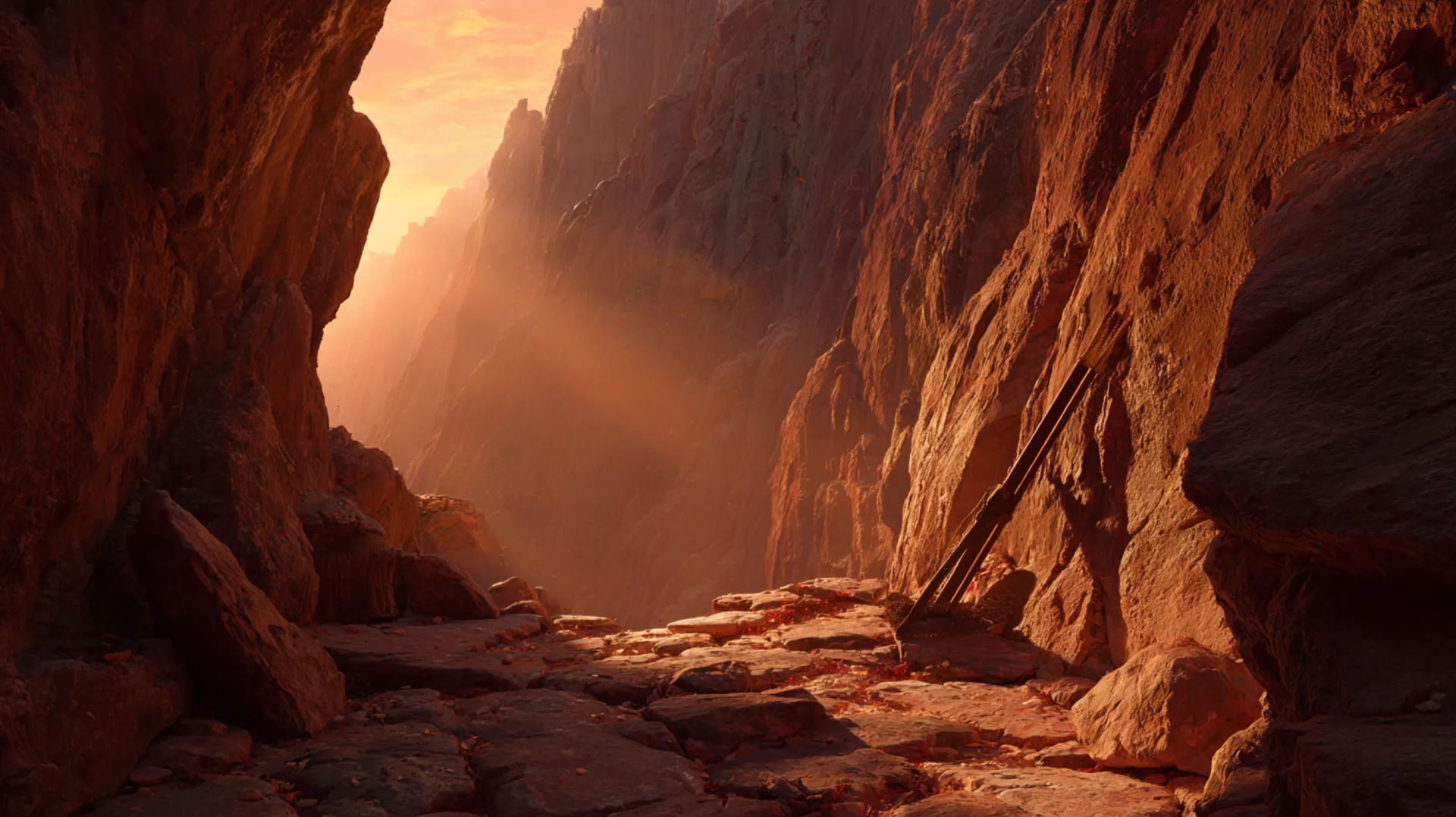
The mountain of Uhud is not a single peak but a jagged range stretching over a mile north of Madinah, riddled with crevices and narrow openings in the rock. Somewhere along its face there is a fissure — not quite a cave, more a slender crack in the stone, barely wide enough for one or two bodies to press inside. Someone in the retreating group knows exactly where it is. They are heading there now, scrambling upward over loose scree while the Quraysh contingent closes in behind them.
The Prophet calls out to his companions: Who will hold them off, and be my companion in Paradise?
Talha ibn Ubaidullah (may Allah be pleased with him) steps forward immediately. But the Prophet holds him back — Stay here, O Talha — and sends one of the Ansar instead. The logic is devastating in its clarity: Talha is the most formidable fighter among them, and the Prophet wants to preserve him for the final stand. The Ansari volunteer descends the slope and dies fighting, buying precious minutes for the retreat.
This sequence repeats itself with agonizing regularity. One by one, seven Ansari warriors offer themselves as decoys, drawing the Quraysh search parties away from the Prophet’s actual position. Each time, Talha begs to go next. Each time, he is refused. We do not know the names of these seven men — the sources have not preserved them — and perhaps that anonymity is itself a kind of testimony. They did not die for recognition. They died so that the message would survive.
Scholarly Note
The identities of the seven Ansari defenders who sacrificed themselves as decoys remain unknown in the major seerah sources. Ibn Ishaq and al-Waqidi record the general sequence of events but do not name them individually. Their anonymity has led some scholars to suggest they may have been from among the newer converts whose biographical details were less thoroughly documented.
Three Men Against an Army
When the last of the seven falls, only three remain: the Prophet, Talha, and Sa’d ibn Abi Waqqas (may Allah be pleased with him). By now, they appear to have reached the crevice in the rock. The Prophet is inside — or nearly so — and Talha positions himself at the opening like a living door, his body a shield of flesh and iron.
“My chest instead of your chest, O Messenger of Allah.”
This is what Talha says when the Prophet tries to peer outside to see what is happening. Do not look out, Talha insists. A stray arrow might find you. Let me stand guard. Let my body be the barrier.
Sa’d ibn Abi Waqqas, meanwhile, is firing arrows with terrifying precision. He is one of the finest archers in the Muslim ranks, and from the elevated position he can pick off anyone who approaches. The Prophet gathers fallen arrows from the ground and hands them to Sa’d, and in this moment he says something that Sa’d will carry like a badge of honor for the rest of his life:
“Shoot, O Sa’d — may my mother and father be given in ransom for you!”
The phrase fidaka abi wa ummi — “may my mother and father be your ransom” — was one the companions used constantly for the Prophet. It was the highest expression of devotion in their culture, a declaration that one would sacrifice even one’s parents for the person addressed. But the Prophet himself had never used it for anyone. Not for Abu Bakr. Not for Umar. Not for Ali. Only here, in this desperate crevice on Uhud, does he turn the phrase around and direct it at Sa’d. The companions noted this for the rest of their lives: the only time the Prophet combined both parents in this expression of honor was for Sa’d ibn Abi Waqqas on the day of Uhud.
Scholarly Note
The hadith regarding the Prophet’s unique use of fidaka abi wa ummi for Sa’d ibn Abi Waqqas is well-attested. Both Sa’d and Talha are counted among the ten companions promised Paradise (al-‘ashara al-mubashsharun), which contextualizes the extraordinary nature of their defense at Uhud. Ali ibn Abi Talib later narrated Sa’d’s distinction in this regard.
Then a single Quraysh warrior begins climbing toward them. Talha is finally sent to engage him. He fights the man hand-to-hand and kills him, but in the struggle a sword blow severs several of his fingers. Talha cries out — Hiss! — the Arabic equivalent of a sharp gasp of pain. The Prophet’s response is remarkable: If you had only said “Bismillah,” the angels would have lifted you up while the people watched, and carried you to the heavens. There is no rebuke in this — saying “ouch” is not sinful — but the Prophet is telling Talha how close he has come to a station so exalted that a single invocation of God’s name would have transported him bodily into the unseen.
The Wounds of the Prophet
It is here, in the chaos of the mountainside retreat, that the Prophet sustains the gravest physical injuries of his entire life. The sources record at least three separate wounds, though the exact sequence and attribution remain a matter of scholarly discussion.
The first: Utbah ibn Abi Waqqas — the blood brother of Sa’d, fighting on the opposite side — hurls a stone that strikes the Prophet’s face and splits his lower lip.
The second, and most severe: an arrow, also attributed to Utbah, finds the gap between the links of the Prophet’s helmet and pierces his cheek, dislodging one of his teeth. The arrowhead lodges in the wound and will not come free.
The third: a sword blow delivered at close range by either Abdullah ibn Shihab or Abdullah ibn Qami’ah — both names appear in the sources. Talha manages to deflect the strike with his shield, but the deflection is incomplete. The sword does not cut the Prophet directly; instead, it drives the metal rings of his own helmet into the flesh of his other cheek. Both sides of his face are now bleeding.
Scholarly Note
The number and attribution of the Prophet’s wounds at Uhud are debated among the classical historians. Some reports mention one wound, others two, and a careful reading of all narrations suggests at least three distinct injuries — a stone, an arrow, and a sword blow. Ibn Ishaq, al-Waqidi, and the hadith collections in Bukhari and Muslim each preserve slightly different details, and scholars like Ibn Hajar in Fath al-Bari have attempted to reconcile them. The identity of the swordsman — Abdullah ibn Shihab or Abdullah ibn Qami’ah — is similarly uncertain.
It is in this condition — blood streaming down both cheeks, an arrowhead embedded in his face, a tooth knocked loose — that the Prophet wipes the crimson from his beard and speaks the words recorded in Sahih Muslim:
“How can a people be successful who have done this to their own Prophet, who is calling them to their Lord?”
The grief in this statement is palpable. It is not self-pity but bewilderment — a human cry from a man who has offered these people nothing but guidance and received violence in return. And yet Allah’s response, revealed after the return to Madinah, is swift and stunning in its directness:
“You have no share in the matter — whether He turns to them in mercy or punishes them, for indeed they are wrongdoers.” — Al Imran (3:128)
The Arabic is blunt almost to the point of severity: laysa laka min al-amri shay’ — literally, “you have nothing of this affair.” Not even the most beloved human being in creation has the authority to determine who is forgiven and who is condemned. That prerogative belongs to God alone. Yes, they have committed zulm — the verse itself acknowledges this — but the Prophet cannot foreclose the possibility of their guidance.
The Theology of Laysa Laka: Divine Sovereignty at Uhud
This single verse — Al Imran (3:128) — carries immense theological weight. Ibn al-Qayyim discusses it extensively in Zad al-Ma’ad, noting that the Prophet’s statement was born of legitimate human anguish, not arrogance. Yet Allah corrected him because no created being, regardless of rank, can dictate the boundaries of divine mercy.
The proof of this principle would arrive in the most dramatic fashion imaginable. Khalid ibn al-Walid, the very commander whose cavalry charge caused the catastrophe at Uhud, would later embrace Islam and be honored by the Prophet with the title Sayfullah — the Sword of Allah. Abu Sufyan, who stood at the foot of Uhud taunting the Muslims, would enter the faith at the conquest of Makkah. Ikrimah ibn Abi Jahl, who pushed hardest for a return attack, would become a devoted companion.
The verse thus functions as both a correction and a prophecy. The Prophet was told he could not decide who would be forgiven — and then Allah forgave the very men who had wounded him. For later Muslim theology, this became a foundational text on tawhid al-rububiyyah: the absolute sovereignty of God over guidance, mercy, and judgment. If even the Prophet cannot intercede in this domain without divine permission, then no saint, no scholar, no intermediary of any kind possesses that authority.
After this revelation, the Prophet reversed his earlier statement entirely and prayed: “O Allah, forgive my people, for they do not know.” The transformation from anguished protest to compassionate supplication mirrors the broader arc of Uhud itself — from devastation to renewal.
The Eye of Qatada
As the hours wear on, other companions begin to locate the Prophet’s position and make their way up the mountain. Among the first is Qatada ibn al-Nu’man al-Awsi (may Allah be pleased with him), who arrives and is given a bow by the Prophet — evidence that the Prophet has been collecting weapons from the battlefield during the retreat. Qatada fires so many arrows that the bow loses its flexibility entirely, rendered useless from overuse.
When the arrows run out, Qatada does the only thing left to him: he uses his own body as a shield. He monitors incoming arrows and throws himself in their path. One arrow, coming too fast and at too sharp an angle, can only be blocked by his face. It strikes his eye.
The Prophet weeps when he sees this. He takes the arrow out himself and makes a supplication:
“O Allah, Qatada has protected Your Prophet with his face. So make his eye the best of eyes and the most precise in sight.”
Qatada later testified that the wounded eye healed completely and became sharper than his other eye — a miracle witnessed by the companions present in that narrow crevice of stone.
”I Have Killed Muhammad!”
Meanwhile, on the plain below, Abdullah ibn Qami’ah has found another target. Musab ibn Umayr (may Allah be pleased with him) — the standard-bearer, the former son of Meccan luxury who gave up everything for his faith — bears a physical resemblance to the Prophet: similar complexion, similar features, and he may even have been wearing a borrowed cloak from the Prophet’s own wardrobe. When Ibn Qami’ah strikes Musab down, he believes he has killed the Prophet himself.
He screams it at the top of his lungs: I have killed Muhammad!
The cry spreads like fire through dry brush. Among the Quraysh, it produces euphoria — the mission is accomplished, the war is over, time to go home. Among the scattered Muslim fighters still on the field, it produces something close to paralysis. Some sit down and drop their swords. Others wander aimlessly, stunned beyond the capacity for action.
But not Anas ibn al-Nadr (may Allah be pleased with him), the uncle of the young Anas ibn Malik. He comes upon a group of companions sitting motionless and demands to know why they have stopped fighting. Haven’t you heard? they say. The Prophet has been killed.
His response rings across the centuries:
“Even if Muhammad has been killed, the Lord of Muhammad has not been killed. And what will you do with life after the Prophet is gone? Rise, and die as he died.”
He charges into the Quraysh lines alone. He meets Sa’d ibn Mu’adh on the way and tells him: O Sa’d, I can smell the fragrance of Paradise from behind that mountain. Then he prays aloud as he runs: O Allah, I seek Your forgiveness for what these Muslims have done, and I dissociate myself from what the pagans have done.
He fights with such ferocity that when his body is finally recovered, it bears more than eighty wounds — stabs, cuts, and gashes covering every part of him. His face and body are so disfigured that no one can identify him until his sister arrives and recognizes him by the tips of his fingers.
Allah revealed concerning him and those like him:
“Among the believers are men who have been true to their covenant with Allah.” — Al-Ahzab (33:23)
The Reunion on the Mountain
It is Ka’b ibn Malik (may Allah be pleased with him) — the same Ka’b who will later feature in the famous incident of the three who stayed behind at Tabuk — who first recognizes the Prophet from the battlefield below. Even with the helmet and armor obscuring his features, Ka’b knows those eyes. He shouts with uncontainable joy: O Muslims, rejoice! The Prophet is alive!
The Prophet quickly silences him — announcing his location to the enemy is the last thing they need — but the damage, if it can be called that, is already done. The word spreads among the Muslim survivors, and they begin streaming up the mountain. Ka’b reaches the Prophet and gives him his own armor, perhaps because the Prophet’s has been damaged beyond function, perhaps to disguise his identity. Ka’b will finish the battle with more than twenty wounds, all sustained after giving away his protection.
Abu Bakr al-Siddiq (may Allah be pleased with him) is among those rushing uphill. He later told his daughter Aisha that as he ran, he saw a single figure defending the Prophet and prayed: O Allah, let it be Talha. It was. Behind Abu Bakr, another man sprints past him with astonishing speed — Abu Ubaidah ibn al-Jarrah (may Allah be pleased with him), so overjoyed that the Prophet is alive that he bounds up the mountainside like a gazelle.
When they reach the Prophet, they see the two wounds in his face — metal and arrowhead embedded in his cheeks. Abu Bakr reaches forward to extract them, but Abu Ubaidah begs for the honor. He bites down on the lodged arrowhead with his own teeth and pulls it free, losing two of his own teeth in the process. Then he insists on doing the same for the other side, losing another tooth or two. Abu Ubaidah would carry those gaps in his smile for the rest of his life — and the companions considered him more beautiful for it.
The Death of Ubayy ibn Khalaf
Sometime during this desperate retreat — the precise moment is uncertain — one final confrontation takes place. Ubayy ibn Khalaf, that most vulgar of the Prophet’s Meccan tormentors, the man who had once boasted of a special horse he was fattening to ride when he killed Muhammad, spots the Prophet from a distance and charges.
The companions huddle around the Prophet protectively, but he waves them aside. He is mine.
He grabs a spear from a companion named al-Harith ibn al-Samit, sidesteps Ubayy’s mounted charge, and thrusts the spear into the narrow gap between Ubayy’s helmet and his armor, piercing his neck. The wound is shallow — the spear catches on the armor — but Ubayy screams as though he has been run through entirely. He gallops back to the Quraysh lines shrieking: Muhammad has killed me!
His companions examine the wound and assure him it will heal. But Ubayy knows better. Back in Makkah, the Prophet had once responded to his taunts with a quiet promise: No — I will be the one to kill you, God willing. Now, bleeding from the neck on his prized horse, Ubayy croaks: By God, if he had merely spat in my face, I would have fallen dead.
He dies on the journey back to Makkah, at a place called the Valley of Raghib. He is the only man in history to die directly at the Prophet’s hand — a singular dishonor reserved for a singular cruelty.
Abu Sufyan’s Parting Words
After Khalid ibn al-Walid’s forces scour the mountainside without locating the Prophet, the Quraysh begin to regroup. Abu Sufyan, who apparently did not participate in the counter-offensive himself, arrives to close the affair. He stands at the base of Uhud and shouts upward:
Is Muhammad alive? Answer me!
Silence. The Prophet has ordered Umar and Abu Bakr not to respond.
Is the son of Abu Quhafa alive? Is the son of al-Khattab alive?
Still silence. Abu Sufyan begins to exult: We have killed them all!
At this, Umar ibn al-Khattab (may Allah be pleased with him) can contain himself no longer. He roars back: You lie, O enemy of Allah! All of them are alive, and they will remain to bring you grief another day!
Abu Sufyan, now knowing the truth, shifts to a different register. Today in return for the day of Badr, he calls out. War goes in turns — one day for you, one day for us. Then, with unsettling honesty: You will find mutilation among your dead. I did not command it, but I am not displeased by it either.
Umar fires back: Our dead and yours are not the same. Ours are in Paradise; yours are in the Fire.
Then Abu Sufyan raises his voice one final time: Glory to Hubal! Glory to Hubal!
Now the Prophet speaks. Not before — not when his own name was called, not when his companions were mocked. Only when the idols are praised does he break his silence. He tells his companions: Answer him. Say: Allah is Most High and Most Glorious.
Abu Sufyan tries again: We have al-Uzza, and you have no Uzza!
The Prophet instructs them to respond: Allah is our Protector, and you have no protector.
Ibn al-Qayyim observes in Zad al-Ma’ad that this sequence reveals a profound principle: when his own honor was at stake, the Prophet chose silence and dignity. When God’s honor was invoked, he would not allow a single word to go unanswered.
Returning to Madinah
The aftermath is almost too painful to narrate. The Prophet walks the battlefield and sees the mutilated body of his uncle Hamza ibn Abd al-Muttalib (may Allah be pleased with him) — nose severed, ears cut off, stomach desecrated, liver chewed and spat out by Hind bint Utbah. He weeps. He says, in his grief, that if he catches those responsible, he will mutilate thirty of their dead in return.
Then Allah reveals:
“And if you punish, then punish with the equivalent of that with which you were punished. But if you are patient — it is better for those who are patient.” — An-Nahl (16:126)
The Prophet chooses patience. He forbids mutilation permanently — it becomes haram in Islamic law, even against enemy combatants. The dead are buried in shared graves, two or three or four to a pit, with the one who memorized the most Quran placed first. Even in death, even in this shattered hour, the Book of God determines the order of honor.
Back in Madinah, Fatimah bint Muhammad (may Allah be pleased with her) tries to wash the blood from her father’s face. Ali ibn Abi Talib (may Allah be pleased with him) pours water, but the bleeding will not stop — hours after the battle, the wounds are still open. Finally, Fatimah burns date palm leaves, crushes them into a paste with water, and presses it into the gashes to seal them shut. Only then does the bleeding cease.
And in those same days, as Madinah mourns its seventy dead — mostly Ansar, the people who had opened their homes to the faith — a small, quiet thing happens. An Ansari man approaches the Prophet. His wife has just given birth. What should we name the child?
The Prophet’s answer comes without hesitation: Name him the most beloved name to me — Hamza.
A newborn named for the dead. Life reaching across the grave to clasp the hand of loss. In that single naming, the entire meaning of Uhud crystallizes: the community is wounded but not destroyed, grieving but not without hope, bleeding but still, impossibly, bringing new life into the world.
Was Uhud a Defeat? Reassessing the Battle's Outcome
The conventional narrative frames Uhud as a Muslim defeat, and by the grim arithmetic of casualties — seventy Muslims dead against twenty-two Quraysh — there is no sugarcoating the loss. The Quran itself references this disparity: “When a calamity befell you, though you had inflicted double that amount, you said, ‘How is this?’” — Al Imran (3:165). The “double” refers to Badr’s toll: seventy Quraysh killed and seventy captured.
Yet by nearly every other metric, the Quraysh failed. Their strategic objective was the destruction of the Muslim community; they achieved nothing of the sort. The Muslims remained on the battlefield; the Quraysh withdrew. The Muslims took one prisoner of war; the Quraysh took none. The Prophet personally led a pursuit force to Hamra al-Asad the very next day, camping there for three days — a demonstration of strength that the Quraysh, despite Ikrimah ibn Abi Jahl’s urging, dared not challenge. The trade route to Syria remained blocked.
Even the Quraysh knew. Ikrimah’s own complaint — “We have neither killed Muhammad nor earned the admiration of our young women” — is an admission of failure from within their own ranks. Ibn al-Qayyim concludes that Uhud was neither a pure victory nor a genuine defeat, but a painful and necessary trial whose ultimate fruit was the purification of the Muslim community and the exposure of hypocrisy within its ranks.
The Lesson Written in Blood
Eight years later, in the final week of his life, the Prophet will mount the pulpit in his mosque one last time. He will pray for the martyrs of Uhud — as if they are standing before him, as if he is bidding them farewell. And then he will say to the living:
“I will be waiting for you at the Fountain. I am a witness over you. And indeed, our meeting place is at the Fountain.”
As recorded in Sahih al-Bukhari, he will add: I am not worried that you will fall into idolatry after me. What I fear for you is that this world will open up before you and you will compete with one another for it.
Uhud. The world. Competition. The very last public sermon he ever delivers, and he is still thinking about what happened on that mountain — still warning against the love of dunya that pulled the archers from their post, that shattered the Muslim lines, that turned victory into catastrophe.
But ahead of that final sermon lie years of rebuilding, of revelation, of a community learning to carry its scars with grace. The immediate future, however, holds no such comfort. Within months, the Prophet will send seventy of his finest scholar-companions on a mission of teaching — and nearly all of them will be slaughtered in one of the most devastating betrayals the young community has yet faced. The wounds of Uhud have barely closed. The wounds of Bi’r Ma’una are about to open.
Quranic References
Continue Your Journey

Cite this Narrative
APA
SeerahQuest. (2026). The Blood on His Blessed Face. *SeerahQuest: The Eternal Narrative*. https://seerahquest.com/chapters/battle-of-uhud-part-4 Adapted from Yasir Qadhi's Seerah Series, Episode 49, Episode 50.
MLA
"The Blood on His Blessed Face." *SeerahQuest: The Eternal Narrative*, 2026, https://seerahquest.com/chapters/battle-of-uhud-part-4. Adapted from Yasir Qadhi's Seerah Series, Episode 49, Episode 50.
Chicago
"The Blood on His Blessed Face." *SeerahQuest: The Eternal Narrative*. Accessed April 3, 2026. https://seerahquest.com/chapters/battle-of-uhud-part-4. Adapted from Yasir Qadhi's Seerah Series, Episode 49, Episode 50.
Install SeerahQuest — read chapters offline, anytime.