Tears at al-Abwa
On a dusty road between two cities, a Prophet walked off the path to weep at a grave no one else remembered — and in doing so, changed Islamic law forever.
pre-hijra · 610 – 613 CE
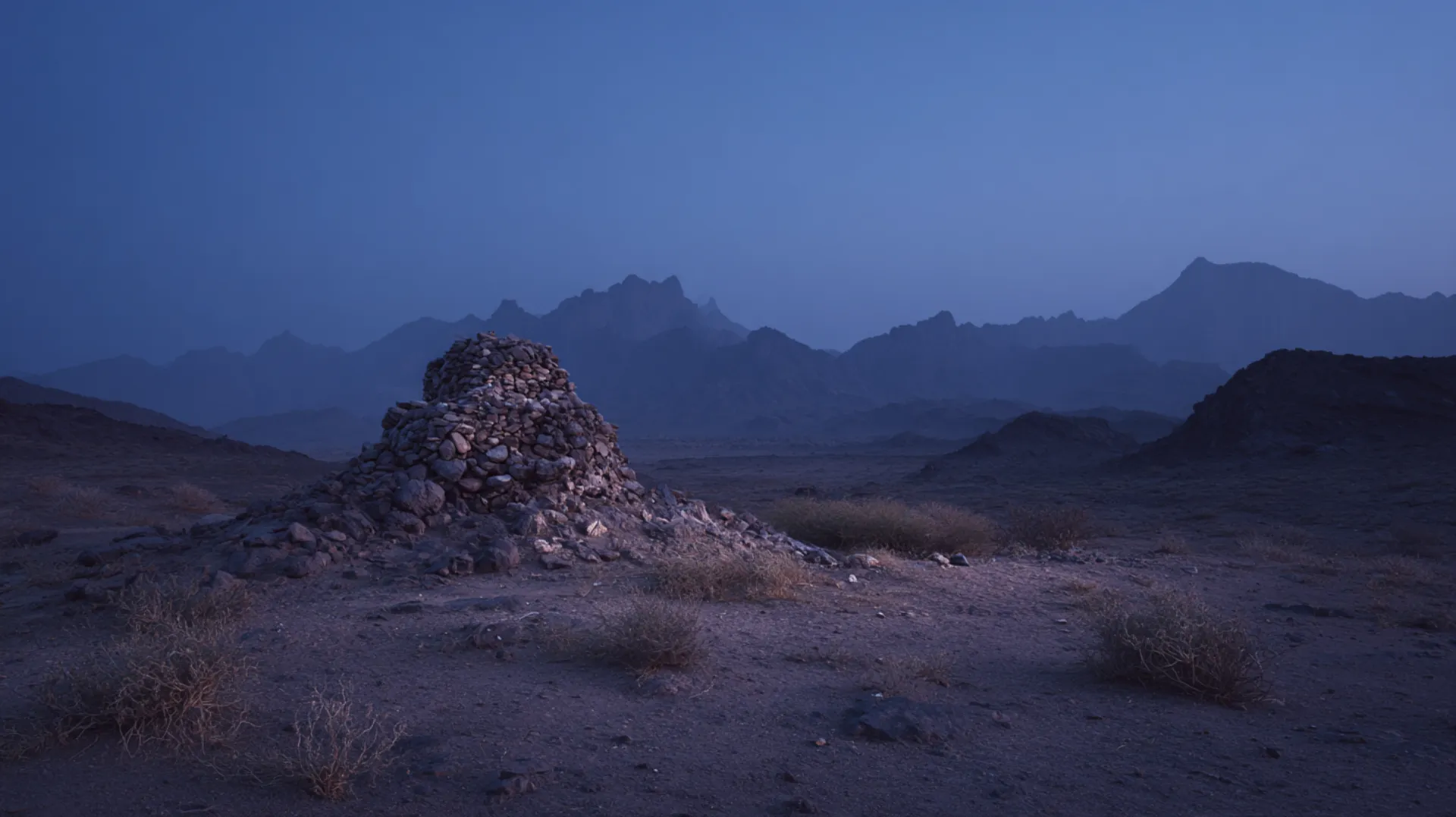
The road stretches endlessly through the Hijaz, a ribbon of dust and memory winding between black volcanic ridges. A caravan of Companions follows their Prophet in the late afternoon light, the familiar landmarks of the route to Medina passing one by one. Then, without warning, the man they love more than their own lives turns off the path. He says nothing. He simply walks away from the road, into the open wilderness, as though drawn by something invisible. The Companions do not ask where he is going. They never do. They simply follow.
He walks until he finds a grave — unmarked, unremarkable, a small mound in a small settlement called al-Abwa. And there, the Messenger of God sits down and weeps. He weeps until his beard is soaked with tears, until the men who have crossed deserts and battlefields beside him stand helpless, crying too, not even knowing why.
This is the grave of Aminah bint Wahb. This is where a six-year-old boy became an orphan for the second time. And this is where, more than forty years later, a Prophet (peace be upon him) came back to mourn her.
The Desert Cradle
To understand the tears at al-Abwa, we must return to the beginning — to the days after the birth, when a mother did what the noble families of Quraysh had always done: she gave her newborn son away.
The custom strikes modern sensibilities as strange, even cruel. But for the elite of Mecca, sending an infant to be raised among the Bedouin tribes was an act of love wrapped in pragmatism. The city, for all its sacred prestige, was a crucible of disease. Infant mortality was staggeringly high wherever people congregated, and the surest way to protect a child was to remove him from the crowds entirely — to place him in the care of a single family in the open desert, where the air was clean and contact with strangers rare.
There were other reasons too, and they reveal a people who thought in generations. The Quraysh wanted their children hardened. A boy raised in the austerity of the desert would return to Mecca and find its hardships almost luxurious by comparison. Children, after all, adapt to their circumstances with an ease that adults never recover — a truth the Quraysh understood instinctively. They also wanted to shield their sons from the indulgence of extended family, the grandparents and uncles and aunts who would inevitably soften every boundary a parent tried to set.
And then there was the matter of language. The Arabic of the cities was changing, corrupted by the loan-words of Yemeni traders and foreign merchants. The Quraysh prized eloquence above almost everything, and they knew that the purest Arabic survived only among certain desert tribes, untouched by the linguistic drift of commerce. The most famous of these custodians of the ancient tongue was the Banu Sa’d ibn Bakr.
The Economics of Foster Care in Pre-Islamic Arabia
The relationship between the Bedouin foster mothers and the Meccan elite was fundamentally economic. The women of the Banu Sa’d ibn Bakr and similar tribes would make an annual journey to Mecca, arriving when word spread of newly born children among the nobility. Each mother needed to have recently given birth herself — she had to be lactating to nurse another child. The biological mother would then choose from among the candidates, much as a wealthy family today might select a nanny, and the foster family would receive payment for their service.
This was not charity. For the Bedouin, who lived lives of grinding poverty in the open desert, fostering a Qurayshi child was a vital source of income. The arrangement lasted roughly two years, though it could be extended by mutual agreement. During this time, the child would return periodically to visit his biological family, maintaining the bond even as he absorbed the language, resilience, and independence of desert life.
The custom was exclusively for the wealthy. As the Prophet himself later said in an authentic hadith: “I was foster-cared by the Banu Sa’d ibn Bakr.” He described himself as the answer to Ibrahim’s prayer and the glad tidings foretold by Isa, and then added this detail of his upbringing — placing it alongside the grandest theological statements, as though the desert years were equally essential to who he became.
Halimah’s Reluctant Gift
The year the women of the Banu Sa’d came to Mecca, one child remained unclaimed. Word had spread quickly: there was an orphan among the newborns. His father, Abdullah, was already dead. The grandfather, Abd al-Muttalib, was the chieftain of Quraysh, yes — but he had ten sons and numerous grandchildren. Who would pay generously for an orphan?
Some women did not even bother visiting the house of Aminah. Others came, saw the modest circumstances, and moved on to wealthier prospects.
Halimah al-Sadiyyah (may Allah be pleased with her) was among those who hesitated. She and her husband were suffering terribly from poverty — that was precisely why she had come. She needed a child whose family would pay well. She visited Aminah’s home but could not bring herself to accept what seemed like a poor investment. When the week ended, every one of her companions had secured a foster child. Halimah alone was returning empty-handed.
It was her husband who changed the course of history with a single sentence: Why don’t you take the orphan child? Perhaps Allah will bless us through him.
There is something quietly luminous in this moment — two impoverished pagans, living in the spiritual darkness of pre-Islamic Arabia, and yet the husband’s heart reaches instinctively toward mercy. He does not calculate the return on investment. He invokes God’s blessing. And Halimah agrees.
What followed reads like a cascade of grace. The old goat that had stopped giving milk suddenly filled with it. The exhausted mount that could barely carry them became the fastest animal in the caravan. The blessings were so immediate, so unmistakable, that when the standard two-year contract neared its end, Halimah invented every excuse she could think of to keep the child longer. The air in Mecca is unhealthy. The boy is still too young. There are plagues. She persisted until Aminah, sensing the depth of care her son was receiving, agreed to extend the arrangement.
Scholarly Note
The story of Halimah al-Sadiyyah is narrated in her own words and recorded in multiple books of hadith and seerah. The account of the blessings — the goat’s milk, the mount’s speed — is part of her first-person testimony. While some modern readers may find these details extraordinary, classical scholars accepted them as consistent with the divine care surrounding the Prophet from infancy. The hadith is considered authentic by the scholars of seerah.
The Opening of the Heart
It was during this extended stay with the Banu Sa’d, when the child was approximately four years old, that something happened which would leave a physical mark on his body for the rest of his life.
The children were playing in the open desert — the young Muhammad, his foster brother, and his foster sister Shayma. Then, as Anas ibn Malik (may Allah be pleased with him) narrates in Sahih Muslim, Jibril came.
The other children fled in terror. The four-year-old stood his ground. When the angel overpowered him — sara’ahu, the Arabic says, meaning he struggled, he fought — the boy resisted. A four-year-old child, grappling with the mightiest angel in creation, refusing to submit without a fight. It is the earliest recorded display of the courage that would define his entire life.
Jibril opened his chest, removed his heart, extracted from it a black clot — described as the portion through which Shaytan maintains his whispered influence over every human being — and discarded it. He washed the heart in a golden vessel of Zamzam water, then replaced it and sealed the chest.
The children who had fled came running back to Halimah screaming that their brother had been killed, that a man had attacked him. When the adults arrived, they found the boy sitting alone. His face was pale. But he was not crying, not wailing — sitting in quiet composure, bearing whatever had happened to him with a self-possession that no four-year-old should possess.
And on his chest, a line. A scar. Anas ibn Malik, narrating this hadith when the Prophet was approximately sixty years old, said: “I could see the traces of that line on his chest.”
“Alam nashrah laka sadrak” — “Have We not expanded for you your chest?”
This verse from Surah al-Sharh (94:1) is interpreted by the majority of scholars of tafsir as a direct reference to this incident — the physical, spiritual cleansing that prepared the Prophet for the purest life any human being has ever lived.
Scholarly Note
The incident of shaqqus sadr (the opening of the chest) is recorded in Sahih Muslim and is considered authentically established. Scholars note that a similar event occurred approximately forty-five years later, before the night journey of al-Isra wal-Mi’raj, when Jibril again opened the Prophet’s chest and washed his heart — but on that second occasion, there was no black clot to remove, as it had already been extracted during childhood. The Companions physically witnessed the scar on the Prophet’s chest, lending corporeal evidence to what was fundamentally a spiritual purification.
This was the incident that frightened Halimah beyond her ability to keep the child any longer. Strange blessings she could accept. But a supernatural visitation that left her foster son pale and scarred — this was beyond her understanding. Quietly, without fully explaining what had happened, she returned the boy to Aminah.
The Road to Yathrib and the Grave at al-Abwa
What followed was the briefest, most precious window of time between mother and son. Aminah had her boy back, and for a period we can only estimate at roughly two years, she raised him herself. Of this time — the lullabies she sang, the stories she told, the way she held him — we know almost nothing. The silence of the sources here is one of the great sorrows of seerah scholarship. Umm Ayman, the servant whom Abd al-Muttalib had given to the couple at their marriage, was the only witness to these private years, and though she lived all the way into the caliphate of Abu Bakr al-Siddiq (may Allah be pleased with him), no one thought to sit with her and record what she had seen.
What we do know is that Aminah decided to take her son to Yathrib. The choice was not random. As discussed in earlier chapters, Abd al-Muttalib’s own mother had come from Yathrib — a seemingly minor genealogical detail that, in retrospect, reveals the quiet architecture of divine planning. Out of all the cities in Arabia, the only one to which the Prophet had family ties beyond Mecca was the small oasis settlement that would one day be renamed Medina.
They traveled together — Aminah, the boy, and Umm Ayman — and stayed for what was likely several months, long enough for a six-year-old to form memories of buildings and streets he would recognize half a century later when he returned as an emigrant and a prophet.
On the return journey, in the small settlement of al-Abwa, Aminah fell ill. She died there, and Umm Ayman arranged for her burial among the people of the village. A six-year-old boy who had already lost his father before birth now lost his mother on a dusty road between two cities.
The silence that follows in the historical record is deafening. We do not know who comforted him. We do not know if he cried or if he had already learned, at six, to hold his grief inside the way he would at four when Jibril left him pale and scarred. We know only that Umm Ayman brought him back to Mecca, back to the aging, blind chieftain Abd al-Muttalib, who would himself die just two years later — orphaning the boy for the third time.
The Tears at al-Abwa
And so we return to the scene that opened this chapter: a man in his fifties, surrounded by Companions, walking off the road toward a grave.
The hadith is in Sahih Muslim. The Prophet told his Companions:
“I had used to forbid you from visiting graves. But I asked Allah permission to visit my mother’s grave, and He allowed me.”
There is a world of meaning compressed into that statement. The Prophet does not take a single step without divine permission. He wants to visit his own mother’s grave, and even for this — especially for this — he seeks Allah’s consent first. When permission is granted, he walks to al-Abwa, sits beside the mound of earth where Aminah has lain for nearly five decades, and weeps as his Companions have never seen him weep. His beard becomes wet with tears. The men around him, who do not yet know what is happening, begin crying simply because he is crying. This is the depth of their love — they share his grief before they even understand it.
And then, from this intensely personal moment of mourning, comes a ruling that has shaped Muslim practice for fourteen centuries:
“Visit graves, for they remind you of death.”
The permissibility of visiting graves in Islamic law traces directly to this moment — to a Prophet’s love for his mother, to tears shed at al-Abwa, to a grief that time could not diminish.
The Wisdom of Orphanhood: Why the Prophet Lost Everyone
Scholars have long reflected on why Allah decreed such a painful childhood for His most beloved creation. If God had willed, the Prophet could have been born into luxury, raised by loving parents who lived to see him grow. Instead, he lost his father before birth, his mother at six, and his grandfather at eight. Why?
The scholars offer several interlocking wisdoms. First, as Allah says of Musa in the Quran, “that you may be raised under My eye” (Ta-Ha, 20:39) — by removing every human protector, Allah ensured that no one could claim a favor over the Prophet. His survival, his formation, his character were all directly under divine care.
Second, orphanhood forges qualities that privilege never can. Independence, maturity, emotional depth, resilience — these are the hallmarks of children who must stand on their own feet early. The Prophet would need every one of these qualities when, at forty, he was tasked with overturning the entire social, spiritual, and political order of Arabia.
Third, suffering breeds compassion. It is the wealthy who tend toward selfishness, the comfortable who become indifferent. The Prophet’s intimate knowledge of loss — of what it means to have no father to defend you, no mother to comfort you — made him the most tender-hearted of all human beings toward the weak. When he later said, as recorded in hadith, “I and the one who takes care of an orphan will be like this in Paradise” — holding up two fingers pressed together — he was speaking from the deepest well of personal experience.
And finally, his upbringing among the Banu Sa’d gave him the most eloquent Arabic tongue of his generation. The Prophet himself said: “I have been given jawami’ al-kalim — the most comprehensive of speech.” A small phrase from his lips could be unpacked across volumes. This mastery of language was not incidental to his mission; it was essential to it. The Quran was revealed in Arabic, and its first audience needed to hear it delivered by someone whose command of the language was beyond reproach.
Under the Shadow of the Ka’bah
After Aminah’s death, the boy was taken in by Abd al-Muttalib, the aging patriarch of the Quraysh. Of this period, we possess only two incidents — two small windows into a relationship between a blind old man and the grandchild he cherished above all others.
The first: Abd al-Muttalib had a raised platform connected to the Ka’bah where he sat each afternoon in the shade, conducting the affairs of the tribe. This was his throne, and no one — not his sons, not his other grandchildren — was permitted to sit upon it. One day, the young Muhammad came running and leaped onto the platform. His uncles pulled him back. Abd al-Muttalib stopped them. “Leave him,” the old chieftain said. “This is my child, and he can remain.”
The second: the uncles once sent the boy into the desert to find lost camels. Ibn Sa’d, one of the earliest historians of Islam, explains why — the child never failed at anything he was assigned. Whatever task he undertook succeeded. The uncles were desperate, the camels were expensive, so they sent the boy. When Abd al-Muttalib discovered what they had done, he was furious. He paced and waited, and when the child returned, he embraced him and declared: “From now on, I will never let you out of my sight.”
Two years later, when the boy was eight, Abd al-Muttalib died. On his deathbed, he entrusted his grandson to Abu Talib — Abdullah’s full brother, the only one who shared both father and mother with the Prophet’s late father. Abu Talib would remain the Prophet’s protector for over four decades, until his own death in the year that would come to be called the Year of Sorrow.
The Story of Buhaira: A Lesson in Critical Scholarship
There is a famous story, found in Sunan al-Tirmidhi and in Ibn Ishaq’s seerah, that when the Prophet was around eleven years old, Abu Talib took him on a trading journey to Syria. Along the way, they passed a monastery where a Christian monk named Buhaira lived. This monk, who had never before shown interest in passing caravans, suddenly came out to greet them, invited them to a feast, and announced that the boy in their midst would become a prophet. He said he had seen clouds sheltering the child and trees bending to shade him. The story continues with the appearance of seven Roman soldiers supposedly sent to capture the future prophet, whom Buhaira hid before urging Abu Talib to take the boy back to Mecca immediately. The narration in Tirmidhi adds that Abu Bakr al-Siddiq and Bilal ibn Rabah (may Allah be pleased with them both) accompanied them.
Most scholars of the classical tradition accepted this account at face value — Tirmidhi himself, Ibn Hajar, al-Hakim, and others. But some of the most critically minded scholars in Islamic history raised serious objections.
Imam al-Dhahabi, the great chronicler and historian of the seventh Islamic century and a student of Shaykh Ibn Taymiyyah, subjected the story to withering scrutiny. His objections were numerous and devastating: Abu Bakr was merely a child at the time and had no reason to be traveling with Abu Talib’s caravan. Bilal ibn Rabah had not yet been born, and he was not acquired by Abu Bakr until after the advent of Islam. If the clouds were already sheltering the boy, why would the trees need to do so as well? And most damning of all — if Buhaira had publicly announced that this child would become a prophet, why did Abu Talib later find it strange when his nephew actually claimed prophethood? Why did the Quraysh resist a message that had supposedly been foretold in their presence? Why did the Prophet himself not understand what was happening when Jibril came to him in the Cave of Hira, running terrified to Khadijah, saying he did not know what had occurred?
Al-Dhahabi’s conclusion was blunt: he declared the story fabricated.
Ibn Sayyid al-Nas, another classical scholar of seerah, independently identified significant logical inconsistencies within the narrative. Ibn Kathir, the famous historian, also expressed reservations.
Scholarly Note
The Story of Buhaira represents an important case study in Islamic historical criticism (naqd al-hadith). While scholars like al-Tirmidhi and Ibn Hajar accepted the account, Imam al-Dhahabi went so far as to declare it fabricated, and Ibn Sayyid al-Nas identified serious logical problems. The presence of Abu Bakr and Bilal in the narration is particularly problematic — Bilal had not yet been born, and Abu Bakr had no connection to Abu Talib’s trading caravan. This scholarly disagreement illustrates that the Islamic tradition has always contained a robust culture of internal criticism, in which even widely circulated stories are subjected to rigorous scrutiny of both their chains of transmission (isnad) and their content (matn). The next chapter will revisit the Buhaira narrative from a different angle, examining the version that some scholars have found more defensible.
The story matters not only for what it claims to describe but for what it reveals about methodology. Throughout Islamic history, well-meaning people have fabricated hadith — sometimes out of devotion, sometimes out of a desire to embellish the Prophet’s biography with miraculous details. One famous fabricator, when caught inventing hadith about the blessings of individual Quranic surahs, protested that he only wanted people to return to reading the Quran. His intentions were sincere. His method was catastrophic.
This is why the science of hadith criticism exists — a rigorous, structured discipline dedicated to distinguishing the authentic from the weak from the fabricated. And it is why scholars like al-Dhahabi, who loved the Prophet as deeply as anyone, were willing to reject a popular story when the evidence demanded it. The Prophet’s greatness does not need embellishment. What is authentically preserved about his life is more than sufficient to demonstrate who he was.
The Buhaira story also carries a modern danger. Non-Muslim historians, searching for a naturalistic explanation of how an illiterate man in the middle of pagan Arabia could produce the Quran’s detailed accounts of biblical prophets, have seized upon this narrative as their answer: he must have learned it from the monk. Even if the story were authentic, the theory collapses under its own weight — a twenty-minute feast with an eleven-year-old boy cannot account for the encyclopedic, theologically sophisticated content of the Quran, delivered forty years later. But as al-Dhahabi and others have shown, the story itself does not withstand scrutiny.
The Architecture of a Life
Step back from the individual incidents and a pattern emerges — not of random suffering, but of deliberate preparation. A father dies before the child is born, so that no man can claim to have shaped the Prophet. A mother dies when the boy is six, so that the tenderness of loss becomes permanently woven into his character. A grandfather dies when he is eight, so that he learns, again and again, that no human protector is permanent — that only God endures.
Between these losses, the desert years with the Banu Sa’d give him the purest Arabic and the hardiest constitution. The opening of his chest removes the last spiritual impediment to a life of absolute purity. The journey to Yathrib plants in a child’s memory the geography of the city that will one day save him and his followers from annihilation.
Nothing is wasted. Nothing is accidental.
And at the center of it all stands a boy who fights angels and does not cry, who finds lost camels because he cannot fail, who sits on a chieftain’s platform because even a blind old man can see what others cannot — that this child is unlike any other.
The tears at al-Abwa remind us that he was also, always, fully human. A man who missed his mother. A man who needed God’s permission even to grieve. A man whose sorrow, when it finally surfaced, was so overwhelming that battle-hardened Companions wept in sympathy without knowing why.
In the years ahead, this orphan will enter the household of Abu Talib, participate in a pact of justice called Hilf al-Fudul, and encounter — according to some scholars — a monk on the road to Syria who may or may not have recognized what he was. The boy is growing into a young man, and the world he will reshape is already taking shape around him.
Quranic References
Continue Your Journey
Cite this Narrative
APA
SeerahQuest. (2026). Tears at al-Abwa. *SeerahQuest: The Eternal Narrative*. https://seerahquest.com/chapters/birth-of-the-prophet-muhammad-part-2 Adapted from Yasir Qadhi's Seerah Series, Episode 7.
MLA
"Tears at al-Abwa." *SeerahQuest: The Eternal Narrative*, 2026, https://seerahquest.com/chapters/birth-of-the-prophet-muhammad-part-2. Adapted from Yasir Qadhi's Seerah Series, Episode 7.
Chicago
"Tears at al-Abwa." *SeerahQuest: The Eternal Narrative*. Accessed April 3, 2026. https://seerahquest.com/chapters/birth-of-the-prophet-muhammad-part-2. Adapted from Yasir Qadhi's Seerah Series, Episode 7.
Install SeerahQuest — read chapters offline, anytime.