When Arabia Forgot Its God
A rough-hewn stone called Hubal, carried home from Syria by a tribal chieftain, tore open a wound in the monotheism of Ibrahim that would bleed for five hundred years.
pre-hijra · 570 – 610 CE
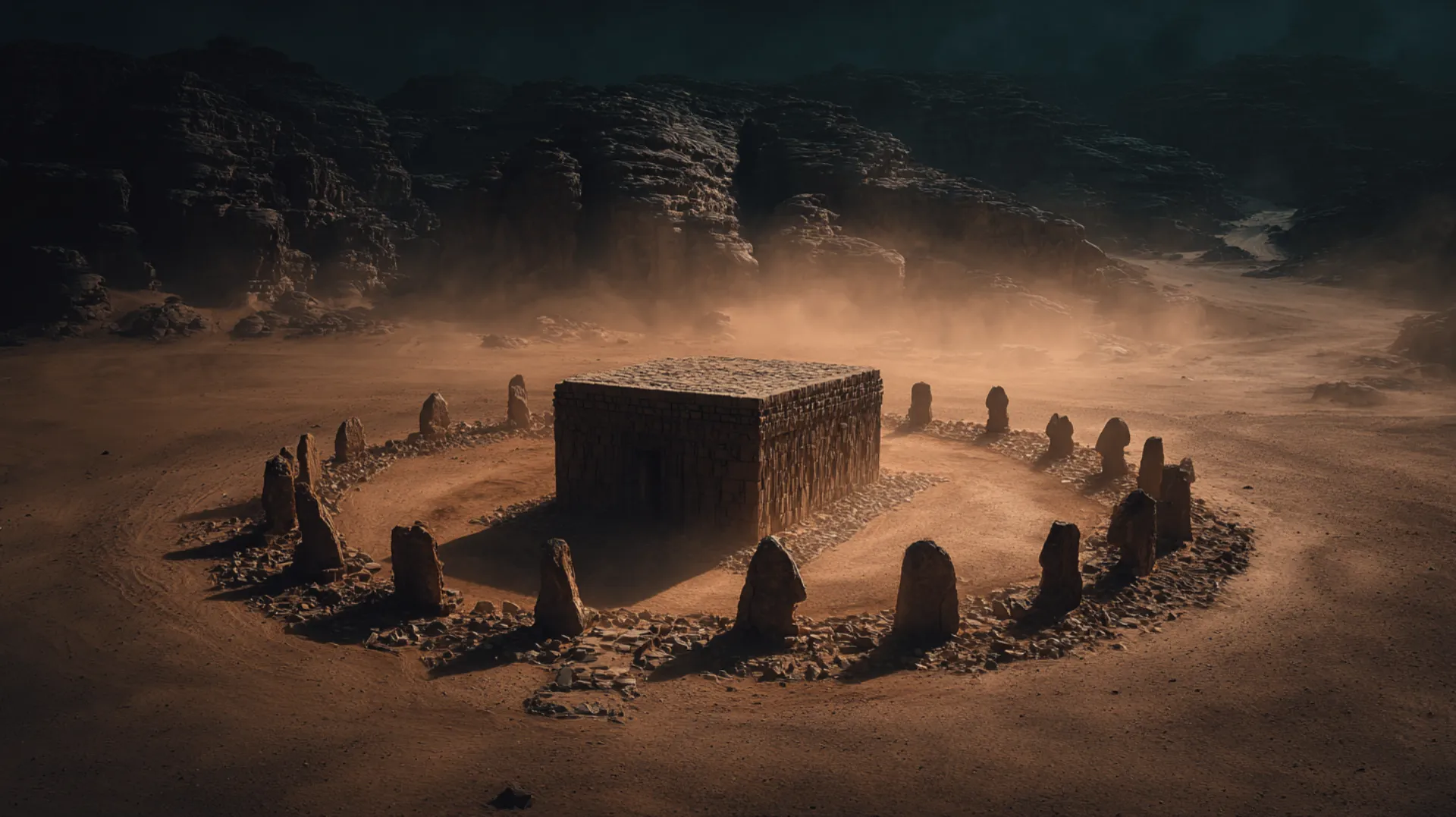
The stone stands no taller than a man’s forearm, rough-hewn and unremarkable, carried across the Syrian desert in the saddlebags of a tribal chieftain returning home from a journey that would poison a civilization. It is a block of carved rock — an idol called Hubal — and when Amr ibn Luhay al-Khuzai sets it before the Ka’bah, he does not merely place a stone upon the ground. He tears open a wound in the fabric of monotheism that will bleed for five hundred years, until a Prophet yet unborn will rise to close it.
This is the story of how Arabia forgot its God — and of the handful of souls who refused to forget.
The Man Who Changed a Religion
To understand how idolatry took root in the land of Ibrahim and Ismail (peace be upon them), we must first understand the man who planted it. Amr ibn Luhay al-Khuzai was no wandering eccentric. He was the chieftain of the Khuzaa tribe, the very people who had wrested control of Mecca from the descendants of Ismail’s tribe, the Jurhumites. He was a military leader who had defended Mecca against foreign invasions, a man of legendary generosity whose people adored him. When he spoke, the city listened.
And so when he returned from a journey to Syria, carrying tales of wonder and a stone idol in his arms, the city listened then too.
The Prophet Muhammad (peace be upon him) himself told us what happened next. In a hadith recorded in Sahih Muslim, the Prophet said:
“I saw Amr ibn Luhay al-Khuzai wandering in the fire of Hell, with his entrails cut open behind him.”
The punishment was severe because the crime was singular. The Prophet identified him as the first person to baddala — to corrupt and alter — the religion of Ismail. The pure monotheism that Ibrahim and his son had established in that barren valley, the worship of one God without partners, the Hajj with its tawaf and sa’i and sacrifice — all of it had been transmitted across generations like a sacred inheritance. Amr ibn Luhay was the man who broke the chain.
Scholarly Note
Pinpointing when Amr ibn Luhay lived is notoriously difficult. The pre-Islamic Arabs did not use a fixed calendar — they marked time by memorable events (“the year of the great battle,” “three years before the elephant”). By tracing his generational position relative to Fihr, the progenitor of Quraysh, and assuming roughly forty to forty-five years per generation, scholars estimate that Amr ibn Luhay lived in approximately the first century of the Common Era — roughly five hundred years before the Prophet’s birth around 570 CE. This is necessarily an approximation, as Ibn Ishaq and other early sources provide no precise dates for this period.
What had he seen in Syria? He had visited the Amaliqah — the Amalekites — an ancient civilization known throughout the Near East for their military power, their architecture, their seeming invincibility. The Old Testament describes them as a feared nation of giants. When Amr ibn Luhay saw their temples and their idols, he asked about them. They told him these were their sources of power: in drought, in famine, in war, they prayed to these figures and miracles followed.
He was mesmerized. He asked them to gift him one of their idols. They gave him Hubal.
Three Poisons: How One Man Corrupted a Continent
How could a single individual overturn the religion of two prophets? The question is not merely historical — it is a mirror held up to every generation. Three factors converged to make the unthinkable possible.
The first was an inferiority complex. The Amalekites were a civilization with history, writing, architecture, and military dominance. Amr ibn Luhay looked upon their power and made a catastrophic logical leap: because they are mighty, they must be right — in everything. Their technology, their buildings, their armies — surely their gods must be the source of it all. He confused material supremacy with spiritual truth.
The second was the authority of the messenger. Amr ibn Luhay was not some marginal figure shouting on a street corner. He was the most respected chieftain in Arabia, the guardian of Mecca itself. His people loved him for his victories and his generosity. When a man of such stature endorses a new theology, ordinary people follow. Credentials, prestige, and eloquence can make falsehood shimmer like truth.
The third was ignorance. At least two thousand years had passed since Ibrahim and Ismail walked the earth. Two millennia without prophets, without revelation, without anyone to refresh the original message. The monotheism of Ibrahim had thinned to a cultural memory, diluted by time and neglect. Into that vacuum of knowledge, Amr ibn Luhay poured his imported idolatry, and the people drank.
The Corruption of the Talbiya: Rewriting Sacred Words
Perhaps nothing illustrates the subtlety of this corruption more than what happened to the Talbiya — the ancient call of Hajj. Since the time of Ibrahim, pilgrims had chanted: Labbayk Allahumma labbayk, labbayk la sharika laka labbayk — “I am responding to Your call, O Allah, I am responding. You have no partner, I am responding.”
The phrase la sharika laka — “You have no partner” — was the theological backbone of the entire pilgrimage. But once Amr ibn Luhay introduced partners alongside Allah, that phrase became inconvenient. So it was modified. As recorded in Sahih Muslim, the Quraysh eventually chanted a revised version: Labbayk Allahumma labbayk, labbayk la sharika laka — and then added — illa sharikan huwa laka, tamlikuhu wa ma malak — “except for a partner who belongs to You; You control him and all that he controls.”
The addition is breathtaking in its theological gymnastics. They kept the original monotheistic formula and then appended an exception clause — “You have no partner… except the partners You own.” Allah remained the supreme deity, the “big boss,” but now lesser gods orbited Him like courtiers around a king. It was not a wholesale rejection of Allah; it was a demotion of His exclusivity. The Quraysh did not deny the Creator — they simply decided He was too exalted to approach directly, and so they installed intermediaries.
This corrupted Talbiya was chanted for centuries, until the Prophet restored the original words during Umrat al-Qada, cleansing the Hajj of its polytheistic accretions and returning the pilgrimage to its Ibrahimic purity.
The Proliferation of Idols
Hubal was only the beginning. Once the theological barrier was broken, idolatry metastasized across Arabia with astonishing speed. The process was almost organic. The Quran records that the people of Nuh were the first in human history to invent idol worship, venerating five righteous men — Wadd, Suwa, Yaghuth, Ya’uq, and Nasr — whose statues were originally built as memorials and gradually became objects of worship (Nuh 71:23). Some historical sources suggest that Shaytan himself inspired Amr ibn Luhay to resurrect these ancient names, and remarkably, by the time the Prophet was born, each of these five idols had been adopted by a different Arabian tribe. Names dormant for millennia had been exhumed and given new altars.
“And they said: ‘Do not abandon your gods, and do not abandon Wadd, nor Suwa, nor Yaghuth, nor Ya’uq, nor Nasr.’” — Nuh (71:23)
The Ka’bah itself became a quarry for idolatry. Whenever a caravan departed Mecca, travelers would chip away a stone from the sacred house and carry it with them as a portable object of veneration. They confused the bricks with the blessing, the structure with the sanctity. In reality, as later Islamic teaching would clarify, there is nothing inherently sacred about the physical materials of the Ka’bah — it is the location, the ground consecrated by Allah, that holds sanctity. The Ka’bah has been rebuilt many times across the centuries; the current structure is barely decades old. But the pre-Islamic Arabs did not grasp this distinction, and so fragments of masonry became gods.
Abu Raja al-Utaridi, a companion who accepted Islam, recalled the depths of this degradation in a hadith recorded in Sahih al-Bukhari: before Islam, he said, they used to worship rocks and stones. If they found a more beautiful rock, they would discard the old one and worship the new. And if they were traveling in the desert and could find no suitable rock at all, they would gather sand into a mound, squeeze goat’s milk over it to make it firm, and then perform tawaf around that pile of damp sand.
By the time of the Prophet’s birth, 360 idols surrounded the Ka’bah — figures of every shape and description. Some were fully human in form, others animal, and most were hybrid creatures: half-human, half-beast, echoing the mythological imagination of the ancient world. The house that Ibrahim had built to declare la ilaha illallah had become a pantheon.
Among the most disturbing stories is that of Isaf and Na’ilah, two idols placed on the hills of Safa and Marwah. According to traditions narrated by Aisha bint Abi Bakr (may Allah be pleased with her), the legend held that Isaf and Na’ilah were two illicit lovers who consummated their affair inside the Ka’bah and were petrified by divine punishment on the spot. Rather than taking this as a warning, the Quraysh enshrined the petrified figures as objects of veneration. When Islam came, the early Muslims felt deeply uneasy about performing sa’i between Safa and Marwah, fearing association with these idols. Allah addressed their concern directly:
“Indeed, Safa and Marwah are among the symbols of Allah. So whoever makes Hajj to the House or performs Umrah — there is no blame upon him for walking between them.” — Al-Baqarah (2:158)
Safa and Marwah were sacred long before Isaf and Na’ilah were ever placed there. The verse gently but firmly separated the original Ibrahimic rite from the pagan corruption layered on top of it.
A Theology Without a Creed
The pre-Islamic Arabs did not possess a unified theology. There was no Arabian catechism, no systematic creed, no agreed-upon doctrine about the nature of God, the afterlife, or moral law. This is characteristic of idolatrous societies — without revelation, belief fragments into a thousand personal mythologies. Some Arabs believed in a Day of Judgment; many denied it. Some believed the angels were Allah’s daughters; others held different views entirely. One Arab might worship one god while his neighbor worshipped another, and neither considered the other heretical, because there was no orthodoxy to violate.
Yet beneath this theological chaos, one paradox persisted: nearly all of them acknowledged Allah as the supreme Creator. They did not deny His existence. They simply believed He was too transcendent, too remote, to be approached directly. The idols were intermediaries — intercessors who could carry human prayers upward to the divine throne. Their shirk was not in rejecting Allah but in refusing to worship Him alone. It was a corruption of access, not of acknowledgment.
This is precisely the form of polytheism that the Quran addresses with such precision and persistence — not the denial of God, but the dilution of His exclusive right to worship.
The Hunafa: Torches in the Darkness
And yet, even in this spiritual wasteland, not every soul surrendered to the prevailing idolatry. History records a small but remarkable group of individuals known as the Hunafa — the singular is Hanif, meaning “one who turns away” from shirk and turns toward Allah. They were the moral and theological dissenters of their age, men who looked at the 360 idols ringing the Ka’bah and felt in their bones that something was profoundly wrong.
Qus ibn Sa’idah: The Preacher from the East
From the distant tribe of Banu Iyad, near modern-day Oman, came an elderly man named Qus ibn Sa’idah. He was not of the Quraysh, but he traveled to Mecca for the Hajj — which remained, despite its pagan distortions, a universal gathering that drew Arabs from every corner of the peninsula. There, mounted on a red camel, he preached against idolatry in a style of oratory so powerful that some scholars have remarked it is the closest pre-Islamic speech to the language of the Quran itself.
His words have survived in fragments:
“O people, listen and understand! Whoever lives shall die, and whoever dies is gone. And everything that is decreed shall surely come to pass.”
And to his own people:
“O people of Iyad! Where is Thamud? Where is ‘Ad? Where are your fathers and grandfathers? Who will reward the one who did good but was never thanked? Who will punish the one who did evil but was never held to account? I swear by Allah, there must be a religion better than the religion you are upon.”
That final line is haunting: I swear by Allah that there must be a religion better than this. Qus ibn Sa’idah knew something was coming, but he did not know what. He died decades before the Prophet began his mission. Yet when the Banu Iyad came to Medina in the ninth year of the Hijrah to accept Islam, the Prophet asked about him. They told him Qus had died long ago. The Prophet said he remembered him — an old man on a red camel, with mesmerizing speech — and asked the delegation to remind him of the words. They recited what Qus had said, and the Prophet was pleased.
The Four of Mecca
More famous than Qus are the four Hunafa of Mecca itself. Ibn Hisham narrates that before the Prophet’s birth, the Quraysh held a great festival outside the city to celebrate their idols. The entire population departed to feast and sacrifice. When the city emptied, four men found themselves left behind — each too ashamed of the idolatry to participate, each unaware that the others felt the same way. When they discovered their shared conviction, they made a pact: they would befriend one another in secret and search for the original religion of Ibrahim.
They were: Waraqah ibn Nawfal, the elderly cousin of Khadijah bint Khuwaylid (may Allah be pleased with her); Ubaidullah ibn Jahsh, the Prophet’s cousin through his maternal aunt; Uthman ibn al-Huwairith; and Zayd ibn Amr ibn Nufayl, the first cousin of Umar ibn al-Khattab (may Allah be pleased with him), though some forty to fifty years his senior.
They scattered from Mecca, each searching for truth in his own direction. Three of the four eventually embraced Christianity — the closest approximation to monotheism they could find. Waraqah ibn Nawfal learned Hebrew and Aramaic, studied the scriptures, and waited. When the Prophet, at age forty, came trembling to Khadijah after the first revelation of Iqra, it was Waraqah whom she took him to see. The old scholar recognized immediately what had happened: “This is the same entity who came to Musa,” he said. “How I wish I were a young man, so that I could support you when your people persecute you and expel you.” He died shortly after — the first Muslim to die in Mecca, having waited a lifetime for a truth he glimpsed only at its dawn.
Scholarly Note
The question of whether Waraqah ibn Nawfal should be considered the first male convert to Islam is a matter of scholarly discussion. Some scholars argue that his recognition and affirmation of the Prophet’s mission constitutes the earliest male acceptance of Islam, preceding even Abu Bakr al-Siddiq (may Allah be pleased with him), since it occurred before the formal call to Islam began. Others maintain that Waraqah’s affirmation was an act of recognition rather than formal conversion. What is agreed upon is that Khadijah bint Khuwaylid was the first person — male or female — to believe.
Ubaidullah ibn Jahsh’s story is the most tragic. He accepted Islam, married Umm Salamah (may Allah be pleased with her), and migrated with her to Abyssinia. But there, in the Christian kingdom of the Negus, he apostatized and returned to Christianity. He died a non-Muslim. Umm Salamah eventually returned and later married the Prophet. The story is a sobering reminder that the search for truth does not always end where it begins.
Uthman ibn al-Huwairith traveled to Rome, became a Christian, and rose to prominence as an interpreter in the court of Caesar. He never returned to Mecca and died a Christian, likely never hearing the Prophet’s message.
But it is Zayd ibn Amr ibn Nufayl whose story burns brightest. Unlike the other three, he rejected both Christianity and Judaism, telling the rabbis and priests he encountered: “This is not the religion of Ibrahim, and you know it.” He returned to Mecca and declared publicly: “O people of Quraysh, there is no one left upon the religion of Ibrahim in this whole city other than me.”
Asma bint Abi Bakr (may Allah be pleased with her) remembered seeing him as a child, rebuking the Quraysh for their idolatry, for sacrificing meat to stones, and for the horrific practice of burying infant daughters alive. When any man of Quraysh intended to kill his newborn daughter, Zayd would intervene: “Give her to me. I will raise her.” He adopted every girl he could save, building a household of rescued children — a one-man resistance against both theological and moral barbarism.
The Prophet met Zayd as a young man, before revelation began, and asked him about his estrangement from his people. Zayd explained his rejection of idolatry, and the Prophet found in him a kindred spirit — for the Prophet himself had never bowed to an idol, never sacrificed meat to a stone, never participated in the rites of the Jahiliyyah. Zayd died five years before the Prophet began preaching. His son, Sa’id ibn Zayd (may Allah be pleased with him), became one of the ten companions promised Paradise. And when Sa’id asked about his father’s fate in the Hereafter, the Prophet told him that Zayd would be resurrected on the Day of Judgment as a one-man ummah — a community unto himself, without a prophet, because his sincerity and his rejection of idolatry had earned him that singular honor. After the Night Journey, the Prophet told Sa’id: “I entered Paradise and I saw your father. Allah had blessed him with not one but two gardens.”
Beyond Arabia: The World the Prophet Was Born Into
The spiritual crisis was not confined to the Arabian Peninsula. To understand the religious landscape into which the Prophet was born, we must look beyond the desert to the two superpowers that flanked it.
To the east, the Sassanid Persian Empire practiced Zoroastrianism — a dualistic theology built around the eternal struggle between Ahura Mazda, the god of light and goodness, and Ahriman, the god of darkness and evil. Sacred fires burned perpetually in their temples, never permitted to be extinguished; when a new temple was built, its flame had to be imported from an existing one, maintaining an unbroken chain of fire. From the Islamic perspective, this was another form of idolatry — the worship of creation rather than Creator.
To the west, the Roman Empire professed Christianity. But the Christianity of Rome in the sixth century bore little resemblance to the original teachings of Isa ibn Maryam (peace be upon him). For the first three centuries after Jesus was raised, Christians had been a persecuted minority — burned alive by Nero, thrown to lions in the arena. During those centuries, at least two major strands of belief competed for the soul of the faith. The first, which modern academics call “Jewish Christianity,” held that Jesus was the promised Messiah sent to the children of Israel, that his followers must continue observing the Law of Moses — circumcision, dietary laws, the Sabbath — and that Jesus was a prophet and servant of God, not divine. This understanding aligns remarkably with the Islamic view of Isa.
The second strand, associated with Paul — who never met Jesus in person but claimed a visionary encounter — introduced radically different doctrines: that Jesus possessed elements of divinity, that the Mosaic Law was abrogated by faith in Christ, and that salvation was available to Gentiles without conversion to Judaism. This “Pauline Christianity” gradually introduced the theological scaffolding that would become the Trinity.
The decisive moment came in 325 CE, when Emperor Constantine — the first Roman emperor to convert to Christianity — convened the Council of Nicaea in what is now Turkey. Constantine was not merely a convert; he was a political strategist who needed religious unity in his empire. The Council declared Pauline Christianity the orthodox standard, formalized the Nicene Creed, and condemned the teachings of Arius — a priest from Alexandria who maintained that Jesus was created by God and subordinate to Him, a position far closer to Islamic theology than to what Nicaea established.
Scholarly Note
The figure of Arius and his followers (known in Arabic sources as the Arisiyun) occupies an interesting place in Muslim-Christian theological history. Arius’s insistence on the createdness and subordination of Jesus resonated with later Islamic critiques of Trinitarian doctrine. The medieval European scholar Peter the Venerable, who commissioned the first Latin translation of the Quran, described Prophet Muhammad as “a successor to Arius” — a characterization that, while polemical in intent, inadvertently acknowledged the theological continuity between Arian monotheism and Islamic tawhid. Whether any direct historical link existed between Arian communities and the Arabian Hunafa remains a matter of scholarly speculation.
Constantine’s decree had devastating consequences. Jewish Christianity was banished. Its adherents were persecuted with the same ferocity that pagan Rome had once directed at all Christians. Books that contradicted the newly established orthodoxy were burned. Constantine selected four Gospels that affirmed his theology and destroyed the rest, obliterating centuries of alternative Christian witness. A massive exodus of original Christians fled to the margins of the empire — some to Abyssinia, others to Persia and beyond.
By the time the Prophet was born in approximately 570 CE — some 245 years after Nicaea — authentic monotheistic Christianity had been reduced to scattered, dying embers. The story of Salman al-Farsi (may Allah be pleased with him), narrated in Sahih Muslim and the Musnad of Imam Ahmad, captures this twilight with extraordinary poignancy. A Zoroastrian priest’s son from Persia, Salman was drawn to a Christian monk’s worship, secretly converted, and then spent decades traveling from one monastery to another, each dying teacher directing him to the next. When the fourth and final teacher lay on his deathbed, he told Salman something devastating: “I do not know anyone remaining upon our understanding of Christianity. We are all gone now.” But then he added: “The time of the promised one is near.” He gave Salman three signs by which to recognize this prophet: he would appear in a land of dates, he would bear a physical seal on his back, and he would accept gifts but never charity.
Salman’s journey to find this prophet — his enslavement by Arab traders, his decades of toil in Yathrib, his testing of the three signs when the Prophet finally arrived — is one of the most extraordinary conversion narratives in all of religious history. It is also a testament to how thoroughly Nicaea had succeeded in extinguishing the original Christian witness: by the sixth century, a sincere seeker had to cross empires, endure slavery, and wait a lifetime to find the truth that the Council of 325 had tried to bury.
A World Waiting
Stand back, then, and survey the world into which the final Prophet would be born. Arabia: five centuries deep in idolatry, the Ka’bah ringed with 360 gods, the Talbiya of Ibrahim corrupted with polytheistic amendments, infant daughters buried alive in the sand. Persia: fire-worshippers tending eternal flames to a dualistic theology. Rome: a Christianity that had executed its own monotheists and enshrined a creed that its earliest followers would not have recognized.
And yet — and this is the thread of mercy running through the darkness — truth had not been entirely extinguished. Qus ibn Sa’idah still preached from his red camel. Zayd ibn Amr still rescued infant girls from the grave. Salman al-Farsi still searched. Waraqah ibn Nawfal still waited. In the deepest night, scattered across continents and centuries, individual souls kept the ember of tawhid alive through nothing more than the innate human recognition — the fitrah — that there must be something better than this.
They were right. Something was coming. In the genealogical lines converging upon a single clan in Mecca — the Banu Hashim of the Quraysh — a child would soon be born in the Year of the Elephant, into a world that desperately needed him. But before we meet him, we must first trace the family tree from which he would emerge, and the extraordinary events that marked the year of his arrival.
Quranic References
Continue Your Journey
Cite this Narrative
APA
SeerahQuest. (2026). When Arabia Forgot Its God. *SeerahQuest: The Eternal Narrative*. https://seerahquest.com/chapters/religious-status-of-pre-islamic-arabia Adapted from Yasir Qadhi's Seerah Series, Episode 4.
MLA
"When Arabia Forgot Its God." *SeerahQuest: The Eternal Narrative*, 2026, https://seerahquest.com/chapters/religious-status-of-pre-islamic-arabia. Adapted from Yasir Qadhi's Seerah Series, Episode 4.
Chicago
"When Arabia Forgot Its God." *SeerahQuest: The Eternal Narrative*. Accessed April 3, 2026. https://seerahquest.com/chapters/religious-status-of-pre-islamic-arabia. Adapted from Yasir Qadhi's Seerah Series, Episode 4.
Install SeerahQuest — read chapters offline, anytime.