When Arabia Came Knocking
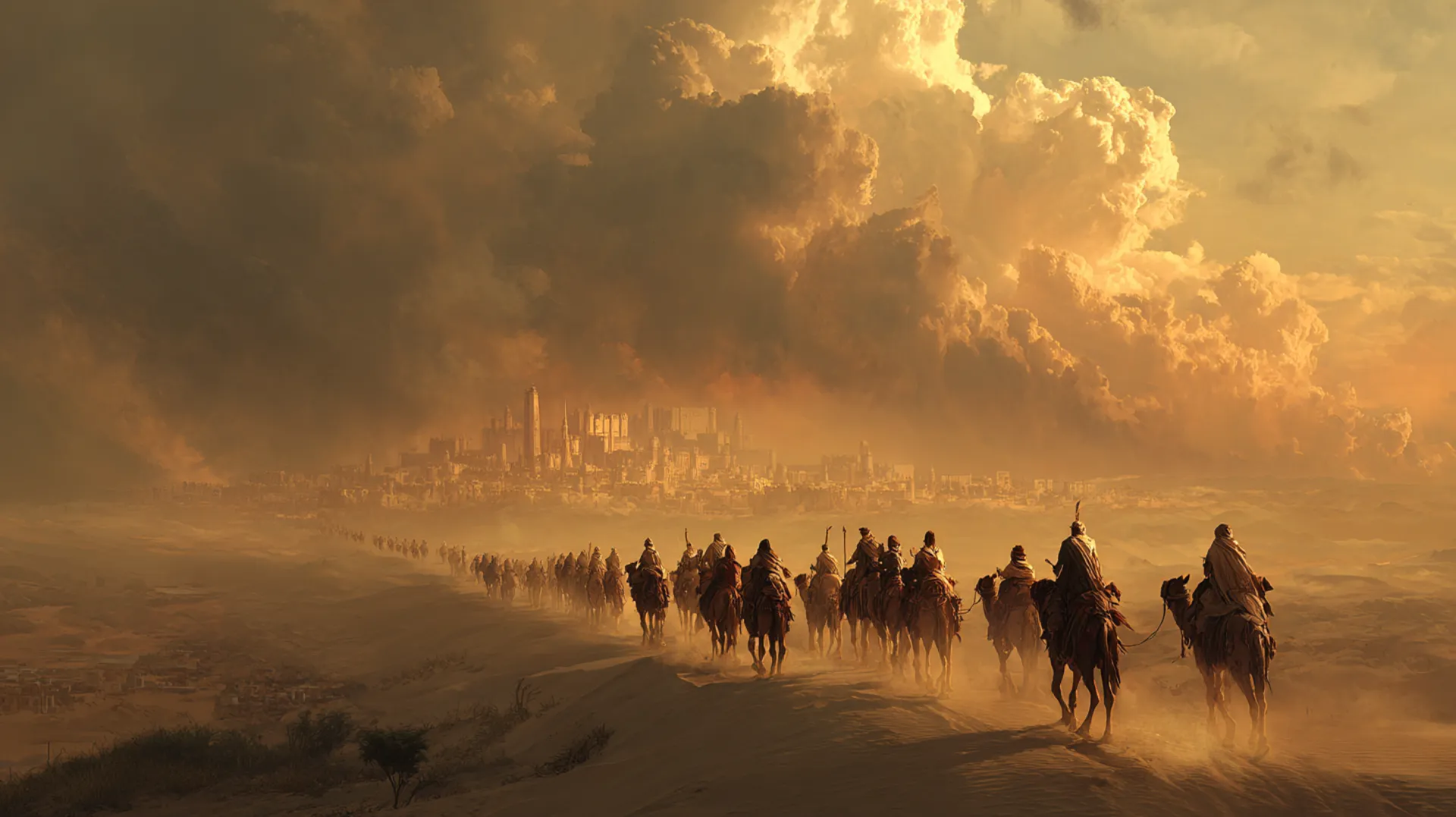
The road from Bahrain to Medina stretched across a thousand miles of desert, yet a band of converts who had never met a single Companion pressed forward — the first tribe outside the Hijaz to accept Islam voluntarily.
5-9 AH · 628 – 630 CE
The road from Bahrain to Medina stretched across a thousand miles of desert, threading between hostile tribal territories where pagan warriors still sharpened their blades. Yet somewhere along that road, in the fifth year after the Hijrah, a small band of converts pressed forward — men from the tribe of Abd al-Qais who had never met a single Companion, never heard a single lesson from the Prophet Muhammad (peace be upon him), yet had somehow, through the whisper-networks of Arabian trade routes and pilgrim caravans, learned enough about Islam to stake their lives on the journey. They were the first tribe outside the Hijaz to accept Islam voluntarily, and their arrival in Medina would set the template for a phenomenon that, four years later, would reshape the entire Arabian Peninsula: the Year of Delegations.
The Tides Turn: Why the Tribes Came
To understand why the ninth year of the Hijrah became known as Aam al-Wufood — the Year of Delegations — one must first understand the seismic shifts that preceded it. The conquest of Mecca in the eighth year had removed the single greatest obstacle to Islam’s spread. Mecca was not merely a city; it was the symbolic capital of Arabian civilization, the custodian of the Ka’bah, the seat of Quraysh power. And if there was any tribe under whose banner the disparate clans of Arabia might have united against Islam, it was the Quraysh. They had tried precisely that at the Battle of the Trench, marshaling a confederation of tribes against Medina — and failed.
Now Mecca had fallen. The Quraysh had submitted. The Battle of Hunayn had crushed the last major military resistance in the Hijaz. And the expedition to Tabuk, from which the Muslim army returned unvanquished — the Romans never appeared, the Ghatafan never materialized — sealed the perception of Islamic invincibility across the peninsula.
The smaller tribes did the arithmetic. Each knew it could not stand alone against a force that had subdued Quraysh and marched unopposed to the borders of the Byzantine Empire. One by one, then in a flood, they sent their representatives to Medina. Some came to embrace Islam with genuine conviction. Others came to negotiate treaties. Some were hypocrites who would abandon their professions of faith the moment the Prophet’s eyes closed in death. And a few came with threats on their lips and daggers in their sleeves.
Not every delegation was the same. But in the ninth year, the sheer volume became overwhelming — over one hundred and ten delegations are recorded by name in the classical sources — earning the year its famous title.
The Spectrum of Delegations
The delegations that arrived in Medina during this period fell into several distinct categories, and understanding this spectrum is essential to grasping the political reality of late-prophetic Arabia.
Sincere converts: Tribes like Abd al-Qais and Muzayna who embraced Islam wholeheartedly, often before any military pressure.
Negotiators: Tribes seeking peace treaties without necessarily accepting Islam, such as early delegations from the Hawazin sub-tribes.
Reluctant submitters: Tribes like Banu Asad ibn Khuzaymah who came boasting about their conversion, revealing weak faith beneath a veneer of compliance.
Hypocrites: Groups whose Islam was purely political, exposed only after the Prophet’s death when they abandoned the faith en masse during the Ridda wars.
Hostile delegations: Figures like Amir ibn Tufayl from Banu Amir ibn Sa’sa’a, who came not to negotiate in good faith but to threaten, and Musaylama al-Kazzab from Banu Hanifa, who would audaciously propose splitting prophethood itself.
This diversity reveals that even in the Prophet’s lifetime, the Muslim community was navigating an extraordinarily complex political landscape — one that required wisdom, patience, and the ability to distinguish genuine faith from strategic calculation.
The Delegation of Abd al-Qais: Best of the East
The tribe of Abd al-Qais lived in the region then called Bahrain — not merely the island we know today, but the broader eastern coastal territory encompassing what is now the Eastern Province of Saudi Arabia, including modern Dammam and Dhahran. It was a land bordering the Persian Empire, home to a mixture of Christians and pagans, and remarkably distant from the Hijaz.
Their first delegation arrived in the fifth year of the Hijrah — years before the major military campaigns that would later compel other tribes to submit. No army had marched to their territory. No ambassador had been dispatched. The message of Islam had simply reached them through the organic channels of Arabian communication, and a group among them had believed.
Ibn Ishaq records that the Prophet had predicted their arrival during a sermon, telling the Companions that a delegation would soon come from the east, describing them as the best people from that direction. When Umar ibn al-Khattab (may Allah be pleased with him) spotted the arriving delegates in the marketplace of Medina, he leapt up in joy, rushing to embrace them and relay the Prophet’s words.
The entire group surged toward the Prophet’s mosque — all except the youngest among them. His name was Al-Ashaj, from the tribe of Qais, a man whose nickname meant “the one with the wound” on account of a mark on his head. While his companions rushed ahead in their excitement, Al-Ashaj stayed behind. He bathed. He put on clean garments. He applied perfume. Only then did he walk, composed and deliberate, to meet the Messenger of Allah.
The Prophet observed this and spoke words that would echo through fourteen centuries of Islamic ethical teaching:
“You possess two qualities that Allah and His Messenger love: forbearance (al-hilm) and deliberateness (al-anaat).”
As recorded in Sahih al-Bukhari and Sahih Muslim, Al-Ashaj then asked a question of remarkable intelligence: “These two qualities — did I develop them myself, or did Allah implant them in me?” The Prophet replied that Allah had implanted them. Al-Ashaj’s response was immediate and eloquent: “All praise be to Allah, who has implanted in me characteristics that He loves.”
Scholarly Note
This hadith, recorded as muttafaq alayhi (agreed upon by both Bukhari and Muslim), carries significant theological implications. When the delegation asked the Prophet to teach them what would cause them to enter Paradise, he responded by commanding them to have iman in Allah, then defined iman using the pillars of Islam — the shahada, prayer, fasting, and zakat (omitting hajj, which had not yet been commanded in the fifth year). This overlap between the definitions of iman and Islam has generated extensive theological discussion, particularly in relation to the Hadith of Jibreel, where the two terms are defined separately. The relationship between Islam and iman remains one of the foundational questions of Islamic theology (aqidah).
The delegates explained that the hostile tribe of Mudar occupied the territory between Bahrain and Medina, making travel possible only during the sacred months when fighting was prohibited. They asked for teachings they could carry back and transmit to their people. The Prophet listed the pillars of faith and specifically prohibited every type of intoxicating drink they were known to consume — naming each variety by name, demonstrating an intimate knowledge of their culture that astonished them.
It is said that upon their return, the tribe of Abd al-Qais built the first mosque outside the Hijaz and established the first Friday prayer outside of Medina — a remarkable testament to the depth of their commitment.
The Delegation of Banu Sa’d ibn Bakr: A Bedouin’s Directness
The tribe of Banu Sa’d ibn Bakr holds a unique place in the Prophet’s personal history. This was the tribe of Halimah al-Sa’diyyah, the Bedouin wet-nurse who had raised him in the open desert air during his infancy — a connection that stretched back to the very beginning of his life. A sub-tribe of the larger Hawazin confederation, they were desert-dwellers through and through: rough-mannered, fiercely independent, and utterly without pretension.
Their delegate was Dhimam ibn Tha’laba, a man who arrived in Medina not as a Muslim but as a negotiator. He was, by all accounts, a spectacle. The sources describe him as massively built, extraordinarily hairy, with two long braids hanging from his head in the Bedouin fashion. He rode his camel directly to the door of the Prophet’s mosque, parked the animal right at the entrance, and barged inside.
“Where is the son of Abd al-Muttalib?” he demanded.
The Prophet responded calmly: “I am the son of Abd al-Muttalib.”
Dhimam stood over the seated assembly and said, bluntly: “You are Muhammad?” The Prophet confirmed. Then Dhimam made a single concession to courtesy: “I am going to ask you questions, and I will be very tough with you, so do not get angry at me.”
The Prophet replied: “Ask whatever you want.”
What followed was a methodical interrogation, building with theatrical deliberation. Who created the heavens? Allah. Who created the earth? Allah. Who placed the mountains? Allah. Then: “I ask you by the One who created the heavens and the earth and placed the mountains — did Allah truly send you to us?”
The Prophet swore by Allah that He had.
Dhimam proceeded through each pillar of Islam — the five daily prayers, the zakat, the fast of Ramadan, and the hajj (now included, as this visit likely occurred in the ninth year when hajj had been commanded). For each, he demanded the Prophet swear by the One who sent him. For each, the Prophet swore.
Scholarly Note
Some scholars identify Dhimam ibn Tha’laba as the same Bedouin referenced in the well-known hadith where a man asks whether he must perform anything beyond the obligatory prayers, zakat, and fasting, and the Prophet responds in the negative. The man then declares he will neither add to nor subtract from the bare minimum. The Prophet’s comment — “He will enter Paradise if he is truthful” — establishes the theological principle that the obligatory acts constitute the minimum threshold for salvation. However, there is scholarly discussion about whether this is definitively the same individual or a separate incident, as the details vary across narrations.
Then, with the same dramatic energy with which he had arrived, Dhimam declared: “I swear by the One who has sent you with the truth that I shall not increase one bit upon this nor decrease from it.” And he stormed out.
The Prophet watched him go and said: “If he is truthful, he shall enter Paradise.”
Ibn Ishaq records that when Dhimam returned to his people, he immediately began preaching. So respected was he among his community that the entire tribe embraced Islam that very day. Dhimam himself destroyed the tribal idol with his own hands. Ibn Ishaq, through one of the Tabi’un, preserves the judgment: no single envoy was ever more of a blessing for his community than Dhimam ibn Tha’laba.
There is something quietly profound in this connection. The tribe that had once nursed the infant Muhammad in the clean desert air now received the message of Islam through the bluntest possible messenger — and embraced it completely. The barakah of Halimah al-Sa’diyyah’s ancient kindness seemed to ripple forward through the decades.
The Tribe of Muzayna and the Miracle of the Dates
Among the delegations that arrived — perhaps as early as the fifth year, according to al-Waqidi — was the entire tribe of Muzayna, some four hundred people strong, all coming to embrace Islam and study directly under the Prophet. When their time in Medina was complete and they prepared to return to their lands, the Prophet turned to Umar ibn al-Khattab and said: “Go and provide them with the food they need for their journey.”
Umar’s response was practical and honest: “I have only one sack of dates at home. That will not be sufficient for four hundred people to travel back to their lands.”
The Prophet repeated his instruction: “Go and provide food for them.”
Umar submitted. He said simply: “I will do that.” And he went home.
What he found there defied every expectation. His room was filled with dates — packed to the ceiling, as though a resting camel occupied the entire space. Umar called the tribe. All four hundred came, one by one, filling their travel sacks from the miraculous provision. The last person to leave looked back and saw the pile exactly as it had been before anyone had taken a single date.
This miracle — quiet, domestic, witnessed by hundreds — belonged to the same category of divine provision that had sustained the early Muslim community through years of hardship. It was not a battlefield miracle or a cosmic sign. It was dates in a room, enough for everyone, with nothing diminished. The extraordinary dressed in the clothing of the ordinary.
Banu Asad ibn Khuzaymah: The Danger of Spiritual Boasting
Not every delegation arrived with the right spirit. Ten men from the tribe of Banu Asad ibn Khuzaymah entered the Prophet’s mosque loudly and announced: “O Messenger of Allah, we testify to the shahada. We are Muslims. And we want you to know — we came to you without you sending anyone to us. We accepted Islam without anyone having to fight us. We traveled through darkness and cold to reach you. We are not like the other Arabs.”
The boasting was unmistakable. They wanted credit. They wanted recognition that their Islam was somehow superior because it was voluntary and inconvenient.
Allah’s response came swiftly, preserved in Surah Al-Hujurat:
“They consider it a favor to you that they have accepted Islam. Say: Do not consider your Islam a favor to me. Rather, Allah has conferred favor upon you that He has guided you to the faith, if you should be truthful.” — Al-Hujurat (49:17)
The verse is remarkable for its precision. It does not deny their Islam — they were Muslims, however weak their faith. But it reframes the entire transaction. Faith is not a gift from the servant to God. It is a gift from God to the servant. The one who should be grateful is the one who has been guided, not the One who guides.
Amir ibn Tufayl and the Failed Assassination
Some delegations brought not faith but danger. The tribe of Banu Amir ibn Sa’sa’a — the same tribe responsible for the massacre at the Well of Ma’una, where seventy Companions had been slaughtered — sent a delegation that included Amir ibn Tufayl, one of the original instigators of that atrocity.
Amir came with his henchman, Arbad ibn Qays, and a plan: Amir would distract the Prophet with conversation while Arbad, positioned behind, would strike with a poisoned dagger at a secret signal.
The plan unraveled in the most extraordinary way. Amir gave the signal once — Arbad did nothing. He gave it again — nothing. A third time — still nothing. When they left and Amir turned on his companion in fury, Arbad’s explanation was chilling in its simplicity: “When I entered upon him, I could only see you. Every time you gave me the signal, I could only see you. Did you want me to kill you? I could not see him at all.”
This was not the first time divine protection had rendered the Prophet invisible to those who meant him harm — echoes of the night of the Hijrah, when the assassins surrounding his house could not see him depart.
Having failed at assassination, Amir resorted to arrogance, offering the Prophet three options: share power, name Amir as successor, or face an army of a thousand camels. The Prophet refused all three and made a supplication that believers have drawn upon ever since:
“O Allah, suffice me against Amir ibn Tufayl.” (Allahumma ikfini Amir ibn Tufayl.)
Then he added: “O Allah, guide his people.” Even against a man who had just attempted to murder him, the prophetic methodology distinguished between the individual and the community. The man was evil; his tribe need not be condemned with him.
Both conspirators met terrible ends. Amir ibn Tufayl, on his journey home, stopped at a house of ill repute and was struck by a sudden, disfiguring disease that spread across his body in a single night. Horrified at the prospect of dying in such a place, he mounted his horse and fled into the darkness. His body was never found.
Arbad’s fate was even more dramatic. He returned to his people and spoke blasphemously about Allah. The very next day, as he rode his camel before his own community, lightning struck from the sky and incinerated both man and animal where they stood.
The Quran itself is said to reference this event:
“He sends the thunderbolts and strikes therewith whom He wills, while they dispute about Allah — and He is severe in assault.” — Al-Ra’d (13:13)
Scholarly Note
The connection between Arbad ibn Qays and the verses of Surah Al-Ra’d (13:11-13) is reported in the books of tafsir, though scholars note that Quranic verses often carry both a specific occasion of revelation (sabab al-nuzul) and a general, timeless application. The chronological placement of this delegation is also debated — some scholars place it before the conquest of Mecca (seventh or early eighth year), arguing that an assassination attempt after Mecca’s fall would have been strategically implausible. The ninth-year dating found in some sources may reflect the general tendency to group delegations together thematically rather than strictly chronologically.
Tamim al-Dari and the Story of the Dajjal
Among the most unusual delegations was that of Tamim al-Dari, a Christian from the northern tribes who came to Medina and embraced Islam. What made his arrival extraordinary was not the conversion itself but the story he carried with him — a story so remarkable that the Prophet called an unscheduled assembly to share it.
Fatimah bint Qais (may Allah be pleased with her), a Companion who had participated in both emigrations — to Abyssinia and to Medina — narrates the scene. She was observing her waiting period (iddah) when she heard the call ring out from the mosque: “As-salatu jami’a!” — the summons used outside regular prayer times to gather the community for an urgent matter.
She went to the mosque and took her place in the front row of the women’s section. After the prayer, the Prophet ascended the pulpit, his face beaming with a smile, and said: “Let every person stay in their place. Do you know why I have called you here today?” The Companions replied as they always did: “Allah and His Messenger know best.” He said: “By Allah, I did not call you for any sermon or lesson. Rather, I have called you to hear the story of Tamim al-Dari.”
The story, as recorded in Sahih Muslim, describes Tamim’s maritime journey with thirty companions from the tribes of Lakhm and Judham. Lost at sea for a month, they washed ashore on an unknown island where they encountered a creature covered entirely in hair — the Jassasa — who directed them to a monastery. Inside, they found a giant of a man, bound in iron chains from neck to ankle.
The chained figure questioned them about specific landmarks: Were the date palms of Baysan still bearing fruit? Was the lake of Tabariyyah still full of water? Was the spring of Zughar still flowing? To each answer, he offered ominous predictions of their eventual drying up. Then he asked about “the unlettered Prophet” — had he emerged? Had the Arabs fought him? Had he prevailed?
When they confirmed all of this, the figure declared: “I am the Dajjal.” He claimed that Allah would soon grant him permission to emerge, that he would travel the earth and remain in every town for forty nights — except Mecca and Medina, which would be guarded by angels with drawn swords.
The Prophet, standing on the pulpit with his staff, struck the wood and declared: “This is Taybah! This is Taybah! This is Taybah!” — using one of Medina’s blessed names. He affirmed that Tamim’s account corroborated what he had already told them about the Dajjal’s inability to enter the two holy cities.
The Hadith of the Jassasa: A Scholarly Debate
This hadith, recorded in Sahih Muslim, has generated significant scholarly discussion precisely because of its singular nature. It is the only narration that describes the Dajjal as currently alive and chained on an island, and the only mention of the creature called the Jassasa anywhere in the hadith literature.
Several points of tension with other established narrations have been identified:
- The hadith in Bukhari and Muslim in which the Prophet stated that no soul alive at that time would still be living after one hundred years — seemingly precluding the Dajjal’s continued existence on an island.
- Other narrations describe the Dajjal as short and stocky, while this hadith describes a giant.
- Narrations suggesting the Dajjal will be born to human parents at a future date contradict the idea of his current imprisonment.
- The famous controversy of Ibn al-Sayyad — a figure in Medina whom even Umar ibn al-Khattab suspected of being the Dajjal — makes little sense if the Dajjal was known to be chained on a distant island.
- The Dajjal’s most distinctive feature — the word kafir written on his forehead and his damaged eye — is entirely absent from Tamim’s description.
A minority of scholars have expressed reservations about this hadith. Shaykh Rashid Rida of Egypt questioned its reliability, and Shaykh Muhammad ibn al-Uthaymin stated that “my heart tells me something is wrong with this hadith,” clarifying that his concern was not based on personal discomfort but on its apparent contradiction with more firmly established narrations. Some researchers have also noted that the chain of narration passes through al-Sha’bi, a Tabi’i known to occasionally transmit material from storytellers (qussas).
The majority of scholars, however, accept the hadith on the strength of its inclusion in Sahih Muslim and have attempted various reconciliations — suggesting, for instance, that the Dajjal’s appearance may change over time, or that the hundred-year hadith applied only to those present at that gathering.
The believer’s position, as expressed by the scholars on both sides, remains: if the Prophet truly said it, we believe it without reservation. The question is one of authentication, not of possibility.
The Flood That Changed Arabia
Step back from the individual stories and the larger pattern emerges with startling clarity. In the span of roughly four years — from the fifth year of the Hijrah to the ninth — the political and spiritual landscape of the Arabian Peninsula underwent a transformation without historical precedent. Never before had the peninsula been consolidated under a single authority. Never before had its fractious tribes, separated by blood feuds stretching back generations, found a unifying principle powerful enough to override the ancient logic of tribal loyalty.
The Quran itself captured this moment in language of breathtaking economy:
“When the victory of Allah has come and the conquest, and you see the people entering into the religion of Allah in multitudes…” — Al-Nasr (110:1-2)
Afwaja — in multitudes, in waves, in floods. Not one by one, as in the long years of Meccan persecution, but tribe after tribe, delegation after delegation, the trickle becoming a torrent.
Yet even within this flood, the human reality remained stubbornly diverse. There were Al-Ashajs — calm, deliberate, spiritually refined. There were Dhimams — blunt, theatrical, but searingly honest. There were Banu Asad — Muslims in name, boasters in spirit. There were Amir ibn Tufayls — wolves in delegates’ clothing. The Prophet met each according to their nature, with a wisdom calibrated to the individual standing before him.
As the ninth year drew toward its close, the delegations continued to arrive. From Ta’if, the proud tribe of Thaqif would soon send its own representatives, carrying the weight of years of enmity and the memory of stones thrown at a Prophet who had come to them in peace. Their negotiations would test the boundaries of prophetic diplomacy in ways that the simpler delegations never had — and their story belongs to the chapter that follows.
Quranic References
Continue Your Journey
Cite this Narrative
APA
SeerahQuest. (2026). When Arabia Came Knocking. *SeerahQuest: The Eternal Narrative*. https://seerahquest.com/chapters/year-of-delegations-aam-al-wufood-part-1 Adapted from Yasir Qadhi's Seerah Series, Episode 94.
MLA
"When Arabia Came Knocking." *SeerahQuest: The Eternal Narrative*, 2026, https://seerahquest.com/chapters/year-of-delegations-aam-al-wufood-part-1. Adapted from Yasir Qadhi's Seerah Series, Episode 94.
Chicago
"When Arabia Came Knocking." *SeerahQuest: The Eternal Narrative*. Accessed April 3, 2026. https://seerahquest.com/chapters/year-of-delegations-aam-al-wufood-part-1. Adapted from Yasir Qadhi's Seerah Series, Episode 94.
Install SeerahQuest — read chapters offline, anytime.