The Stick and the Standard
A reed-thin stick catches a man in the stomach, and on the morning of Islam's most decisive battle, the supreme commander drops everything to offer his bare skin to an infantryman's right of retaliation.
1-2 AH · 622 – 624 CE
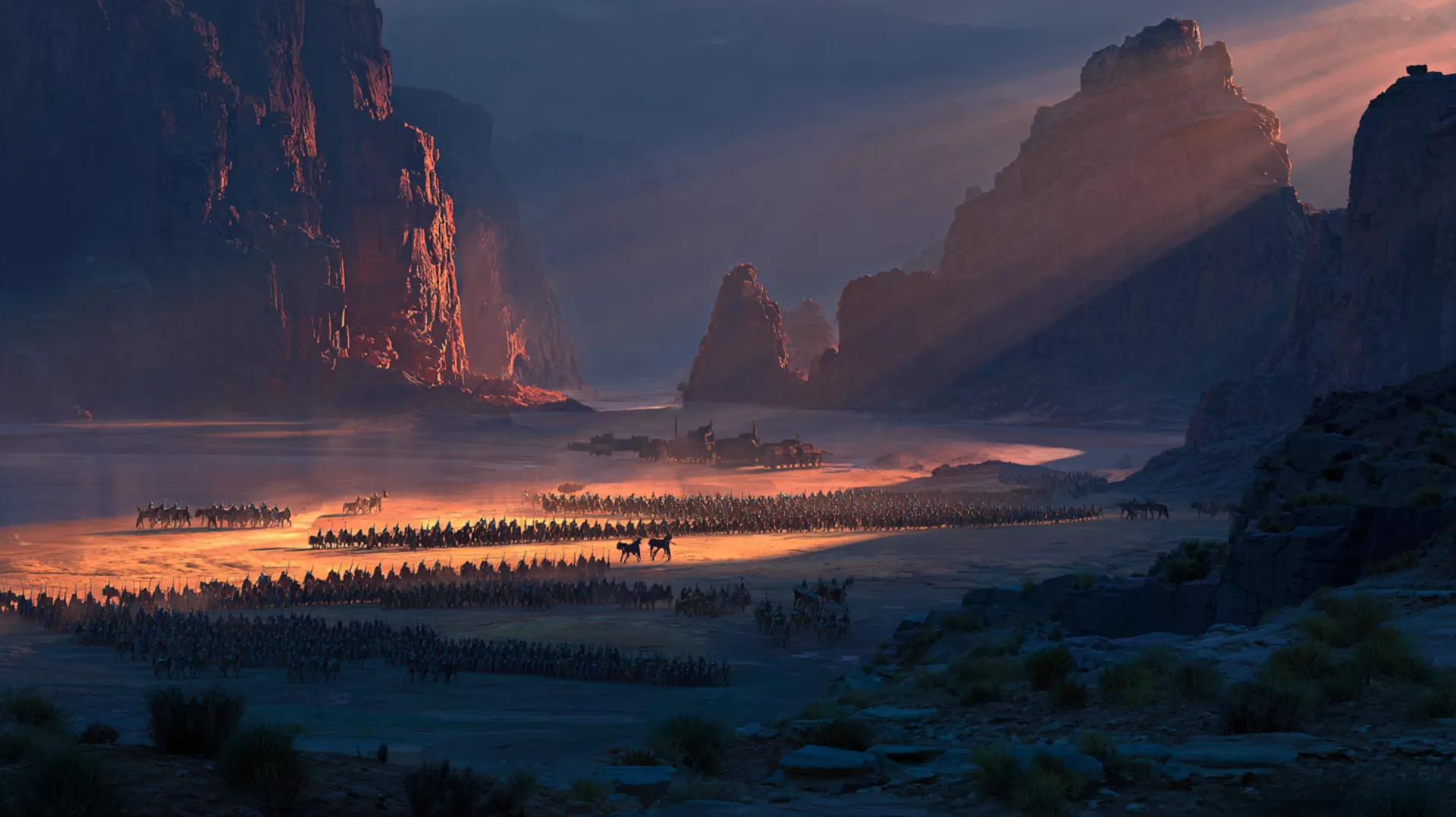
The stick is light in his hand — a reed, really, nothing more than a twig plucked from the scrubland of the Hejaz. He walks the line of men the way a man walks a furrow he has plowed himself, tapping a shoulder here, nudging a hip there, pressing each body into the geometry of war. No Arab army has ever stood like this: row upon row, shoulder to shoulder, a living wall of flesh and iron facing the pale dawn. The men of Yathrib and the men of Mecca-in-exile breathe together in the half-light, and the man with the stick — Muhammad, the Messenger of God (peace be upon him) — is teaching them something the deserts have never seen.
Then the stick catches a man in the stomach, and everything changes.
The Architecture of an Army
The plains of Badr stretch wide and pale under the Ramadan sky, a shallow depression cupped between ridges of dark lava rock. It is the sixteenth of Ramadan in the second year of the Hijrah — roughly mid-March, 624 CE — and the Muslim force of just over three hundred men has arrived first, a full day ahead of the Quraysh. Every advantage matters when you are outnumbered three to one.
The Prophet’s first instinct is to camp on the outskirts of the plain, but Al-Hubab ibn al-Mundhir (may Allah be pleased with him), a seasoned desert scout who knows this terrain the way a sailor knows his coastline, approaches with a question that will echo through centuries of Islamic jurisprudence:
“O Messenger of Allah, is this a position that Allah has revealed to you — such that we may not advance or retreat from it — or is it a matter of opinion and military strategy?”
The distinction is everything. The Prophet answers plainly: it is his own judgment, a tactical decision. Al-Hubab then proposes they advance past the midpoint of the plain, placing the wells of Badr behind them. The Muslims would have water; the Quraysh, arriving from Mecca with only what their canteens could carry, would have none. The psychological blow alone could be devastating.
Scholarly Note
In one narration, Jibreel (Gabriel) descended and confirmed Al-Hubab’s counsel, telling the Prophet to follow his advice. Ibn Ishaq records this exchange, and it became a foundational text in discussions of shura (consultation) in Islamic governance. The incident also features prominently in usul al-fiqh (principles of jurisprudence) debates about whether the Prophet sometimes exercised personal ijtihad (independent reasoning) in non-revelatory matters. The majority scholarly position holds that while this occurred, it cannot be extrapolated to dismiss the binding nature of the Prophet’s legislative commands in matters of Shari’ah.
The Prophet accepts the advice without hesitation: “You have directed us to the better opinion.” The army moves forward. The smaller wells are systematically blocked — sand poured in, stones tamped down — and their water is drawn out and emptied into the single large well at the center of the Muslim camp. When the Quraysh arrive, they will find a desert drier than the one they left.
Then comes the question of leadership and symbolism. The Prophet divides his force along natural lines: the Muhajirun — the Meccan emigrants — under one command, and the Ansar — the Medinan helpers — under another. Over the Muhajirun he places Ali ibn Abi Talib (may Allah be pleased with him), young but carrying the unmistakable gravity of the Banu Hashim — great-grandson of Abd al-Muttalib, son of the late chieftain Abu Talib. Over the Ansar he places Sa’d ibn Mu’adh (may Allah be pleased with him), the future leader of his people, a man whose authority among the Aws required no explanation.
And for the flag — the single standard that would serve as the army’s compass in the chaos of battle — he chooses Musab ibn Umayr (may Allah be pleased with him). The choice is inspired. Musab is Qurayshi by blood, a Muhajir by sacrifice, but he is also the man who carried Islam to Medina before anyone else, the missionary at whose hands most of the Ansar first took their shahada. He is, as scholars have noted, the most Medinan of the Meccans. No single figure could better symbolize the unity of this fragile, improbable army.
The flag bearer’s position is both honor and hazard. One hand always grips the standard; the other must fight alone. The enemy’s first objective is always to bring the flag down — its fall demoralizes an army faster than any sword. Musab accepts this burden without recorded complaint.
The Innovation of Military Rows
The Arab way of war before Badr was al-farr wal-karr — a cycling pattern of charge and retreat, wave after wave of horsemen swooping in and pulling back, like birds of prey circling a carcass. It was brave, chaotic, and deeply personal, each warrior seeking his own glory in a whirlwind of dust and steel.
The Prophet introduced something radically different: ranked infantry formations, with spearmen in the front row, swordsmen in the center, and archers at the rear. This was the standard military formation of the great empires — Rome, Persia, Byzantium — yet there is no record of the Prophet having studied or encountered these tactics. He had never attended a military academy, never served in an organized army, never traveled to the frontiers where such formations were common.
The Quran itself references this formation: Allah loves those who fight in His cause in rows, as if they were a solid structure (Al-Saff, 61:4). Modern military historians note that ranked formations provide mutual psychological support, prevent individual flight, concentrate force at the point of contact, and allow commanders to coordinate movements across the entire line. Every professional army in the world still trains its soldiers to march in ranks. At Badr, this innovation gave the outnumbered Muslims a structural advantage the Quraysh simply could not match.
A Stick, a Stomach, and the Law
It is in this context — walking the line, perfecting the geometry of these unprecedented rows — that the Prophet comes upon Suwad (may Allah be pleased with him), a companion standing slightly out of alignment. The Prophet taps him in the stomach with the stick and tells him to straighten up, to find his place in the line.
What happens next is one of the most remarkable exchanges in the entire Seerah.
Suwad speaks up: “O Messenger of Allah, you have poked me and caused me pain without just cause. Allah has sent you with truth and justice — so I demand justice. I demand qisas.”
The word hangs in the morning air. Qisas — equal retaliation, the ancient principle that predates Islam itself, rooted deep in the tribal customs of Arabia and later refined into formal Islamic legal doctrine. A man has been struck; he claims the right to strike back, measure for measure. And he is saying this to the commander of the army, on the morning of battle, with the Quraysh visible on the horizon.
No general in human history would have tolerated such a demand. The response would be a flogging, a demotion, perhaps worse. But the Prophet does not hesitate for even a breath. He drops the stick, lifts his shirt to expose his stomach, and says: “Here — take your qisas.”
Suwad bows forward, wraps his arms around the Prophet’s exposed midsection, and presses his lips to the bare skin. He kisses the Prophet’s stomach and holds him close.
The Prophet, surprised, asks: “What is this? You were supposed to poke me back.”
Suwad’s answer carries the weight of a man who believes he may die before sunset: “You see the situation we are in. If I am killed today, I wanted my last act to be that my skin touched your skin.”
Scholarly Note
This incident is widely reported in the books of Seerah, including by Ibn Ishaq and Ibn Hisham. Some scholars have noted the strategic genius embedded in Suwad’s request — he may have spontaneously conceived the idea the moment the stick touched him, recognizing that invoking qisas was the only socially legitimate way to achieve the physical closeness he desired. The Prophet responded with a supplication (du’a) for Suwad. Notably, Suwad survived the Battle of Badr. The incident became a foundational illustration in Islamic jurisprudence of the principle that rulers and subjects stand equally before the law — a principle later demonstrated when Ali ibn Abi Talib, as Caliph, was judged against in court and accepted the ruling.
The Prophet makes du’a for Suwad and continues down the line. But the moment has already accomplished something far greater than one man’s embrace. Every soldier in that line has just witnessed their supreme commander — prophet, head of state, military general — submit instantly and without reservation to the claim of an ordinary infantryman. The message reverberates: under the law of God, no one is above accountability. Not even the Messenger himself.
The Night Before
The previous evening had been one of extraordinary contrasts. Sa’d ibn Mu’adh suggested constructing a special headquarters — a khayma — on elevated ground where the Prophet could monitor the battle. The Prophet agreed, and from this vantage point the entire plain of Badr would be visible at dawn.
The companions settled in for the night, making their camels kneel, laying out their sleeping arrangements on the open ground. There would be no tents — this was a single night’s encampment before what everyone knew would be the morning’s reckoning.
Then the rain began.
Not a downpour — a drizzle, light and persistent, the kind of desert rain that seems to come from nowhere and everywhere at once. The men scrambled for cover beneath trees, shrubs, the shelter of their camels’ flanks. But the Prophet did not move. He remained in prayer, prostrating behind a tree, making du’a through the darkness.
Ali ibn Abi Talib later testified: “If you could only have seen us on the night of Badr — every one of us was dead asleep except for the Prophet. He was praying behind a tree, making du’a until morning.”
The sleep itself was a miracle. The night before battle is the night no soldier sleeps — the mind races, the stomach churns, the fear of death keeps the eyes wide open. Yet Allah caused a deep drowsiness to fall upon the Muslim camp. The Quran records this explicitly:
When He caused drowsiness to overcome you as a security from Him, and sent down upon you rain from the sky to purify you, to remove from you the defilement of Satan, and to make firm your hearts and steady your feet thereby. — Al-Anfal (8:11)
Three benefits of the rain are enumerated in this single verse: physical purification after a day’s march through the desert; spiritual cleansing, washing away the whispers of doubt; and — most practically — the firming of the sand. A light rain on desert ground transforms loose, ankle-swallowing sand into a firm surface. Too much rain creates impassable mud. Allah sent precisely the right amount. Reports suggest the Quraysh side of the field received heavier rainfall, turning their ground treacherous.
Meanwhile, the Prophet’s du’a through the night carried a desperate, absolute urgency. As recorded in Musnad Ahmad, he pleaded:
“O Allah, if You destroy this group, You will not be worshipped on earth.”
The logic is stark and total. He is the final prophet. There will be no successor, no second chance, no later messenger to try again. If this band of three hundred men falls on the plains of Badr, monotheism itself — as a living, organized force in the world — may perish with them. Ibn Mas’ud (may Allah be pleased with him), as reported in al-Tabarani, said: “I have never seen anyone pleading more than the Prophet was pleading on the night of Badr.”
Scholarly Note
Ibn Kathir discusses whether the Prophet slept at all that night, concluding that he likely dozed briefly. It was during this brief sleep that Allah showed him a dream in which the Quraysh army appeared small in number. The Quran references this in Al-Anfal (8:43): When Allah showed them to you in your dream as few; and if He had shown them to you as many, you would have lost courage and would have disputed in the matter. Ibn Kathir notes that this was not misinformation — the Prophet saw a true portion of the enemy, not a fabricated image — but it served to bolster his confidence before the engagement.
Dawn: Two Armies Face Each Other
The seventeenth of Ramadan breaks over Badr. The Prophet wakes his companions for Salat al-Fajr — he is the one who rouses them, having been awake through the darkness. After prayer, as the sun climbs and the two armies become visible to each other across the plain, the Prophet begins his final alignment of the rows. It is during this process that the incident with Suwad occurs.
Then, looking across the field, the Prophet notices something: a man on a red camel, galloping back and forth through the Quraysh lines with obvious agitation. The Prophet says: “If there is any good in the Quraysh, it is in that man. If they listen to him, they shall be successful.”
The man is Utbah ibn Rabi’ah, one of the senior nobles of Mecca, and he is making a desperate, last-minute case for peace. Utbah has never wanted this battle. He has offered to personally pay the blood money (diyah) for Amr al-Hadrami — the man killed in the controversial Nakhla raid — from his own considerable wealth, if only it will prevent the slaughter of kinsmen by kinsmen. His argument is rooted not in faith but in tribal pragmatism, and it is devastatingly logical: even if the Quraysh win, they will be killing their own blood relatives who stand in the Muslim ranks. How will any man return to Mecca and live in peace beside the killer of his nephew, his cousin, his brother?
And then Utbah makes a remarkable prediction: if Muhammad prevails against the rest of Arabia, his victory is our victory too — he is Qurayshi, after all. And when he comes to Mecca, you can remind him that you chose not to fight.
Hakim ibn Hizam (may Allah be pleased with him — he later embraced Islam) carries Utbah’s peace proposal to the broader Quraysh leadership. For a moment, it seems as though the battle might be averted.
Then Abu Jahl — Amr ibn Hisham — intervenes with the precision of a man who has been stoking this fire for years. He goes directly to the blood brother of the slain al-Hadrami and inflames him with talk of honor and vengeance. He mocks Utbah publicly, calling him a coward. Utbah had anticipated this — he had even told his allies beforehand, “If anyone accuses you of cowardice, blame me; say Utbah lost his nerve.” But when the insult comes from Abu Jahl’s mouth, something in Utbah snaps. His honor, built on the foundations of jahiliyyah rather than revelation, cannot withstand the taunt.
In a fury, Utbah calls his brother Shaybah and his son al-Walid to march out with him for the mubarazah — the ritual one-on-one combat that traditionally preceded Arabian battles.
The Mubarazah: Three Against Three
The mubarazah was the overture to war, a ceremonial bout between champions meant to establish psychological dominance before the general engagement. Utbah, Shaybah, and al-Walid stride to the center of the field and call out: “Who will come forth and battle us?”
Three young Ansar leap up immediately — Awf ibn Afra, Mu’awwidh ibn Afra, and Abdullah ibn Rawahah (may Allah be pleased with them all) — burning to prove themselves. But Utbah dismisses them with contempt: “We have no quarrel with you. We don’t even know you. Send us our own blood — send us Quraysh.”
The tribal logic is pure jahiliyyah: they cannot conceive of bonds stronger than blood. They do not understand — cannot understand — that the men facing them across this field are bound by something that makes kinship look like a rope of sand.
The Prophet himself assigns the three Muslim champions. He calls Ubaidah ibn al-Harith (may Allah be pleased with him), the eldest — a senior figure of the Banu Abd Manaf, the Prophet’s father’s second cousin. He calls Hamza ibn Abd al-Muttalib (may Allah be pleased with him), the Lion of God. And he calls Ali ibn Abi Talib.
When Utbah asks their names and hears the lineage, he nods: “Noble adversaries. Come, let us fight.”
The pairings fall naturally by age. Ali, the youngest, faces al-Walid. Hamza, in his prime, faces Shaybah. Ubaidah, the eldest, faces Utbah. The sources record that both Ali and Hamza dispatched their opponents swiftly, without sustaining a single wound. Ubaidah’s contest was harder — Utbah managed to sever his leg before Hamza and Ali, their own fights finished, rushed to Ubaidah’s aid and killed Utbah. Ubaidah was carried from the field on the shoulders of his two companions; he would die of his wounds days later, the first Muslim casualty of Badr’s formal combat.
All three Quraysh champions lay dead. The moral blow was immense.
These are the two adversaries who disputed concerning their Lord. — Al-Hajj (22:19)
Ali ibn Abi Talib would later say: “I will be the first to kneel before Allah in argument on the Day of Judgment, because I was the first to fight at Badr, and this verse was revealed about us.”
Scholarly Note
The pairing of combatants in the mubarazah varies slightly across sources. Ibn Ishaq’s arrangement — Ali vs. al-Walid, Hamza vs. Shaybah, Ubaidah vs. Utbah — is the most widely accepted and the most logically consistent, matching opponents by age and seniority. Some hadith collections record minor variations, but the overall narrative is consistent across the major Seerah sources.
The Hands That Would Not Come Down
With the mubarazah decided, the general engagement draws near. The Prophet turns once more to face the qiblah, raises his hands to the sky, and begins to plead with Allah. This is not the measured supplication of the prayer niche — this is the raw, desperate crying out of a man who carries the weight of prophecy on his shoulders and three hundred lives in his hands.
As recorded in Sahih Muslim, he raises his hands not merely outward but fully upward — palms open to the heavens, face lifted to the sky — a posture reserved in the Sunnah for moments of extreme distress. He repeats: “O Allah, fulfill Your promise to me. O Allah, give me what You have promised. If this group is destroyed, You shall not be worshipped on earth.”
He pleads so long, so intensely, that he becomes oblivious to everything around him. His upper garment — his rida’ — slips from his shoulders and falls to the ground. He stands bare-chested in the morning light, arms raised, tears flowing, utterly lost in his supplication.
Abu Bakr al-Siddiq (may Allah be pleased with him) stoops down, retrieves the garment, wraps it around the Prophet’s shoulders, embraces him from behind, and says: “Enough, O Messenger of Allah. Enough. Your Lord will give you what He has promised.”
In this single tableau, two essential qualities of faith stand embodied. The Prophet perfects the station of khawf — sacred fear, the overwhelming awareness that nothing is guaranteed, that even a prophet must beg. Abu Bakr perfects the station of raja’ — hope, the serene confidence that God’s promise is already fulfilled. Both are necessary. Both are true. And in the hierarchy of the moment, fear is the more appropriate — because the swords are real, and the enemy is close, and the outcome is still, from the human vantage, uncertain.
Abu Bakr has barely finished speaking when the Prophet’s body stiffens — the unmistakable sign that revelation is descending. His eyes close. His frame goes taut. And when the wahy lifts, Ibn Mas’ud reports that the Prophet’s face shone like the moon. He turns to Abu Bakr with radiance breaking across his features:
“You tell me to calm down? I tell you — be glad! For indeed the help of Allah has come. This is Jibreel, wearing his turban, holding the reins of his horse, leading it through the valley.”
And the Quran descends:
When you asked help of your Lord, and He answered you: “Indeed, I will reinforce you with a thousand angels, following one another.” — Al-Anfal (8:9)
Then the Prophet stoops, gathers a handful of pebbles and dust, and hurls it toward the distant Quraysh line. “May these faces be cursed!” he cries. And every man in the opposing army — every single one, across a distance no human throw could cover — feels grit in his eyes, sand in his nostrils, a sudden blinding that forces him to claw at his own face.
And you did not throw when you threw, but it was Allah who threw. — Al-Anfal (8:17)
The general charge begins. The seventeenth of Ramadan — a Friday, according to most scholars — unfolds into the most consequential military engagement in the history of Islam. By midday, seventy of the Quraysh will lie dead, seventy more will be prisoners, and the small, under-equipped, improbable army of believers will stand victorious on a field that will give its name to an eternal turning point.
The Weight of What Was Settled
Before the full engagement, two final details deserve attention. The Prophet issues an order that certain Quraysh fighters should not be killed — among them Abu al-Bukhtari, who had been instrumental in breaking the boycott against the Banu Hashim years earlier, and others whom the Prophet knew were fighting under compulsion rather than conviction. Even in war, even against an army marching to destroy him, he distinguishes between enemies. Not all who carry swords carry the same guilt.
And before even the mubarazah, there had been a single death — Al-Aswad ibn Abd al-Asad al-Makhzumi, who attempted to cross the Muslim lines and reach the blocked wells. “I will get water for you or die trying,” he had declared. Hamza intercepted him, severed his leg, and killed him before he reached the water. He was true to his word, though not in the way he had intended.
These details — the mercy shown to reluctant enemies, the desperate thirst of a man who died for water — remind us that Badr was not an abstraction. It was a morning of dust and blood and fear, where real men made real choices that determined whether the light of monotheism would survive or be extinguished in a shallow desert basin.
The battle itself — its individual duels, its acts of breathtaking courage, its moments of heartbreak — awaits in the next chapter. Young men barely old enough to grow beards will bring down the Pharaoh of the Ummah. Old friendships will shatter against the rock of opposing faiths. And the plain of Badr will earn the name the Quran gives it: Yawm al-Furqan — the Day of Criterion, when truth and falsehood were separated forever.
Quranic References
Continue Your Journey
Cite this Narrative
APA
SeerahQuest. (2026). The Stick and the Standard. *SeerahQuest: The Eternal Narrative*. https://seerahquest.com/chapters/battle-of-badr-prelude-and-preparations-part-3 Adapted from Yasir Qadhi's Seerah Series, Episode 38.
MLA
"The Stick and the Standard." *SeerahQuest: The Eternal Narrative*, 2026, https://seerahquest.com/chapters/battle-of-badr-prelude-and-preparations-part-3. Adapted from Yasir Qadhi's Seerah Series, Episode 38.
Chicago
"The Stick and the Standard." *SeerahQuest: The Eternal Narrative*. Accessed April 3, 2026. https://seerahquest.com/chapters/battle-of-badr-prelude-and-preparations-part-3. Adapted from Yasir Qadhi's Seerah Series, Episode 38.
Install SeerahQuest — read chapters offline, anytime.