The Aftermath of Badr: Spoils, Souls, and the Day of Separation
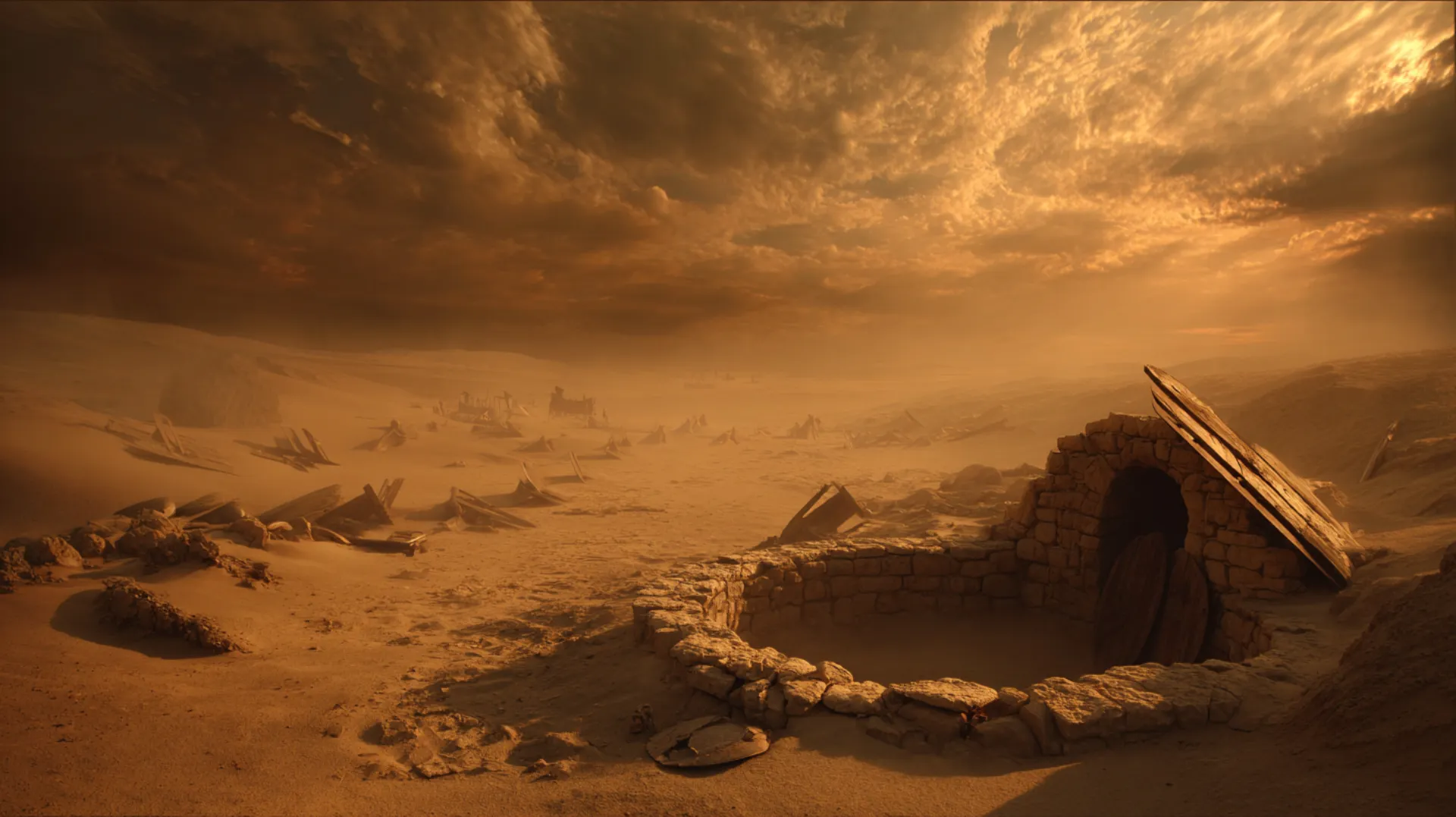
The dust has barely settled on the plains of Badr. Seventy Qurayshi bodies lie scattered across the desert, and seventy-three prisoners kneel in the sand — and now the Prophet must decide what victory demands.
1-2 AH · 622 – 624 CE
The dust has barely settled on the plains of Badr. Seventy bodies of the Quraysh lie scattered across the desert floor, and seventy-three men kneel in the sand with bound wrists, blinking in the afternoon sun as prisoners of a force one-third the size of their own. The greatest military humiliation in Meccan memory is only hours old. And now, as the Prophet Muhammad (peace be upon him) surveys the aftermath, a question rises that will echo across fourteen centuries of Islamic thought: What do you do with victory once you hold it in your hands?
The Field After the Storm
The battle had ended swiftly. What began at dawn on the 17th of Ramadan — a Friday, a day already sacred in the Muslim calendar — was finished by midday. The Quraysh, who had marched from Mecca a thousand strong with the certainty of annihilation in their hearts, had broken and fled. They poured through the one open passage back toward Mecca, a corridor that some modern military analysts believe the Prophet had deliberately left unblocked. The logic is ancient and devastating: an army that knows it fights to the death will fight with the ferocity of the cornered. Leave a pressure valve, and resolve evaporates. The Quraysh chose flight over martyrdom, and the plains of Badr belonged to the believers.
The numbers tell their own story. Of the Quraysh’s army of over a thousand, roughly seventy were killed and seventy-three or seventy-four taken prisoner — approximately fifteen percent of their force eliminated. On the Muslim side, around fifteen men fell as martyrs, less than five percent of the three hundred and thirteen who had ridden out from Madinah expecting to intercept a trade caravan, not face the full wrath of Mecca’s aristocracy.
Scholarly Note
The precise casualty figures vary slightly across sources. Ibn Ishaq and Ibn Hisham generally agree on approximately seventy Qurayshi dead and a similar number of prisoners. The Muslim martyrs are consistently reported as fourteen or fifteen. These figures are widely accepted across the classical seerah literature.
The Prophet announced that the Muslims would remain camped at Badr for three days. The decision was strategic, practical, and symbolic all at once. The Muslim martyrs needed proper burial. The army needed time to recuperate and ensure the Quraysh would not regroup for a counterattack. And perhaps most importantly, the three-day encampment declared to all of Arabia, in terms no one could misunderstand, who had won and who had lost. The Quraysh did not dare return.
The Rites of the Fallen
Here, on this blood-soaked plain, a new body of sacred law began to take shape. This was the first time the Muslim community confronted the question of what Islam requires for its battlefield dead, and the rulings that emerged at Badr would become permanent features of Islamic jurisprudence.
The shaheed — the martyr who falls in battle — is not washed. The shaheed is not given the funeral prayer, the salat al-janazah. The shaheed is buried in the clothes he wore when he died, his wounds left unwashed, because the Prophet declared that on the Day of Resurrection, the martyr would rise with his blood still the color of blood, but its fragrance would be the fragrance of musk.
“Its color will be the color of blood, and its scent will be the scent of musk.”
And the shaheed is buried where he falls. Even though Madinah was only half a day’s journey away — a distance one could cover in roughly an hour and twenty minutes by modern car — the bodies were not transported home. Individual graves were dug in the earth of Badr itself, and there the fifteen companions were laid to rest. To this day, visitors to the site can find those graves, quiet markers in the desert where young men chose paradise over dates.
Scholarly Note
The practice of burying martyrs where they fall became established sunnah from Badr onward. At the later Battle of Uhud, where the Muslim casualties were far greater — over seventy — the burden of digging individual graves proved too heavy, and two companions shared a single grave. But at Badr, with only fifteen martyrs, each received his own resting place.
The Qurayshi dead received a different treatment. Over seventy bodies could not simply be left to the desert sun. The Prophet ordered them gathered and cast into one of the abandoned wells on the plain — covered with sand, given a minimal dignity that Islamic law extends even to enemy dead. It was not the same honor afforded to the Muslim martyrs, but it was not desecration either. Even in victory, even against men who had sought to destroy them hours before, there was a floor of human decency that could not be breached.
The Voice at the Well
What happened next at that well became one of the most debated incidents in Islamic theology.
The Prophet stood at the edge of the well where the Qurayshi dead had been buried and began to address them by name. He called out to the chieftains of Mecca — men who had led the war against Islam, men whose bodies now lay tangled in the darkness below — and he asked them whether they had found what their Lord had promised them to be true.
Umar ibn al-Khattab (may Allah be pleased with him), standing nearby, was bewildered. “O Messenger of Allah,” he said, “how can you speak to bodies that have no souls?”
The Prophet’s response was immediate and emphatic. As recorded in Sahih al-Bukhari, he declared:
“By the One in whose hand is my soul, you do not hear what I am saying any better than they do.”
This single sentence detonated a theological debate that has never fully been resolved — a debate that reached back to the Companions themselves and forward through every generation of Muslim scholarship. Can the dead hear the living?
The Great Debate: Can the Dead Hear?
The question of whether the deceased can hear those who visit their graves is one of the rare theological issues where sincere disagreement exists within Sunni Islam — not between theological schools, but cutting across them. Both sides claim Companions, Successors, and towering scholars in their ranks.
Those who affirm that the dead can hear — and this is the majority position, held by scholars including Ibn Hazm, al-Nawawi, al-Suyuti, Ibn Kathir, Ibn Taymiyyah, and Ibn al-Qayyim — point to several evidences:
First, the incident at Badr itself, where the Prophet explicitly stated the dead could hear him “just as well as” the living.
Second, the hadith in Sahih al-Bukhari describing what happens to the soul after death: the deceased hears the footsteps of those who buried him as they walk away from the grave.
Third, the Prophet’s practice of visiting the cemetery of al-Baqi and greeting its inhabitants with “As-salamu alaykum, O people of the graves among the believers and Muslims” — a greeting that, this camp argues, implies the dead can hear the salutation.
Fourth, the wasiyyah (final testament) of the Companion Amr ibn al-As (may Allah be pleased with him), who instructed his family to remain at his grave after burial for “the length of time it takes to slaughter an animal and distribute its meat” — roughly half an hour — so that their presence might comfort him as he faced the questioning of the angels.
Those who deny that the dead can hear — including Aisha bint Abi Bakr (may Allah be pleased with her), Umar ibn al-Khattab, the tabi’i Qatada, and later scholars such as al-Bayhaqi, Ibn al-Jawzi, Ibn Qudama, al-Shawkani, and in modern times Shaykh al-Albani — marshal their own formidable evidence:
The Quran states repeatedly and explicitly that the dead cannot hear. In Surah Fatir (35:22): “You cannot make those in the graves hear.” In Surah al-Rum (30:52): “You cannot make the dead hear.” In Surah al-Naml (27:80): “The living and the dead are not alike. Allah makes whoever He wills hear, but you cannot make those in the graves hear.”
This camp interprets the Badr incident as an exception, not a rule. They note that Umar questioned how the dead could hear, and the Prophet did not correct Umar’s underlying assumption. Instead, he said “they can hear me right now” — a specific exception for specific people at a specific moment. Had the dead always been able to hear, why would the Prophet not simply say, “O Umar, don’t you know the dead can hear?”
As for the footsteps heard at burial, this too is an exceptional moment — the instant when the soul is reunited with the body for the questioning by the angels Munkar and Nakir. It does not establish that the dead hear visitors at any other time.
As for the Prophet’s greeting at al-Baqi, this camp argues it was a du’a — “may peace be upon you” — not a conversational greeting expecting a response. The Arabic as-salamu alaykum literally means “may Allah’s peace be upon you,” and one can sincerely make this supplication without the recipient hearing it.
As for the hadith stating that whoever passes by the grave of someone they knew and gives salam, the deceased will recognize them and return the greeting — this hadith is classified as weak (da’if) by hadith scholars. It does not appear in the six major collections.
Perhaps most tellingly, this camp points to the hadith that whoever sends salutations upon the Prophet, Allah dispatches an angel to convey the greeting to him. If even the Prophet requires an angelic intermediary to receive salam, this suggests the dead do not hear directly.
The critical point, emphasized by scholars on both sides, is that this is a theoretical question from which no practical ruling is derived. One does not go to a grave to hold conversations or, God forbid, to ask the dead for intercession — which all scholars agree is forbidden. Whether the dead hear or not, the living owe them only du’a and remembrance.
The tabi’i Qatada, the great student of Ibn Abbas (may Allah be pleased with them both), offered his own interpretation of the Badr incident in the narration recorded in Sahih Muslim: Allah brought the Qurayshi dead temporarily back to life so they could hear the Prophet’s words — a miracle, not a general principle. It was a moment of divine humiliation for the enemies of Islam, not a window into the ordinary experience of the grave.
The Realm Between: Munkar, Nakir, and the Alam al-Barzakh
The debate over hearing in the grave opens onto a far vaster landscape — the Islamic understanding of what happens between death and resurrection, the mysterious intermediary realm known as the Alam al-Barzakh.
According to the hadith in Sahih al-Bukhari describing the journey of the soul after death, the process unfolds with terrifying precision. The soul departs the body. It ascends — the righteous soul rising through the heavens, the wicked soul cast back down. And then the soul is returned to the body in the grave for the most consequential examination any human being will ever face.
Two angels arrive. Islamic tradition names them Munkar and Nakir. They ask three questions: Who is your Lord? What is your religion? Who is this man who was sent among you? The believer answers with certainty. The hypocrite and the disbeliever stumble, stammer, fail. And upon the answers hang consequences that stretch until the Day of Resurrection — the grave either becoming a garden from the gardens of Paradise or a pit from the pits of Hell.
It is this moment — this reunion of soul and body for the questioning — that gives context to Amr ibn al-As’s extraordinary deathbed request. The great Companion, one of the last to make hijrah from Mecca, a man who knew the terrors that awaited, told his children: Stay at my grave for the length of time it takes to slaughter an animal and distribute its meat, so that I may find comfort in your presence, until I am settled and can respond to the messengers of my Lord.
The rawness of that plea — a warrior and statesman confessing his fear of loneliness in the grave, asking his children to simply be there while he gathered the courage to face the angels — is one of the most human moments in all of Islamic literature.
The Question of the Spoils
Back on the plains of Badr, the living faced their own trial. The Quraysh had fled, and scattered across the battlefield lay the spoils of war — weapons, armor, horses, supplies, personal effects of the dead and the captured. The Muslims had never possessed war booty before. No previous nation in Islamic theology had been permitted to keep it; earlier communities had been required to pile their captured goods and watch divine fire consume them as a sign of acceptance.
Now, for the first time, the spoils were halal. But who would receive them?
The Companions had naturally divided during the battle into groups with different roles. One group had collected the physical booty from the field. Another had pursued the fleeing Quraysh to ensure they would not return. A third had remained as a protective guard around the Prophet. Each group felt it had a special claim. One Companion came forward holding a magnificent sword he had taken from the man he killed and said, “O Messenger of Allah, give this sword to me, for by Allah I used it in battle.”
The discussion was earnest, not hostile — but it was real. And it was into this moment that the first verse of Surah al-Anfal descended, literally on the battlefield:
“They ask you about the spoils of war. Say: the spoils are for Allah and the Messenger. So fear Allah and amend that which is between you, and obey Allah and His Messenger, if you are believers.” — Al-Anfal (8:1)
The message cut through the competing claims like a blade. This wealth does not belong to you. It belongs to Allah and His Messenger. Do not let greed fracture the brotherhood that just won you a miracle.
The Quran then established the framework for distribution: one-fifth (khumus) was set aside and itself divided into five shares — a portion for the Prophet, a portion for his household, and portions for orphans, the poor, and travelers. The remaining eighty percent was distributed equally among the fighters. At Badr, every participant received an identical share. The distinction between cavalry and infantry — where a mounted warrior would receive triple the share of a foot soldier — would not be introduced until the expedition of Khaybar years later.
Nine men who were absent from the battlefield received shares as though they had fought. The most significant was Uthman ibn Affan (may Allah be pleased with him), who had remained in Madinah at the Prophet’s own instruction to care for his gravely ill wife Ruqayyah, the Prophet’s daughter. Uthman is counted among the Badriyyun — the people of Badr — despite never setting foot on the plain. On the very day the Prophet returned to Madinah in triumph, Ruqayyah was buried.
A Debt of Honor: The Memory of Mut’im ibn Adi
As the Prophet surveyed the seventy-three prisoners kneeling before him — men who had tried to kill him that very morning — he made a statement that has reverberated through Islamic ethics ever since.
As recorded in Sahih al-Bukhari, he said:
“If Mut’im ibn Adi were alive and spoke to me about these filthy ones, I would have freed them all for his sake.”
Mut’im ibn Adi was dead. He had died only months before Badr. He had never been a Muslim. And yet the Prophet was declaring that one word from this pagan chieftain would have been enough to release prisoners whose ransom would amount to a fortune — millions of dollars in modern terms.
Why? Because Mut’im had been a man of principle. He had fed the Muslims during the brutal boycott in the Valley of Abu Talib. He had stood up to break that boycott. And most critically, when Abu Lahab had revoked the Prophet’s protection — effectively stripping him of the right to live in Mecca — and when the Prophet returned from his devastating journey to Taif to find himself locked out of his own city, it was Mut’im who armed his own sons, escorted the Prophet back through the gates of Mecca, commanded him to perform tawaf under his family’s protection, and stood in public to declare: “I have protected Muhammad. Whoever harms him has harmed me.”
Even Abu Lahab, the Prophet’s own uncle who had cast him out, had to bow his head and honor Mut’im’s declaration.
The Prophet never forgot. Mut’im was dead, he was not Muslim, he would never hear this hadith. But the Prophet gave him the equivalent of every medal of honor, every tribute a grateful leader can bestow. It was a 21-gun salute fired over an empty grave — and it established a principle that reverberates into every age: those who stand for justice, even without sharing your faith, deserve to be honored and remembered.
Scholarly Note
The hadith about Mut’im ibn Adi is recorded in Sahih al-Bukhari. Classical scholars have noted that this statement illustrates the Islamic principle of reciprocating good treatment regardless of the benefactor’s religious affiliation. Mut’im’s multiple acts of protection for the Prophet during the Meccan period are well-documented across the major seerah sources, including Ibn Ishaq and Ibn Hisham.
The Tears Beneath the Tree
The question of the prisoners remained. The Prophet consulted his two closest advisors — the men Ali ibn Abi Talib (may Allah be pleased with him) would later call wazira Rasulillah, the two ministers of the Messenger of Allah.
Abu Bakr al-Siddiq (may Allah be pleased with him) counseled mercy. These are our kith and kin, he said. Show them compassion for the sake of kinship. Perhaps they will one day accept Islam.
Umar ibn al-Khattab (may Allah be pleased with him) counseled severity. Give me someone from the Banu Khattab and I will do the job myself, he said. They tried to kill us. Why should we release them so they can attack us another day?
The Prophet responded with one of the most luminous analogies in the entire seerah. He told Abu Bakr: You are like Ibrahim, who said, “Whoever follows me is of me, and whoever disobeys me — then You, O Allah, are Forgiving and Merciful.” And you are like Isa, who said, “If You punish them, they are Your servants; but if You forgive them, You are the Mighty, the Wise.”
And he told Umar: You are like Nuh, who said, “My Lord, do not leave upon the earth a single one of the disbelievers.” And you are like Musa, who said, “Our Lord, harden their hearts so they will not believe until they see the painful punishment.”
The Prophet chose the path of Abu Bakr. The prisoners would be ransomed.
But the next morning, Umar found the Prophet weeping beneath a tree, Abu Bakr weeping beside him. Umar asked what had caused these tears, and the Prophet recited the verses of Surah al-Anfal that had just been revealed:
“It is not for a prophet to have prisoners of war until he has thoroughly established authority in the land. You desire the commodities of this world, but Allah desires the Hereafter. And were it not for a prior decree from Allah, a severe punishment would have touched you for what you took.” — Al-Anfal (8:67-68)
Allah had gently but firmly corrected the decision. The ransom was not wrong in itself — the decree stood, and the prisoners were indeed ransomed — but the best course would have been different. The nascent Muslim state was still fragile, still establishing itself. Releasing trained warriors back to an enemy that would certainly regroup was a strategic vulnerability that mercy alone could not justify.
The Prophet's Ijtihad: Human Judgment and Divine Correction
The incident of the Badr prisoners opens one of the most profound questions in Islamic jurisprudence: did the Prophet exercise independent judgment (ijtihad), or did everything he said and did emanate directly from divine revelation?
The vast majority of Sunni scholars hold that Allah granted the Prophet the right to exercise his own reasoned judgment, and that this ijtihad was sometimes confirmed by silence (meaning it was correct) and sometimes corrected by revelation. In either case, the Prophet’s commands were binding on the Companions.
The evidence for prophetic ijtihad is extensive. At Badr itself, he chose to ransom the prisoners based on his own assessment, and Allah corrected this. In the famous hadith of cross-pollination recorded in Sahih Muslim, he advised farmers against a practice, they followed his advice, the crop failed, and he clarified: “If I command you regarding matters of your religion, then follow it. But if I command you regarding worldly matters, you know your worldly affairs better than I do.”
He once prohibited visiting graves, then later reversed his own ruling: “I used to forbid you from visiting graves, but now go ahead and visit them.” He considered prohibiting marital intimacy during the breastfeeding period, then observed that the Romans and Persians practiced it without harm to their children, and withdrew the potential prohibition.
Even in matters touching theology, correction came. At the Battle of Uhud, wounded and bleeding, the Prophet said, “How can Allah ever forgive a people who did this?” Allah revealed in response: “You have no say in the matter — whether He turns to them in mercy or punishes them” — Aal Imran (3:128).
The minority position — that everything the Prophet uttered was direct revelation — cites the Quranic verse “He does not speak from desire; it is only revelation revealed” — al-Najm (53:3-4). But the majority interprets this as referring specifically to the Quran itself, not to every statement the Prophet ever made in daily life.
The critical consensus across all positions: whatever the Prophet commanded, whether from revelation or ijtihad, was binding. Over sixty Quranic verses command obedience to the Messenger. The ijtihad of the Prophet carried the force of law precisely because Allah authorized it and corrected it when necessary.
Yawm al-Furqan
Stand back from the details — the burials, the legal rulings, the tears, the theological debates — and behold the day whole.
On one side of the plain of Badr stood Iblis himself, the very entity who had refused to prostrate before Adam at the dawn of creation. He had come in the guise of Suraqah ibn Malik, promising the Quraysh his protection, marching with them to the battlefield. Beside him stood Abu Jahl — whom the Prophet called the Pharaoh of this nation — and Utbah and Walid and Shaybah ibn Rabi’ah and Umayyah ibn Khalaf, the aristocracy of pagan Mecca.
On the other side stood Jibril, descending from the heavens on his horse, leading ranks of angels. Beside him stood the Prophet Muhammad, and Abu Bakr, and Umar, and Ali, and the three hundred and thirteen who had ridden out expecting a caravan and found instead the defining moment of their civilization.
When Iblis — still wearing Suraqah’s face — saw Jibril and the angels descend, he turned and ran. Al-Harith ibn Hisham tried to stop him: “Where are you going, Suraqah?” But the entity that was not Suraqah shoved him so violently that Al-Harith flew backward and crashed to the ground. And Iblis cried out the words Allah preserves in the Quran:
“Indeed, I see what you do not see. Indeed, I fear Allah, the Lord of the worlds.” — Al-Anfal (8:48)
As the Prophet said, in a hadith narrated in the Muwatta of Imam Malik: Shaytan was never more humiliated than he was on the day of Badr.
Scholarly Note
The hadith about Shaytan’s humiliation at Badr is narrated in the Muwatta of Imam Malik, though scholars note there is some discussion regarding its chain of transmission (fi isnadihi maqal). The Quranic reference to Shaytan’s abandonment of the Quraysh is found in Surah al-Anfal (8:48). The identification of the disguise as Suraqah ibn Malik is found in the major seerah works.
Allah calls Badr Yawm al-Furqan — the Day of Criterion, the Day of Separation. Faraqa means to divide, to cleave apart, to make the boundary between two things absolute and irreversible. On this day, truth was separated from falsehood with a violence that shook the spiritual and material worlds simultaneously. Jibril versus Iblis. The Prophet versus Abu Jahl. The believers versus the deniers. Never before in human history, and never again until the Day of Judgment, would the cosmic battle between good and evil manifest so completely in a single afternoon on a single plain.
And as the Muslims broke camp three days later and turned their faces toward Madinah — carrying their wounded, mourning their dead, leading their prisoners, dividing their spoils, reciting the fresh verses of Surah al-Anfal that had descended upon them like rain — they were no longer a persecuted religious community sheltering in a borrowed city. They were a state. They were a force. They were, for the first time in the history of this ummah, a power that the world would have to reckon with.
But power, as they were about to discover, brings enemies not only from without but from within. Back in Madinah, a man named Abdullah ibn Ubayy ibn Salool — who had been on the very cusp of being crowned king of the city before the Prophet’s arrival changed everything — watched the triumphant return with a smile that did not reach his eyes. And far away in Mecca, a young woman named Zainab, the Prophet’s own daughter, was about to attempt the dangerous journey to join her father — a journey that would end in tragedy at the hands of a man named Habbar ibn al-Aswad.
Quranic References
Continue Your Journey

Cite this Narrative
APA
SeerahQuest. (2026). The Aftermath of Badr: Spoils, Souls, and the Day of Separation. *SeerahQuest: The Eternal Narrative*. https://seerahquest.com/chapters/battle-of-badr-prelude-and-preparations-part-5 Adapted from Yasir Qadhi's Seerah Series, Episode 40.
MLA
"The Aftermath of Badr: Spoils, Souls, and the Day of Separation." *SeerahQuest: The Eternal Narrative*, 2026, https://seerahquest.com/chapters/battle-of-badr-prelude-and-preparations-part-5. Adapted from Yasir Qadhi's Seerah Series, Episode 40.
Chicago
"The Aftermath of Badr: Spoils, Souls, and the Day of Separation." *SeerahQuest: The Eternal Narrative*. Accessed April 3, 2026. https://seerahquest.com/chapters/battle-of-badr-prelude-and-preparations-part-5. Adapted from Yasir Qadhi's Seerah Series, Episode 40.
Install SeerahQuest — read chapters offline, anytime.