
The Night the Prophet Left Mecca
The streets of Mecca lie empty under a merciless midday sun — and a figure wrapped in cloth moves through the silence toward the house of Abu Bakr, carrying news that will change the world.
1 AH · 622 CE
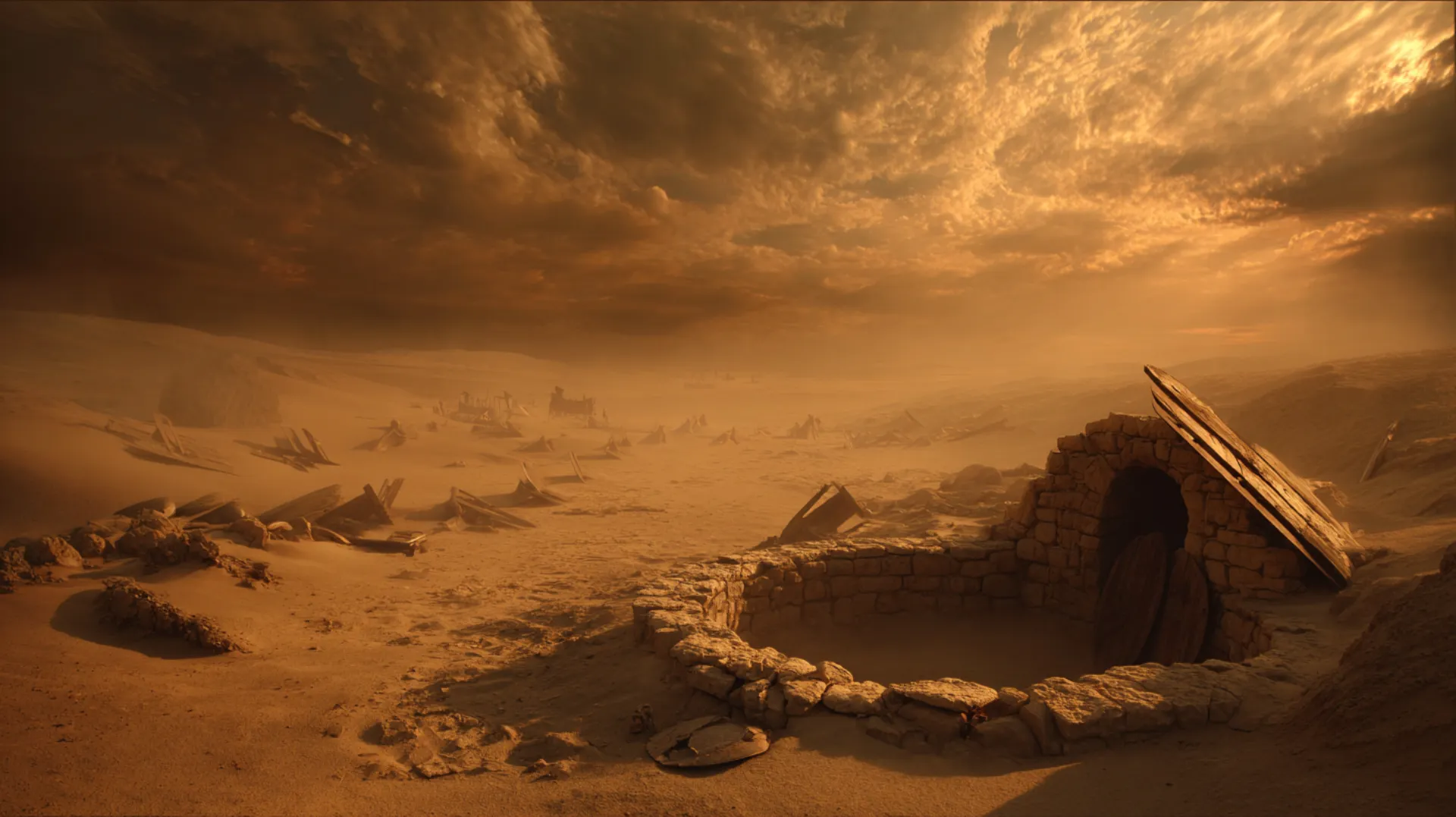
The streets of Mecca lie empty under a merciless midday sun. It is the hour of the qaylulah, the siesta, when the heat drives every living soul behind walls of mud-brick and stone, when even the dogs seek the narrow shadows between buildings. No one walks the alleys at this hour — no merchant, no child, no beggar. Which is why the young girl watching from behind a curtain knows, the moment she sees the solitary figure approaching with his turban wrapped tight around his face, that something extraordinary is about to happen.
The Figure in the Heat
Aisha bint Abi Bakr (may Allah be pleased with her) would remember this moment for the rest of her long life. She was a child then, too young to prepare food or saddle a camel, but old enough to understand the gravity of what she witnessed. As she narrated in the hadith recorded in Sahih al-Bukhari:
“I don’t remember any day except that both of my parents were upon the religion of Islam. And I don’t remember any day except that the Prophet would come visiting us in our house, sometimes in the morning and in the evening.”
But this visit was different. This was not the Prophet’s (peace be upon him) customary morning call, nor his gentle evening stop. This was the dead center of the day, the hour when the Arabian world held its breath against the furnace-blast of the sun. Aisha saw the figure moving through the deserted streets, face concealed beneath layers of cloth, and even before she could make out his features, she knew him — from the way he walked, from the shape of his shoulders, from the particular fall of his garment. She knew, and she was afraid.
“By Allah,” she recalled, “the only reason he must be coming is for something very grave to have occurred.”
The Prophet asked permission to enter. Abu Bakr al-Siddiq (may Allah be pleased with him) granted it. Then came the first instruction, sharp and urgent: Remove everybody from the room. In those days, Arabian homes were not divided into separate rooms with doors and locks. They were open chambers separated by hanging curtains — hujurat — and the Prophet could not see who might be concealed behind them. Abu Bakr understood immediately. “Ya Rasulallah,” he said, “they are but your family.” Only Aisha and her older sister Asma. No one else.
And so, from behind those curtains, a young girl listened as the course of history pivoted on a single sentence.
“Allah has given me permission to emigrate.”
The Tears of Abu Bakr
For months, Abu Bakr had been waiting for this moment. When the Prophet had first told the Muslims to emigrate to Yathrib, Abu Bakr had prepared a camel and asked permission to leave. The Prophet’s response had been careful, deliberate: “Wait, for I hope that Allah will give us permission.” Abu Bakr had understood the implication at once. The Prophet was not merely asking him to be patient — he was hinting that they might travel together.
“As-Suhbah, Ya Rasulallah?” Abu Bakr had asked. Are you hoping for my companionship?
“Yes,” the Prophet had replied. “This is what I am hoping for.”
From that day, Abu Bakr had prepared not one camel, but two. And he had done so with the meticulous care of a man who understood what desert travel demanded. Preparing a camel for a long journey was not a matter of hours — it was a matter of weeks. The animal had to be fed a special diet, given extra salt to force it to drink water beyond its usual intake, kept confined so it would not burn its stored fat. Slowly, the hump would swell with reserves. For nearly four months, Abu Bakr had been fattening those two camels, waiting.
Now, when the Prophet spoke those words — Allah has given me permission — Abu Bakr asked the only question that mattered: “Ya Rasulallah, As-Suhbah? Bi Abi Anta Wa Ummi — I beg you by my mother and father — did Allah allow me to be the companion?”
“Naam.” Yes.
What happened next imprinted itself on Aisha’s memory with the force of revelation. “I saw Abu Bakr cry,” she said, in a narration found in both Bukhari and Ibn Ishaq. “And I had never believed that people could cry out of happiness until I saw Abu Bakr cry out of happiness on that day.”
This was a man who had spent 90 percent of his personal wealth in the cause of Islam. Ibn Ishaq narrates that when Abu Bakr first accepted Islam, he possessed 40,000 dirhams — a considerable fortune. By the time of the Hijrah, 35,000 of those dirhams had been spent purchasing and freeing persecuted slaves like Bilal ibn Rabah (may Allah be pleased with him). He had 5,000 dirhams left, and he would take every last coin with him, leaving nothing for his daughters.
When Abu Bakr offered one of the two camels as a gift, the Prophet refused. “Illa bi thaman,” he said. Only if I pay you the price. Even in this moment of urgency, the Prophet insisted on purchasing the camel at its full value — a gesture that spoke to his profound sense of propriety and his desire that the full spiritual reward of the emigration be his own.
Scholarly Note
The date of the Hijrah is a matter of scholarly reconstruction. No hadith gives an exact calendar date, but Ibn Abbas narrates in Sahih Muslim that the Prophet stated Monday was the day of his birth, the day Iqra was revealed, and the day he emigrated. Modern researchers, working backward through lunar calendar calculations, have estimated the departure as the 26th of Safar in the 13th year of the Da’wah — not Muharram, as the later Islamic calendar year might suggest. The Companions chose Muharram as the start of the Hijri calendar for separate administrative reasons during the caliphate of Umar ibn al-Khattab.
The Conspiracy at Dar al-Nadwa
While Abu Bakr wept with joy, the machinery of assassination was already grinding into motion across the city.
In the Dar al-Nadwa — the ancient council hall that served as Mecca’s parliament — representatives from every tribe of the Quraysh had gathered for a secret midnight session. Every tribe, that is, except two conspicuous absences. The Banu Hashim had not been invited. And neither had Mut’im ibn Adi.
The exclusions were deliberate and deeply calculated. Abu Lahab (Abd al-Uzza ibn Abd al-Muttalib), despite his open hatred of his nephew, could not be present at a meeting that plotted the murder of his own blood relative. It was not a matter of affection — Abu Lahab had long since withdrawn his tribal protection from the Prophet. It was a matter of public honor. For a man to sit in a room and sanction the killing of his own nephew would have been a shame that followed him to the grave. As the scholars note: ignorance was bliss. If Abu Lahab did not know, Abu Lahab did not have to answer.
Mut’im ibn Adi’s exclusion followed similar logic. Mut’im was the man whose personal guarantee of protection had allowed the Prophet to remain in Mecca after Abu Talib’s death. He was a pagan, not a Muslim, but he was a man of his word. To invite him to a meeting that would violate his own pledge was something even the Quraysh could not bring themselves to do. There was, even in their conspiracy, a residual sense of the honor code they claimed to live by.
The Quran itself memorializes the deliberations of that night. Ibn Abbas (may Allah be pleased with him) identified Surah al-Anfal, verse 30, as a direct reference to this gathering:
“And when those who disbelieved plotted against you to restrain you, or kill you, or evict you. They plotted, and Allah plotted. And Allah is the best of plotters.” (Al-Anfal, 8:30)
Three proposals were put forward. The first: imprison him. Lock the Prophet in a house and keep him there. But Arabia had no real concept of long-term imprisonment — the idea of confining a man for years in a room was alien to their culture. And even if they managed it, his words would still reach his followers. Messages would be smuggled out. The Quran would spread regardless.
The second: exile him. Send him away from Mecca entirely. But exile would only deliver the Prophet directly to his followers in Yathrib, strengthening rather than weakening the growing Muslim community.
Then Abu Jahl (Amr ibn Hisham) rose to speak, and he said what everyone in the room had been thinking but no one had dared to voice: Kill him.
The problem, of course, was the blood-feud system that governed Arabian justice. If one tribe killed a man from another tribe, the victim’s clan was honor-bound to exact revenge — either by killing a member of the offending tribe or by demanding diyah, blood money. If the Banu Makhzum alone killed the Prophet, the Banu Hashim would be obligated to wage war against them. The resulting cycle of revenge could tear Mecca apart.
Abu Jahl’s solution was diabolical in its elegance. Rather than one tribe bearing the guilt, every tribe would send a young, strong representative. Together, they would strike the Prophet simultaneously, so that his blood would be on all their swords at once. No single tribe could be held responsible. The Banu Hashim, facing the collective might of every clan in Mecca, would have no choice but to accept the diyah and let the matter rest.
The Pre-Islamic Concept of Diyah and Qisas
The system of diyah (blood money) and qisas (retributive justice) that Abu Jahl sought to exploit was not an Islamic invention — it was a deeply rooted pre-Islamic institution that Islam would later refine and codify. In the tribal system of seventh-century Arabia, justice was not administered by courts or judges but by the balance of power between clans. If a man was killed, his tribe had two options: demand a life for a life (qisas), or accept monetary compensation (diyah).
The genius of Abu Jahl’s plot lay in its manipulation of this system. By distributing the act of killing across every tribe, he ensured that qisas became impossible — the Banu Hashim could not wage war against all of Mecca simultaneously. This would force them into the only remaining option: accepting diyah. The plotters would then collectively pay the blood money, and the matter would be legally settled according to the customs of the time.
What Abu Jahl did not account for was divine intervention. The very system he sought to exploit — one built on human calculations of power and tribal arithmetic — was overridden by a power that no council chamber could contain. Islam would later preserve the concepts of diyah and qisas but placed them within a framework of divine law, removing them from the arena of tribal power politics where they had been so easily weaponized.
Scholarly Note
A narration transmitted through Qatadah — a tabi’i who did not witness these events firsthand — describes an old man arriving at the Dar al-Nadwa, claiming to be a chieftain from the Najd, who encouraged the plotters and endorsed Abu Jahl’s plan as the wisest course. Ibn Abbas identified this figure as Iblis (Satan) himself. This narration has a missing link in its chain (mursal), as Qatadah is reporting events he did not witness. Scholars such as Ibn Ishaq include it in their accounts, and while it cannot be verified with the same certainty as narrations in Bukhari and Muslim, there is nothing theologically problematic in affirming it.
The Night Escape
That very night, Jibreel descended to the Prophet with the command: Leave now.
The timing was not coincidental. The young men selected by each tribe were already moving toward the Prophet’s house — the house of Khadijah bint Khuwaylid (may Allah be pleased with her), where the Prophet still lived after her passing. Ali ibn Abi Talib (may Allah be pleased with him), now a young man of about eighteen or nineteen, was instructed to remain behind, lying in the Prophet’s bed. In the darkness, with only the faint light filtering through the open windows that Arabian houses used in place of glass, the assassins peering in would see a figure lying there and assume their target was still inside.
Ibn Ishaq reports — without an isnad, as scholars carefully note — that as the Prophet walked out past the surrounding men, he recited the opening verses of Surah Ya-Sin, and Allah placed a barrier over their eyes so that they could not see him. He even, according to this account, cast dust upon their heads as he passed, and they did not realize it until after he was gone.
“And We have put before them a barrier and behind them a barrier and covered them, so they do not see.” (Ya-Sin, 36:9)
The Prophet made his way to Abu Bakr’s house. In the middle of the night, the two men mounted their camels and rode — not north toward Yathrib, but south, in the exact opposite direction, toward the cave of Thawr.
Asma and the Two Belts
Before they departed, provisions had to be prepared. Aisha was too young to help, but her older sister Asma bint Abi Bakr (may Allah be pleased with her) — at least ten to fifteen years Aisha’s senior — had already bundled food and water for the journey. In the frantic urgency of the moment, she realized she had nothing to tie the provision bag. Without hesitation, she tore her own belt in half with her teeth, using one piece to secure the food bundle and the other to hold her own garment together.
This single act of quick-thinking devotion earned her an immortal title: Dhat al-Nitaqayn — She of the Two Belts. It is one of the most beloved honorifics in Islamic history, a name that would follow Asma for the rest of her remarkable life.
And Asma’s trials were not over. When Abu Bakr’s father, Abu Qahafa — a blind, sharp-tongued old pagan who had never accepted his son’s faith — came to mock his granddaughters for being left penniless, Asma thought quickly. She gathered pebbles, dropped them into the empty money sack, wrapped it in cloth, and placed it in her blind grandfather’s hands. He felt the weight, assumed it was coins, and left satisfied. In truth, Abu Bakr had taken every last dirham — all 5,000 that remained of his once-great fortune — because in the desert, money might mean the difference between life and death. His daughters, at least, were in a city where people would feed them.
Later, Abu Jahl himself came to interrogate Asma, demanding to know where her father and the Prophet had gone. When she refused to speak, he struck her so hard she bled. She said nothing.
The Cave and the Plan
The cave of Thawr was a deliberate choice — a crevice in a mountain to the south of Mecca, barely large enough for two men to squeeze inside. The entrance was at ground level, so small that a person walking above it might mistake it for just another crack in the rock. Abu Bakr had planned their stay with the precision of a military strategist. Three days and three nights in the cave, then onward.
He had assigned three people to three critical tasks.
His eldest son, Abdullah ibn Abi Bakr, would come each morning with food and water, and more importantly, with intelligence. The boy would wander through Mecca’s markets as if running ordinary errands, eavesdropping on conversations, tracking which direction search parties were heading, then report back to the cave under cover of darkness. Because he was young, no one paid him any attention.
Abu Bakr’s freed servant, Amir ibn Fuhayrah, had the task of taking his flock of sheep out to graze — and deliberately driving them back and forth over Abdullah’s footprints, erasing every trace of the path to the cave.
The third man was the most remarkable of all: Abdullah ibn Urayqit — a Bedouin guide who was neither from the Quraysh nor a Muslim. His job was to lead them along a route that no one in Mecca would think to search: a back road heading south toward the coast, then swinging northwest toward what is now Jeddah, before turning north along a path parallel to — but entirely separate from — the main highway between Mecca and Medina.
Scholarly Note
The exact name of the guide is uncertain — sources give both “Abdullah ibn Arqat” and “Abdullah ibn Urayqit.” Ibn Hajar al-Asqalani himself notes that he searched for further information about this man and could find nothing. We do not know whether he ever accepted Islam. What we do know is that both the Prophet and Abu Bakr trusted him completely — a trust that proved well-founded. Scholars have drawn from this the principle that Muslims are permitted to employ and trust non-Muslims in professional capacities when their honesty is established. As Allah says in the Quran regarding the People of the Book: among them are those who, if entrusted with a great treasure, would return it faithfully (Aal Imran, 3:75).
The Quraysh, meanwhile, had discovered the Prophet’s absence and sent riders in every direction. When the main roads yielded nothing, they hired an expert tracker — a private detective of the desert — who followed traces of camel dung and hoof-prints from Abu Bakr’s house all the way to the base of Jabal Thawr. From there, the mountain’s rocky surface swallowed all signs.
It was enough. Abu Jahl, Umayyah ibn Khalaf, and the senior men of Mecca converged on the mountain. Abu Bakr, peering out from the cave’s narrow opening, could see them. He whispered to the Prophet in barely controlled panic: “If they just look down at their feet, they will see us.”
The Prophet’s response entered the permanent vocabulary of the Muslim soul:
“O Abu Bakr, what do you think of two people whose third is Allah?”
The famous stories of the spider spinning its web over the cave’s entrance, of the tree bending its branches to conceal the opening, of pigeons nesting at the mouth — these are narrated in various sources with varying degrees of strength. The spider web tradition appears in Musnad Ahmad with a slight weakness in its chain. The accounts of the tree and the pigeons are reported with significant missing links — third or fourth-generation narrators describing events they did not witness.
Scholarly Note
The story of the spider web at the cave of Thawr is found in Musnad Imam Ahmad but carries a slight weakness in its isnad. The narrations of the tree leaning over the entrance and pigeons building a nest are reported with major missing links (mursal narrations from later generations). While there is nothing theologically problematic in affirming these accounts — if Allah willed such miracles, they are well within His power — scholars note that they are not found in Bukhari or Muslim and should not be presented with the same certainty as the authenticated core narrative of the cave episode.
The Quraysh passed over the cave and moved on. Three days elapsed. On the morning after the third night, Abdullah ibn Urayqit arrived with the camels, and the three men — the Prophet, Abu Bakr, and their pagan guide — set out on the road that no one traveled.
Suraqah and the Bracelets of an Emperor
The Quraysh had placed a bounty of one hundred camels on the Prophet and Abu Bakr — dead or alive. In a society where the Prophet himself had not owned a single camel until this journey, one hundred camels was an almost unimaginable fortune.
The news reached Suraqah ibn Malik, chieftain of the Banu Mudlij, a Bedouin tribe far from Mecca. He was sitting with his tribesmen when one of his men returned from a hunting expedition, breathless: “I saw three riders in the distance. It must be the ones the Quraysh are looking for.”
Suraqah wanted the bounty for himself. Immediately, he lied: “Oh, that’s not them. That’s so-and-so’s party — I know they’re traveling in that direction.” He waited until the conversation moved on, then slipped away, armed himself, mounted his war horse, and galloped toward the three distant figures at full speed.
What happened next, Suraqah himself narrated after his eventual conversion to Islam. As he closed in, his horse suddenly sank into the ground and threw him. He remounted. It happened again. A strange smoke seemed to rise between him and the riders. He pulled out his azlam — the pagan equivalent of divination arrows — and cast them. The answer: Do not proceed. He ignored it. He charged again. For a third time, more violently than before, his horse hurled him to the sand.
“I knew,” Suraqah said, “that this was a force beyond me. And I knew that the affair of this man would spread.”
He called out, begging permission to approach peacefully. When he finally drew near, he observed something that would stay with him forever: one of the two riders — Abu Bakr — was in constant, agitated motion, looking right and left, riding ahead and then falling behind, consumed by anxiety for the Prophet’s safety. The other rider moved calmly, steadily, never once turning his head, reciting something — the Quran — in perfect serenity.
Suraqah asked for — and received — written protection: a guarantee of safety, inscribed on a piece of leather by Abdullah ibn Urayqit at the Prophet’s instruction. Then, according to the narration of Ibn Abd al-Barr, the Prophet turned to Suraqah as he was leaving and said something that must have seemed, in that moment, like the words of a madman:
“Suraqah, how will you be the day that you put on the bracelets of Kisra?”
Kisra — Khosrow, the emperor of Persia, the most powerful man in the known world, famous for the jeweled bracelets he wore as symbols of his absolute authority. Suraqah could only stammer: “Kisra, the son of Hurmuz?” As if there could be another.
The Prophet did not elaborate. He turned and rode on.
Years later — after the Prophet’s death, after the Muslim armies swept through the Sassanid Empire, after the magnificent palace of Persepolis fell and its treasures were shipped to Medina — Umar ibn al-Khattab (may Allah be pleased with him) sat in the Prophet’s mosque surrounded by the glittering spoils of an empire. He called for Suraqah. He found, among the captured treasures, the very bracelets of Kisra. He placed them on the hands of a Bedouin from the Banu Mudlij, and the entire congregation rose to their feet crying Allahu Akbar.
“Alhamdulillah,” Umar said, “who has taken these bracelets from Kisra, the son of Hurmuz, and given them to Suraqah, a Bedouin from the tribe of Banu Mudlij.”
A prophecy spoken in the desert by a fugitive with a bounty on his head, fulfilled in a mosque overflowing with the treasures of the world’s mightiest empire.
The Road That Was Always There
The route the three men traveled — south toward the coast, then northwest along an obscure path parallel to the main Mecca-Medina highway — was unknown to most Arabs of the time. It was a Bedouin back road, the kind of trail that only someone like Abdullah ibn Urayqit would know. Travelers preferred the main highway for the same reasons people prefer highways today: safety, wells, provisions, the comfort of knowing that if something went wrong, a caravan would eventually pass.
In a remarkable footnote to history, when modern Saudi engineers set out to determine the optimal route for a new highway between Mecca and Medina, their calculations led them to a path that swings toward Jeddah before heading north — essentially the same route the Prophet traveled fourteen centuries earlier. The highway is called, to this day, Tariq al-Hijrah — the Road of the Emigration. The most efficient path, it turned out, had been there all along. It simply took a fugitive prophet and a pagan guide to discover it first.
Trusting a Non-Muslim Guide: Lessons from Abdullah ibn Urayqit
One of the most striking details of the Hijrah is the Prophet’s decision to entrust his life — and the life of Abu Bakr — to a man who was not Muslim. Abdullah ibn Urayqit was a polytheist, a member of a Bedouin tribe with no connection to the Quraysh or to Islam. He was hired for a sum that must have been a fraction of the hundred-camel bounty on the Prophet’s head. Yet he proved utterly trustworthy.
This decision carries profound implications. It demonstrates that the Prophet evaluated people on the basis of their demonstrated character, not solely their religious affiliation. As Allah states in the Quran: “Among the People of the Book is he who, if you entrust him with a great amount of wealth, will return it to you. And among them is he who, if you entrust him with a single coin, will not return it to you” (Aal Imran, 3:75). Honesty, the Prophet’s example teaches us, is a human quality that transcends creedal boundaries.
Ibn Hajar al-Asqalani, one of Islam’s greatest hadith scholars, notes that he searched extensively for information about Abdullah ibn Urayqit’s later life and could find nothing — not even whether he eventually accepted Islam. The man who held the Prophet’s life in his hands during the most dangerous journey in Islamic history simply vanishes from the historical record. His service, however, endures as a permanent lesson in the ethics of trust.
A Final Glance
At-Tirmidhi records in his Sunan that as the Prophet passed the last shops on the outskirts of Mecca — the souq that marked the city’s edge — he paused in the darkness and turned around for one final look. He would not enter this city again except as a conqueror, more than eight years later.
He spoke to Mecca as if the city itself could hear:
“You are the most blessed land on earth and the most beloved to me. And were it not for the fact that my own people have expelled me, I would never have left you.”
The words echoed, almost exactly, the prophecy that Waraqah ibn Nawfal had spoken nearly thirteen and a half years earlier, when the trembling young man had come down from the cave of Hira with the first verses of revelation burning in his chest. “Your people will expel you,” Waraqah had said. And now, in the silence of a Meccan night, the prophecy was complete. My qawmi akharajuni. My own people have driven me out.
The camels turned south. The darkness swallowed the riders. Behind them, a city slept, unaware that its most consequential citizen had just walked out of its life. Ahead of them lay a desert, a cave, a bounty hunter whose horse would refuse to carry him, and a road that would lead not merely to another city, but to the birth of a civilization.
In Yathrib, the people who had pledged their blood and their honor at the cliffs of Aqaba were waiting. They did not yet know that their guest was on his way. But the road was open, the camels were strong, and somewhere between the lava fields that flanked the city they would one day call Madinah, a new chapter in human history was preparing to begin.
Quranic References
Continue Your Journey

Cite this Narrative
APA
SeerahQuest. (2026). The Night the Prophet Left Mecca. *SeerahQuest: The Eternal Narrative*. https://seerahquest.com/chapters/second-bayah-of-aqaba-bayat-al-aqaba-al-thaniya-part-2 Adapted from Yasir Qadhi's Seerah Series, Episode 27.
MLA
"The Night the Prophet Left Mecca." *SeerahQuest: The Eternal Narrative*, 2026, https://seerahquest.com/chapters/second-bayah-of-aqaba-bayat-al-aqaba-al-thaniya-part-2. Adapted from Yasir Qadhi's Seerah Series, Episode 27.
Chicago
"The Night the Prophet Left Mecca." *SeerahQuest: The Eternal Narrative*. Accessed April 3, 2026. https://seerahquest.com/chapters/second-bayah-of-aqaba-bayat-al-aqaba-al-thaniya-part-2. Adapted from Yasir Qadhi's Seerah Series, Episode 27.
Install SeerahQuest — read chapters offline, anytime.