The Fortress Between Two Rivers of Fire
The city that would shelter the Prophet had been preparing for millennia — not by human hands, but by volcanic eruptions that carved a fortress from the earth itself.
1 AH · 622 CE
Between Two Rivers of Black Stone
The desert stretches endlessly in every direction, a sea of sand and scrub beneath a sky so vast it swallows the horizon. But somewhere ahead — perhaps three days’ ride at speed, perhaps seven at the pace of a laden caravan — a city waits between walls of ancient fire. Not walls built by human hands, but by the earth itself: twin fields of volcanic rock, dark and jagged, sprawling east and west like the outstretched arms of a fortress that God alone could have designed. The travelers cannot see them yet. They are still crossing open country, still fugitives with a bounty on their heads. But the land they are riding toward has been preparing for them for millennia, shaped by eruptions no living person remembers, sculpted by forces that predate every tribe, every lineage, every poem sung around a campfire in the Hijaz.
Before the Prophet Muhammad (peace be upon him) and Abu Bakr al-Siddiq (may Allah be pleased with him) arrive at the gates of the city that will bear their legacy forever, we must understand why this city — out of every settlement in Arabia, every oasis in the Najd, every port on the Red Sea coast. The answer lies in geography, genealogy, and what can only be described as the long arc of divine planning, visible only in hindsight, when the scattered dots of history finally connect into a single, luminous line.
The City Between the Lava Fields
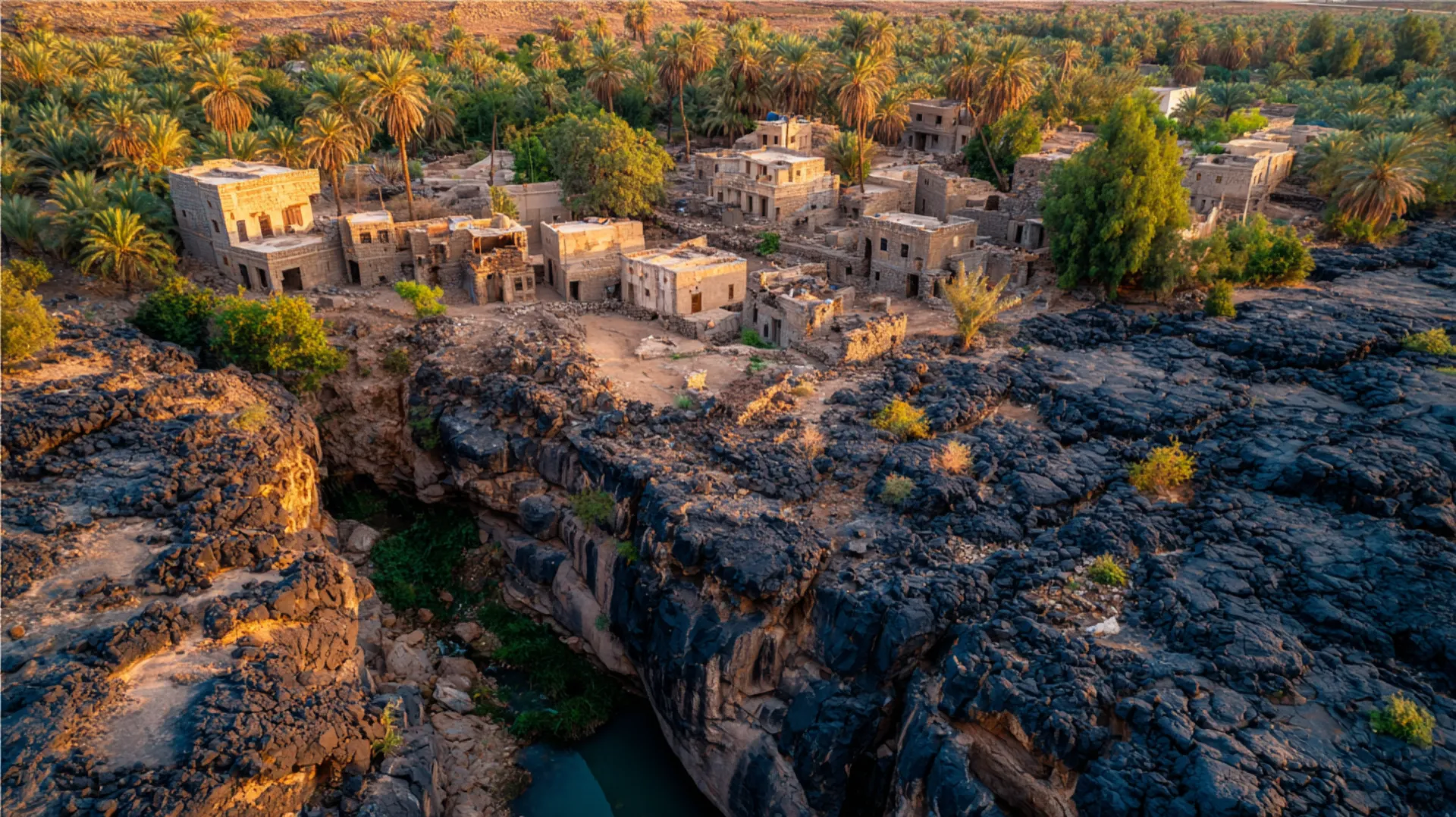
Yathrib — the name it still carried in those final days before the Hijrah — sat in a landscape unlike anywhere else in the Arabian Peninsula. The city was flanked to its east and west by two immense volcanic lava fields: the Harrah Sharqiyah and the Harrah Garbiyah. These were not gentle hills or rolling dunes. They were vast expanses of hardened magma — porous, uneven, treacherous terrain that no army could cross, no cavalry could charge through, no column of camels could navigate. The rock was neither sand nor stone nor gravel, but something in between: the frozen residue of volcanic eruptions that had occurred perhaps thousands of years before the first Arab pitched a tent in the region.
The Prophet himself would later define the sacred boundaries of his adopted city by these very formations. As recorded in Sahih al-Bukhari, he declared:
“Al-Madinah is a haram between its two labbatayn.”
Labbatayn — the dual form of labba, meaning lava. The city’s sanctity was literally demarcated by geology.
Scholarly Note
The term labba (لابة) refers specifically to volcanic lava fields, known in Arabic geographical terminology as harrah (حرّة). While the labbatayn as precise boundary markers are no longer visible due to modern urban construction, both Harrah Sharqiyah and Harrah Garbiyah retain their historical names and geographical presence to this day. A survey conducted by scholars at the Islamic University of Madinah in the 1970s attempted to establish more precise boundaries based on the prophetic descriptions, and their conclusions form the basis of the current Saudi government’s official demarcation.
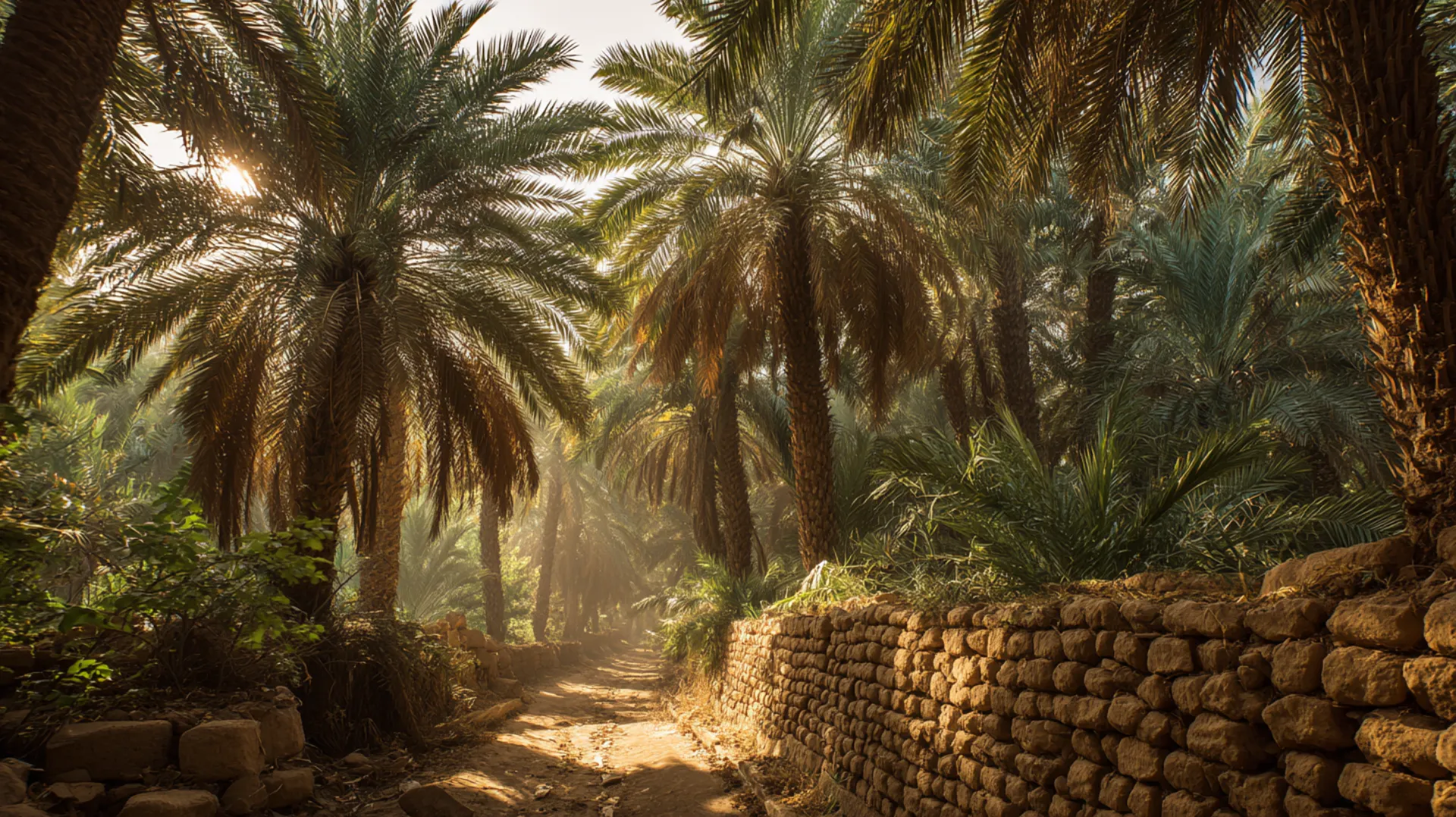
To the south, where the road from Mecca approached, the terrain offered yet another natural barrier: dense groves of date palms, so thickly planted that an army could no more march through them than through a forest. And to the north, between the mountains of Uhud and Ayr, there remained only one stretch of open ground — a corridor perhaps a few miles wide. This was the sole direction from which a large military force could realistically approach the city.
Years later, when ten thousand warriors from every hostile tribe in Arabia descended upon Madinah in the Battle of the Trench, it would be precisely this narrow corridor that the Muslims needed to defend. A trench dug across a few miles of open ground — an audacious, unprecedented tactic suggested by Salman al-Farisi — would be sufficient to hold back the combined might of Arabia. Had the city been located anywhere else, such a defense would have been impossible. You cannot dig a moat around an entire city in a week. But you can dig one across the only gap in a natural fortress.
Ibn Ishaq, the earliest biographer of the Prophet, explicitly notes that Madinah was naturally protected from three sides, leaving only one vulnerable approach. The city was, in military terms, a gift.
A Dream of Date Palms
The Prophet had seen this city before he ever set foot in it — not with his waking eyes, but in a vision. As recorded in Sahih al-Bukhari, he told his companions in Mecca:
“I saw in a dream that I was emigrating from Mecca to a land with many date palms. I thought it might be al-Yamama or Hajar, but it turned out to be Madinah — Yathrib.”
Al-Yamama and Hajar were cities far to the east and south, in the direction of Yemen, where date cultivation was also known. But in the Hijaz itself — the western spine of the peninsula where Mecca stood — there were only two places blessed with the vast underground water sources that could sustain such groves: Khaybar and Yathrib. The Prophet saw the palms but could not identify the city. The recognition came only later, when the men of the Khazraj embraced Islam and extended their invitation. The dream preceded the event; the meaning followed the reality.
And there was another hadith, also in Sahih al-Bukhari, more direct and more prophetic in its implications:
“I have been commanded to emigrate to a city that shall devour all other cities. They call it Yathrib, but it is al-Madinah.”
Ta’kulu al-qura — it shall devour all other cities. The language is striking, almost aggressive, for a settlement that at the time was little more than a collection of fortified farms and feuding clans. Yet within a generation, from this city would emerge a civilization that would indeed consume the old order — the tribal paganism of Arabia, the Persian Empire, the Byzantine holdings in the Levant — absorbing them all into something new.
The Name That Was Changed
The Prophet’s insistence on renaming the city was not mere preference. It was a theological act. Yathrib, scholars note, likely derives from tathrib — meaning criticism or blame — or from tharb, meaning evil and corruption. The Quran itself reinforces this distinction with remarkable precision: every time the name Yathrib appears in its pages, it comes from the mouths of the hypocrites.
In Surah al-Ahzab, during the crisis of the Battle of the Trench, when fear gripped the city and faith was tested to its limits, it is the munafiqun who cry out:
“O people of Yathrib, there is no place for you here, so go back!” (Al-Ahzab, 33:13)
The hypocrites clung to the old name because they rejected the new reality. The believers called it al-Madinah — simply “the City,” with the definite article that elevated it above all others. Its longer name, Madinatu Rasulillah, the City of the Messenger of God, would become perhaps the most beloved place-name in Islamic civilization.
The Prophet also called it Taba and Tayba — both meaning “the pure” or “the source of purity.” In a hadith recorded in Sahih Muslim, he said:
“Whoever calls Madinah ‘Yathrib’ should seek forgiveness from Allah, for it is Taba, it is Taba, it is Taba.”
The triple repetition carries the weight of emphasis. The old name, with its connotations of corruption, was to be buried with the old era. The new name carried the promise of what the city would become.
The Hundred Names of Madinah
The historian al-Samhudi, who wrote extensively about the history of Madinah, catalogued over one hundred names for the city — a phenomenon that reflects an ancient Arab cultural practice of bestowing multiple names upon things considered grand or beloved. Among these names were al-Madinah (the City), Taba (the Pure), Tayba (the Good), al-Munawwarah (the Radiant), Dar al-Hijrah (the Abode of Emigration), and Dar al-Iman (the Abode of Faith). Another early scholar noted that no city in the known world had more names than Madinah. The Prophet himself, however, primarily used only two or three: al-Madinah, Taba, and Tayba. The proliferation of names in later tradition reflects the deep emotional attachment that generations of Muslims developed toward the city where the Prophet lived, taught, and was buried.
The Blessings Poured Upon a City
The prophetic traditions concerning Madinah’s blessings are remarkable both for their abundance and their specificity. They appear in the most rigorously authenticated collections — Sahih al-Bukhari and Sahih Muslim — and they paint a portrait of a city that exists under a kind of divine protection unlike any other place on earth save Mecca itself.
The Prophet made a supplication recorded in Sahih al-Bukhari:
“O Allah, cause us to love Madinah as much as we love Mecca, or even more.”
And this love was not merely commanded; it was felt. Ibn Abbas (may Allah be pleased with him) narrates that whenever the Prophet returned from an expedition and glimpsed the silhouette of Madinah on the horizon, his face would brighten with joy and he would urge his mount to quicken its pace. The mountain of Uhud, visible from afar, drew from him a declaration that has echoed through the centuries:
“This is a mountain that loves us and we love it.”
The blessings extended to the practical and the eschatological alike. The Prophet prayed for barakah in the city’s weights and measurements — meaning that food purchased in Madinah would stretch further, sustain more people, carry a divine surplus invisible to the eye but felt in the belly. He declared that no plague would ever devastate the city. And across fourteen centuries of recorded history — through the bubonic plague that swept the medieval world, through the Spanish influenza of 1918 that killed a third of the global population — Madinah has remained untouched by epidemic. Famines came, yes. But plagues, never.
He also established Madinah as the second haram — sacred sanctuary — in Islam. In a hadith in Sahih al-Bukhari, he said:
“O Allah, your servant and khalil Ibrahim declared Mecca a haram, and I too am your servant and your messenger, so I make supplication to You to make Madinah a haram.”
Scholarly Note
The designation of Madinah as a haram carries specific legal consequences: hunting is prohibited within its boundaries, vegetation may not be plucked without necessity, and weapons may not be carried except by those with legitimate security duties. These rulings parallel those of Mecca’s haram, though scholars note that Mecca’s sanctity is more ancient — dating, according to the majority opinion, to the creation of the heavens and earth, with Ibrahim (peace be upon him) later announcing its sacred status — while Madinah’s sanctity was established with the Prophet’s emigration. The question of whether Madinah is more blessed than Mecca or vice versa generated scholarly discussion: Imam Malik, himself a Madani scholar, inclined toward Madinah’s superiority in certain respects, while the majority held that each city possesses its own distinct virtues. Mecca offers 100,000 times the reward for prayer; Madinah offers 1,000 times. The Prophet’s supplication that Madinah receive “double the blessings” of Mecca added further complexity to this discussion. Most scholars conclude that comparison is inappropriate — each city is blessed in its own way.
It is worth pausing here to clarify a point that carries implications for Muslim understanding of sacred geography. There are precisely two harams in Islam from a legal (fiqhi) perspective: Mecca and Madinah. Jerusalem — al-Quds — is blessed, is the first qiblah, is a place where prayer carries 250 times its normal reward, and is a land described in the Quran as muqaddas (holy). But it is not a haram in the technical legal sense. The animals of Jerusalem may be hunted; its trees may be felled. The popular designation of the Temple Mount area as al-Haram al-Sharif reflects cultural usage, not legal classification. Every haram is blessed, but not every blessed place is a haram.
The Blood Connection
Of all the reasons for Madinah’s selection, perhaps the most astonishing is the genealogical one — a thread of blood that stretches back three generations and connects the Prophet directly to the people who would become his hosts.
The story begins with Hashim, the Prophet’s great-grandfather and the patriarch of the Banu Hashim. Hashim was a trader whose caravan routes took him regularly through Yathrib on his way to Syria. On one such journey, he encountered a woman named Salma bint Amr — daughter of a chieftain of the Banu Adi ibn Najjar, a clan of the Khazraj. She was, by all accounts, a formidable personality: a businesswoman who married and divorced men on her own terms, who refused to surrender her independence or her commercial enterprises for any husband. When Hashim proposed, she laid down her conditions: she would remain in Yathrib, any children would stay with her, and she would continue her work.
Hashim agreed. But their time together was brief. He died in Gaza — in Palestine, then under Roman jurisdiction — while on a trading expedition. Salma, pregnant with his child, chose not to inform the Quraysh. The boy was born with a distinctive white streak in his hair and was named Shayba. He grew up in the streets of Yathrib, unknown to his father’s people.
It was only when a passing traveler noticed the boy’s unmistakably Qurayshi features and learned his parentage that word reached Mecca. Al-Muttalib, Hashim’s brother, traveled secretly to Yathrib and persuaded the young teenager — perhaps twelve or thirteen — to return with him, spiriting the boy away before Salma could intervene. When they entered Mecca and people asked who the child was, al-Muttalib’s silence led them to assume the boy was a purchased slave. And so Shayba became known as Abd al-Muttalib — “the slave of al-Muttalib.”
Abd al-Muttalib, of course, was the Prophet’s grandfather. The man who rediscovered the well of Zamzam, who stood before Abrahah’s army and declared that the Ka’bah had a Lord who would protect it, who held the infant Muhammad in his arms with a tenderness that witnesses never forgot — this man had spent his formative years walking the very streets, playing in the very alleyways, that his grandson would one day sanctify.
And so when the Prophet emigrated to Madinah, he was not arriving as a stranger. He was, through his great-grandmother Salma, a second cousin to the Khazraj. In the kinship-obsessed culture of Arabia, where every person could recite twenty generations of ancestry without hesitation, this mattered enormously. The Prophet was blood. Not through the patrilineal line — the stronger bond in Arab custom — but through the maternal connection, the akhwal. It was enough. It was more than enough.
And it was no coincidence that upon his arrival in Madinah, the Prophet’s camel knelt at the house of Abu Ayyub al-Ansari (may Allah be pleased with him) — who was of the Banu Adi ibn Najjar, the very clan of Salma. The Prophet’s first host in his new city was his closest relative among the Ansar.
The Convergence of Adnan and Qahtan
There is yet another layer to this divine selection. The Aws and the Khazraj were not ordinary Arab tribes. They were Qahtani Arabs — descendants of the ancient Yemeni lineage of Qahtan, distinct from the Adnani Arabs of the Hijaz, from whom the Quraysh descended. These were the two great branches of the Arab family tree, and between them ran centuries of rivalry, suspicion, and occasional conflict.
By choosing Madinah as the seat of the new Islamic state, a merging occurred that was as symbolic as it was strategic. The Muhajirun — emigrants from Mecca — were Adnani. The Ansar — the helpers of Madinah — were Qahtani. From the very foundation of the Islamic polity, both great branches of Arab civilization were represented. No one could dismiss the new community on ethnic or tribal grounds. The old divisions were being dissolved not by decree but by design.
The Prophet himself praised the Yemeni character from which the Ansar descended. As recorded in authenticated traditions:
“Wisdom is Yemeni, and faith is Yemeni.”
The Ansar embodied this praise. Their softness of heart, their readiness to sacrifice, their willingness to share their homes and their wealth with strangers who arrived with nothing — all of this reflected the qualities the Prophet attributed to their Yemeni heritage.
Lessons from the Road
Even as we contemplate the city that awaited them, the journey itself yields its own harvest of meaning. Somewhere in the desert between Mecca and Madinah, a caravan crossed paths with the two fugitives. The travelers recognized Abu Bakr from some previous trading fair and called out a greeting. When they asked about his companion, Abu Bakr replied instantly with what the scholars call tawriyah — a statement with double meaning:
“He is my guide, guiding me to the path.”
The caravan understood this to mean a hired desert guide. Abu Bakr meant the guide to sirat al-mustaqim — the straight path to Paradise. It was not a lie. Both meanings were true. But only one was understood, and the Prophet’s identity remained concealed.
Scholarly Note
The concept of tawriyah (تورية) — using language with a double meaning to conceal a truth without resorting to falsehood — is recognized in Islamic jurisprudence as permissible when there is a legitimate need, such as protecting life. This incident is frequently cited by scholars as a paradigmatic example. The distinction between tawriyah and lying (kadhib) is that in tawriyah, the statement is literally true in at least one of its meanings, whereas a lie has no truthful interpretation.
This exchange also reveals that by this point in the journey, their hired guide — Abdullah ibn Urayqit, the non-Muslim Bedouin tracker who had led them along the secret coastal route — had already parted ways with them. He had brought them far enough that they could navigate the remaining distance on their own. The two travelers were alone now, approaching the threshold of a new world.
And yet even in flight, even with a bounty of a hundred camels on his head, the Prophet did not cease his essential work. The story of Umm Ma’bad — the Bedouin woman whose barren goat miraculously produced milk at the Prophet’s touch, whose detailed physical description of the stranger would become one of the most celebrated portraits in Islamic literature — reminds us that da’wah does not pause for crisis. At least four or five people are reported to have accepted Islam during the journey from Mecca to Madinah. The names of most are lost to history. But the principle endures: wherever the Prophet went, goodness radiated outward, and no moment was considered too dangerous, too desperate, or too insignificant for an invitation to truth.
The deeper lesson, as scholars have long observed, lies in the relationship between meticulous preparation and absolute trust in God — what the Arabic tradition calls tawakkul. The Prophet had planned every detail of the escape: the camels fattened in advance, the departure at the dead of night, Ali left sleeping in his bed as a decoy, Amir ibn Fuhayrah herding sheep over their tracks, Abdullah ibn Abi Bakr bringing intelligence reports each morning. Yet once in the open desert, with all precautions exhausted, the Prophet walked calmly, reciting Quran, not glancing left or right, while Abu Bakr’s heart raced and his eyes darted in every direction.
In the cave of Thawr, when the Quraysh search party stood close enough that Abu Bakr could see their feet, and he whispered in anguish that if they merely looked down they would be discovered, the Prophet’s response was the very embodiment of tawakkul:
“Do not grieve; indeed, Allah is with us.” (Al-Tawbah, 9:40)
This verse, revealed years later when the Muslim community stood at the height of its power after the conquest of Mecca, carries a pointed reminder. Allah told the believers: if you will not help the Prophet, it does not matter — Allah already helped him when he was the second of only two, hiding in a cave, with an entire city hunting him. The unseen army — whether the spider’s web, the dove’s nest, or simply the divine will that turned the searchers’ eyes away — was sufficient.
And embedded in this same verse is a distinction that carries theological weight across all schools of Islamic thought: Abu Bakr is the only Companion whose suhbah — companionship — is explicitly affirmed by God Himself in the Quran. “Idh yaqulu li sahibihi” — “when he said to his companion.” By unanimous consensus of every Muslim group, the companion in the cave was Abu Bakr al-Siddiq. His status as sahabi is not merely historical tradition; it is Quranic text.
The Fortress Awaits
And so the pieces fall into place with a precision that defies coincidence. A city protected by ancient lava fields. A population exhausted by civil war and hungry for new leadership. A genealogical connection stretching back through a grandmother’s love and a teenager’s kidnapping. The convergence of Adnan and Qahtan. A people who had lived alongside monotheists for two centuries and absorbed, almost by osmosis, the concepts of prophecy, scripture, and divine law — concepts their Jewish neighbors had used as instruments of superiority, but which now prepared the Aws and the Khazraj to recognize truth when it finally appeared in a form they could embrace.
The wars of Bu’ath — that devastating civil conflict that had raged for a generation or more — had, as Aisha bint Abi Bakr (may Allah be pleased with her) later observed, been a gift from God to His Messenger. The wars had eliminated the old guard, the entrenched chieftains too proud and too invested in the old ways to accept change. In their place rose a younger generation: open-minded, weary of bloodshed, desperate for a leader who came from outside the bloodied tribal factions. They found that leader in a man who was, through the quiet workings of ancestry, their own kin.
The Prophet stands now at the edge of a new era. Behind him lies Mecca — the city of his birth, the city that rejected him, the city whose leaders conspired to murder him in his bed. Before him lies Madinah — the city that chose him, the city whose people pledged their lives at Aqaba, the city whose very geography seems designed to shelter and protect the fragile seedling of a new civilization.
But a city is more than its geography. It is its people — their rivalries, their alliances, their secret loyalties and hidden resentments. When the Prophet enters Madinah, he will find not a blank canvas but a complex social landscape: Arab and Jewish tribes intertwined in centuries of coexistence and competition, converts burning with new faith alongside neighbors suspicious of change, and a small but dangerous current of hypocrisy that will shadow the community for years to come. The fortress of stone is ready. The question now is whether the fortress of hearts will hold.
Quranic References
Continue Your Journey
Cite this Narrative
APA
SeerahQuest. (2026). The Fortress Between Two Rivers of Fire. *SeerahQuest: The Eternal Narrative*. https://seerahquest.com/chapters/second-bayah-of-aqaba-bayat-al-aqaba-al-thaniya-part-3 Adapted from Yasir Qadhi's Seerah Series, Episode 28.
MLA
"The Fortress Between Two Rivers of Fire." *SeerahQuest: The Eternal Narrative*, 2026, https://seerahquest.com/chapters/second-bayah-of-aqaba-bayat-al-aqaba-al-thaniya-part-3. Adapted from Yasir Qadhi's Seerah Series, Episode 28.
Chicago
"The Fortress Between Two Rivers of Fire." *SeerahQuest: The Eternal Narrative*. Accessed April 3, 2026. https://seerahquest.com/chapters/second-bayah-of-aqaba-bayat-al-aqaba-al-thaniya-part-3. Adapted from Yasir Qadhi's Seerah Series, Episode 28.
Install SeerahQuest — read chapters offline, anytime.