Brothers by Decree: The Mu'akha and the Birth of the Hijri Calendar
A man who once commanded caravans stands in an unfamiliar marketplace with nothing but the clothes on his back — and declines half a fortune, asking only to be shown where to trade.
1 AH · 622 CE
The Weight of a Date Seed
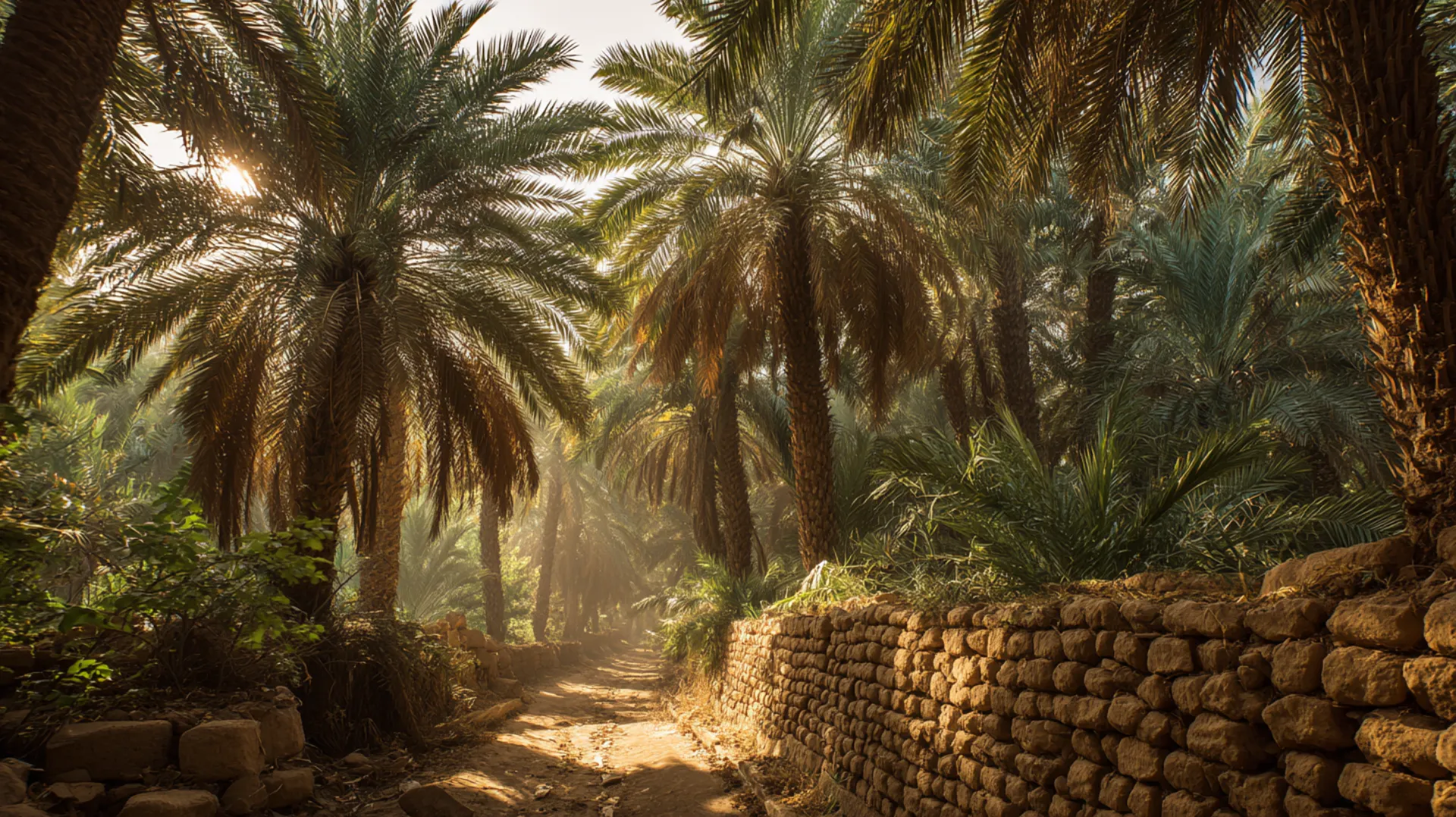
A man stands in a marketplace he does not recognize, carrying on his back everything he owns in the world. The air is thick with the scent of unfamiliar spices, the calls of Jewish merchants hawking their wares in a dialect of Arabic tinged with Hebrew. Date palms tower overhead where there should be barren rock. Water runs through channels where there should be dust. Everything is wrong — not because Madinah is hostile, but because it is not home.
This is Abdur Rahman ibn Auf (may Allah be pleased with him), once one of the wealthiest merchants in Mecca, now a refugee with nothing but the clothes on his back and the faith in his heart. His Ansari brother, Sa’d ibn Rabi’ah, has just offered him half of everything — half his wealth, half his house, even the choice of one of his two wives after the proper waiting period. It is an offer so staggering in its generosity that it defies the imagination.
And Abdur Rahman ibn Auf declines it all.
“May Allah bless you in your wealth and your family. Just show me where the marketplace is.”
This single exchange — recorded in Sahih al-Bukhari — captures the entire architecture of what the Prophet Muhammad (peace be upon him) was building in Madinah: not a community of dependents, but a brotherhood of dignified equals. The marketplace he was pointed toward, the pairings that made such generosity possible, the calendar that would one day mark these events in the memory of civilization — all of it was being constructed in those first extraordinary months after the Hijrah, brick by invisible brick.
Homesick in Paradise
Before the grand institutions could take shape, there was a more immediate crisis: the emigrants were dying — not from persecution, but from heartbreak.
Madinah was greener than Mecca, lusher, richer in water and date palms. By every objective measure, it was a better place to live. But the human heart does not measure comfort in date yields and water tables. The Muhajirun missed the dry, thorny valleys of Mecca. They missed the familiar crags of Abu Qubays and the scent of idhkhir grass baking in the desert sun. And the very abundance that made Madinah prosperous — its water, its vegetation — also bred fevers and plagues that the desert-hardened Meccans had never known.
Aisha bint Abi Bakr (may Allah be pleased with her), still a young girl at the time, narrates a scene of devastating tenderness. She went to visit her father, Abu Bakr al-Siddiq (may Allah be pleased with him), and found him drenched in sweat, gripped by a severe fever. Bilal ibn Rabah (may Allah be pleased with him) was with him, equally stricken. When she asked her father how he was feeling, Abu Bakr — the man who had given up everything for the sake of Allah, who had wept in the Cave of Thawr from sheer gratitude — recited a line of poetry so bleak it spoke of death:
“Every man wakes among his family, yet death is closer to him than the strap of his sandal.”
He was so sick he was contemplating his own mortality.
Bilal, for his part, expressed his anguish differently. The man who had once been tortured under the Meccan sun, who had been dragged through the streets with a boulder on his chest, now yearned for the very landscape of his suffering:
“How I wish I could spend the night in a valley full of idhkhir and jalil.”
These were the thorny, scraggly plants of Mecca’s outskirts — hardly the stuff of paradise. But they were the plants of home. And then Bilal’s grief turned to fury: “O Allah, curse Shaybah ibn Rabi’ah! O Allah, curse Umayyah ibn Khalaf!” — naming the men who had driven them from their land. Even Bilal, who owned almost nothing in Mecca, felt the exile like an open wound.
Aisha returned to the Prophet with this report. And he responded not with a sermon, but with a supplication — one of the most consequential prayers in Islamic history:
“O Allah, make Madinah beloved to us as we love Mecca, or even more. O Allah, bless us in our food measurements. O Allah, remove its plagues and fevers and cast them to the barren land of Juhfa.”
As recorded in Sahih al-Bukhari (1889), this prayer transformed the emotional landscape of the community. Slowly, imperceptibly, the ache of exile gave way to something warmer. The Prophet himself, as Anas ibn Malik (may Allah be pleased with him) tells us in Bukhari, would visibly brighten when he saw Madinah’s silhouette on the horizon after a journey, urging his camel to quicken its pace.
Scholarly Note
The love Muslims feel for Madinah — distinct from the reverence for Mecca — is understood by scholars as a direct consequence of this prophetic supplication. Imam al-Nawawi notes in his commentary on Sahih Muslim that this prayer encompassed both the spiritual attachment to the city and its physical well-being, as evidenced by the specific mention of food blessings and the removal of disease.
The Architecture of Brotherhood
With the emotional crisis addressed, the Prophet turned to the structural one. The Muhajirun had arrived in Madinah with nothing — no homes, no businesses, no social networks, no means of livelihood. The Ansar were generous, but generosity alone could not build a society. What was needed was a system.
The Prophet instituted the Mu’akha — the formal pairing of every Muhajir man with an Ansari counterpart. This was not a symbolic gesture or a ceremonial handshake. It was a binding social contract so complete that, in its initial form, the paired brothers would inherit from one another as if they shared blood. Anas ibn Malik narrates that the Prophet conducted this pairing in his neighborhood of Madinah, sitting down and matching individuals one by one — over a hundred pairs in total.
The pairings were not random. The Prophet knew his community with an intimacy that allowed him to match temperaments, skills, and stations with remarkable precision. Abu Bakr al-Siddiq, the most senior of the Muhajirun, was paired with Khalid ibn Zayd (Abu Ayyub al-Ansari), one of the noblest of the Ansar. Abdur Rahman ibn Auf, the former merchant prince, was paired with Sa’d ibn Rabi’ah, a wealthy Ansari businessman — men who spoke the same language of commerce. Salman al-Farsi (may Allah be pleased with him), the Persian seeker who had traversed empires in search of truth, was paired with Abu al-Darda (may Allah be pleased with him), the contemplative ascetic.
The Mu'akha as a Living Institution
A common misconception in seerah literature is that the Mu’akha was a one-time event at the beginning of the Madinah period. The evidence suggests otherwise. The names of those paired together span the entire prophetic era in Madinah. Salman al-Farsi did not accept Islam immediately upon the Prophet’s arrival — his conversion came some years later, yet he was paired with Abu al-Darda. Ja’far ibn Abi Talib (may Allah be pleased with him) was paired with Mu’adh ibn Jabal (may Allah be pleased with him), yet Ja’far only returned from Abyssinia in the seventh year of the Hijrah. Most strikingly, Mu’awiyah ibn Abi Sufyan (may Allah be pleased with him) was paired with an Ansari companion, yet Mu’awiyah only accepted Islam after the Conquest of Mecca in the eighth year.
This continuity reveals that the Mu’akha was not a temporary emergency measure but a permanent institution — a prophetic practice that continued as long as there were newcomers who needed integration into the community. The practical implications for Muslim communities today are significant: the pairing of new converts or immigrants with established community members is not merely a nice idea but a neglected sunnah with deep roots in prophetic practice.
The results of these pairings were not merely administrative. They produced genuine, lifelong bonds that echo through the hadith literature. The famous incident between Salman al-Farsi and Abu al-Darda illustrates this vividly. Salman visited Abu al-Darda’s home and found his wife, Umm al-Darda, in old, tattered clothes, her appearance neglected. When Salman reproached her gently, she replied with resignation: “Your brother has no need of women.” Abu al-Darda had become so consumed with voluntary worship — fasting by day, praying through the night — that he had neglected his family. Salman, exercising the authority of a true brother, made Abu al-Darda break his fast, eat with him, and sleep rather than pray tahajjud. When Abu al-Darda complained to the Prophet the next day, the Prophet affirmed Salman’s intervention: your body has a right over you, your family has a right over you.
Scholarly Note
The inheritance provision of the Mu’akha was later abrogated by the revelation of Surah al-Anfal (8:75), which states: “Those related by blood are closer to one another in the decree of Allah.” Scholars note this abrogation came approximately a year and a half after the initial Mu’akha, following the Battle of Badr, by which time the Muhajirun had begun to establish their own families and economic independence in Madinah. The Mu’akha itself, however — as a social institution of brotherhood — was never abrogated.
The Quranic Portrait of Two Communities
The relationship between the Ansar and the Muhajirun was not merely praised by the Prophet — it was immortalized by divine revelation. In Surah al-Hashr (59:8-9), Allah paints a portrait of both communities in consecutive verses that shimmer with theological precision.
The Muhajirun are described first: the poor emigrants who were driven from their homes and their wealth, seeking the bounty of Allah and His pleasure, supporting Allah and His Messenger. Allah calls them all fuqara — destitute — because every single Muhajir, regardless of their former wealth in Mecca, arrived in Madinah with nothing.
Then comes the verse about the Ansar, and here Allah’s choice of language reveals layers of meaning:
“And those who prepared the abode (al-dar) and faith before them — they love those who emigrated to them and find no need in their hearts for what was given to them, and they prefer others over themselves, even if they themselves are in poverty.” — Al-Hashr (59:9)
The word al-dar — “the abode” or “the home” — is striking. Allah did not say “their home,” which would have been technically accurate since Madinah belonged to the Ansar. By saying simply “the home,” Allah declared Madinah the shared home of both communities. The Ansar had prepared it not for themselves alone, but for the entire ummah.
And there is another linguistic detail worth noting: every time the Quran mentions both groups together, the Muhajirun are named first. In Surah al-Tawbah (9:100): “The first forerunners among the Muhajirun and the Ansar…” In Surah al-Tawbah (9:117): “Allah has turned in mercy to the Prophet, and the Muhajirun, and the Ansar…” Even in the very passage that contains the highest Quranic praise of the Ansar — Surah al-Hashr (59:9) — the verse immediately preceding it (59:8) describes the Muhajirun. This consistent ordering reflects a theological hierarchy: the Muhajirun, by virtue of their sacrifice in leaving everything behind, hold a degree above the Ansar, even though the Ansar’s generosity earned them praise from above the seven heavens.
This hierarchy, paradoxically, is what troubled the Muhajirun most. They came to the Prophet with a complaint that was really a praise — and a fear:
“O Messenger of Allah, we have never seen a people like those we have come to. They share equally with us in hardship and are generous with us in ease. They have taken care of our needs and shared with us their wealth. We fear, O Messenger of Allah, that they will take all of our reward.”
The Prophet reassured them: as long as they praised the Ansar and made supplication for them, their own reward was secure. Each would be rewarded according to their own deeds.
The Wisdom of Refusing Free Gifts
The Ansar’s generosity reached its apex when they came to the Prophet with an offer that would have reshaped the entire economy of Madinah: they would give half of all their agricultural land — every date palm, every garden — to the Muhajirun, free of charge.
The Prophet made supplication for them. And then he refused.
Instead, he established a labor arrangement: the Muhajirun would work the Ansar’s lands, performing the manual labor of tending date palms and harvesting crops, and would receive a share of the produce as wages. The Ansar would benefit from the additional labor; the Muhajirun would earn their livelihood through work rather than charity.
This decision reveals the Prophet’s extraordinary long-term thinking. A free transfer of half the land would have created immediate comfort but long-term resentment. What happens a generation later, when the descendants of the Ansar look at half their ancestral land in the hands of others? What happens when the hypocrites — already lurking in Madinah’s social fabric — whisper about how the newcomers took everything? The Prophet cut off these future poisons at the root by insisting on dignified labor rather than handouts.
It was this same principle that animated Abdur Rahman ibn Auf’s refusal of Sa’d ibn Rabi’ah’s extraordinary offer. “Just show me where the marketplace is.” He went to the Jewish market outside Madinah, bartered what little he had carried from Mecca, and began trading — buying and selling, reinvesting, building. Within a remarkably short time, the Prophet noticed him dressed well and wearing perfume, and joked: “Have you gotten married?” Abdur Rahman had indeed married an Ansari woman, giving her a mahr of gold weighing no more than a date seed — a trivial sum, perhaps the equivalent of a few dollars. The Prophet’s response was characteristic: “Hold a walimah, even if it is with just one sheep.” Celebrate. Build community. Even with almost nothing, mark the occasion with generosity.
Marking Time: The Birth of the Hijri Calendar
All of these events — the pairings, the prayers, the marketplace transactions — were happening in real time, without a calendar to fix them in memory. The Arabs had twelve months, inherited from the earliest prophetic traditions, and four of those months were sacred: Dhul Qa’dah, Dhul Hijjah, Muharram, and Rajab. But they had no year-numbering system. Events were remembered by association: the Year of the Elephant, the Year of the Drought, the Year of the Great Battle. When nothing remarkable happened, years simply blurred together.
Worse, the powerful tribes — especially the Quraysh — had corrupted even the monthly system through a practice called nasi’ (intercalation). If a tribe wanted to wage war during a sacred month, they would simply swap it with a non-sacred one: “This isn’t really Muharram — it’s Safar now.” After decades and centuries of such manipulation, the months had become hopelessly jumbled.
The Quran condemned this practice in the strongest terms. In Surah al-Tawbah (9:37), Allah calls nasi’ an increase in disbelief — a deliberate corruption of the divine order of time itself. It was not until the Farewell Hajj in the tenth year after the Hijrah that the Prophet announced the restoration of the original calendar:
“Time has returned to its rightful order, as it was on the day Allah created the heavens and the earth. A year is twelve months, four of which are sacred: three consecutive — Dhul Qa’dah, Dhul Hijjah, and Muharram — and the Rajab of Mudar, which falls between Jumada and Sha’ban.”
As recorded in Sahih al-Bukhari (3197), this declaration froze the calendar in its correct alignment. From that day forward, no more swapping. The months would cycle in their divinely ordained order until the end of time.
But the year — the numbering of years — remained unresolved during the Prophet’s lifetime. He did not institute a calendar. That task fell to the second caliph, Umar ibn al-Khattab (may Allah be pleased with him), approximately seventeen years after the Hijrah.
The catalyst was mundane: a legal dispute. Two men appeared before Umar, arguing over a debt. One claimed the other was supposed to repay him by Sha’ban; the debtor insisted he meant the next Sha’ban. Without a year-numbering system, the contract was ambiguous. Around the same time, Abu Musa al-Ash’ari (may Allah be pleased with him), serving as a provincial governor, wrote to Umar with a similar complaint: “O Commander of the Faithful, your orders arrive with instructions to complete tasks by a certain month, but we cannot tell which year you mean.”
Umar convened the Companions. The need for a calendar was unanimous. The first question — should they adopt the Roman or Persian calendar? — was immediately dismissed. The Muslims were a civilization in their own right; they would have their own system.
The second question was more consequential: which year should mark the beginning? Several proposals emerged. The Prophet’s birth. His death — but this was rejected as too sorrowful a marker. The Battle of Badr, as the first great victory. Then Ali ibn Abi Talib (may Allah be pleased with him) spoke: it should be the year of the Hijrah. His reasoning was elegant and irrefutable. The Hijrah was the turning point — the moment the Muslim community passed from humiliation to honor, from persecution to sovereignty. Every other event in Islamic history flowed from that single migration.
The Companions agreed unanimously. Umar declared it the wise opinion. The year of the Hijrah became Year One.
Scholarly Note
The Prophet’s actual emigration occurred in the month of Safar, not Muharram. The choice of Muharram as the first month of the calendar was a separate decision. Uthman ibn Affan (may Allah be pleased with him) proposed Muharram, and scholars offer two explanations. The first links it to the Hijrah itself: the Bay’at al-Aqabah took place during Dhul Hijjah, and the announcement for emigration effectively came in Muharram, when the bulk of the Companions began their journey to Madinah. The second explanation, attributed to Uthman himself, is that the Companions performed Hajj nearly every year, and the return from Hajj represented a spiritual renewal — a fresh start. Muharram, as the month following Dhul Hijjah, marked the beginning of that new life. Later scholars attempted to find Quranic support in Surah al-Tawbah (9:108) — “A mosque founded on piety from the first day” — reading “the first day” as a reference to the beginning of the Islamic calendar. However, this interpretation is acknowledged as a stretch, and it is not attributed to the Companions themselves.
The Gradual Unfolding of Divine Law
The establishment of the Mu’akha — and its eventual partial abrogation — illustrates a principle that would define the entire Madinah period: the gradual revelation of Islamic law. The Sharia did not descend as a complete legal code on a single day. It unfolded in stages, calibrated to the evolving circumstances and capacity of the community.
In the beginning, when the Muhajirun had no family whatsoever in Madinah, the Mu’akha brothers inherited from one another. This was not a permanent law but a temporary provision for extraordinary circumstances. Once the Muhajirun married, had children, and established their own family networks, Allah revealed in Surah al-Anfal (8:75) that blood relatives take priority in inheritance — and the Mu’akha inheritance was abrogated.
The same principle applied across the entire spectrum of Islamic legislation. The prohibition of wine did not come overnight — it descended in four stages, from a gentle warning to a complete ban. The obligation of fasting was introduced first through a single day — the tenth of Muharram — before the full month of Ramadan was ordained. Zakatul fitr, the simpler charity, preceded the more comprehensive zakatul maal.
Nabi and Rasul: The Theological Distinction Behind Gradual Revelation
The gradual nature of Quranic legislation connects to a fundamental theological distinction in Islamic thought: the difference between a Nabi (Prophet) and a Rasul (Messenger). While every Rasul is a Nabi, not every Nabi is a Rasul. The key distinction, according to the majority of scholars, is that a Rasul brings a new Sharia — a new legal and moral framework — while a Nabi reinforces and implements an existing one.
Prophet Muhammad stands as the paradigmatic Rasul: he received revelation and was commanded to proclaim an entirely new Sharia that would supersede all previous dispensations. The gradual manner in which this Sharia was revealed reflects divine wisdom — the community needed time to absorb and internalize each new obligation before the next was introduced.
Interestingly, the Islamic legal tradition (Sharia, literally “the way” or “the path”) shares remarkable structural parallels with the Jewish legal code (Halakha, also literally meaning “the way” or “the walk”). Classical Muslim scholars noted that approximately eighty percent of the two systems’ rulings overlap — a fact that underscores the common Abrahamic root of both traditions while highlighting the distinctive elements that make each a complete system in its own right.
An important corollary: this principle of gradual revelation applied only to the first generation. A new convert today cannot claim the right to abandon alcohol gradually, citing the four-stage Quranic prohibition as precedent. The Companions were the first society of Muslims, building the framework from nothing. Every subsequent Muslim enters a community with the complete Sharia already established. By unanimous scholarly consensus, the full body of Islamic law applies to a convert from the moment of their shahada — even if, practically, the community should exercise wisdom in how quickly they teach the details.
Three Eras of a New Civilization
As the foundations were being laid — the mosque built, the brothers paired, the calendar eventually established — the Prophet was simultaneously navigating the most complex political landscape in Arabian history. The Madinah period, though shorter than the Meccan era (ten years versus thirteen), would generate three times the historical material.
The period divides naturally into three distinct eras. The first, spanning roughly from the Hijrah to the Battle of al-Ahzab in the fifth year, was the era of consolidation — a time when the Muslim community faced existential threats from within and without. Internal challenges came from the hypocrites, the Jewish tribes, and the remaining pagans of Madinah. External threats came primarily from the Quraysh. At Badr, the Prophet himself had prayed with a desperation that reveals how precarious the situation was:
“O Allah, if this group is destroyed today, You will not be worshipped on earth ever again.”
The second era, from the Treaty of Hudaybiyyah to the Conquest of Mecca — roughly two and a half years — was the era of truce. During this period of peace, the Muslim community expanded fivefold, dwarfing the growth achieved through years of conflict. The third era, from the Conquest of Mecca to the Prophet’s death in the eleventh year, was the era of complete establishment, when the Arabian Peninsula embraced Islam en masse, fulfilling the Quranic vision: “And you see the people entering into the religion of Allah in multitudes” — Al-Nasr (110:2).
All of this lay ahead. But its seeds were planted in those first fragile months — in a prayer for love, in the pairing of strangers, in a merchant’s refusal of charity, in the quiet decision that time itself would be measured from the moment a persecuted community found its home.
The Thread Forward
The Mu’akha had woven the Muhajirun and Ansar into a single social fabric. The Prophet’s supplication had transformed exile into belonging. But Madinah was not only Muslims. The city’s population included Jewish tribes — Banu Qaynuqa, Banu Nadir, Banu Qurayza — as well as Arab pagans and the emerging faction of hypocrites who professed Islam while harboring hostility. Binding these disparate groups into a functioning polity would require something unprecedented: a written constitution — a document that would define the rights, obligations, and mutual defense arrangements of every community in Madinah. What the Prophet would draft next had no precedent in Arabian history, and some scholars argue it had no precedent anywhere in the world.
Quranic References
Continue Your Journey

Cite this Narrative
APA
SeerahQuest. (2026). Brothers by Decree: The Mu'akha and the Birth of the Hijri Calendar. *SeerahQuest: The Eternal Narrative*. https://seerahquest.com/chapters/establishment-of-the-islamic-hijri-calendar Adapted from Yasir Qadhi's Seerah Series, Episode 32.
MLA
"Brothers by Decree: The Mu'akha and the Birth of the Hijri Calendar." *SeerahQuest: The Eternal Narrative*, 2026, https://seerahquest.com/chapters/establishment-of-the-islamic-hijri-calendar. Adapted from Yasir Qadhi's Seerah Series, Episode 32.
Chicago
"Brothers by Decree: The Mu'akha and the Birth of the Hijri Calendar." *SeerahQuest: The Eternal Narrative*. Accessed April 3, 2026. https://seerahquest.com/chapters/establishment-of-the-islamic-hijri-calendar. Adapted from Yasir Qadhi's Seerah Series, Episode 32.
Install SeerahQuest — read chapters offline, anytime.