When the Earth Closed In
The dust has barely settled in the valley of Hunayn when the earth itself seems to shift — a black cloud descends from the heavens, dense as a swarm of ants, and the tide of battle turns on the edge of a prophet's refusal to flee.
8 AH · 628 – 630 CE
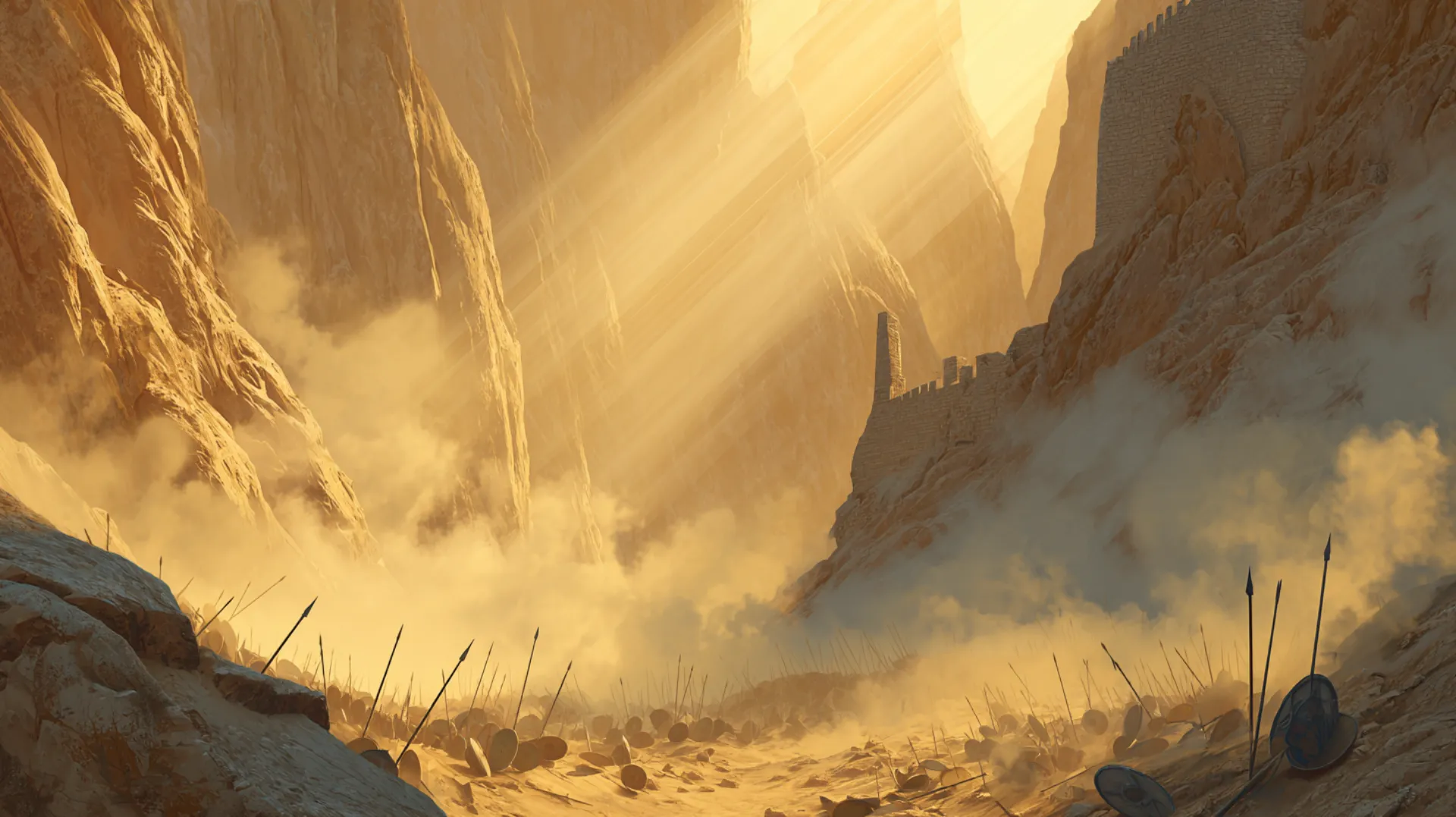
The dust has barely settled in the valley of Hunayn when the earth itself seems to shift — a black cloud descends from the heavens, dense as a swarm of ants, spreading across the battlefield in every direction. Jubayr ibn Mut’im (may Allah be pleased with him), watching from somewhere in the chaos, realizes what he is seeing: angels, pouring into the fight on the side of the believers. Moments ago, twelve thousand Muslim soldiers were fleeing in terror through a narrow mountain pass, showered by volleys of arrows from hidden archers above. Now something has changed. The tide is turning. And in the center of it all, mounted on his white mule, refusing to retreat, the Prophet Muhammad (peace be upon him) is calling out into the roar of battle.
The Rout and the Rally
To understand the miracle of what happened next, we must return to the moment everything fell apart.
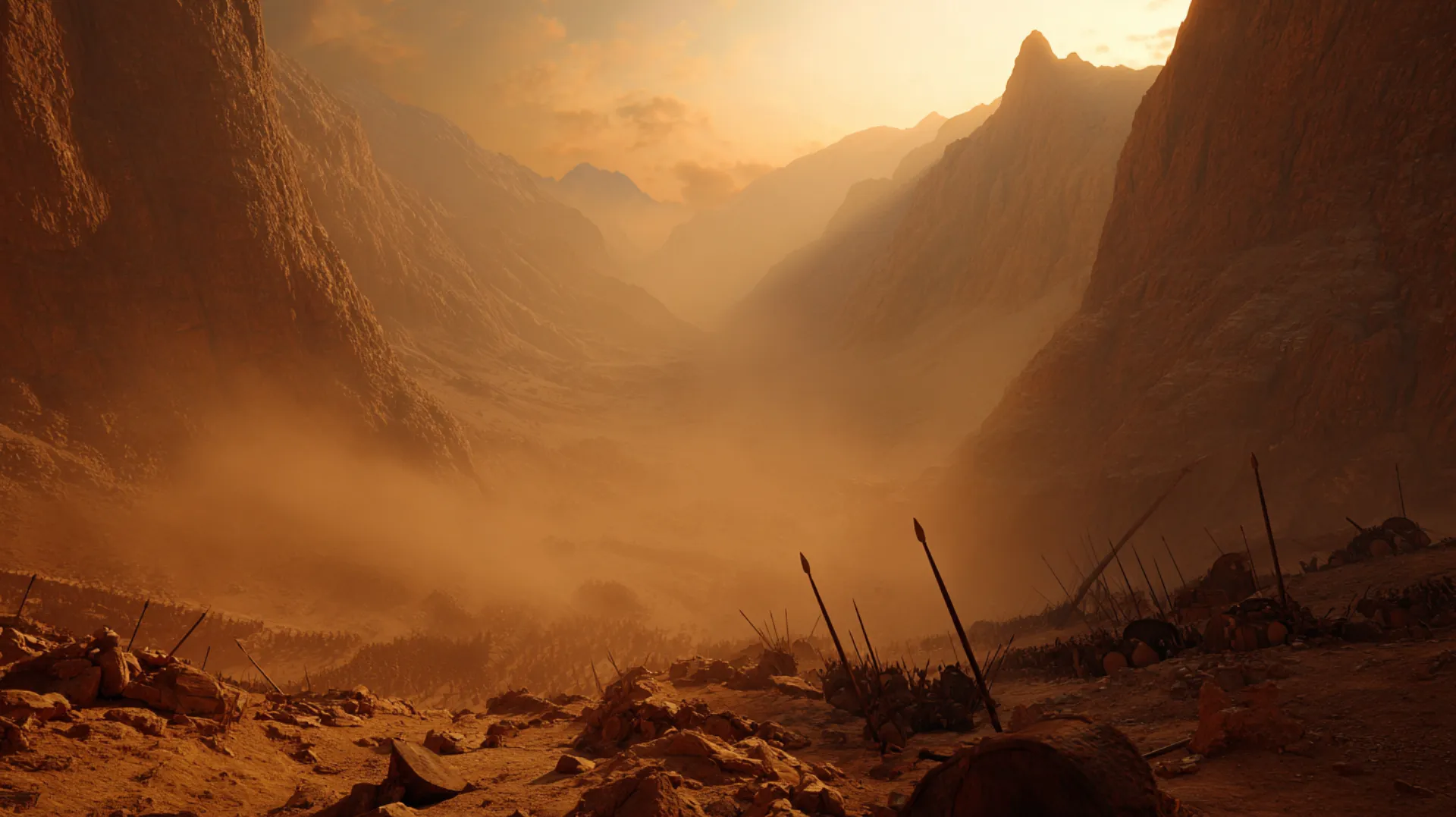
The ambush had worked exactly as the young Hawazin commander Malik ibn Auf al-Nasri had planned. A false contingent of warriors waited at the far end of a narrow valley, pretending to be the enemy’s main force. When the Muslims charged forward, eager and confident after their conquest of Mecca, the trap was sprung. Archers stationed in the cliffs and crevices on both sides of the pass unleashed volley after volley. Simultaneously, the full mass of the Hawazin and Thaqif coalition — over twenty thousand strong — surged into the valley from the front. It was a masterpiece of tactical deception, executed on home terrain that the tribes of Thaqif knew intimately.
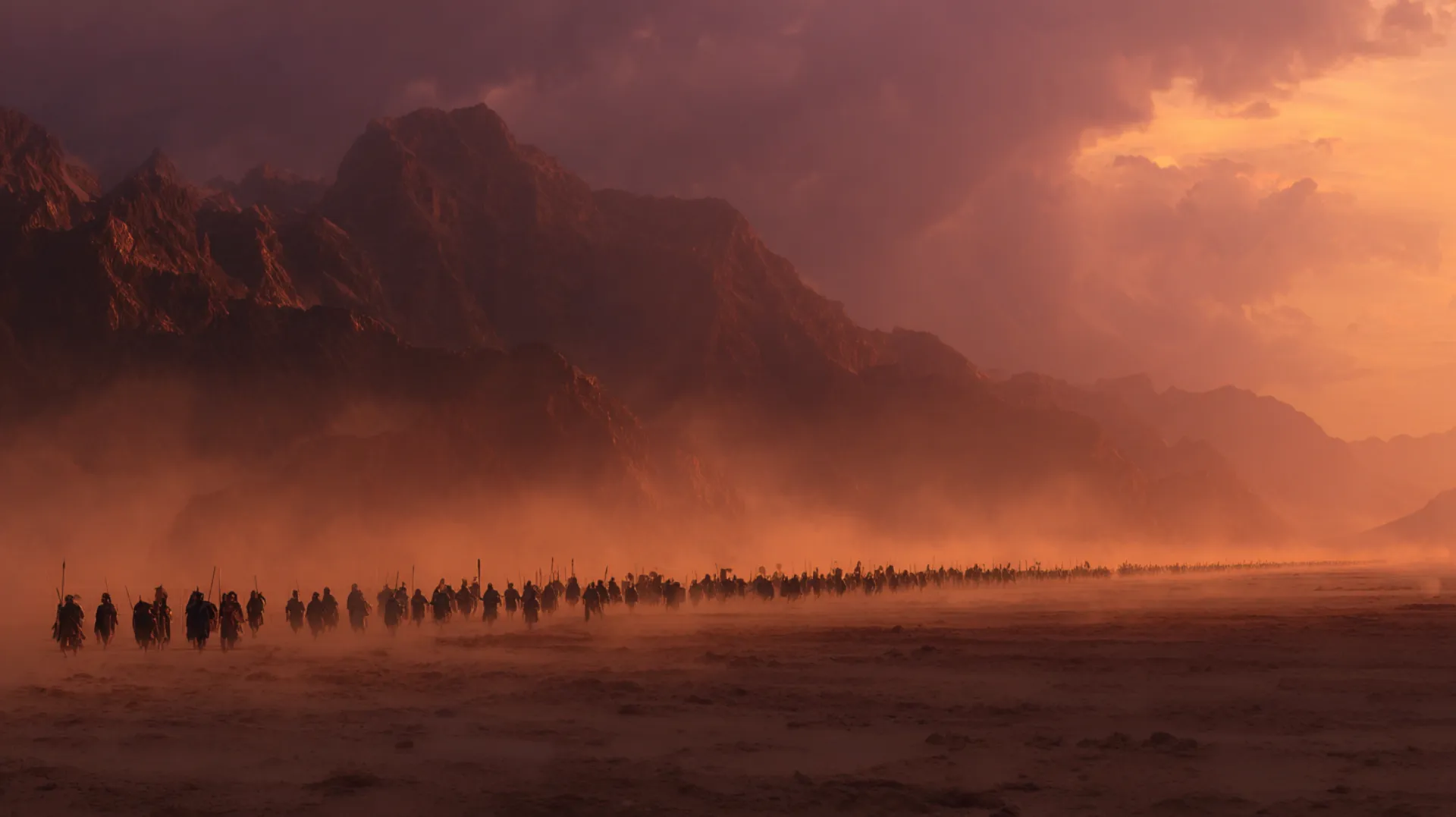
The newer Muslims broke first. The two thousand Meccan converts, many of whom had accepted Islam barely weeks earlier, turned and fled. The panic was contagious. Within moments, the vast majority of the twelve-thousand-strong army was in full retreat, the earth seeming to close in around them despite its vastness. The Quran itself would immortalize this terrible moment:
“And on the day of Hunayn, when your great numbers pleased you, but they availed you nothing, and the earth, despite its vastness, was straitened for you; then you turned back in retreat.” — At-Tawbah (9:25)
But the Prophet did not flee. Around him gathered a small knot of the most steadfast Companions — Abu Bakr al-Siddiq, Umar ibn al-Khattab, Uthman ibn Affan, and Ali ibn Abi Talib (may Allah be pleased with them all). All four future caliphs stood their ground at Hunayn, and all four were wounded in the fighting. The Prophet called out to his uncle al-Abbas, whose voice was legendary for its power, and commanded him to shout to the fleeing soldiers — to the men of the Pledge of the Tree, to the men of Surah al-Baqarah, to the Ansar and the Muhajirun. The voice carried across the valley, and slowly, then with gathering force, the Muslims began to turn back.
It was at this moment that the Prophet declared a phrase that would enter the Arabic language forever: “Al-ana hamiyatil watis” — “Now the battle grows hot.” He took a handful of dust and stones and hurled it toward the enemy, calling out, “Shahatil wujuh” — “May the faces be disfigured!” — an invocation of divine aid that, according to the sources, blinded and disoriented the opposing archers. Then came the descent of the angels, the sakeenah — the divine tranquility — that the Quran describes settling over the believers:
“Then Allah sent down His tranquility upon His Messenger and upon the believers, and sent down soldiers you did not see, and punished those who disbelieved.” — At-Tawbah (9:26)
Scholarly Note
The Battle of Hunayn is one of only two battles mentioned by name in the Quran, the other being Badr. While the Battle of the Confederates (al-Ahzab) is referenced in the Quran, the word “Ahzab” refers to the confederate army rather than naming the battle itself. This distinction is noted by multiple scholars of tafsir.
The Assassin Who Became a Believer
Among the most extraordinary stories to emerge from the chaos of Hunayn is that of Shayba ibn Uthman, from the Banu Abd al-Dar — a sister tribe of the Banu Hashim. Shayba’s father had been killed fighting for the pagans at the Battle of Uhud, and though Shayba had nominally accepted Islam during the conquest of Mecca, his conversion was barely a week old. His faith, as the sources describe it, was verbal — Islam had not yet entered his heart.
When he saw the Muslim army scattering and the Prophet virtually alone, something dark stirred in him. This was his chance. He could avenge his father’s death in the confusion. He took up his spear and began galloping toward the Prophet’s unprotected back.
Then, as Shayba himself later narrated, a blinding light appeared before him — so intense he had to shield his face and eyes. He began screaming. The Prophet turned, saw what was happening, and raised his hands in supplication. Three times he called out: “Allahumma ihdi Shayba” — “O Allah, guide Shayba.” Three times.
Shayba said that immediately, faith entered his heart. By the time his horse completed its gallop, he was fighting on the side of the Muslims against the very tribes he had intended to aid. He lived a pious life thereafter. The distance between attempted assassination and sincere belief was, in his case, the length of a single charge.
The Decisive Victory and Its Aftermath
The Hawazin and Thaqif, it turned out, had no contingency plan. Their entire strategy had been the ambush — shower the enemy with arrows, trigger a rout, then overwhelm them. When the Muslims did not stay routed, when they surged back with renewed ferocity and what appeared to be supernatural reinforcement, the tribal coalition shattered. The Hawazin and Thaqif fled in every direction, and the Prophet commanded pursuit — three hundred Companions sent in one direction, two hundred in another — to prevent the enemy from regrouping.
In these aftermath skirmishes, real losses were suffered. The uncle of Abu Musa al-Ash’ari (may Allah be pleased with him), a commander named Abu Amir, was struck by a javelin while pursuing the retreating Hawazin. His nephew Abu Musa reached him as he lay bleeding, the javelin protruding from his chest. Abu Amir pointed out his killer; Abu Musa attacked and slew the man, then returned. “Take the javelin out,” his uncle said. Abu Musa did, but the wound was mortal. Abu Amir’s final request was simple: tell the Prophet what happened, give him my greetings, and ask him to pray for me.
When Abu Musa delivered this message, the Prophet rose from where he had been resting, called for water, performed ablution, faced the qiblah, and raised his hands so high that the whiteness of his armpits was visible. He prayed: “Allahumma-ghfir li Abi Amir. Allahumma irfa’ darajatahu fil-illiyyin” — “O Allah, forgive Abu Amir. O Allah, raise his rank among the highest.” Abu Musa, overcome, blurted out: “Ya Rasulallah — one for me too!” And the Prophet prayed for him as well, asking Allah to forgive his sins and grant him a noble entrance on the Day of Judgment.
Scholarly Note
This hadith is recorded in the books of Sunan. Abu Musa’s son, Abu Burdah, became one of the most prominent scholars of the Tabi’un generation in Madinah and took great pride in narrating this tradition of the Prophet’s supplication for both his father and grandfather.
It was also during the aftermath at Hunayn that the Prophet, walking the battlefield, came upon the body of a woman who had been killed. He was visibly disturbed. “It was not right for her to have been killed,” he said, and upon learning that Khalid ibn al-Walid was responsible, he sent an urgent message: Khalid was not to kill any more women, children, or non-combatants. This command — recorded and cited in virtually every classical work of Islamic jurisprudence — established one of the foundational principles of the Islamic law of war: the categorical prohibition of targeting civilians.
The Siege of Ta’if
The tribe of Thaqif did not scatter into the wilderness like the Hawazin. They retreated to their fortified city of Ta’if — that green, lush plateau nestled in the mountains, with its running streams, its famous grapes, its massive walls, and its instruments of war. The people of Ta’if had prepared for this moment. They had stockpiled supplies for nearly a year. They had turrets equipped to pour burning oil on attackers. No other city in Arabia possessed such fortifications.
But the Prophet had been thinking several steps ahead. While still in Mecca, before the Battle of Hunayn had even begun, he had dispatched a small group of Companions to the tribe of Jurash to learn three technologies the Muslims had never employed: the catapult, the battering ram, and the testudo — a large mobile shield under which soldiers could advance toward walls while protected from projectiles raining down from above. These Companions missed the Battle of Hunayn entirely, but by the time the Prophet arrived at Ta’if, they had returned with the knowledge to construct all three.
For the first time in Islamic military history, a catapult was built and deployed — right outside the walls of Ta’if. The Muslims attempted to breach the walls using the battering ram and advanced under the testudo, but the defenders poured burning oil through gaps in the shield, and when the soldiers fled from underneath, they were met with showers of arrows. The siege ground on — perhaps twelve or thirteen days, though scholars differ on the exact duration.
The Siege of Ta'if: One Battle or Two?
Classical scholars of Seerah have long debated whether the Battle of Hunayn and the Siege of Ta’if should be counted as one engagement or two. They occurred back-to-back against the same enemy coalition, and many works combine them under a single heading. However, they took place at different locations with different tactical situations — Hunayn was an open-field battle while Ta’if was a siege. This disagreement feeds into the broader scholarly discussion about how many military expeditions (ghazwat) the Prophet personally participated in. Zayd ibn Arqam, as recorded in Sahih al-Bukhari and Sahih Muslim, narrated that the Prophet participated in nineteen ghazwat, while other Companions gave slightly different counts depending on whether Hunayn and Ta’if were counted separately. Buraida, also in Sahih Muslim, specified that the Prophet fought in only eight of these, with the remainder ending without actual combat.
The Prophet suggested withdrawal twice. The first time, the younger Companions — still riding the euphoria of Mecca and Hunayn — insisted on staying. He deferred to them, demonstrating the principle of shura even when his own judgment differed. But when another assault failed and more lives were lost, he proposed departure again. This time, they quietly agreed.
Before leaving, the Companions asked him to make supplication against the people of Thaqif. He raised his hands, and every soldier raised theirs, expecting a devastating curse upon the city that had tortured him twenty years earlier, the city that had sent its children to stone him until his sandals filled with blood. Instead, his words were: “Allahumma ihdi Thaqif. Allahumma i’ti bi-Thaqif” — “O Allah, guide Thaqif. O Allah, bring Thaqif to us.”
This was the second time he had prayed for the people of Ta’if rather than against them. And Allah would answer his prayer — within months, the entire tribe would send a delegation to Madinah and embrace Islam.
The Treasure of Ji’irrana
The Battle of Hunayn produced the largest war booty in the entire Seerah. Because the young Hawazin commander had insisted on bringing the entire tribal population — women, children, livestock, all possessions — to the battlefield, the Muslims now held an estimated six thousand prisoners of war, over twenty-four thousand camels, and more than forty thousand sheep and goats. In modern terms, this was a fortune worth tens of millions of dollars.
All of it was gathered in a valley called Ji’irrana, on the road between Ta’if and Mecca. The Prophet stationed an armed guard and waited — for over a week after returning from the failed siege of Ta’if — hoping the Hawazin would come to negotiate. He wanted them to accept Islam, after which everything could be returned. It was the same strategy that had worked with the Banu Mustaliq years earlier, when his marriage to Juwayriyyah (may Allah be pleased with her) had led to the release of the entire tribe.
But the Hawazin did not come. And the soldiers were growing restless. The Prophet began distributing the spoils — not equally, but strategically. He gave staggering gifts to specific individuals: Abu Sufyan received one hundred camels. Safwan ibn Umayyah — still technically not a Muslim, still within his two-month grace period — received one hundred camels. Uyaynah ibn Hisn of the Ghatafan, al-Aqra’ ibn Habis of Tamim, Mu’awiyah ibn Abi Sufyan, al-Harith ibn Hisham (the full brother of Abu Jahl) — perhaps sixty to seventy dignitaries of the Quraysh and allied tribes went home with fortunes. The Muhajirun received their shares as well.
The Ansar received nothing from this distribution.
It was not an oversight. It was deliberate. And it was human nature that the younger Ansar began to murmur. One of them said: “When there is war, we are the first to be called. When there is money, we are nowhere to be found.” Another said, with bitter eloquence: “May Allah forgive the Messenger — he gives to the Quraysh and leaves us, even as our swords still drip with their blood.”
Sa’d ibn Ubadah (may Allah be pleased with him), the senior leader of the Ansar, sought a private audience with the Prophet. He did not come to complain — but he could not pretend the problem did not exist. When pressed, he said simply: “I am one of my people.” It was a confession of shared humanity wrapped in the dignity of faith.
The Prophet asked Sa’d to gather every member of the Ansar in a single tent, with no one else present. They crowded in until there was no space left, with others listening from outside. And then he spoke — one of the most powerful addresses of his entire life:
“I give to some people because I fear for their greed and their desires, and I leave others because I trust what Allah has placed in their hearts — a fortune greater than anything I could give.”
He reminded them of what they had been before Islam and what Allah had made them through it. He declared that if all of humanity went in one direction and the Ansar went in another, he would go with the Ansar. He said that were it not for the historical fact of the Hijrah, he would have wished to be counted among them.
And then, the line that shattered every heart in the tent: “Are you not content that people go home with sheep and camels, and you go home with the Messenger of Allah among you?”
The tent erupted in weeping. Beards were soaked with tears. They said: “We are content with Allah and His Messenger.”
Scholarly Note
The Prophet’s distribution of spoils at Ji’irrana falls under the Islamic legal category of al-mu’allafati qulubuhum — “those whose hearts are to be reconciled.” This is explicitly mentioned in the Quran as one of the eight categories eligible for zakat (At-Tawbah 9:60). Classical jurists differ on whether this category remains operative after the Prophet’s death. Abu Hanifah held that it was abrogated by the strength of Islam, while al-Shafi’i and others maintained it remains valid. The incident at Ji’irrana is the primary historical evidence cited in this discussion.
The Proto-Kharijite and the Hawazin’s Return
It was also at Ji’irrana that a man approached the Prophet — described in the hadith as having a scraggly beard and a large forehead — and said: “Be fair in this distribution.” When the Prophet asked who would be just if he were not, the man pressed further: “This distribution is not for the sake of Allah.”
The Prophet’s response was sharp: “Woe to you — will you not trust me when the One in the heavens has trusted me?” Umar suggested the obvious remedy. The Prophet refused: “Let not the people say that I kill my own companions.”
But then he issued a prophecy: from this man’s type — his mentality, his spiritual lineage — would come a group who would recite the Quran without it passing beyond their throats, whose prayer and fasting would seem to surpass that of ordinary believers, yet who would pass through Islam as an arrow passes through its target. These would be the worst of creation.
This was the prophetic warning about the Khawarij — the ultra-fanatics who, within a generation, would assassinate Ali ibn Abi Talib and plunge the Muslim community into civil war. The prototype stood right there at Ji’irrana, convinced of his own righteousness, accusing the Prophet of Allah of injustice.
Finally, days after the distribution was complete, the Hawazin arrived. They had embraced Islam and came hoping it was not too late. The Prophet told them to choose: their families or their property. They chose their families without hesitation. He then orchestrated a masterful act of communal generosity — after the congregational prayer, the Hawazin delegation stood and publicly appealed for intercession, and the Prophet led by example, releasing every captive held by the Banu Abd al-Muttalib. One by one, the tribal leaders of the Ansar and others followed suit. A few of the newer Bedouin converts demanded payment, which the Prophet guaranteed from future revenues. In the end, all six thousand captives were returned.
Among them was a woman who had been screaming at her captors: “Don’t you know I am the sister of your own companion?” She was Shayma — the Prophet’s foster sister from the household of Halimah al-Sa’diyyah. He had not seen her in fifty-six years. When she was brought before him, he asked for proof. She showed him a mark on her back — a bite from when he was a toddler and she had been carrying him. He laughed, recognized her, and offered her a choice: stay with honor among the Muslims, or return to her people with generous gifts. She chose to return.
Before departing Ji’irrana, the Prophet donned the ihram and performed his third Umrah — known as Umrat al-Ji’irrana — entering Mecca not as a conqueror this time, but as a pilgrim. It was the third of four Umrahs in his lifetime: the first being the symbolic Umrah of Hudaybiyyah (for which Allah granted the reward though it was not completed), the second being Umrat al-Qada the following year, this third at Ji’irrana, and the fourth incorporated into his farewell Hajj — a qiran Hajj in which Umrah and Hajj were performed together under a single ihram.
The Battle of Hunayn was the last organized military confrontation between Islam and Arab polytheism. After it, the mushrikun of Arabia never again assembled an army against the Muslims. Ta’if, that stubborn island of idolatry, would surrender peacefully within months. The Quran’s description of what was to come was already unfolding before the believers’ eyes: “When the victory of Allah has come and the conquest, and you see the people entering into the religion of Allah in multitudes…” — An-Nasr (110:1-2).
But the age of the sword was giving way to something perhaps more challenging — the age of the word. Soon, a poet named Ka’b ibn Zuhayr would ride into Madinah with nothing but his verses and his life on the line, and the Prophet would answer not with a blade but with the gift of his own cloak.
Quranic References
Continue Your Journey
Cite this Narrative
APA
SeerahQuest. (2026). When the Earth Closed In. *SeerahQuest: The Eternal Narrative*. https://seerahquest.com/chapters/battle-of-hunayn-part-2 Adapted from Yasir Qadhi's Seerah Series, Episode 83.
MLA
"When the Earth Closed In." *SeerahQuest: The Eternal Narrative*, 2026, https://seerahquest.com/chapters/battle-of-hunayn-part-2. Adapted from Yasir Qadhi's Seerah Series, Episode 83.
Chicago
"When the Earth Closed In." *SeerahQuest: The Eternal Narrative*. Accessed April 3, 2026. https://seerahquest.com/chapters/battle-of-hunayn-part-2. Adapted from Yasir Qadhi's Seerah Series, Episode 83.
Install SeerahQuest — read chapters offline, anytime.