The Voice Above the Ka'bah
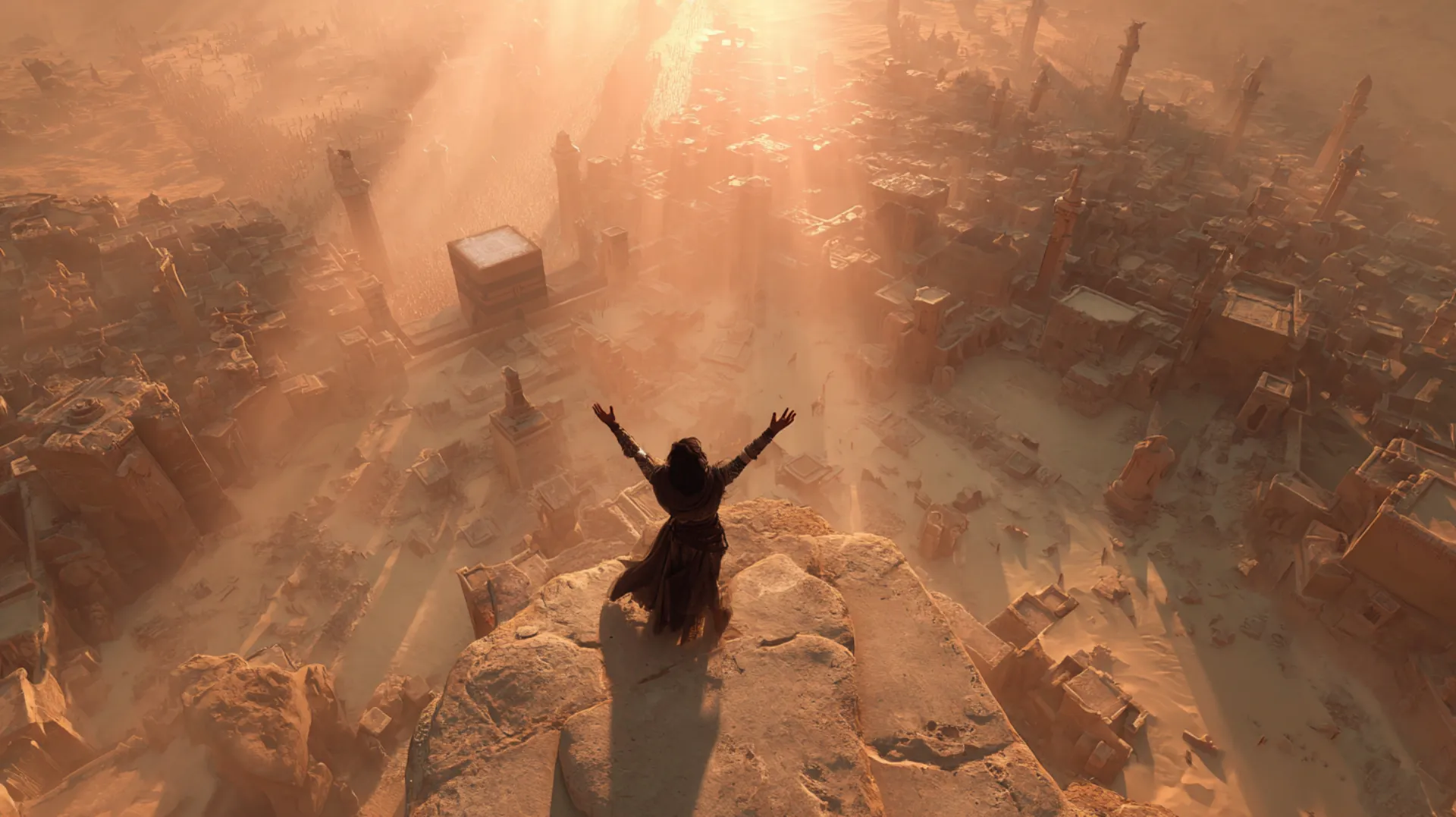
The voice that once cried 'Ahad! Ahad!' under a torturer's boulder now rises above the Ka'bah itself — and below, the men who once owned him are forced to listen.
8 AH · 628 – 630 CE
The voice that once cried “Ahad! Ahad!” — “One! One!” — under the crushing weight of a boulder in the Meccan sun now rises above the Ka’bah itself, calling all of creation to the worship of the One God. Bilal ibn Rabah (may Allah be pleased with him) stands atop the most sacred structure in Arabia, and his adhan splits the morning air of the twentieth of Ramadan, in the eighth year of the Hijrah. Below him, the shattered remains of three hundred and sixty idols litter the sanctuary floor. The city that tortured him, that placed burning stones on his chest, that sold him like chattel — this city now listens to his voice declare the sovereignty of Allah over every false god it ever carved.
And in the crowd below, three men are seething.
The Voices Beneath the Adhan
Abu Sufyan stands among the newly conquered elite of Quraysh, flanked by two men of the Banu Makhzum: Itab ibn Asid and al-Harith ibn Hisham. Itab mutters that Allah has honored his dead father by sparing him the sight of a Black man standing atop the Ka’bah. Al-Harith — the full brother of Abu Jahl, sharing both mother and father with the man who had been Islam’s most relentless enemy — goes further: “By Allah, if I thought this man was upon the truth, I would be following him.” The old contempt is still alive, still breathing, even as the idols lie in pieces around them.
Abu Sufyan, who accepted Islam only hours earlier outside the city walls, says nothing of substance. “As for me,” he tells his companions, “my tongue is sealed. I am too scared to say anything. Because if I were to say anything, even the rocks would inform him of what I said.”
Scholarly Note
Abu Sufyan’s remark is deeply revealing of his spiritual state at this moment. As Dr. Yasir Qadhi observes, the statement demonstrates that Abu Sufyan intellectually believed in the Prophet’s prophethood — he feared supernatural exposure — yet his soul had not fully submitted. This aligns with the Qur’anic distinction in Surah al-Hujurat (49:14): “The Bedouins say, ‘We believe.’ Say, ‘You have not believed; rather say, “We have submitted,” for faith has not yet entered your hearts.’” Scholars note that for some individuals, Islam is a process rather than a single moment of transformation.
The Prophet (peace be upon him) exits the Haram shortly after. He passes the same group — Abu Sufyan, al-Harith, and Itab — and addresses each by name. He recounts their private conversation word for word, letter for letter, as though he had been standing among them. No one had been listening. No one among them would have reported it.
Al-Harith ibn Hisham — brother of Abu Jahl, skeptic moments earlier — speaks immediately: “By Allah, you must be a Prophet. No one was listening to our conversation, and none of us would inform you.” And there, amid the rubble of his brother’s life’s work, al-Harith declares the shahada.
There is an Arabic maxim that runs through this entire episode like a thread of gold: al-jaza’u min jinsi al-‘amal — the reward matches the nature of the deed. Bilal, whose voice proclaimed the oneness of Allah under persecution, is chosen to proclaim it in the hour of triumph. The voice that refused to break is the voice that now breaks open a new era.
Al-Harith ibn Hisham: From Abu Jahl's Brother to Martyr of Yarmouk
Al-Harith’s conversion at the conquest of Mecca was only the beginning of a remarkable trajectory. As a brand-new Muslim, he possessed a directness that the senior Companions — out of profound reverence — could never muster. He asked the Prophet directly: “How does the revelation come to you?” This question, recorded in Sahih al-Bukhari, is one of the most important hadith in Islamic theology. The Prophet responded that sometimes the revelation came “like the ringing of a bell,” which was the most difficult form, and sometimes the angel Jibril appeared in the form of a man and spoke to him directly.
Ibn Umar (may Allah be pleased with him) once remarked that the Companions would love it when an intelligent Bedouin visited Madinah, because a local would never be so frank, and an unintelligent visitor would not ask useful questions. Al-Harith occupied a similar position: as a recent convert of high status, he felt no inhibition in asking what Abu Bakr, Umar, Uthman, and Ali (may Allah be pleased with them all) would never dare to ask.
On another occasion, when the Prophet was in his tent and revelation descended, Umar ibn al-Khattab called al-Harith over and told him to look. Al-Harith lifted the tent flap and witnessed the state of the Prophet during revelation — eyes closed, head lowered, perspiration forming on his brow, cut off from the world around him. This was a privilege granted to very few.
Al-Harith ibn Hisham died as a shaheed at the Battle of Yarmouk against the Romans. He is one of three Companions in the famous story of selfless sacrifice: when water was brought to him as he lay dying, he saw another wounded Companion nearby and said, “Send it to him.” That Companion — Ikrima ibn Abi Jahl, son of Abu Jahl — saw a third, Ayyash ibn Abi Rabi’ah, and redirected the water again. By the time the cup returned, all three had died. The water remained untouched. Two sons of Islam’s fiercest enemies — al-Harith, brother of Abu Jahl, and Ikrima, son of Abu Jahl — died in the service of the faith their families had spent decades trying to destroy.
The Circle Closes at Safa
After the adhan and the khutbah, the Prophet makes his way to Mount Safa. He sits — perhaps at its base, perhaps partway up its slope — and begins receiving the oath of allegiance from the people of Mecca.
The symbolism is almost unbearable in its perfection. This is the same Safa where, nearly two decades earlier, a lone man climbed and called out to the clans of Quraysh one by one, warning them of a fire they could not see. They had mocked him. Abu Lahab had cursed him. The mountain had witnessed the most fragile beginning of the public call to Islam.
Now the Qur’an’s prophecy unfolds before the eyes of those who lived through every chapter of resistance:
“When the victory of Allah comes and the conquest, and you see the people entering into the religion of Allah in multitudes, then glorify the praises of your Lord and seek His forgiveness. Indeed, He is ever Accepting of repentance.” — Al-Nasr (110:1-3)
Hordes press forward, thronging around the Prophet, waiting to pledge. Where he once stood and shouted into indifference, he now sits and receives submission. The da’wah that began on Safa closes on Safa. The mountain that concealed the early Muslims’ movements to and from the house of al-Arqam now witnesses the culmination of everything that secret gathering had set in motion.
During this bay’ah, a Companion approaches with his brother — a blood brother who had been a mushrik until this very day. The Muslim brother asks the Prophet to grant his sibling the same blessings of hijrah that he himself had received. The Prophet’s response becomes one of the most famous hadith in Islamic jurisprudence:
“There is no hijrah after the conquest.” — Recorded in Sahih al-Bukhari and Sahih Muslim (mutawatir)
The special hijrah — the singular, communal obligation that had defined Muslim identity for eight years — is now abrogated. The door that had been open since the emigration to Madinah has closed. Those who made it through that door carry a distinction that can never be replicated. But the Prophet adds a consolation: what remains is jihad and sincere intention. If the brother truly desired the reward of hijrah, there would be ample opportunity ahead — against the Romans, against the Persians, in the great campaigns that would soon reshape the world.
Scholarly Note
The abrogation of the obligation of hijrah after the conquest of Mecca is a well-established ruling in Islamic jurisprudence. Scholars clarify that what was abrogated was the universal obligation for every Muslim to emigrate to Madinah — a ruling that had been in effect for approximately eight years. Personal hijrahs — emigrating from a land of persecution to a land of safety — remain valid and are not affected by this ruling. The hadith “La hijrata ba’da al-fath” is classified as mutawatir (transmitted through so many chains as to be beyond doubt) and is recorded in both Sahih al-Bukhari and Sahih Muslim.
Hind Behind the Veil
After the men’s bay’ah is complete, the women of Quraysh are called. They gather before the Prophet, and among them, wearing a full face veil that conceals her identity from everyone present, stands Hind bint Utbah — the wife of Abu Sufyan, the woman who only hours earlier had been clutching her husband’s beard, screaming at him for his cowardice in surrendering. This is the same Hind whose actions at the Battle of Uhud against Hamza ibn Abd al-Muttalib (may Allah be pleased with him) remain among the most painful episodes in the entire Seerah.
She knows what she has done. The niqab is not merely modesty — it is a shield.
The Prophet begins reciting the conditions of the women’s bay’ah, drawn from the verse in Surah al-Mumtahanah (60:12). The first condition: that they shall not worship anything besides Allah. From within the crowd, a voice — unmistakably bold, unmistakably Hind — calls out: “You are asking of us something you did not ask of the men!” She has assumed this is a political conquest, not a religious one. She is wrong — the men were given the same condition — but her assumption reveals how she has processed the entire event. When she sees no support for her objection, she relents: “Very well. If you want this from us, then we shall give it.”
The second condition: that they shall not steal. Hind retorts again: “I used to take from the money of Abu Sufyan bit by bit without his knowing. I don’t know if that was allowed or not.” Abu Sufyan, sitting in the audience and likely more tense than anyone in Mecca at this moment, immediately interjects: “All of that which happened in the past, I have forgiven it.” He is trying to defuse a situation that could explode at any moment. His phrasing is precise — of the past. The future, he leaves unaddressed.
This exchange gives Hind away. The Prophet asks: “Are you Hind?” She is cornered by her own tongue. “Yes, I am,” she says. “Forgive the past, may Allah forgive you.”
The Prophet does not respond. He simply moves on to the next condition.
The silence is eloquent. He does not punish her. He does not say she is forgiven. He does what he told Wahshi ibn Harb — the man who killed Hamza — in a different register: with Wahshi, he said, “Just avoid my presence.” With Hind, who is a woman and will not be in his daily company, he simply lets the moment pass. It is neither vengeance nor absolution. It is the restraint of a man whose uncle’s body was mutilated, and who carries that wound with a grace that defies human expectation.
The third condition: that they shall not commit zina. Hind flares with genuine indignation: “Do you expect a free lady to commit zina?” Her outrage is revealing — even in the depths of Arabian paganism, among women of noble lineage, this crime was considered beneath contempt. The condition offends her aristocratic sensibility more than the abandonment of her gods.
The fourth condition: that they shall not kill their children. Here, Hind’s sharp tongue produces its most devastating riposte: “As for this one — we took care of them as babies, and you killed them as adults at Badr.”
The barb is so unexpected, so lacerating in its wit, that Umar ibn al-Khattab (may Allah be pleased with him) bursts into laughter so violent he falls onto his back. The great Umar — stern, formidable, feared by hypocrites and enemies alike — is knocked flat by the audacity of a woman who has been a Muslim for approximately ninety seconds.
The conditions are accepted. The bay’ah proceeds. The Prophet himself never touched the hand of any woman who was not related to him. As Aisha bint Abi Bakr (may Allah be pleased with her) attested: “By Allah, the hand of the Messenger of Allah never touched the hand of any woman except one who belonged to him.” Umar was delegated to take the women’s physical oath of allegiance.
Scholarly Note
There is scholarly discussion regarding whether Umar physically shook the women’s hands during the bay’ah. Some reports suggest he did, while others indicate the bay’ah was purely verbal. The Prophet explicitly stated on a later occasion: “I do not give the bay’ah by shaking hands. My speech to one of you is my bay’ah to all of you.” The majority of classical scholars held that shaking hands with non-mahram women is impermissible. Some Shafi’i and Hanbali scholars, based on these and other narrations, permitted it under two conditions: the absence of desire (shahwah) and the presence of genuine need. The question remains a point of legitimate fiqh disagreement.
The Ansar’s Fear, the Prophet’s Promise
With the men’s and women’s pledges complete, a murmur begins among the Ansar. They watch the Prophet surrounded by his Qurayshi kinsmen — cousins, tribesmen, the people of his blood — and a fear takes root. One of them says aloud what many are thinking: “Now that he has returned here, softness has overtaken him for his people.” The love of his relatives, they worry, will cause him to forget the people who sheltered him, who bled for him, who gave him a home when his own city cast him out.
The root of their anxiety is not resentment. It is love. It is the jealousy of devotion — the fear that they will lose him.
Jibril descends and informs the Prophet of what the Ansar are saying. And yet, when the Prophet summons them, the first thing he does is ask: “Did you say this?” He already knows the answer. Allah has told him through Jibril. But he asks anyway — because courtesy demands it, because justice demands that the accused be given the chance to speak, because even divine intelligence does not exempt a leader from the ethics of confrontation.
The Ansar confess. Yes, they said it.
The Prophet’s response reaches back across the years to the Second Pledge of Aqaba, when a small group of men from Yathrib promised him their blood and their homes: “Who do you think I am? I am Abdullah and His Messenger. I emigrated to you, and with you, and for you. My life is your life and my death is your death.”
The Ansar weep. They beg forgiveness. The Prophet accepts their excuse. The bond holds.
Conversions in the Aftermath
The Prophet remained in Mecca for approximately nineteen days. During this period, a stream of conversions reshaped the city’s spiritual landscape. Some were instantaneous and dramatic; others were slow, reluctant negotiations between pride and truth.
Fudala ibn Umayr — a young Qurayshi so consumed by rage at the conquest that he concealed a dagger and approached the Prophet during tawaf, intending assassination. As he reached for the weapon, the Prophet turned and said, “Is this Fudala?” Fudala lied: “I was just doing dhikr.” The Prophet laughed — at the transparency of the lie — said Astaghfirullah, and placed his hand on Fudala’s chest. Fudala later testified: “By Allah, as soon as he placed his hand on my chest, no one in the entire world was more beloved to me than him.” The assassination plot dissolved into shahada.
Safwan ibn Umayyah — son of Umayyah ibn Khalaf, the man who had tortured Bilal — fled Mecca threatening suicide rather than live under Muslim rule. His cousin Umayr ibn Wahab, himself a dramatic convert after Badr, chased him to Jeddah and caught him just before he boarded a ship. The Prophet had sent his own turban — the one he wore entering Mecca — as a token of protection. Safwan returned, demanded four months of guaranteed safety, and received it. He did not accept Islam immediately. But when, after the Battle of Hunayn, the Prophet gave him an entire valley of camels and sheep — a fortune beyond imagination — Safwan said: “Such a gift can only come from the heart of a Prophet.” He later narrated: “Before he gave me, he was the most despised person to me. But he gave and continued to give until no one was more beloved to me than him.”
Suhail ibn Amr — the fierce negotiator of Hudaybiyyah, the man who had refused to budge on every clause of that treaty — locked himself in his house, terrified. He sent his son Abdullah to beg for protection, even though his name was not on the list of those denied amnesty. The Prophet granted it and told the Companions: “When Suhail comes, give him respect and do not stare at him. He is a man of intelligence and honor, and he is too intelligent to remain ignorant of Islam.” Suhail came, spoke with the Prophet, but did not accept Islam immediately. He converted after the battles of Hunayn and Ta’if, and went on to live a life of charity and worship.
Abu Qahafa — the father of Abu Bakr al-Siddiq (may Allah be pleased with him) — was the oldest man in Mecca, completely blind and barely able to walk. He had refused Islam throughout the entire prophetic mission. His granddaughter Asma bint Abi Bakr led him by the hand to the Prophet. When the Prophet saw the old man being brought to him, he said to Abu Bakr: “Why didn’t you leave the sheikh at home? We would have come to him.” Abu Bakr replied: “No, by Allah, it is more befitting that he comes to you.” Abu Qahafa accepted Islam, and the Prophet showed him the honor due to his age and to the son who had given everything for the cause of God.
The Principle That Binds It All
Every conversion at the conquest carries the same signature: the Prophet meeting each person exactly where they stood. For al-Harith, it was the shock of supernatural knowledge. For Fudala, the warmth of a hand on a hostile chest. For Safwan, the staggering generosity that no human ego could produce. For Suhail, the dignity of being treated as an honored guest rather than a defeated enemy. For Abu Qahafa, the offer to come to an old man’s home rather than summon him.
Not everyone converted immediately. Abu Sufyan was still vacillating. Safwan needed months. Suhail needed the battles ahead to settle his heart. And this, too, is part of the lesson: that faith, for some, is not a lightning strike but a slow dawn. The Prophet who had been rejected by his own people for twenty-one years understood, better than anyone who has ever lived, that the human heart moves on its own schedule — and that patience with that schedule is itself an act of worship.
The conquest of Mecca was not merely a military achievement accomplished without bloodshed. It was the vindication of a principle the Qur’an had stated from the beginning: that truth, given enough time and enough steadfastness, will prevail. The city that expelled its prophet now received him back. The mountain that heard the first public call now witnessed the final mass acceptance. The voice that was tortured into silence now sang from the rooftop of the world.
But the work is not finished. In the days ahead, Hind bint Utbah will complete her own journey from defiance to allegiance. A Qurayshi poet who spent years weaponizing his words against Islam will turn those same words toward praise. And a woman named Umm Hani will establish a legal precedent that even her brother Ali cannot overrule — proving that the mercy of the conquest extends further than anyone imagined.
Quranic References
Continue Your Journey


Cite this Narrative
APA
SeerahQuest. (2026). The Voice Above the Ka'bah. *SeerahQuest: The Eternal Narrative*. https://seerahquest.com/chapters/conquest-of-mecca-prelude-part-3 Adapted from Yasir Qadhi's Seerah Series, Episode 80.
MLA
"The Voice Above the Ka'bah." *SeerahQuest: The Eternal Narrative*, 2026, https://seerahquest.com/chapters/conquest-of-mecca-prelude-part-3. Adapted from Yasir Qadhi's Seerah Series, Episode 80.
Chicago
"The Voice Above the Ka'bah." *SeerahQuest: The Eternal Narrative*. Accessed April 3, 2026. https://seerahquest.com/chapters/conquest-of-mecca-prelude-part-3. Adapted from Yasir Qadhi's Seerah Series, Episode 80.
Install SeerahQuest — read chapters offline, anytime.