
The Letter in Her Hair
Somewhere in Madinah, a veteran of Badr folds a letter that could unravel everything—and hides it in a woman's braids. The heavens are watching.
8 AH · 628 – 630 CE
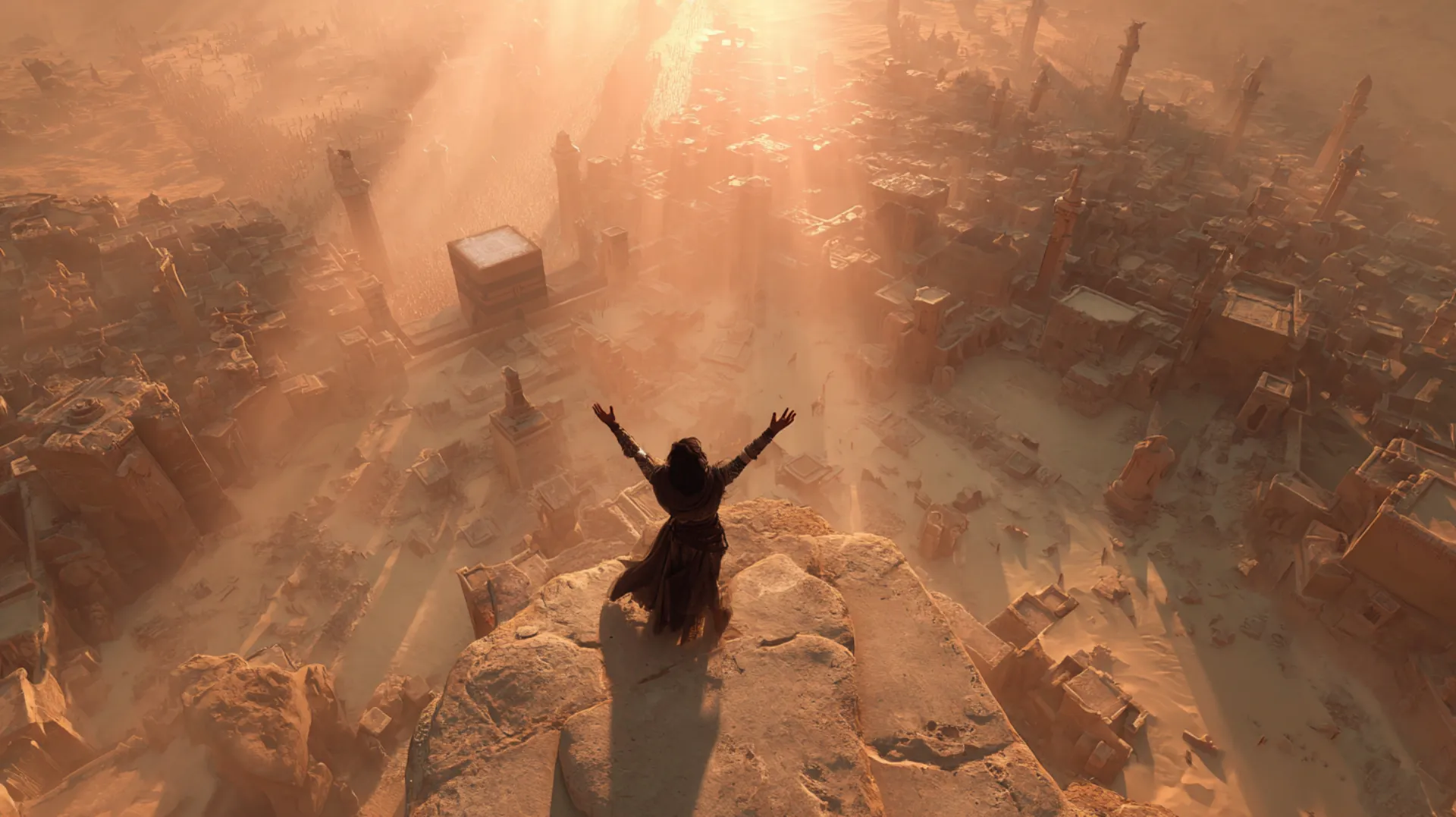
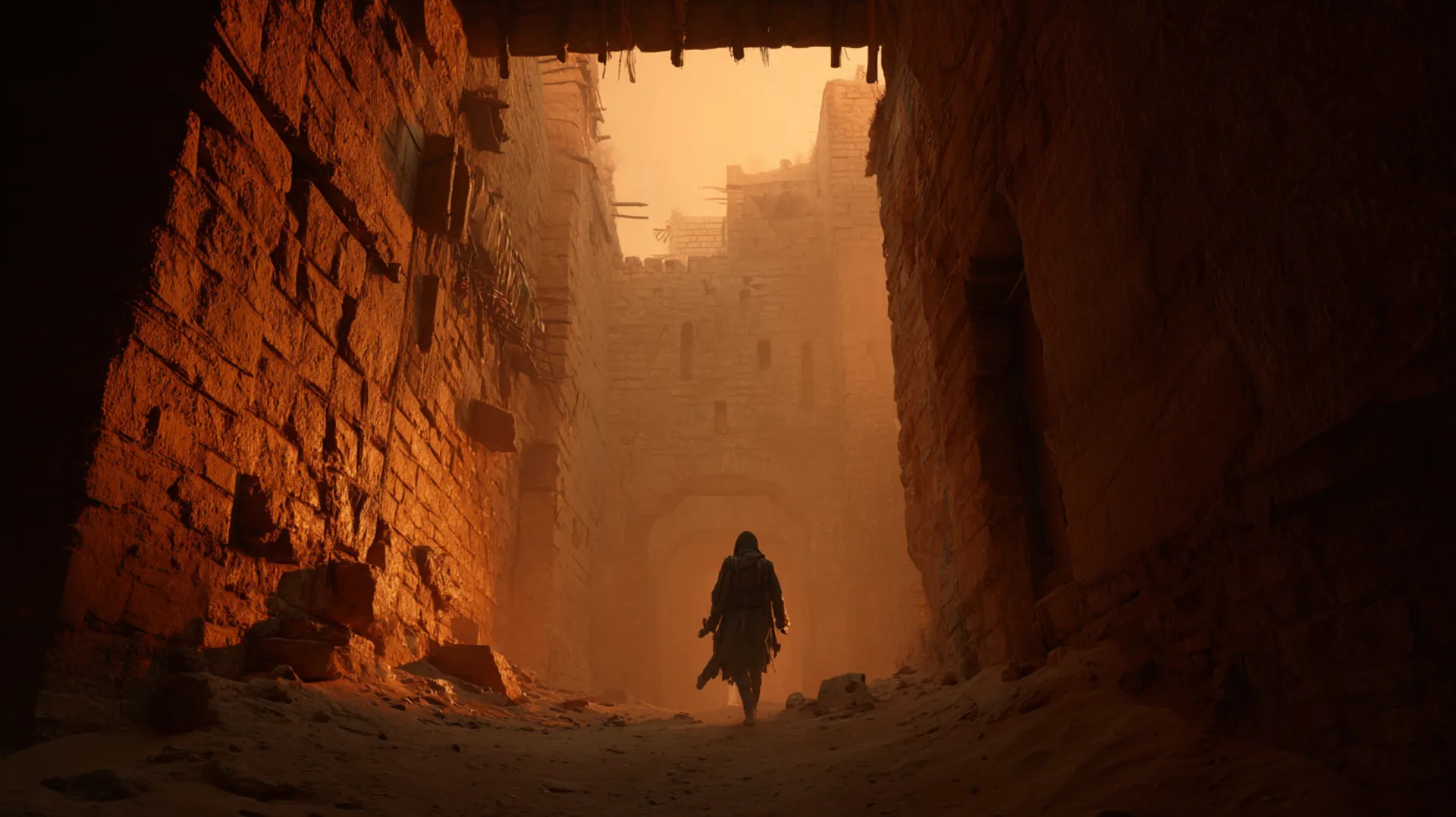
The letter is written in haste. The ink still damp, the hand trembling—not from fear of the act itself, but from the weight of what it means. Somewhere in the narrow alleys of Madinah, a man who fought at Badr, who stood in the line when the fate of Islam hung by a thread, is now folding a piece of parchment that could unravel everything. He presses it into the palm of a woman he barely knows, a woman who does not even know what she carries. She tucks it into the braids of her hair, mounts her camel, and rides south toward Mecca.
No one sees her leave. No one suspects a thing.
And yet, the heavens are watching.
The Treaty Shattered
To understand why ten thousand men are about to march on Mecca, we must return to a watering hole called al-Watir, on the outskirts of the sacred precincts, where the night air still carries the memory of screams.
Two years have passed since the Treaty of Hudaybiyyah divided the Arabian political landscape into two camps. The Khuza’ah—an ancient tribe bound to the Prophet Muhammad (peace be upon him) by blood, treaty, and faith—aligned themselves with the Muslims. The Banu Bakr, the last pagan tribe in the Meccan vicinity, sided with the Quraysh. For two years, an uneasy peace held. Old grudges between Khuza’ah and Banu Bakr—feuds stretching back generations, a ledger of stolen camels and unavenged dead—simmered beneath the surface, restrained only by the treaty’s fragile authority.
Then, in the eighth year of the Hijrah, the Banu Bakr decided to settle old scores. They approached the Quraysh not merely for permission but for material support. The elders of Mecca—men like Suhayl ibn Amr and Safwan ibn Umayyah—did not simply look the other way. They supplied weapons. One of them reportedly assured the raiders that as long as the attack came under cover of darkness, the Prophet would never find out.
They were catastrophically wrong.
The night raid at al-Watir was supposed to be a swift, surgical strike—steal the camels, kill a man or two if necessary, and vanish before dawn. Instead, the alarm was raised. The Khuza’ah camp erupted in chaos. Women and children screamed. More than twenty people were killed, a devastating toll for a small tribal community. In the most egregious act of the night, a fleeing Khuza’i man crossed into the sacred Haram boundary and turned to face his pursuer, invoking the ancient inviolability of the sanctuary: “I am in the Haram! Fear your God!” The Banu Bakr warrior uttered a blasphemous reply—“There is no god today”—and cut him down on sacred ground.
Scholarly Note
The details of the al-Watir massacre are recorded in Ibn Ishaq’s Sirah and Ibn Hisham’s recension. The number of casualties—over twenty—is significant given the small size of the tribal community. The Quraysh’s direct involvement through weapons supply is consistently reported across early sources, establishing their culpability in the treaty violation.
A Poet Rides to Madinah
Within days, Amr ibn Salim al-Khuza’i, the chieftain of Khuza’ah, rode north to Madinah at the head of a delegation of forty men. He came not with a diplomatic brief but with something far more powerful in Arabian culture: a poem.
Standing before the Prophet, Amr recited a full page of verse in the ancient, elevated Arabic that could set a desert ablaze with its imagery. He invoked three claims upon the Prophet’s honor. First, shared blood—reminding him that his great-great-great-grandmother was a daughter of Khuza’ah, that the lineage of Qusay ibn Kilab bound them together. Second, the treaty of Abd al-Muttalib—a pact between the Prophet’s grandfather and the Khuza’ah, sworn to endure “as long as the sun rises over Mount Thabir,” generation after generation. Third, the Treaty of Hudaybiyyah itself—under which the Khuza’ah had placed themselves under the Prophet’s protection.
Then came the lines that cut deepest: They came upon us while we were in ruku’ and sujud. They slaughtered us. Nothing protected us—not even the Haram.
The Prophet was visibly moved. His response was immediate and absolute: “You shall be helped, O Amr ibn Salim. You shall be helped.” Then he added an oath so forceful it left no room for ambiguity: “May Allah never help me if I do not help the Banu Ka’b.”
At that moment, a cloud appeared on the horizon. The Prophet looked at it and said it was a sign of victory for those who had been wronged. In the prophetic tradition, such positive omens—al-fa’l—were not superstition but a reading of hope into the signs of creation, always linked back to Allah’s will.
The Arab Memory: Genealogy as Political Currency
The encounter between Amr ibn Salim and the Prophet reveals something extraordinary about pre-Islamic Arabian society: the depth of genealogical memory. Amr traced a shared female ancestor five generations back—not through the patrilineal line that Arabs typically emphasized, but through a woman. He recited the terms of a treaty his grandfather had made with Abd al-Muttalib, word for word, in poetic form.
The Arabs of the seventh century were largely illiterate, yet they possessed memories of astonishing precision. Genealogy was not merely a matter of family pride; it was political infrastructure. In a society without written constitutions, courts, or centralized government, your lineage determined your alliances, your obligations, and your protection. To know your fifth cousin was not sentimentality—it was survival.
This same genealogical consciousness would later serve Islam’s scholarly tradition. The science of isnad—the chain of narration through which hadith were transmitted—grew directly from this cultural obsession with knowing exactly who said what to whom, and through which line of transmission. The Arabs’ extraordinary memory, which preserved tribal treaties across generations, would become the mechanism by which the words of the Prophet were preserved for posterity.
The Ultimatum
What happened next is a matter of scholarly discussion. Ibn Ishaq’s account suggests the Prophet began preparing his army immediately, treating the attack as an automatic breach of the treaty. This has led the majority of Seerah scholars to conclude that no negotiation was attempted.
However, a report cited by Ibn Hajar—with a chain he grades as mursal sahih (authentic to the Tabi’i generation, with a small gap)—presents a different picture. According to this account, the Prophet sent an ultimatum to the Quraysh offering them three options: pay the blood money for the twenty dead (amounting to two thousand camels—a staggering fortune), sever their alliance with the Banu Bakr, or face war.
Scholarly Note
Ibn Hajar describes the chain of this ultimatum report as mursal sahih, meaning it is authentic to the Tabi’i narrator but has a missing link to the Companion level. Since much of the Seerah literature relies on Tabi’i-level narrations, this report carries significant weight in the genre. The majority view based on Ibn Ishaq does not include this negotiation attempt, though both interpretations are considered valid.
The Quraysh refused on both counts. Two thousand camels would have bankrupted them—“We would be left with nothing but the clothes on our backs,” they protested. And the Banu Bakr were the last pagan tribe in the region willing to stand with them. To cut ties would be to stand utterly alone.
It was at this point that Abu Sufyan, the aging chieftain who had led armies against the Muslims at Uhud and Khandaq, recognized the gravity of the situation. He proposed traveling to Madinah himself to renegotiate the treaty. The Quraysh agreed, placing their fate in the hands of the man who had spent a decade trying to destroy the very community he now had to beg for mercy.
The Humiliation of Abu Sufyan
Abu Sufyan rode to Madinah alone—a detail that speaks volumes about the desperation of his mission. He had never entered the city except at the head of an army. Now he came as a supplicant.
According to Ibn Ishaq’s account, he went first to the Prophet himself. The response was silence. Not a refusal, not a negotiation—simply nothing. The Prophet did not answer him at all. Abu Sufyan left the meeting with no assurance, no promise, no information. The silence was more devastating than any rebuke.
Panicked, he turned to the men he had once known in the old days of Mecca. Abu Bakr al-Siddiq (may Allah be pleased with him), his friend from the days of Jahiliyyah, told him flatly: “I cannot help you.” Umar ibn al-Khattab (may Allah be pleased with him), his former business partner, mocked him openly: “You really think I would go to the Prophet on your behalf?” Then Abu Sufyan sought out Ali ibn Abi Talib (may Allah be pleased with him)—the closest relative he had in all of Madinah, for Abu Sufyan was of the broader Qurayshi clan connected to the Banu Hashim.
The scene at Ali’s home is one of the most poignant in the entire Seerah. Abu Sufyan—the man who had instigated Badr, commanded Uhud, orchestrated the siege of the Khandaq—now stood in the modest dwelling of a young man half his age, begging for intercession. Fatimah bint Muhammad (may Allah be pleased with her) was there, caring for her young son Hasan, who was perhaps five years old, playing at her feet.
Ali’s response was gentle but firm: “Woe to you, O Abu Sufyan. When the Prophet has decided a matter, we are not going to persuade him otherwise.”
Abu Sufyan, grasping at anything, turned to Fatimah: “O daughter of Muhammad, can you ask this little boy of yours to go to his grandfather and seek protection for us? If he does so, he shall be the master of the Arabs until the Day of Judgment.”
The offer was absurd in its desperation—and unknowingly prophetic. Abu Sufyan thought he could confer the title of Sayyid al-Arab upon a five-year-old child. He did not know that the Prophet had already declared, as recorded in Sahih al-Bukhari, that Hasan was the Sayyid of the youth of Paradise. No earthly title Abu Sufyan could bestow would approach what had already been granted from above.
Fatimah’s reply was devastating in its simplicity: “My son has not even reached the age to grant you security, and no one can offer protection against the Messenger of Allah.”
Before leaving Madinah, Abu Sufyan visited his own daughter, Umm Habibah—Ramlah bint Abi Sufyan (may Allah be pleased with her)—whom he had not seen in over thirteen years, since her emigration to Abyssinia. As he moved to sit on the bed, she quickly pulled the covering away, leaving only the hard frame. He looked at her, bewildered: “I don’t know—are you protecting me from the mattress, or the mattress from me?”
“This is the bed of the Prophet,” she said, “and you are not going to sit on it.”
Door after door, shut in his face. His old friend, his former partner, his young kinsman, his own daughter. The man who had once held the fate of Mecca in his hands could not secure so much as a cushion to sit on. Such is the qadr of Allah—the same Abu Sufyan who once pursued the Prophet with armies now wandered Madinah’s streets with no one willing to intercede for him.
Ali, in a final act of what might be called compassionate pragmatism, suggested Abu Sufyan make a public announcement in the mosque, asking if anyone would grant him protection. It was, as the Quraysh later told him when he returned empty-handed, the act of a man who had been made a fool. But Abu Sufyan himself admitted: “There was nothing else I could do.”
The Secret March
With Abu Sufyan’s mission a failure, the Prophet announced a general mobilization. Every able-bodied Muslim man was called to arms. But he did not say where they were going.
The secrecy was unprecedented. Even Abu Bakr, visiting his daughter Aisha bint Abi Bakr (may Allah be pleased with her), could not extract the destination. “I am preparing his bags,” Aisha told her father. “But I have no idea where he is going.” If the Prophet did not tell his most trusted companion and his own wife, it was not from any lack of trust—it was the recognition that secrets, once shared even in innocence, have a way of spreading.
To deepen the deception, Ibn Sa’d records in his Maghazi that the Prophet dispatched a scouting party of eight men northward, toward Syria. The ruse was brilliant: the Battle of Mu’tah had occurred just months earlier, and the memory of the confrontation with Byzantine forces was fresh. The Muslim community naturally assumed the great expedition would head north for a reckoning. Mecca lay to the south.
The Prophet also made a supplication that would prove critical: “O Allah, do not allow my plans to become known to them.” It was a prayer that would be answered—but tested—in the most dramatic fashion imaginable.
Hatib’s Letter
It was precisely at this moment—when the destination had been revealed to the inner circle at the eleventh hour, when ten thousand men were preparing to march south—that Hatib ibn Abi Balta’ah (may Allah be pleased with him) committed what he would later call the greatest error of his life.
Hatib was no ordinary Muslim. He had fought at Badr—the battle that the Prophet would later invoke as the very reason for sparing his life. He had pledged allegiance at the Bayat al-Ridwan. He was a man of proven faith and courage. And yet, upon learning that the army was heading for Mecca, he sat down and wrote a letter to the Quraysh, warning them to prepare.
He chose his courier carefully: an unnamed woman, not famous, not noble—someone who would attract no attention. He did not tell her the contents of the letter. He simply paid her to carry a sealed message to Mecca. She hid it in the braids of her hair, a place she assumed no search would ever reach.
She was wrong.
Jibril descended with precise intelligence. The Prophet summoned Ali ibn Abi Talib and al-Zubayr ibn al-Awwam (may Allah be pleased with them both) and told them exactly where to find the woman—at a place called Rawdat al-Khakh, just outside Madinah—and described the caravan she was traveling with. They rode hard, found the caravan exactly as described, and demanded the letter.
The woman denied everything. They searched her belongings, her saddle, her camel—nothing. Ali, his certainty unshakable, delivered an ultimatum: “I swear by Allah, neither has the Prophet been lied to, nor have we been lied to. You will either hand over the letter, or we will strip you and search you directly.”
The woman saw the determination in their faces. She asked them to turn around. They did. She removed her headscarf, untied her braids, and surrendered the letter.
Scholarly Note
This incident is recorded in Sahih al-Bukhari, Sahih Muslim, Sunan Abu Dawud, Sunan al-Tirmidhi, and Musnad Ahmad, as well as in Ibn Ishaq’s Sirah. It is one of the most widely attested episodes of the conquest narrative. The woman’s identity remains unknown in the sources; she was described as one of the mawla (freed clients) of the Quraysh and was apparently released without punishment, as she had no knowledge of the letter’s contents.
The Trial of Hatib
Back in Madinah, the Prophet held the letter in his hand—physical evidence, confirmed by divine revelation, corroborated by the courier’s testimony. He summoned Hatib. The letter was displayed. Hatib looked at it and confessed immediately: “Yes, O Messenger of Allah. This is my letter.”
Umar ibn al-Khattab’s reaction was instantaneous and volcanic: “O Messenger of Allah, allow me to strike the neck of this hypocrite! He has disbelieved in Allah and His Messenger!”
But the Prophet did not turn to Umar. He turned to Hatib. And the question he asked was not an accusation but an invitation to explain: “O Hatib, why would you do something like this?”
Hatib’s response, pieced together from multiple narrations, is one of the most psychologically revealing statements in the Seerah:
“O Messenger of Allah, why would I want to leave faith in Allah and His Messenger? I did not do what I did leaving my faith, nor did I prefer disbelief over Islam. I have not changed who I am or what I was. I knew that Allah would fulfill His promise and execute His command. But I wanted to establish a favor with the Quraysh, so that my family and property would be protected. For all of your other companions have family that would protect their relatives, and I have no family in Mecca to protect mine.”
The logic was twisted but human. Every Muhajir who would march on Mecca belonged to a powerful Qurayshi clan—Abu Bakr to the Banu Taym, Umar to the Banu Adi, Uthman to the Banu Umayyah. Their relatives in Mecca would never be harmed. But Hatib was an outsider, a halif (ally) with no tribal protection. His mother, his children—they had no clan to shield them when the army arrived. He had convinced himself that a small act of betrayal, one that would not actually harm the Muslims (since Allah would protect them anyway), could buy his family’s safety.
The Prophet’s verdict was swift and merciful: “He has spoken the truth. No one should say anything about Hatib except good.”
Umar pressed again, this time on different grounds—not apostasy, but the crime of espionage: “He has betrayed us. Allow me to execute him.”
The Prophet’s response invoked a reality that silenced every voice in the room:
“Did he not witness Badr? And how do you know, O Umar? Perhaps Allah has looked upon all of the people of Badr and said: ‘Do as you please, for I have forgiven all of you.’”
Umar wept.
And then the heavens spoke. Allah revealed the opening verses of Surah al-Mumtahinah:
“O you who believe, do not take My enemies and your enemies as allies, offering them affection while they have disbelieved in what has come to you of the truth… You secretly extend to them affection, but I know what you have concealed and what you have declared. And whoever does that among you has certainly strayed from the soundness of the way.” — Al-Mumtahinah (60:1)
The verse condemned the act without condemning the man. Allah called Hatib’s deed a grave straying—faqad dalla sawa’ al-sabil—but He did not call him a disbeliever. He did not strip away his faith. The distinction was crucial, and it would echo through fourteen centuries of Islamic jurisprudence.
The Theological Legacy of Hatib's Case
The story of Hatib ibn Abi Balta’ah became one of the most consequential case studies in Islamic legal and theological history. The central question it raises—does aiding an enemy of Islam constitute apostasy or a grave sin?—has been debated by scholars across every era.
One school of thought, associated with many medieval scholars and later emphasized by Muhammad ibn Abd al-Wahhab in his Nawaqid al-Islam (Ten Nullifiers of Islam), holds that aiding disbelievers against Muslims is an act of kufr akbar (major disbelief) that expels a person from Islam entirely. In this reading, Hatib was forgiven only because of his unique status as a veteran of Badr—a specific divine dispensation that cannot be generalized.
Ibn Taymiyyah, writing in his Majmu’ al-Fatawa (Volume 7, p. 523), offered a more nuanced position. He argued that if a person aids the enemy for personal, worldly reasons—family protection, financial interest—rather than out of love for disbelief itself, the act constitutes a major sin that diminishes faith but does not destroy it. He cited Hatib’s case directly as evidence, noting that Hatib’s motivation was the safety of his family, not any desire to see Islam defeated.
Both positions agree on one point: if a person aids the enemies of Islam out of love for their disbelief and hatred for Islam itself, this is unambiguous apostasy regardless of any other consideration. The disagreement lies in cases where the motivation is worldly—fear, greed, family loyalty—rather than ideological.
This debate has taken on acute relevance in modern contexts, where questions of political allegiance, cooperation with foreign powers, and the boundaries of loyalty intersect with the classical categories in complex ways. The Prophet’s own handling of the case—hearing the accused, accepting his explanation, invoking his prior service, and ultimately pardoning him—offers a model of deliberation that resists the impulse toward hasty judgment.
What Hatib Teaches
The Prophet’s handling of Hatib’s case illuminates principles that transcend the seventh century. First, the infinite knowledge of Allah—that nothing escapes divine awareness, no matter how carefully concealed. The letter was hidden in braids of hair, carried by an unknown woman, written in secret. Yet Jibril brought the news from above the seven heavens.
Second, divine intervention does not replace human effort. Allah could have struck the courier with lightning or swallowed her camel into the earth. Instead, He informed the Prophet, who then dispatched riders, who then searched, confronted, and retrieved the evidence. Even miracles, in the prophetic model, require human hands to complete the work.
Third, the Prophet confirmed the report before passing judgment. He held the letter in his hand. He had the testimony of Jibril himself. Yet he still called Hatib and asked: Did you do this? And after the confession, he asked: Why? The accused was given the chance to speak, to explain, to present the circumstances that no letter or courier could convey. Justice, in the prophetic model, demands hearing both sides—even when the evidence seems overwhelming.
Fourth, people are judged by the totality of their lives, not by their worst moment. The hadith in Sunan Abu Dawud captures this principle: the Prophet said that when people of stature and nobility stumble, they should be given some grace. Hatib’s entire life of service—Badr, the Bayat al-Ridwan, years of faithful companionship—could not be erased by one terrible lapse in judgment.
And perhaps most remarkably, when the Prophet declared that no one should speak ill of Hatib, the Muslim community obeyed for the remaining twenty-two years of Hatib’s life. He died in the thirtieth year of the Hijrah, during the caliphate of Uthman ibn Affan (may Allah be pleased with him), never once publicly shamed for what had happened. Generations later, one of his descendants—Ziyad al-Shabtun—would become a principal student of Imam Malik and one of those who carried the Muwatta to North Africa, helping establish the Maliki school across Andalusia and the Maghreb.
The Army Assembles
With the crisis of Hatib resolved, the march proceeded. Not a single Muhajir or prominent Ansari remained behind. The outlying tribes sent their contingents—the tribe of Muzaynah contributed a thousand men, the Banu Sulaym seventeen hundred. In total, more than ten thousand Muslims gathered under the Prophet’s banner.
The number is staggering when set against the arc of the Seerah. At Badr, barely six years earlier, three hundred and thirteen men had stood against the might of Mecca, and the Prophet had raised his hands in desperate supplication: “O Allah, if we are destroyed, You will never be worshipped again on this earth.” At the Battle of the Khandaq, just three years before, ten thousand enemies had besieged Madinah, and the Muslims had trembled behind a trench. Now ten thousand believers—the same number that had once threatened to annihilate them—were marching in the opposite direction.
They departed Madinah on the tenth of Ramadan in the eighth year of the Hijrah. They arrived on the outskirts of Mecca on the nineteenth—nine days for an army of ten thousand, an extraordinary pace that reflected both the urgency of the mission and the discipline of the force. The Prophet had kept the destination secret until the very last day, and the diversionary scouting party sent northward had done its work. By the time the Quraysh realized what was happening, it was already too late.
The cloud that had appeared on the horizon when Amr ibn Salim recited his poem was no longer a distant sign. It was arriving.
And so the army moves south through the desert night, ten thousand fires flickering across the plain like fallen stars, visible from the hills above Mecca. In the city below, Abu Sufyan—returned from his failed mission, humiliated and empty-handed—will soon find himself standing on those very hills, watching the impossible unfold. What he does next, and the words the Prophet speaks to him, will determine whether Mecca falls in blood or in mercy. That story awaits in the next chapter.
Quranic References
Continue Your Journey

Cite this Narrative
APA
SeerahQuest. (2026). The Letter in Her Hair. *SeerahQuest: The Eternal Narrative*. https://seerahquest.com/chapters/conquest-of-mecca-prelude-part-1 Adapted from Yasir Qadhi's Seerah Series, Episode 76, Episode 77.
MLA
"The Letter in Her Hair." *SeerahQuest: The Eternal Narrative*, 2026, https://seerahquest.com/chapters/conquest-of-mecca-prelude-part-1. Adapted from Yasir Qadhi's Seerah Series, Episode 76, Episode 77.
Chicago
"The Letter in Her Hair." *SeerahQuest: The Eternal Narrative*. Accessed April 3, 2026. https://seerahquest.com/chapters/conquest-of-mecca-prelude-part-1. Adapted from Yasir Qadhi's Seerah Series, Episode 76, Episode 77.
Install SeerahQuest — read chapters offline, anytime.