When Mecca Fell Silent
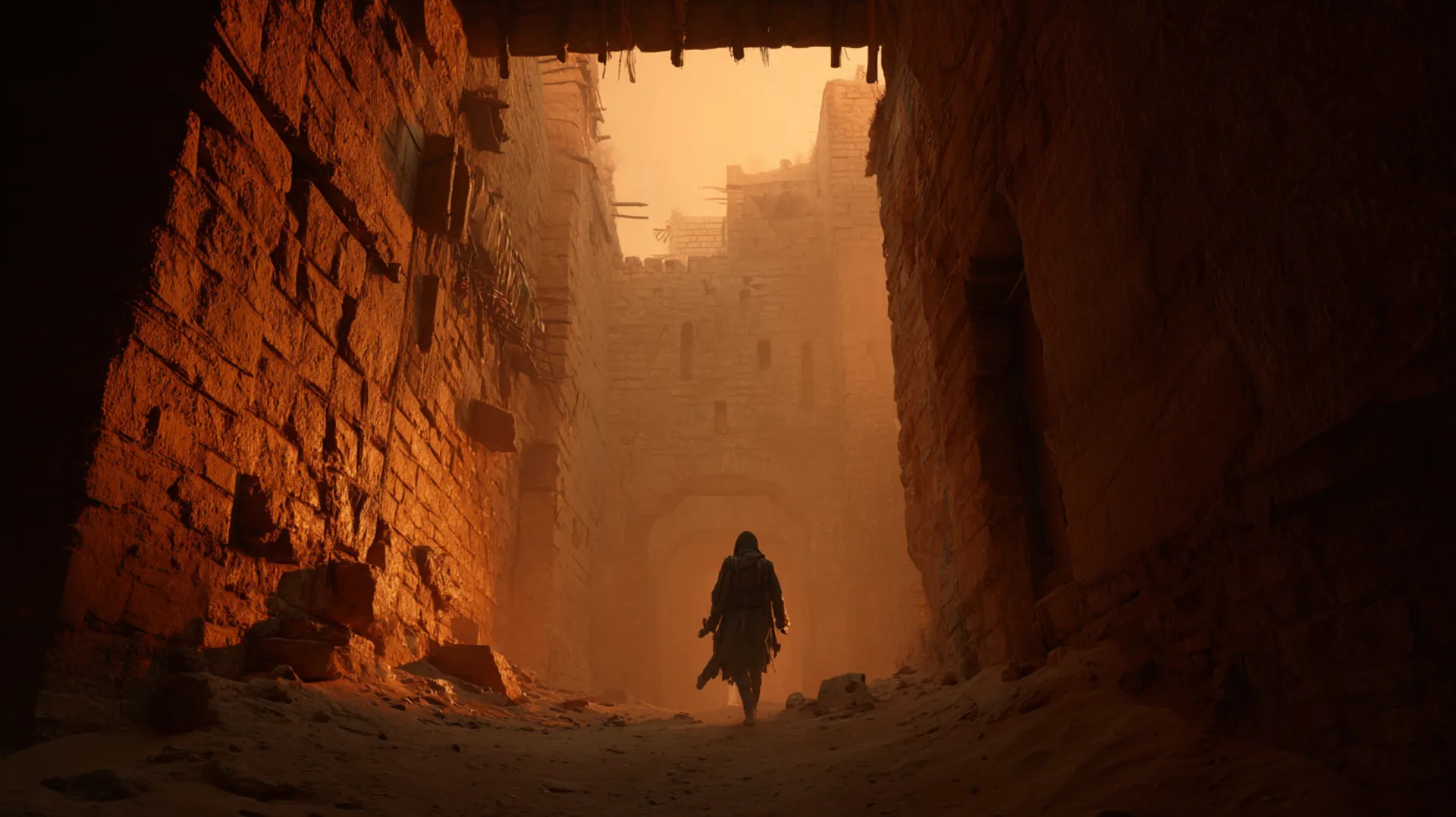
The first soldier to stumble back through the gates of Mecca does not look like a man returning from war. He looks like a man returning from the end of the world.
1-2 AH · 622 – 624 CE
The first soldier to stumble back through the gates of Mecca does not look like a man returning from war. He looks like a man returning from the end of the world.
Al-Haysuman al-Khuza’i enters the city bloodied, broken, his bearing that of someone who has witnessed the unthinkable. The people of Quraysh gather around him — mothers, wives, elders, children — and they ask the question that hangs in the desert air like the scent of coming rain: What happened?
And he begins to speak. Not in the triumphant cadences of a warrior bringing news of victory, but in the flat, hollow tone of a man reciting a funeral list.
“Utbah has been killed. Rabi’ah has been killed. Shaybah has been killed. Abu al-Hakam has been killed. Umayyah ibn Khalaf has been killed. Zam’ah ibn al-Aswad has been killed. Abu al-Bukhtari has been killed. Abu Jahl has been killed.”
Name after name. A who’s who of Meccan aristocracy. The pillars of Quraysh, toppled one after another like clay idols in a sandstorm.
The listeners do not weep. They do not wail. They do something far more telling: they refuse to believe. This man has gone mad, they whisper to one another. It is simply not possible.
The Proof That Shattered Denial
The news reaches Safwan ibn Umayyah, the son of the slain Umayyah ibn Khalaf, who sits with his back against the wall of the Hijr — the semicircular enclosure beside the Ka’bah. Safwan devises a test. If this man is truly deranged, he will not be able to distinguish the living from the dead. “Go ask him,” Safwan instructs someone, “what happened to Safwan ibn Umayyah?” — meaning himself, sitting right there in plain view.
The messenger approaches al-Haysuman and poses the trick question. Al-Haysuman looks at him steadily and says: “Safwan is sitting right over there. And I saw with my own eyes how they killed his father and brother.”
The silence that follows is the silence of a city beginning to comprehend catastrophe.
Slowly, in ragged groups and scattered bands, the survivors filter back to Mecca. There is no organized return — because there had been no plan for retreat. The Quraysh had marched out of Mecca with such absolute confidence in their superiority that the concept of defeat had never crossed their minds. They had no plan B, no rally point, no contingency. They had simply fled the plains of Badr in every direction, like a flock of birds startled by a hawk, and now they straggle home carrying nothing but the weight of the impossible.
Scholarly Note
Ibn Kathir narrates these incidents of the Quraysh’s return to Mecca in his al-Bidayah wan-Nihayah. The detail about the Quraysh having no contingency plan for defeat is noted by multiple seerah scholars, underscoring how unprecedented and psychologically devastating the loss at Badr was for the Meccan establishment.
The End of Abu Lahab
And then comes the final act of divine reckoning — reserved, it seems, for the very last of the old guard.
Abu Lahab (Abd al-Uzza ibn Abd al-Muttalib) had not marched to Badr. He had hired a substitute to fight in his place, and the Quraysh had not pressured him to go, understanding the awkwardness of a Banu Hashim chieftain taking the field against his own nephew. He remains in Mecca, waiting, brooding, desperate for reliable news.
He refuses to believe the returning soldiers. Deserters, he tells himself. Cowards who fled before the real fighting began. He will wait for Abu Sufyan — his trusted friend, a man whose word he cannot doubt.
When Abu Sufyan finally returns, the two men meet at the house of al-Abbas ibn Abd al-Muttalib (may Allah be pleased with him), who is himself a prisoner of war in Madinah. The house is occupied only by Abbas’s wife, Umm al-Fadl, and his servant.
Abu Lahab demands the truth, face to face. Abu Sufyan delivers it with the weariness of a man who has seen the inexplicable: “By Allah, as soon as our side met the Muslims, it was as if they overpowered us without us doing anything. They took prisoners as they pleased and they killed as they pleased.” And then Abu Sufyan adds something that makes the hair on Abu Lahab’s neck stand on end: “Despite all that happened, I cannot criticize our own men. Because by Allah, I saw a group of men with white faces, riding horses that were black and white, hovering between the heavens and the earth. None of us could overpower them.”
Abu Sufyan is describing, without knowing it, the angelic host.
The servant of Abbas — a Muslim, as was Umm al-Fadl herself — has been listening from the kitchen. He cannot contain himself. He leaps up in joy and cries out: “By Allah, those were the angels!”
It is a moment of pure, unguarded ecstasy — a slave’s heart overflowing at the news that Allah’s promise has been fulfilled. But for Abu Lahab, it is the final indignity. A slave, celebrating the destruction of the Quraysh, in his presence. He loses all composure. He throws the servant to the ground and begins beating him savagely.
Umm al-Fadl rushes out to intervene. Abu Lahab turns on her as well, striking the wife of his own brother. And then Umm al-Fadl, wounded but unbowed, unleashes words that cut deeper than any blade: “So when the master of the house is gone, this is what you do to his household? What kind of protector are you?”
The shame hits Abu Lahab like a physical blow. He flees the house in humiliation and is barely seen again. Within days, he is afflicted with a wasting illness — the books of tafsir and seerah mention various diseases — and he dies in misery and isolation. The last of the old Meccan tyrants, the uncle who had stood at the doorstep of the Prophet’s house and cursed him, the man whom an entire surah of the Quran had been revealed to condemn, perishes not on a battlefield but in the grip of his own rage and despair.
Scholarly Note
The exact nature of Abu Lahab’s fatal illness is reported differently across sources. Some narrations mention a plague-like condition, others a type of infection. What is consistent across accounts is the rapidity of his decline following the news of Badr and the incident at Abbas’s house. His death is recorded in Ibn Ishaq’s Sirah and elaborated upon by Ibn Kathir.
A City That Could Not Weep
Ibn Ishaq records that when all the survivors had returned, Mecca was enveloped in the wailing of women. Every household had lost someone — a father, a son, a brother, a cousin. The keening rose from every quarter of the city, a collective howl of grief that fulfilled, with eerie precision, the dream of Atikah bint Abd al-Muttalib from months earlier: she had seen a boulder hurled from a mountaintop that shattered and sent fragments into every house in Mecca. Now that vision had become reality.
But Abu Sufyan, ever the strategist even in defeat, recognized the danger. He convened a gathering of the Quraysh and issued a decree unprecedented in the history of the Arabs: no woman shall wail publicly for the dead of Badr. His reasoning was coldly pragmatic — he did not want the Muslims to derive any satisfaction from hearing that all of Mecca was in mourning. And so the decree went out, and the women of Quraysh were forced to swallow their grief in silence.
Ibn Kathir observes with characteristic insight that this ban became an additional punishment from Allah. The Arabs derived immense psychological comfort from communal mourning — the wailing, the gathering of women, the public display of loss. It was cathartic, a way to externalize pain and begin the process of healing. By forbidding it, Abu Sufyan unwittingly ensured that the grief of Badr festered inward, unprocessed and unrelieved.
The poignancy of this is captured in a single vignette. Al-Aswad ibn al-Muttalib, a distant uncle of the Prophet (peace be upon him) who had lost all three of his sons at Badr, hears a woman wailing one night. His heart leaps with hope. He sends a servant to inquire: has the ban been lifted? Can he finally mourn his beloved youngest son, Zam’ah? The servant returns with devastating news: the woman is not weeping for a loved one. She is weeping for a lost camel. One could wail for anything in Mecca — except for the dead of Badr.
Two Empires, One Day
On the very same day that the sands of Badr drank the blood of the Quraysh — the seventeenth of Ramadan, in the second year of the Hijrah — something extraordinary was unfolding thousands of miles to the northeast. The Byzantine Emperor Heraclius launched a fierce offensive against the Sassanid Persian Emperor Khusro II. Two of Khusro’s generals defected, a member of his own royal family plotted against him, and the Persian army suffered a devastating defeat.
The Muslims at Badr knew nothing of this. It would take weeks for the news to travel. But years earlier, in the middle of the Meccan period, Allah had revealed the opening verses of Surah al-Rum:
“Alif Lam Mim. The Romans have been defeated in the nearest land. But they, after their defeat, will overcome — within a few years. To Allah belongs the command before and after. And that day the believers will rejoice in the victory of Allah.” (Al-Rum, 30:1-5)
Two predictions, woven together with breathtaking precision. First: the Romans, then in steep decline, would defeat the ascendant Persians. Second: on the very day of that Roman victory, the believers would be rejoicing in the victory of Allah — their own victory, at Badr.
Abu Bakr's Wager and the Prophecy of Surah al-Rum
When these verses were first revealed, Ubayy ibn Khalaf — who would later die at Badr — mocked Abu Bakr al-Siddiq (may Allah be pleased with him): “Do you really think the Romans will defeat the Persians after this humiliation?” The political reality of the time made such a reversal seem absurd. The Persians had consolidated power; the Romans were mired in internal conflict.
Abu Bakr, with the certainty of a believer, said yes. The two men made a wager — this was before the prohibition of gambling, and in any case Abu Bakr was not betting on an unknown outcome but affirming a divine promise. They set a timeframe: Abu Bakr chose six years, taking the middle value of the Arabic word bid’ (a few), which linguistically spans three to nine. Six years passed, and the Romans had not yet won. Abu Bakr paid the wager.
But the Quran’s timeline proved exact. Approximately eight and a half years after the revelation, on the day of Badr itself, Heraclius achieved his decisive victory. By then, Ubayy ibn Khalaf was dead — killed at Badr. Abu Bakr had already paid the bet. And the believers were indeed rejoicing in the victory of Allah, just as the verse had promised.
There is a narration — considered weak by most hadith scholars — that the Prophet remarked to Abu Bakr: “Why did you say six? Bid’ can mean up to nine.” Linguistically, this is accurate, and the actual fulfillment at roughly eight and a half years confirms the Quranic precision. This incident is recorded in Sunan al-Tirmidhi.
Scholarly Note
The hadith about the Prophet’s comment to Abu Bakr regarding the timeframe is graded as weak (da’if) by most scholars of hadith. However, the historical synchronicity of the Roman victory and the Battle of Badr is confirmed by both Islamic and non-Islamic historical sources, providing a remarkable example of how the Seerah’s chronology aligns with independently documented world events.
The Rank of the People of Badr
In the aftermath of the battle, as the dust settled and the prisoners were secured, Jibreel (peace be upon him) descended to the Prophet with a question that was also a revelation. As recorded in Sahih al-Bukhari, Jibreel asked: “How do you view the people of Badr among you?” The Prophet responded: “We view them as the best of us.” And Jibreel said: “Similarly, we view the angels who participated in Badr as the best of us.”
The implications are staggering. The 313 men who stood on the plains of Badr that Friday morning were not merely soldiers who won a battle. They were, in the estimation of heaven itself, the elite of this Ummah — just as the angels who fought alongside them were the elite of the angelic host.
Imam al-Bukhari dedicated an entire chapter of his Sahih to the virtues of the people of Badr. The classical scholars of seerah — Ibn Ishaq, Ibn Hisham, Ibn Kathir — painstakingly listed every single one of the 313-plus companions who were present, name by name, tribe by tribe, as an act of reverence.
A Mother’s Question, A Prophet’s Answer
Among the handful of Muslim martyrs at Badr was a young Ansari man named Harithah ibn Suraqa. He was killed not in the clash of swords or the rain of arrows from an enemy archer, but by a stray arrow — a single shaft that came from nowhere and struck him down. He was among the first to fall.
His mother, consumed by the grief that only a mother can know, made her way to the Prophet. Her question was simple, desperate, and eternal: “Tell me about my son. Is he in Jannah?”
The Prophet’s response was remarkable in its specificity and its tenderness. He did not simply say yes. He said: “My dear mother, it is not a Jannah he is in. He is in Jinan — many gardens of Paradise — and he is in al-Firdaws al-A’la.”
Al-Firdaws al-A’la — the highest station of Paradise, the pinnacle of eternal bliss. For a mother standing in the raw wound of her loss, these words were not theology. They were the only balm that could reach the place where her heart was bleeding.
The power of this exchange lies not only in the Prophet’s compassion but in what it reveals about the status of martyrdom at Badr. Harithah was not a great warrior. He did not fell a chieftain or perform a legendary feat of arms. He was struck by a stray arrow — perhaps the most random, most seemingly meaningless way to die in battle. And yet he was granted the highest station in Paradise. The lesson is unmistakable: at Badr, it was not the manner of one’s death that mattered, but the sincerity of one’s presence.
The Hadith of Hatib and the Shield of Badr
Perhaps the most dramatic illustration of how Badr’s status protected its veterans comes years later, in the lead-up to the conquest of Mecca. Hatib ibn Abi Balta’ah (may Allah be pleased with him), a veteran of Badr, committed an act that by any military standard constituted treason: he sent a letter to the Quraysh warning them that the Muslim army was coming, compromising the element of total surprise.
Jibreel informed the Prophet of the betrayal. Ali ibn Abi Talib and others intercepted the messenger — a woman who had hidden the letter in her hair. The letter was opened: “From Hatib ibn Abi Balta’ah to the Quraysh. Beware, the Muslims are coming.”
Umar ibn al-Khattab (may Allah be pleased with him) was incandescent with rage. “Ya Rasulallah, give me the word and I will strike his neck.” The anger was justified — this was wartime intelligence being leaked to the enemy.
The Prophet summoned Hatib and asked why. Hatib’s explanation was that of a desperate man: he had no tribal protection in Mecca, and his family remained there. He knew Allah would protect the Prophet regardless, and he hoped the letter would earn goodwill that might spare his loved ones. “I have no desire to love kufr over Islam,” he said. “But all of you have your tribal protection. I am a nobody.”
The Prophet said: “Hatib has spoken the truth.” Umar pressed again for execution — if not for hypocrisy, then for the crime of treason. And the Prophet’s response, recorded in Sahih al-Bukhari, invoked the shield of Badr: “O Umar, how do you know? Perhaps Allah looked at the people of Badr and said to them: ‘Do as you please, for you are forgiven.’”
Six years after the battle, the Prophet used Badr to save a man’s life. The participation of 313 men on a single Friday morning had earned them a status that transcended even the gravest of subsequent failings.
The Aftershocks: What Badr Changed
The dust of Badr settled, but its reverberations would reshape the entire political landscape of Arabia. Three primary effects emerged with unmistakable clarity.
First, the Muslims were now an undeniable political reality. Before Badr, the community in Madinah could still be dismissed as a band of refugees and their local sympathizers — an irritant, not a threat. After Badr, that illusion was shattered. The Muslims had defeated an army three times their size, killed or captured the cream of Meccan leadership, and demonstrated a military discipline — fighting in organized ranks for the first time in Arabian warfare — that no tribal force could match. They were a state, and the Quraysh would have to deal with them as such.
Second, Badr delivered the single greatest psychological blow in the entire Seerah. Later events — Uhud, the siege of the Khandaq, even the conquest of Mecca — occurred in a context where the Muslims were already a known military power. At Badr, the Quraysh had genuinely believed they would annihilate the Muslim community. The shock of not merely losing but losing catastrophically, losing their most prominent leaders, losing the aura of invincibility that had sustained Meccan hegemony for generations — this was a wound from which Quraysh never fully recovered. Every subsequent defeat was, in a sense, merely a footnote to Badr.
Third, and most ominously, Badr brought hidden treachery to the surface within Madinah itself. Before the battle, the hypocrites (munafiqun) led by Abdullah ibn Ubayy ibn Salul had confined themselves to sarcastic murmurs and passive resistance. The Jewish tribes of Madinah had maintained an uneasy peace under the terms of the Constitution of Madinah. After Badr, both groups began to show their true colors. The hypocrites grew bolder in their subversion. The tensions with certain Jewish tribes escalated toward open hostility. The seeds of future crises — the expulsion of Banu Qaynuqa, the treachery of Banu Nadir, the betrayal of Banu Qurayza — were all planted in the soil that Badr had turned.
The Quran Descends on the Battlefield
It is on these very plains, with the bodies of the slain still being gathered and the prisoners still being bound, that Surah al-Anfal begins to descend. The eighth chapter of the Quran — revealed not in the quiet of a mosque or the solitude of a mountain cave, but on a battlefield still warm with the blood of the fallen.
“They ask you about the spoils of war. Say: ‘The spoils are for Allah and the Messenger.’ So fear Allah and amend that which is between you, and obey Allah and His Messenger, if you are believers.” (Al-Anfal, 8:1)
The very first verse addresses not the glory of victory but a dispute about money. Some companions had been guarding the Prophet, others had charged into battle, still others had pursued the fleeing enemy — and each group felt entitled to the war spoils. Allah’s response cuts through the argument with surgical precision: stop quarreling. The real treasure is not camels and swords. It is taqwa, consciousness of Allah.
And then, verse by verse, Allah replays the entire experience of Badr through the lens of divine purpose. The hesitation when the companions learned they would face an army instead of a caravan:
“Just as your Lord brought you out of your home in truth, while a party of the believers were unwilling.” (Al-Anfal, 8:5)
The terror they felt, described with devastating honesty — yet without stripping them of their honor, for Allah still calls them mu’minun, believers:
“Arguing with you concerning the truth after it had become clear, as if they were being driven toward death while they were looking on.” (Al-Anfal, 8:6)
The miraculous sleep and the rain on the night before battle:
“When He caused drowsiness to overcome you as a security from Him, and sent down upon you rain from the sky to purify you.” (Al-Anfal, 8:11)
And the divine command to the angels:
“I will cast terror into the hearts of those who disbelieved, so strike them upon the necks and strike from them every fingertip.” (Al-Anfal, 8:12)
Perhaps most theologically profound is the verse about the Prophet’s casting of pebbles at the start of battle:
“And you did not throw when you threw, but it was Allah who threw.” (Al-Anfal, 8:17)
In this single verse, the Quran articulates the delicate balance of divine decree and human agency that lies at the heart of Islamic theology. The Prophet did throw — his will, his arm, his intention were real. But the supernatural effect — a handful of dust blinding an entire army — was Allah’s doing. Neither pure determinism nor pure free will, but a middle path that affirms both human action and divine sovereignty.
The surah continues to lay down principles that will govern the Muslim community for centuries: the prohibition against fleeing in battle except as a tactical maneuver, the obligation to honor treaties even with enemies, the imperative of Muslim unity as the prerequisite for victory, and the remarkable verse that establishes peace as the default aspiration of the Islamic state:
“And if they incline to peace, then incline to it also, and rely upon Allah.” (Al-Anfal, 8:61)
War, the Quran makes clear, is not the goal. It is the instrument of last resort, deployed only when the word of Allah is being actively suppressed. When the enemy offers peace, the believer must accept.
The Bridge to What Comes Next
The Battle of Badr is over, but its consequences are only beginning to unfold. The Quraysh nurse their wounds in silence, forbidden even to weep. The Muslims return to Madinah with a confidence they have never known — and with enemies, both external and internal, who are now more dangerous precisely because they are more desperate.
In the days that follow, a man named Umair ibn Wahb will sit in the shadow of the Ka’bah with Safwan ibn Umayyah, and the two of them will hatch a plan born of grief and vengeance — a plan to end the Muslim threat with a single blade in the dark. Umair will ride to Madinah with murder in his heart and poison on his sword. But what awaits him there will be something he never imagined: not the death of a prophet, but the death of his own disbelief.
Quranic References
Continue Your Journey
Cite this Narrative
APA
SeerahQuest. (2026). When Mecca Fell Silent. *SeerahQuest: The Eternal Narrative*. https://seerahquest.com/chapters/battle-of-badr-prelude-and-preparations-part-7 Adapted from Yasir Qadhi's Seerah Series, Episode 42.
MLA
"When Mecca Fell Silent." *SeerahQuest: The Eternal Narrative*, 2026, https://seerahquest.com/chapters/battle-of-badr-prelude-and-preparations-part-7. Adapted from Yasir Qadhi's Seerah Series, Episode 42.
Chicago
"When Mecca Fell Silent." *SeerahQuest: The Eternal Narrative*. Accessed April 3, 2026. https://seerahquest.com/chapters/battle-of-badr-prelude-and-preparations-part-7. Adapted from Yasir Qadhi's Seerah Series, Episode 42.
Install SeerahQuest — read chapters offline, anytime.