The Wind and the Whisper
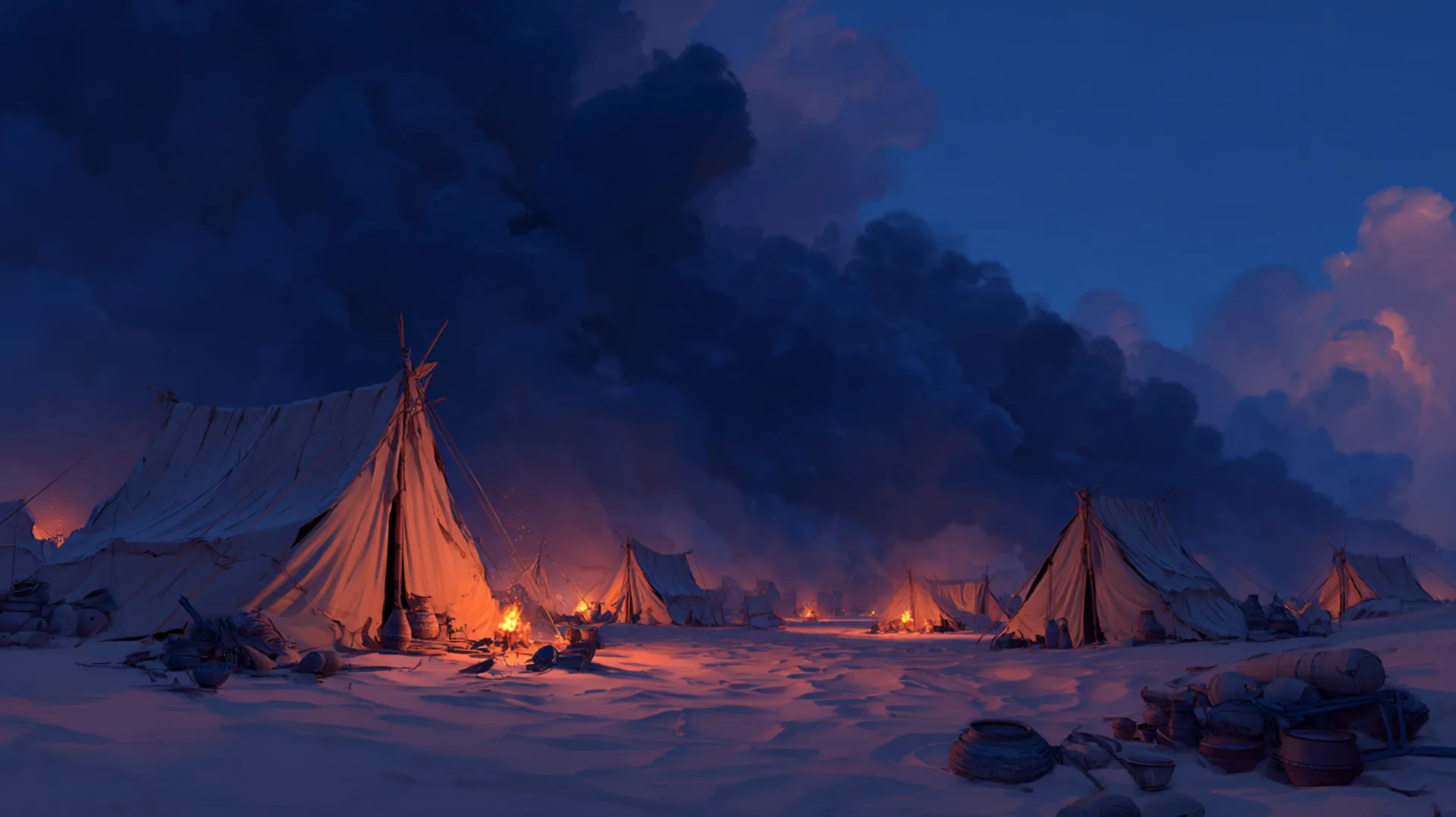
The wind begins as a whisper. It threads through the date palms, stirs the cold sand into spirals, and then—without warning—it howls like something summoned.
5 AH · 627 CE
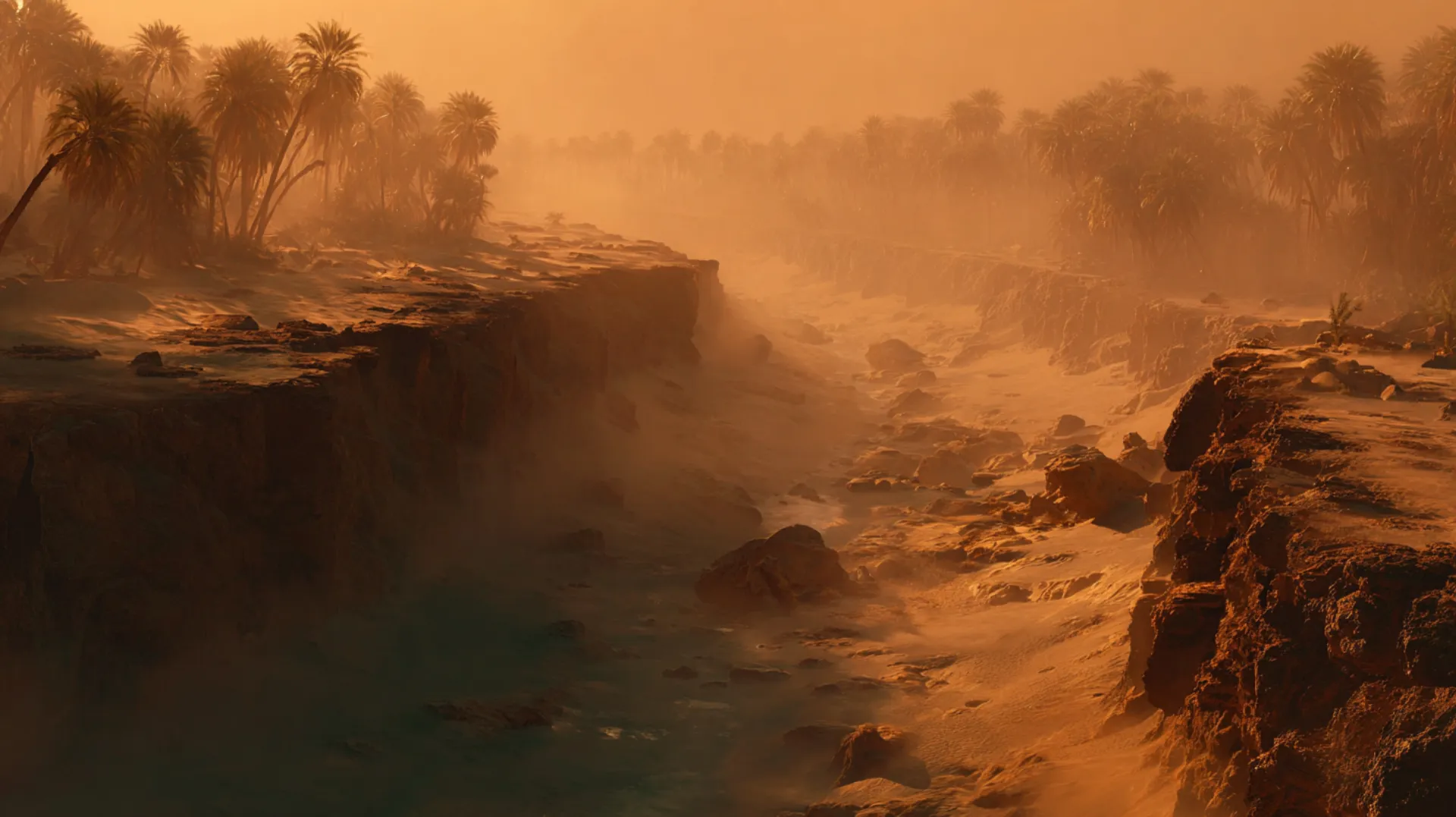
The wind begins as a whisper. It threads through the date palms south of the trench, stirs the cold sand into spirals, and then—without warning—it howls. It howls like something alive, something summoned. The campfires of ten thousand men gutter and die. Iron cooking pots cartwheel across the desert floor, spilling lentils and barley into the darkness. Tent pegs wrench free from the earth, and canvas snaps like the crack of a whip. On the Muslim side of the trench, huddled men cannot see their own fingertips when they extend their hands. On the Quraysh side, Abu Sufyan ibn Harb stands in the wreckage of his camp and makes a decision that will change the course of Arabian history.
But before the wind, there was a man. A man who walked out of the darkness on the wrong side of the trench and offered the Prophet (peace be upon him) something more dangerous than a sword: his mind.
The Convert No One Expected
His name was Nu’aym ibn Mas’ud al-Ghatafani (may Allah be pleased with him), and everything about him was improbable.
He was a nobleman of the Banu Ghatafan, the second-largest contingent in the coalition army encamped outside Madinah. He was a merchant and a man of connections—a man who drank wine with Ka’b ibn Asad, the chieftain of Banu Qurayza, who dined in the tents of Abu Sufyan, who moved between tribes with the ease of a man trusted by everyone and beholden to no one. Years earlier, Abu Sufyan had paid him to travel to Madinah and spread misinformation—a mission Nu’aym had carried out faithfully as a pagan loyal to his tribe’s interests. That errand had earned him Abu Sufyan’s lasting confidence.
And then, on one of the darkest nights of the siege, Islam entered his heart.
He described it himself: it came upon him suddenly, inexplicably, as though a door had been flung open in a room he did not know existed. Not a single member of his tribe was Muslim. His people were camped with their spears pointed at the Prophet’s city. And yet here he was, crossing the trench lines in the dead of night, presenting himself before the Messenger of Allah and declaring his faith.
The Prophet’s response was immediate and practical. He recognized what stood before him: not merely a new believer, but a strategic asset of extraordinary value—a man trusted simultaneously by the Quraysh, the Ghatafan, and the Banu Qurayza, the three pillars of the coalition. And so the Prophet gave him a single instruction and a single permission. The instruction: go and sow discord among them. The permission: say what you need to say.
“War is indeed deceit (al-harbu khid’ah).”
This statement, recorded in the authenticated collections, was the Prophet’s sanction for what would follow.
Scholarly Note
Islamic jurisprudence draws a sharp distinction between khid’ah (strategic deception in war) and ghadr (treachery). Deception—creating false impressions, misdirecting the enemy—is permitted by consensus of scholars during active hostilities. Treachery—violating a sworn covenant, breaking a signed agreement—is categorically forbidden (haram bi’l-ijma’). Nu’aym’s operation fell squarely within the first category: he held no binding covenant with the Quraysh or Banu Qurayza that he violated. He simply allowed each party’s existing suspicions to consume them.
The Web of Whispers
Nu’aym’s genius lay not in what he invented but in what he rearranged. He told each party a version of the truth that was just distorted enough to be devastating.
He went first to the Banu Qurayza—logistically the easiest visit, since their fortress lay within Madinah’s perimeter, on his side of the trench. He sat with Ka’b ibn Asad, the man he had shared meals and wine with in the days before Islam, and spoke as a concerned friend. “Your situation is precarious,” he told them. “The Quraysh can pack up and leave whenever they wish. They have homes to return to. You do not. If they abandon you, you will be left alone to face Muhammad. What you need is insurance: demand that they hand over seventy of their noblemen as hostages. That way, they cannot flee without abandoning their own elite.”
It was a perfectly logical suggestion. Ka’b could see the sense in it immediately. The Quraysh could leave at any time. The Banu Qurayza, having broken their treaty with the Prophet, had no such escape route.
Nu’aym then crossed to the Quraysh camp and sought out Abu Sufyan. Here, his tone shifted—from concerned friend to reluctant informant. “I must tell you something,” he said, his voice low, “because our relationship demands it. But please keep it secret.” He told Abu Sufyan that the Banu Qurayza were having second thoughts. That they had offered the Prophet a gruesome peace offering: the heads of seventy Qurayshi noblemen. “If they come to you asking for hostages,” Nu’aym warned, “know that it is a trap. They intend to hand your men over to Muhammad as an expiation for their betrayal.”
Finally, he returned to his own tribe, the Ghatafan, and delivered a similar warning: the Banu Qurayza had offered seventy Qurayshi heads and seventy Ghatafani heads to the Prophet. “If they ask for hostages from us,” he told his kinsmen, “let us agree to give them nothing.”
The trap was set. All it needed was for someone to spring it.
The Architecture of Nu'aym's Deception
What makes Nu’aym’s counter-intelligence operation remarkable is its structural elegance. He understood a fundamental principle of coalition warfare: alliances built on mutual self-interest are inherently fragile, because each party’s self-interest will eventually diverge.
He exploited this by using the Banu Qurayza against the Quraysh and the Quraysh against the Banu Qurayza—but never directly involving his own tribe, the Ghatafan, in the cross-accusations. This was critical. Had he attempted to play his own people against the others, his neutrality would have been suspect. Instead, he positioned himself as a passive observer relaying intelligence about the other two parties, while warning his own tribe separately.
The number seventy was itself a masterstroke. It was large enough to sound like a serious demand—a genuine security measure—yet specific enough to serve as the “proof” of betrayal when the demand was actually made. When the Banu Qurayza’s emissary, Azal ibn Samuel, arrived at Abu Sufyan’s tent and requested exactly seventy noblemen, Abu Sufyan did not hear a reasonable military precaution. He heard the confirmation of everything Nu’aym had warned him about.
The Prophet’s choice of Nu’aym also reveals his extraordinary knowledge of his companions’ capabilities. He could not have sent a Qurayshi—Abu Bakr or Umar would have been recognized instantly. He needed someone who moved fluidly between all three camps, someone whose presence would raise no suspicions. Nu’aym was perhaps the only man in Madinah who fit that description, and the Prophet knew it.
The Unraveling
The Banu Qurayza made the first move. They dispatched Azal ibn Samuel to Abu Sufyan’s camp with a blunt message: the Quraysh had delayed too long. It was time to set a date for a simultaneous assault—Quraysh from the north, Ghatafan from the east, Banu Qurayza from within. But first, the Banu Qurayza wanted seventy Qurayshi noblemen as a guarantee that the coalition would not abandon them mid-battle.
Abu Sufyan’s blood ran cold. Seventy noblemen—exactly the number Nu’aym had predicted. He sent Azal away, saying he needed to consult his advisors. Then he announced to the Quraysh what Nu’aym had told him: this was a plot. The Banu Qurayza intended to hand their men over to Muhammad.
Nu’aym, ever attentive, returned to the Banu Qurayza the next day with a report of Abu Sufyan’s reaction. “Do you know what he said after your emissary left?” Nu’aym asked Ka’b. “He said: By Allah, we will not hand them a single baby camel, let alone seventy of our noblemen. They expect us to trust them? They will execute all seventy and hand them back to Muhammad.”
Whether Abu Sufyan actually said these words or not hardly mattered—given his state of suspicion, he may well have. The effect on Ka’b ibn Asad was devastating. The chieftain of the Banu Qurayza began to sense the ground shifting beneath him. “Woe to me,” he muttered. “I knew this would happen. That man brings nothing but bad luck.” The man he meant was Huyay ibn Akhtab, the exiled leader of Banu Nadir who had pressured Ka’b into breaking the treaty with the Prophet in the first place.
Another member of the Banu Qurayza, Zubayr ibn Battat, articulated the cold logic of their predicament with painful clarity. “If the Quraysh and Ghatafan leave,” he said, “there will be nothing left for us except the sword.” He understood: the coalition had superior numbers, superior arms, and the freedom to retreat. The Banu Qurayza had none of these. Why would the Quraysh hand over hostages to a weaker party that had everything to lose? It made no sense—and the fact that it made no sense only deepened the suspicion that Nu’aym had planted.
Scholarly Note
Ibn Ishaq records these internal deliberations of the Banu Qurayza, including Ka’b ibn Asad’s lament and Zubayr ibn Battat’s strategic analysis, without a full chain of narration (isnad). However, the broader sequence of events—Nu’aym’s mission, the breakdown of trust between the coalition partners, and the eventual withdrawal—is corroborated by multiple sources and is considered historically established. The specific dialogue should be understood as Ibn Ishaq’s reconstruction based on available reports.
The Sabbath That Shattered an Alliance
Abu Sufyan, increasingly agitated, decided to force the issue. He would issue an ultimatum: a simultaneous three-front assault the following morning. No more delays, no more negotiations. He dispatched a high-level delegation led by Ikrimah ibn Abi Jahl—the son of the late Abu Jahl, now one of the Quraysh’s most prominent statesmen—to the Banu Qurayza’s fortress.
Ikrimah delivered the demand after Asr prayer on a Friday. The attack would commence at dawn.
The Banu Qurayza’s response stopped him cold: “Tomorrow is Saturday. We cannot fight on the Sabbath.”
The Quraysh had never lived alongside Jewish communities. They had no frame of reference for the Sabbath—a day of complete rest, one of the most sacred commandments in the Torah, enshrined in the Ten Commandments themselves. To Abu Sufyan, the claim sounded like the most transparent lie he had ever heard. A day when you do nothing? No work, no war, no activity of any kind? It was absurd. It had to be a stalling tactic—just enough time for the Banu Qurayza to send word to Muhammad and arrange reinforcements.
Ka’b ibn Asad added another condition: even on Sunday, they would not attack unless the Quraysh handed over seventy noblemen. The demand that Nu’aym had predicted. The demand that Abu Sufyan now interpreted as proof of betrayal.
Ikrimah returned to Abu Sufyan confused and alarmed. Abu Sufyan erupted. He summoned Huyay ibn Akhtab, who happened to be in the Quraysh camp at the time, and demanded an explanation. Huyay confirmed that the Sabbath was genuine—a sacred obligation the Banu Qurayza would not violate.
Abu Sufyan swore by al-Lat and al-Uzza: “This is your treachery! This is your deceit! You think I’m a fool?”
Huyay, sensing that Abu Sufyan’s rage might turn physical, quietly slipped away and retreated to the Banu Qurayza’s fortress. There, he pleaded with Ka’b to break the Sabbath and fight on Saturday. Ka’b was incensed. “How dare you ask us to violate the Sabbath? You, of all people, who should uphold our laws?” Ka’b declared: “Even if we are killed, we will not break the Sabbath.”
Whatever else might be said of Ka’b ibn Asad—his indecision, his susceptibility to Huyay’s pressure—this was a man who held fast to his religious convictions when it mattered most. And Huyay’s willingness to urge the violation of one of the Torah’s most fundamental commandments revealed the depths to which his hatred of the Prophet had driven him.
Huyay’s cowardice sealed his own fate. Too frightened to return to Abu Sufyan’s camp, he remained inside the Banu Qurayza’s fortress. When the Quraysh fled that very night, Huyay was left behind—trapped within the lines that the Muslims would soon surround. His decision not to cross back proved to be his death warrant.
The Night of the Wind
Friday night descended on Madinah like a punishment from the sky.
Clouds massed overhead, black and heavy. Thunder rolled across the plain. The temperature plummeted. And then the wind came—not a breeze, not a gust, but a sustained, shrieking gale that tore through the desert with the force of something beyond nature. The sound of it alone was terrifying, a howling that drowned out voices and shook the earth. Sand flew in horizontal sheets, blinding anyone caught in the open. It was, by the testimony of the Companions who endured it, the worst night of their lives.
On the Muslim side of the trench, men huddled together in the darkness, starving, freezing, exhausted after nearly a month of siege. They had been subsisting on dates and dirty water. They could not see their own hands. The enemy was above them—the Quraysh to the north—and below them—the Banu Qurayza to the south. Their families were vulnerable. And now this storm, this apocalyptic wind, was upon them.
It was on this night that the Prophet stood and called for a volunteer.
The account comes to us in the first person, narrated by the man who lived it: Hudhayfah ibn al-Yaman (may Allah be pleased with him). Years later, as an old man in Iraq, Hudhayfah was sitting with a group of young men who boasted about what they would have done had they been alive in the Prophet’s time. “Had I been there,” one of them declared, “I would not even have let the Prophet walk—I would have carried him on my back.”
Hudhayfah’s patience snapped. “You think you would have done better than us? Let me tell you about that night.”
He told them how the Prophet called out three times:
“Who will go and bring me news of the enemy, and I shall be his companion on the Day of Judgment?”
Three times. And three times, not a single Companion moved. Not Abu Bakr al-Siddiq. Not Umar ibn al-Khattab. Not Uthman ibn Affan. Not Ali ibn Abi Talib. Not one of them. The cold, the hunger, the exhaustion, the terror of the storm—it had reduced even these giants to silence.
“And then,” Hudhayfah said, “the Prophet called me by name. Ya Hudhayfah. So I stood up. I had no choice.”
Scholarly Note
This narration is recorded in Sahih Muslim, with longer versions in al-Bayhaqi’s Dala’il al-Nubuwwah. Hudhayfah’s frank admission that he stood only because he was directly commanded—transforming the request from a voluntary (mustahabb) act to an obligatory (wajib) one—is noted by scholars as a mark of his extraordinary honesty and humility. The Prophet’s choice of Hudhayfah was itself strategic: as a non-Qurayshi who had not participated in Badr or Uhud (arriving too late for both), he would not be recognized by the enemy. His father, al-Yaman, had been accidentally killed by Muslims at Uhud, and Hudhayfah had forgiven the killers and returned the blood money—a detail that speaks to his character. He was also the Prophet’s sahib al-sirr (keeper of secrets), entrusted with the names of the hypocrites.
Into the Lion’s Den
Hudhayfah stood shivering—from cold, from fear, from the sheer impossibility of what he had been asked to do. The Prophet prayed over him:
“O Allah, protect him from in front and from behind, from his right and his left, from above and from below.”
Hudhayfah said that every fear in his heart vanished. He walked into the howling darkness, guided by something beyond his own senses, until he found the Quraysh encampment. He made his way through the crowd and positioned himself near a figure he identified as Abu Sufyan—recognizable by the arrangement of men around him, the centrality of his tent.
Hudhayfah had a clear shot. He could have drawn his bow and ended the war with a single arrow. But the Prophet’s command echoed in his mind: Go and find out their news, but do not give yourself or us away. He lowered his bow and listened.
Abu Sufyan’s voice cut through the wind. “I am about to say something,” he announced. “Let every man verify that the person beside him is trustworthy.”
In that instant, Hudhayfah’s mind moved faster than the storm. He seized the hand of the man next to him: “Who are you?” The man identified himself. Hudhayfah grabbed the hand of the man on his other side: “Who are you?” That man, too, gave his name. In the process, neither thought to ask Hudhayfah who he was. He had projected such authority, such confidence, that both men assumed he was one of their own conducting the very security check Abu Sufyan had ordered.
Then Abu Sufyan spoke the words that ended the siege of Madinah.
“My people, we are not in our homes, nor can we remain here forever. Our animals have perished. Our horses are tired. The Banu Qurayza have betrayed us. And you see this wind—we cannot even keep a pot upright, let alone a fire lit. I advise you all to leave. As for me, I am leaving.”
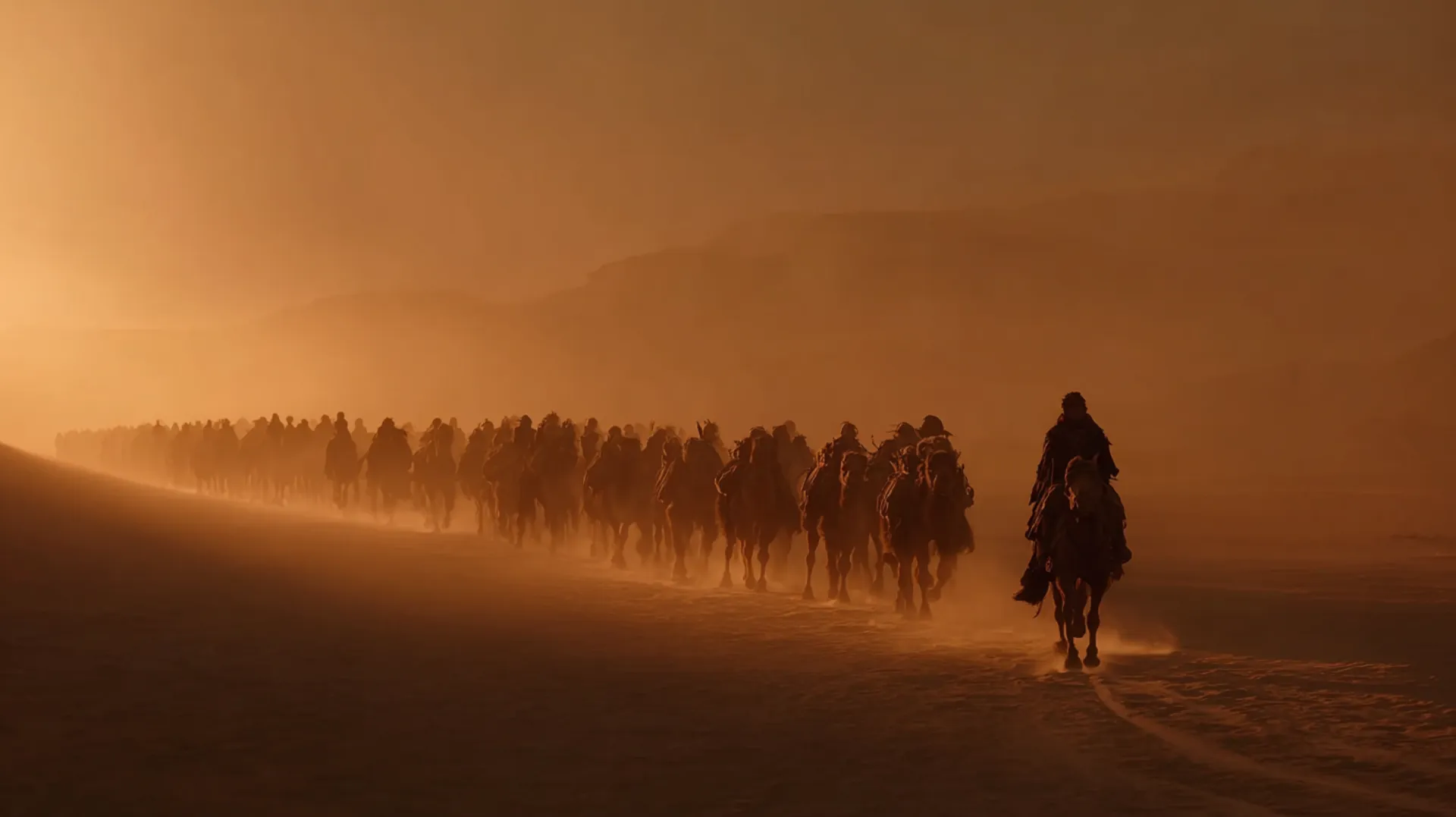
He went to his camel, untied it, and mounted. Hudhayfah had a second clear shot—a rider mounting a camel is completely exposed, defenseless for those few seconds as the animal lurches to its feet. Again, he let the moment pass. Abu Sufyan spurred his camel forward, and the army of the Quraysh followed behind him, streaming into the desert night like water draining from a broken vessel.
Armies You Could Not See
On his way back to the Muslim camp, Hudhayfah encountered something extraordinary. Al-Bayhaqi records that he came upon twenty horsemen, their faces covered with turbans, who told him: “Go tell your companion that we have done the fighting for him.” These, Hudhayfah understood, were the angels—the invisible army that Allah had dispatched alongside the wind.
He found the Prophet standing in prayer. This was the Prophet’s way, as Aisha (may Allah be pleased with her) attested in Sahih al-Bukhari: whenever he was disturbed or anxious, he would rise to pray. On this night, wrapped in a heavy blanket against the cold—the comforter from his own bed, draped over him as he stood outside in the storm—he was making supplication to the Lord of the heavens and the earth.
We know what he prayed. As recorded in Sahih al-Bukhari and Sahih Muslim, the Prophet supplicated:
“O Allah, Revealer of the Book, Swift in reckoning—defeat the confederates. O Allah, defeat them and shake the ground beneath them.”
And in another narration, preserved by Abdullah ibn Abi Awfa (may Allah be pleased with him), who memorized the supplication and sent it in a letter to fellow Companions thirty years later:
“O Allah, the One who sent down the Book, the One who drives the clouds—defeat the confederates, defeat them, and grant us victory over them.”
He had asked Allah to send the armies of the wind and the clouds. And that is precisely what Allah sent.
The Quran itself memorializes the moment:
“O you who believe, remember the favor of Allah upon you when armies came to you, and We sent upon them a wind and armies you could not see.” — Al-Ahzab (33:9)
Not a single tent of the Quraysh or Ghatafan remained standing. Not a single pot stayed upright. Not a single fire could be relit. Ibn Ishaq records that the entire coalition scattered, every man fleeing for himself, the greatest army Arabia had ever assembled reduced to a panicked rout without a single sword being drawn against them.
The Winds of Divine Aid: Saba and Dabur
A fascinating hadith in Sahih Muslim reveals a deeper dimension to the storm. The Prophet said: “I was aided by the wind of Saba, and the people of ‘Ad were destroyed by the wind of Dabur.”
Ibn Hajar al-Asqalani comments in Fath al-Bari that Saba is traditionally identified as the east wind—the same wind, some scholars say, that carried the scent of Yusuf’s shirt across the desert to his father Ya’qub (peace be upon them both). It is the wind that gathers rain clouds, a wind associated with mercy. Dabur, by contrast, is the west wind—harsher, more destructive. It was the Dabur that annihilated the ancient people of ‘Ad, as referenced in the Quran.
The distinction is theologically significant. Allah sent the merciful wind against the Quraysh—powerful enough to scatter their camp and break their morale, but not powerful enough to kill. Not a single member of the coalition died from the storm. Ibn Hajar suggests this was because Allah knew the Prophet’s love for his people and his desire that they be guided to Islam. Had Allah sent the Dabur, the Quraysh would have been annihilated—and the thousands who later embraced Islam at the Conquest of Makkah would never have lived to do so. The wind was calibrated, in its divine precision, to defeat without destroying.
The Tide Turns Forever
When Hudhayfah delivered the news—the Quraysh had fled, the siege was broken—the Prophet wrapped himself in that heavy blanket and spoke words that would echo through the centuries. As recorded in Sahih al-Bukhari, he began to recite a declaration that Muslims repeat to this day in the takbirat of Eid:
“There is no god but Allah alone. He fulfilled His promise, aided His servant, strengthened His army, and defeated the confederates alone.”
The theological weight of that final word—alone (wahdahu)—cannot be overstated. The Muslims had not needed to lift a sword. The largest army in Arabian history had been routed by a wind, by whispered suspicions, by the mysterious workings of a plan that no human strategist could have orchestrated in its totality. Nu’aym ibn Mas’ud had played his part. The Sabbath had played its part. The month-long siege had worn down morale. But above and through all of these causes, there was a cause beyond causes.
“And Allah was sufficient for the believers in battle.” — Al-Ahzab (33:25)
And then the Prophet made a declaration that marked the strategic turning point of the entire conflict between Islam and its enemies. As recorded in Musnad Ahmad:
“Now we shall march against them, and they shall never march against us.”
It was true. Never again would the Quraysh or any coalition launch an offensive against Madinah. The era of Muslim vulnerability—of desperate trenches and sleepless nights and rocks tied to empty stomachs—was over. From this moment forward, the initiative belonged to the believers.
Ten thousand strong, the confederates had come. They had not managed to kill more than a handful of Muslims—casualties countable on the fingers of one hand. They returned to Mecca humiliated, their alliance shattered, their reputation in ruins. The trench that Salman al-Farisi had proposed, that every Muslim in Madinah had dug with bleeding hands, had held. And behind the trench, the faith of the Companions had held firmer still.
Nu’aym ibn Mas’ud, who could never return to his tribe after what he had done, made hijrah to Madinah and settled there permanently—gaining the immense spiritual reward of emigration in addition to his service during the siege. He lived until the caliphate of Ali ibn Abi Talib (may Allah be pleased with him), and is reported to have died in the Battle of the Camel.
But the siege of Madinah was not yet truly over. Inside the city, behind the walls of their fortress, the Banu Qurayza waited. They had broken their treaty. They had conspired with the enemy at the moment of Madinah’s greatest vulnerability. Ka’b ibn Asad himself had admitted, in his own words, that if the coalition departed, nothing awaited his people but the sword. The coalition had departed. And now, even before the dust of the retreating Quraysh had settled, the Prophet turned his attention southward—toward a reckoning that remains one of the most debated episodes in the entire Seerah.
Quranic References
Continue Your Journey

Cite this Narrative
APA
SeerahQuest. (2026). The Wind and the Whisper. *SeerahQuest: The Eternal Narrative*. https://seerahquest.com/chapters/battle-of-khandaq-trench-part-3 Adapted from Yasir Qadhi's Seerah Series, Episode 60.
MLA
"The Wind and the Whisper." *SeerahQuest: The Eternal Narrative*, 2026, https://seerahquest.com/chapters/battle-of-khandaq-trench-part-3. Adapted from Yasir Qadhi's Seerah Series, Episode 60.
Chicago
"The Wind and the Whisper." *SeerahQuest: The Eternal Narrative*. Accessed April 3, 2026. https://seerahquest.com/chapters/battle-of-khandaq-trench-part-3. Adapted from Yasir Qadhi's Seerah Series, Episode 60.
Install SeerahQuest — read chapters offline, anytime.