The Plain of Mu'tah
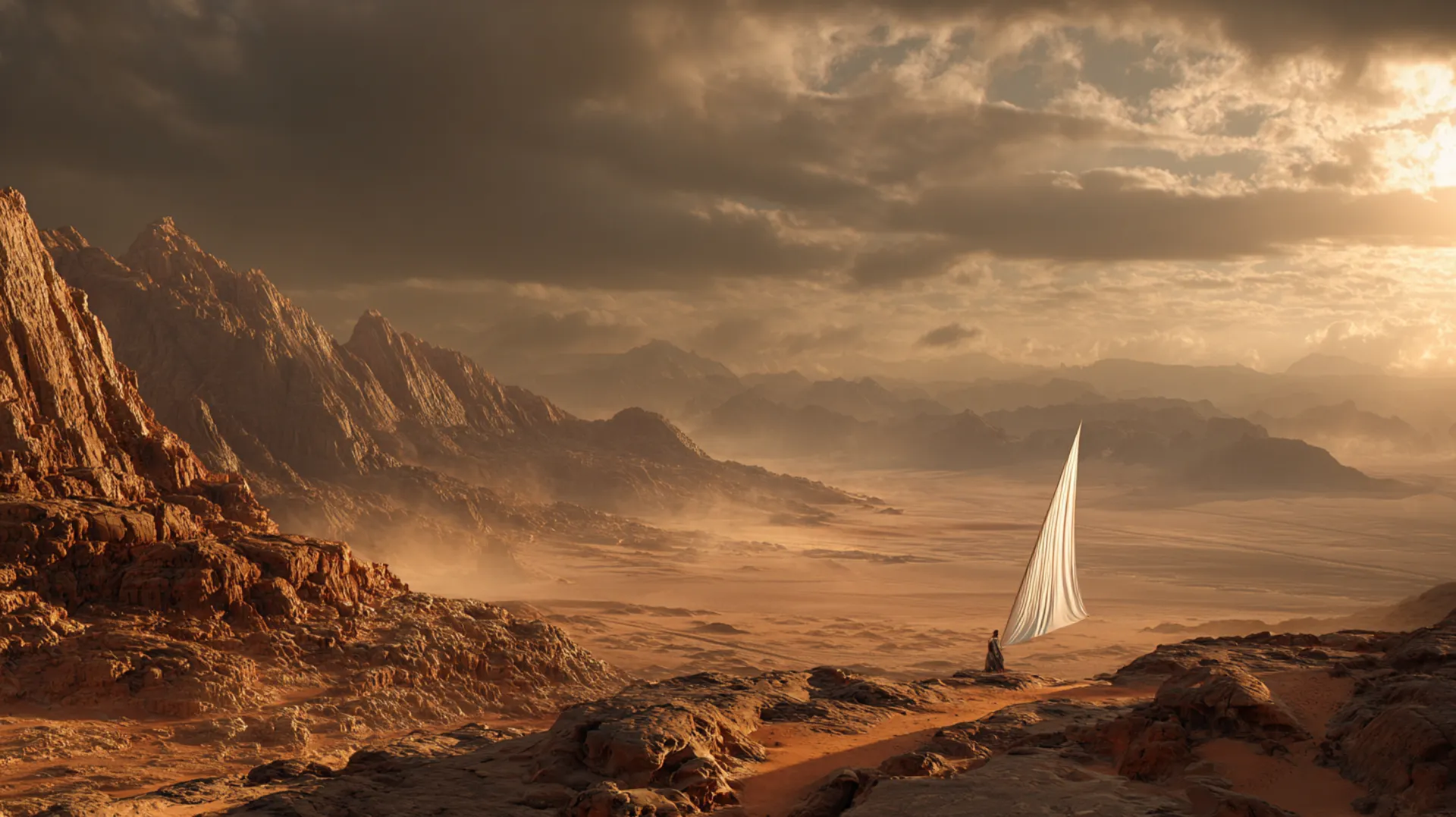
The dust rises in golden curtains over the Jordanian plateau as three thousand men march toward the edge of the known world — and three banners fall before a fourth hand catches them.
8 AH · 628 – 630 CE
The dust rises in golden curtains over the Jordanian plateau, kicked up by three thousand pairs of sandaled feet marching north into territory no Muslim army has ever entered. It is Jumada al-Ula of the eighth year of Hijrah, and the largest expeditionary force ever dispatched from Madinah is walking toward the edge of the known world — toward the frontier where Arabia ends and the Roman Empire begins. In the Prophet’s hand, before they departed, was a white banner. He passed it not to one commander, but to three, in succession, as though he could already see what the hills of Mu’tah would demand of them.
The Envoy’s Blood
To understand why three thousand men are marching seven hundred kilometers from home, we must return to a single act of savagery committed months earlier on a road winding through Ghassanid territory.
The Prophet (peace be upon him) had sent Al-Harith ibn Umayr al-Azdi northward carrying a letter — a diplomatic envoy bearing correspondence for the Roman authorities. Al-Harith never reached his destination. The Ghassanid chieftain, Sharahbeel ibn Amr, intercepted him. When Al-Harith identified himself as an ambassador — a status universally protected even among warring peoples — Sharahbeel had him bound, tortured, and then personally drove the spear that killed him.
The act was calculated provocation. The Ghassanids were Arab Christians who served as vassals of the Byzantine Empire, a buffer state between Rome and the Arabian interior. Sharahbeel’s message was unmistakable: You are seven hundred kilometers away. What can you possibly do?
For a time, the answer was nothing. The Prophet had the Quraysh to contend with, the unresolved tensions of the Hijaz to manage. But Hudaybiyyah brought a truce with Mecca. Khaybar secured the northern flank and filled the treasury. The moment the Prophet’s immediate strategic concerns were resolved, his attention turned north — to the blood of an envoy that still cried out for justice.
Scholarly Note
Al-Waqidi identifies the killing of Al-Harith ibn Umayr al-Azdi as the primary cause of the expedition. Ibn Kathir adds a secondary wisdom: that Mu’tah served as preparation for future engagements with Rome, a signal that Islam’s message was global, not confined to the Arabian Peninsula. A third possible cause — that the governor of Busra had threatened to attack the Muslims — is mentioned in some sources but is considered less convincing, as the battle did not take place at Busra nor target its forces directly.
Three Commanders, One Banner
The army assembled on a Friday morning. As recorded in a hadith narrated by Ibn Abbas (may Allah be pleased with him) in Tirmidhi, the young Companion debated whether to leave with the army or stay behind for Jumu’ah prayer with the Prophet, then catch up later. He chose the prayer. When the Prophet saw him in the masjid afterward and learned why he had stayed, he delivered a sobering rebuke:
“If you were to give in charity all the wealth of this world, you would not be able to attain the reward of having left early with them.”
The lesson cut to the bone: sometimes the extraordinary deed eclipses even the virtuous one.
But the most remarkable moment of the departure was the Prophet’s appointment of commanders. Never before — and never again — did he name three leaders in sequence for a single expedition. As recorded in Sahih al-Bukhari, he declared:
“If Zayd is killed, then Ja’far shall be in charge. And if Ja’far is killed, then Abdullah ibn Rawaha shall be in charge.”
In a version recorded by al-Bayhaqi, he added: And if Ibn Rawaha is killed, then let the Muslims choose someone from among themselves. The triple appointment was itself a prophecy wrapped in a command — an acknowledgment that this mission would exact a price unlike any before it.
Zayd ibn Harithah (may Allah be pleased with him) — the freed slave whom the Prophet had once publicly adopted at the Ka’bah, the only Companion mentioned by name in the Quran, in Surah al-Ahzab (33:37). Aisha bint Abi Bakr (may Allah be pleased with her) herself said of him: “Never did the Prophet send Zayd on an expedition except that Zayd was the one in charge. And if Zayd had been alive when the Prophet died, no one would have been chosen above him.”
Ja’far ibn Abi Talib (may Allah be pleased with him) — the Prophet’s cousin, closer to him in age than Ali, the man who had spent over a decade in Abyssinia and whose return at Khaybar had prompted the Prophet to say he did not know which brought him greater joy: the conquest of Khaybar or seeing Ja’far again.
Abdullah ibn Rawaha (may Allah be pleased with him) — the Ansari poet, one of the elite chosen at the Pledge of Aqabah, the man who had ridden the Prophet’s own camel back to Madinah to announce the victory at Badr, and who had versified defiantly before the Quraysh during Umrat al-Qada.
These were not merely soldiers. They were among the most beloved people on earth to the Prophet. And he was sending all three into the furnace.
The Poet Who Wanted to Die
As the army wound its way northward through the desert, Abdullah ibn Rawaha rode with young Zayd ibn Arqam (may Allah be pleased with him), an orphan in his care, sharing a camel. In the darkness of the journey, Ibn Rawaha began composing poetry — verses that were not war cries but prayers for martyrdom, lines aching with the desire to never return.
The poetry was so moving that young Zayd burst into tears. Ibn Rawaha tapped him with his riding stick and said, with the gentle humor of a man who has already made peace with death: “Oh foolish one, what would it matter to you if I become a shaheed and you get the whole camel to yourself on the way back?”
It was exactly what happened. Zayd ibn Arqam rode home alone.
When a Companion called out a prayer for their safe return as they departed Madinah, Ibn Rawaha versified on the spot — not a prayer for safety, but for a grave somewhere in that distant land:
“As for me, I ask for Allah’s forgiveness and a blow that is mighty, that causes the blood to gush forth, so that when people pass by my grave they shall say: Allah guided him to be a warrior, and how rightly guided he was.”
Abdullah ibn Rawaha: Poet, Warrior, and the Courage of Hesitation
Ibn Rawaha’s story at Mu’tah contains one of the most psychologically honest moments in the entire Seerah. When the battle finally came and both Zayd and Ja’far had fallen, Ibn Rawaha stood at the edge of the melee holding the banner — and he hesitated.
He had spent the entire journey composing poetry about wanting martyrdom. Now, staring at the chaos of swords and spears and the bodies of his two predecessors, his soul recoiled. And in that frozen moment, he did what poets do: he spoke to himself.
“I swear, oh my soul, you shall proceed — you shall proceed, or I will force you to proceed. The people have gathered, the clamor has risen — but what is the matter with you? You don’t want Jannah now? Surely what you have desired has eluded you for too long. What are you except a drop of fluid placed in a bag?”
This is not cowardice. It is the rawest possible portrait of human courage — the kind that exists not in the absence of fear but in its conquest. Ibn Rawaha felt every natural instinct screaming at him to turn away. He overruled them all. Then he plunged into the ranks of the enemy and died.
Some later groups have mocked this hesitation. But as scholars have noted, true bravery is precisely this: the mastery of fear, not its absence. A man who feels nothing before death is not brave — he is numb. Ibn Rawaha felt everything, and still he went forward.
The Plain of Mu’tah
The army reached the province of Ma’an in modern Jordan and received devastating intelligence. The Ghassanids, upon hearing of the approaching Muslim force — the largest ever to leave Madinah — had panicked and sent urgent messages to every ally they possessed: the tribes of Luhm, Jutham, al-Qin, and other Christian Arab confederates. They had also appealed to the Romans themselves.
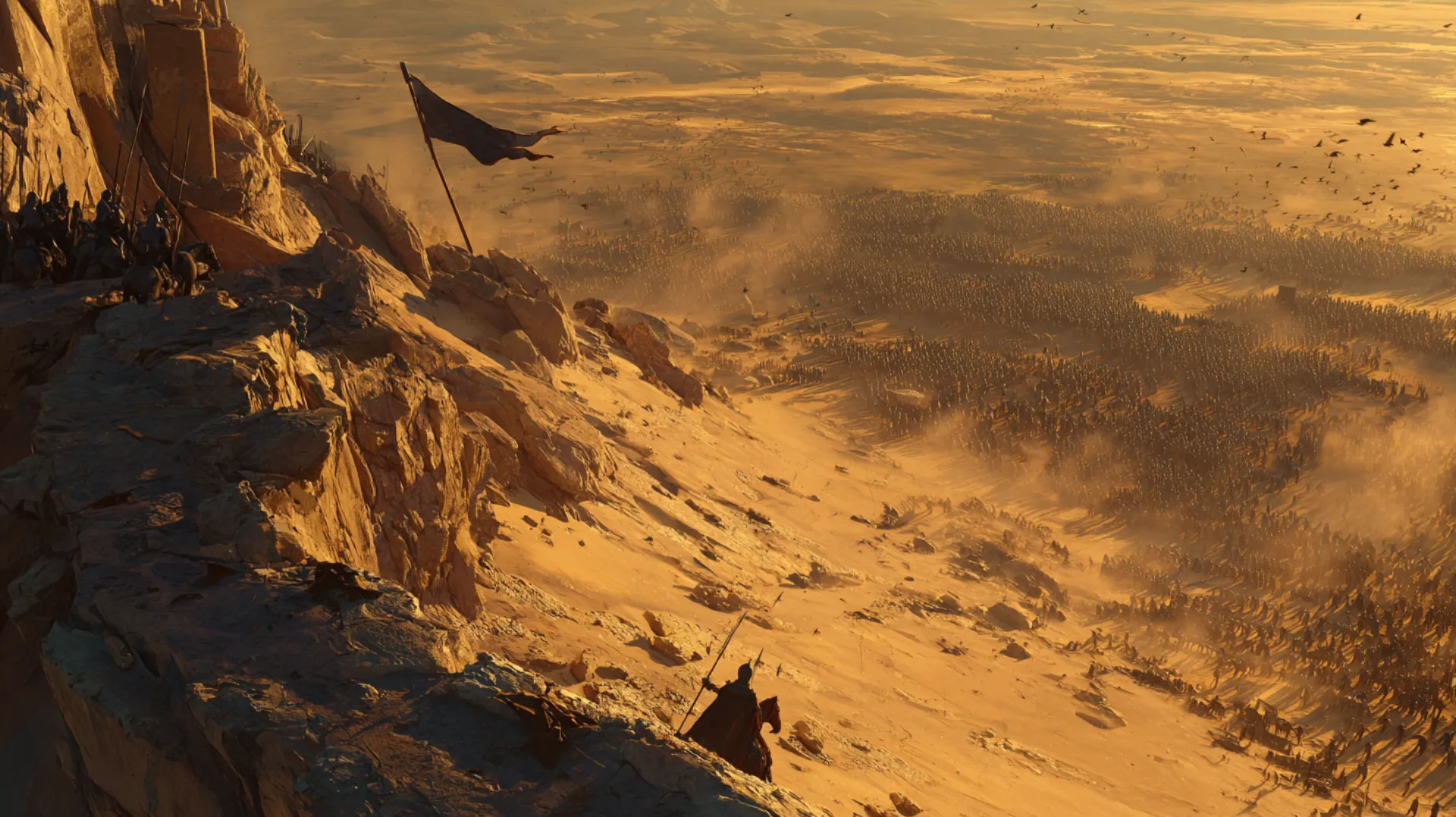
What gathered before the Muslims was not the Ghassanid force they had anticipated, but a coalition army that vastly outnumbered them.
Scholarly Note
Classical sources commonly cite 100,000 or even 200,000 enemy combatants (al-Suhayli mentions 200,000 Roman soldiers). Modern historians consider these figures to be significant exaggerations consistent with the well-documented human tendency to overestimate crowd sizes. Lieutenant General A.I. Akram, a Pakistani military historian who authored a detailed study of Khalid ibn al-Walid’s campaigns, estimates the coalition force at approximately 10,000 — still a ratio of more than three to one against the Muslims. The Romans at this stage did not view the Muslims as a major international threat and would not have committed forces on the scale of a Persian campaign. What is certain is that the Muslims were severely outnumbered and facing a qualitatively superior enemy in terms of arms, armor, and training.
The Muslim camp fell into urgent debate. For two full days they remained in a Jordanian valley, paralyzed by the enormity of what lay ahead. Three options emerged: send a messenger back to the Prophet for reinforcements or new orders (a round trip of at least two weeks), withdraw having demonstrated their reach into enemy territory, or advance.
Zayd ibn Harithah turned to Abdullah ibn Rawaha. It was a deliberate choice — Zayd knew what Ibn Rawaha would say, and he needed that eloquent tongue to rally the army.
Ibn Rawaha rose and delivered a speech that sealed their fate: “Oh my people, what you are afraid of is exactly what you are seeking.” The fear of death — was that not the very martyrdom they desired? Their terror was their treasure. The army marched forward.
They chose the ground at Mu’tah — a plain between the modern Jordanian cities of Amman and Karak, near a river that would supply water and, crucially, with a line of retreat should the worst come. The army divided into the traditional three flanks: center, right, and left. Abu Huraira (may Allah be pleased with him), participating in his first battle, stared wide-eyed at the enemy ranks. A veteran Companion chided him gently: “You were not with us at Badr. We did not win because of the size of our army.”
They expected to win.
Three Banners Fall
Zayd ibn Harithah took the white banner and charged from the center. The enemy converged on the flag — as armies always do — and Zayd was surrounded. He fought until he was overwhelmed and killed, the banner still in his grip as he fell.
Ja’far ibn Abi Talib seized the banner. What followed was one of the most extraordinary displays of individual valor in Islamic military history. Ja’far rode his horse into the thickest fighting until an enemy soldier cut the animal’s legs from under it. He rolled free, stood, and fought on foot — the banner in his right hand, his sword in his left. When his right hand was severed, he caught the falling banner with his left before it could touch the ground. When his left hand was cut off, he pressed the staff between the stumps of his arms and his chest, holding it upright by sheer will and the weight of his body.
A Roman infantryman finally struck him from behind, cleaving his body nearly in two.
Abdullah ibn Umar (may Allah be pleased with him), who participated in the battle, later searched for Ja’far’s body. He found it buried beneath a pile of the dead. As recorded in Sahih al-Bukhari, Ibn Umar said they counted over ninety stab wounds and sword cuts on Ja’far’s body — fifty on his front, forty on his back. He had never turned away.
For the rest of his life, whenever Ibn Umar passed by Ja’far’s children, he would greet them: “Peace be upon you, oh sons of the one with two wings.” Multiple hadith, which together reach the level of hasan, report that the Prophet said he saw Ja’far in Paradise, granted two wings by Allah in place of his severed hands, flying wherever he wished.
Then came Abdullah ibn Rawaha’s moment — and his hesitation, and his conquest of that hesitation, and his death.
The Sword of Allah
The banner lay in the dust. Thabit ibn Arqam (may Allah be pleased with him), a veteran of Badr, snatched it up and retreated to a safe position behind the lines. He called the surviving fighters to him: “Oh Muslims, choose a leader among yourselves!” When they offered him the command, he refused.
Their eyes settled on the newest Muslim among them. A man who had been Muslim for barely two months. A man who had caused more damage to the Muslims at Uhud, Khandaq, and Hudaybiyyah than perhaps any other single warrior. A man whose father, al-Walid ibn al-Mughirah, was the target of some of the Quran’s most severe verses.
But Islam erases what came before it. And desperate situations demand the most capable leader, regardless of seniority in faith. Every surviving fighter on that blood-soaked plain knew who among them possessed the military genius to save what remained of the army.
Khalid ibn al-Walid (may Allah be pleased with him) took the banner.
What Khalid accomplished in the hours that followed was a masterpiece of tactical withdrawal — the preservation of nearly the entire army from what should have been annihilation. The details of his maneuvering are sparsely recorded in Muslim sources, but the result is undeniable: of three thousand men, the overwhelming majority returned home alive.
Live from Madinah
Seven hundred kilometers to the south, something extraordinary was happening. As recorded in Sahih al-Bukhari and Sahih Muslim, Anas ibn Malik (may Allah be pleased with him) narrated that the Prophet informed the Companions of the battle’s events in real time — before any messenger could possibly have arrived:
“Zayd took the banner and he was struck down. Then Ja’far took it and he was struck down. Then Ibn Rawaha took it and he was struck down.” Anas said: “And his eyes were flowing with tears.” Then he said: “Until a sword from the swords of Allah took it, and Allah granted him victory.”
It was in this moment that Khalid ibn al-Walid received the title that would define him for eternity: Saifullah — the Sword of Allah. Not bestowed in a ceremony or after a great conquest, but spoken through tears over the bodies of three beloved men, in recognition of the one who had saved the rest.
Aisha bint Abi Bakr narrated, also in Sahih al-Bukhari, that when the full weight of the news settled upon the Prophet, he sat down — physically unable to stand under the grief. She watched from behind her curtain as a man came to report that the women of Ja’far’s household were wailing uncontrollably. Three times the Prophet sent the man to quiet them. Three times the man returned, confessing the women had overpowered him. Finally, the Prophet said in frustration: “Then go throw dust in their mouths.”
From behind the curtain, Aisha’s voice cracked like a whip at the hapless messenger: “Woe to you! And again, woe to you!” — rebuking him for repeatedly bringing petty complaints to a man drowning in grief. Neither could he control the women nor could he spare the Prophet this additional burden.
The Orphans of Ja’far
Three days later, the Prophet visited the household of Ja’far. He found the children — Abdullah and Muhammad — with hair so unkempt they looked, as Abdullah later recalled, “like baby chickens.” Their mother, Asma bint Umais (may Allah be pleased with her), had been too shattered to tend to them. The Prophet called for a barber and had their hair trimmed himself. Then he spoke to each child individually, finding something special in each one: Muhammad resembled his grandfather Abu Talib; Abdullah resembled the Prophet himself in appearance and character.
He raised Abdullah’s hand and prayed: “Oh Allah, allow Ja’far’s progeny to flourish. Oh Allah, bless Abdullah in all of his transactions.” He said it three times. Then he told the children what he had seen: their father had been given two wings in place of his hands, and he was flying through Paradise wherever he wished.
When Asma expressed her terror at raising orphans alone, the Prophet’s response was immediate:
“Are you afraid of poverty for them, when I am their guardian in this world and the next?”
He commanded that food be prepared for the family of Ja’far, establishing what would become a lasting sunnah: that when tragedy strikes a household, the community feeds them, not the reverse. The grieving family should never be burdened with hosting.
Victory, Defeat, or Something Else
When the survivors of Mu’tah returned to Madinah, they walked into a storm. Whispers spread through the city — some from genuinely indignant Companions, others from hypocrites seizing an opportunity. The veterans were taunted: “Oh you who fled! Have you run away from the path of Allah?” The stigma was so severe that Salama ibn Hisham (may Allah be pleased with him) refused to leave his house, unable to bear the public humiliation.
When the Prophet learned of this, he silenced the smear campaign with a single word. They called the veterans furrar — deserters. The Prophet said: “They are not furrar. They are kurrar” — those who will return to fight again. One letter changed, and shame became promise.
Scholarly Note
Scholars have disagreed on how to classify the outcome of Mu’tah. Al-Waqidi and Ibn Sa’d considered it a military defeat, noting that the Muslims failed to conquer any territory and were forced to withdraw. Musa ibn Uqba called it a great victory, likely reflecting the Prophet’s own use of the word fatah. Ibn Ishaq, Ibn Abd al-Barr, and Ibn al-Qayyim (in Zad al-Ma’ad) took a middle position: neither victory nor defeat, similar to Uhud — a draw in which neither side decisively prevailed. Each perspective contains truth. Militarily, the Muslims did not achieve their objective. Strategically, the survival of 99% of the army against a vastly superior force was itself extraordinary. And in terms of long-term impact, Mu’tah announced the Muslim presence on the Roman frontier and planted fear in the hearts of the Arab Christian tribes that would bear fruit at Tabuk and beyond.
A Battle Recorded in Two Civilizations
Remarkably, Mu’tah is one of the few events from the Prophet’s lifetime documented by both Muslim and Byzantine historians. Saint Theophanes (d. approximately 820 CE), an aristocratic Byzantine monk, recorded the battle in his Chronicles — the earliest Byzantine work to mention the Prophet Muhammad. Drawing on an Arab non-Muslim source no longer extant, Theophanes provides details absent from Islamic accounts: that the Muslims may have timed their attack to coincide with a Christian festival, and that a spy called “Qutaybas” — described as a Qurayshite in Roman pay — may have betrayed their plans to the Byzantine commander Theodore, reportedly a brother of Heraclius.
Most striking is Theophanes’ description of the battle’s conclusion. He notes that three emirs were killed (he incorrectly says four), and then writes that one “called Khalid, whom they call God’s sword, escaped.” The title Saifullah — bestowed by the Prophet in a masjid seven hundred kilometers from the battlefield — had traveled across civilizational boundaries and embedded itself in Roman imperial records. Even the enemy knew the name.
Khalid's Death and the Sword That Could Not Be Broken
Years later, Khalid ibn al-Walid lay dying — not on a battlefield, but in his bed. He wept. He asked those around him to examine his body: there was hardly a span of skin without a scar, a stab wound, or a sword mark. And yet here he was, dying of illness. For a man of warrior blood, it felt like failure.
But later scholars, including Ibn Kathir, saw profound wisdom in it. Khalid was Saifullah — the Sword of Allah. A sword does not break itself; only the one who drew it can sheathe it. If Khalid had fallen in battle, it would have meant that the Sword of Allah had been broken by a human enemy — an impossibility in its theological implications. Khalid was, in a sense, too sacred a symbol to die as a martyr on the field. His death in bed was not a denial of honor but its ultimate expression: the Sword was returned to its scabbard by the only Hand that had the right to do so.
The Garden That Must Be Pruned
In the days after the army’s return, the Prophet found his Companions gathered in the masjid, weeping. They said: “Why should we not cry, O Messenger of Allah, when the best of us and the most noble of us have departed?”
His response, narrated by Ibn Abi Shaybah and graded as hasan by Ibn Hajar, was an image of startling beauty:
“Do not cry, for the example of my ummah is like a garden whose owner prunes the branches and prepares the soil so that each year yields a better crop than the last. And the Messiah, Isa ibn Maryam, will meet this ummah, and he will find among them a group that are like you — or even better than you. Allah will not humiliate an ummah whose first is myself and whose last is the Messiah.”
The pruning metaphor was not merely consolation. It was theology. The losses at Mu’tah — Zayd, Ja’far, Ibn Rawaha — were not signs of divine abandonment but of divine cultivation. A garden that is never pruned never flourishes. The ummah’s greatest growth would come through its most painful losses.
And the reach of that garden had now extended, for the first time, to the very borders of the Roman Empire. The Arab Christian tribes who had gathered so confidently at Mu’tah now knew that the Muslims could project force seven hundred kilometers from their base and return largely intact. The psychological impact would ripple outward: when the Prophet later marched to Tabuk, many of those same tribes chose not to fight at all.
Mu’tah was not the end of the northern story. It was the prologue. The expedition that Khalid saved from destruction would become the seed of something far larger — the eventual Muslim conquest of Bilad al-Sham under the Khilafah of Umar ibn al-Khattab, culminating in the Battle of Yarmouk. The sword that was drawn at Mu’tah would not be sheathed for a generation.
But before the Muslims could look north again, the south demanded their attention. Even as the veterans of Mu’tah nursed their wounds and their grief, events were accelerating toward a confrontation much closer to home. Former enemies were arriving in Madinah to embrace Islam — among them, remarkably, the very man who had just taken the banner at Mu’tah: Khalid ibn al-Walid had converted only weeks before the battle. And he would not be the last great Qurayshi warrior to cross over. Amr ibn al-As was already on his way. The tide was turning, and it was turning toward Mecca.
Quranic References
Continue Your Journey
Cite this Narrative
APA
SeerahQuest. (2026). The Plain of Mu'tah. *SeerahQuest: The Eternal Narrative*. https://seerahquest.com/chapters/battle-of-mutah Adapted from Yasir Qadhi's Seerah Series, Episode 73, Episode 74.
MLA
"The Plain of Mu'tah." *SeerahQuest: The Eternal Narrative*, 2026, https://seerahquest.com/chapters/battle-of-mutah. Adapted from Yasir Qadhi's Seerah Series, Episode 73, Episode 74.
Chicago
"The Plain of Mu'tah." *SeerahQuest: The Eternal Narrative*. Accessed April 3, 2026. https://seerahquest.com/chapters/battle-of-mutah. Adapted from Yasir Qadhi's Seerah Series, Episode 73, Episode 74.
Install SeerahQuest — read chapters offline, anytime.