The Return in White
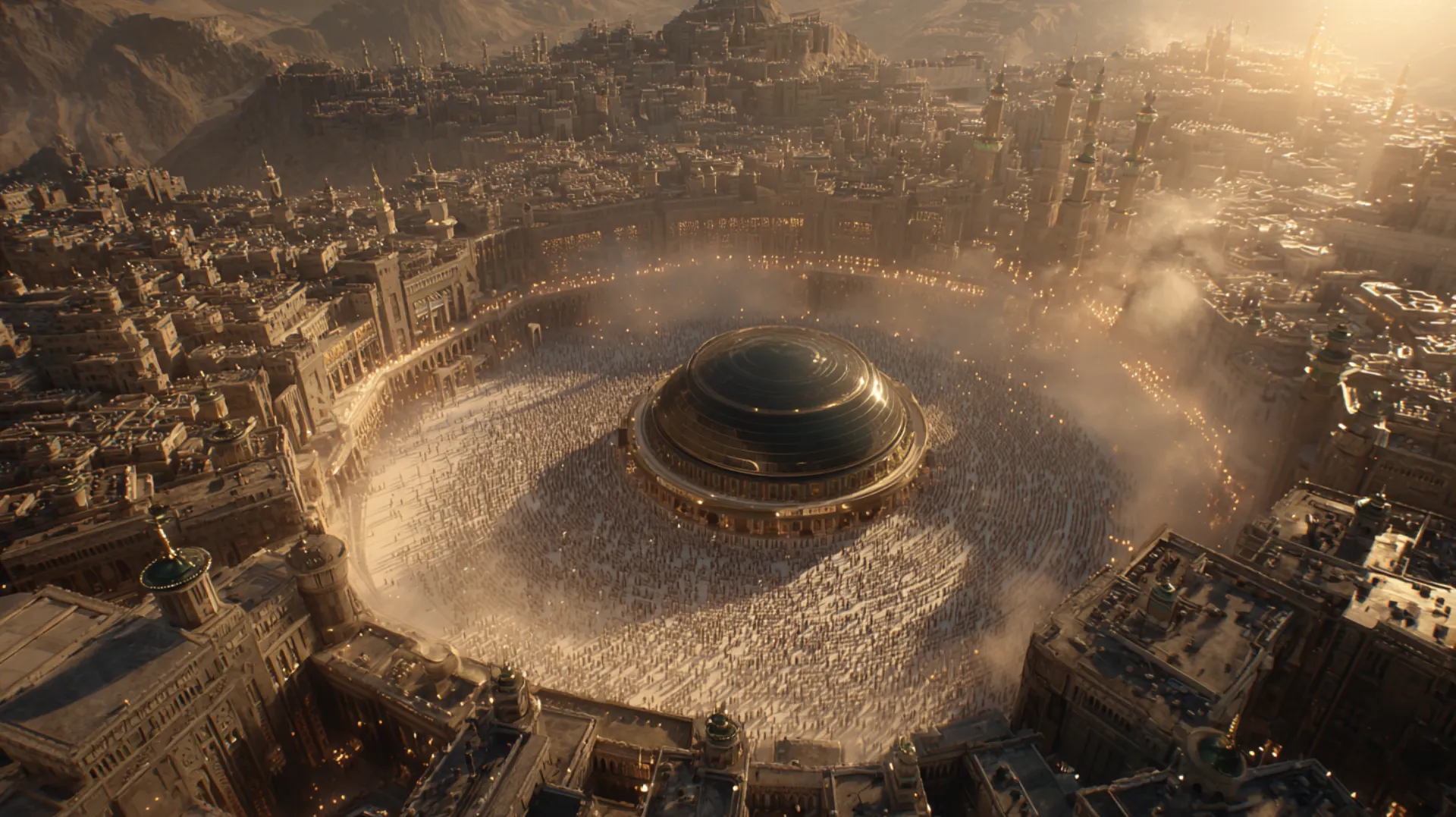
The desert road stretches south from Medina, shimmering under the heat of a Dhul Qa'dah sun. Two thousand men walk it in white — and for the first time in history, the Ka'bah hears the talbiyah of pure monotheism from a mass congregation.
7 AH · 628 – 630 CE
The desert road stretches south from Medina, shimmering under the heat of a Dhul Qa’dah sun. Two thousand men walk it in white — barefoot, unhurried, voices rising in a single refrain that has never before echoed through these valleys in such unison. Labbayka Allahumma labbayk. Labbayka la sharika laka labbayk. No partner, no exception, no idolatrous addendum. The year is the seventh of the Hijrah, and for the first time since their exile, the Muslims are going home.
Not to conquer. Not yet. To fulfill a promise — the one written in ink on leather at Hudaybiyyah barely a year ago, the one that had left the Companions stunned and Umar ibn al-Khattab (may Allah be pleased with him) pacing with frustration. Three days. That was the agreement. Three days inside Mecca, unarmed, to perform the rites of Umrah. And then they must leave.
But what would those three days mean — for the Muslims who had not seen their birthplace in nearly seven years, and for the Quraysh watching from behind locked doors as the balance of power shifted before their eyes?
The Return
The caravan that departed Medina numbered two thousand strong. The Prophet Muhammad ﷺ had learned the lessons of Hudaybiyyah well: trust was a currency the Quraysh had not yet earned. While honoring the letter of the treaty — no weapons would enter the city — he ensured that two hundred armed men remained stationed outside Mecca’s boundaries, guarding a cache of swords, shields, and spears. The pilgrims carried only their sheathed travel swords, the customary arms of any desert traveler, which the treaty permitted. Everything else waited in the hills.
It was a calculated balance: compliance and caution, faith and statecraft, all woven into a single march.
The journey itself followed the well-worn route south through the miqat of Dhul Hulaifa, where the pilgrims entered the state of ihram. Here, at this sacred waypoint nearest to Medina, the Prophet prayed two rak’ahs in what he had described as a blessed valley, donned the white garments of consecration, and pronounced the talbiyah that would carry all the way to the gates of Mecca.
Scholarly Note
The two rak’ahs prayed at Dhul Hulaifa are associated with the sanctity of the valley itself, not with the act of entering ihram. This distinction is noted by scholars of fiqh, though a number of later jurists held that two rak’ahs should be prayed upon entering ihram regardless of location. The stronger evidence, as discussed by Dr. Yasir Qadhi, suggests the prayer was specific to the valley of Dhul Hulaifa.
It was also at Dhul Hulaifa, during the Prophet’s later Hajj journey, that Asma bint Umais (may Allah be pleased with her) — the remarkable woman who had married Ja’far ibn Abi Talib, and would later marry Abu Bakr al-Siddiq and then Ali ibn Abi Talib — gave birth to Muhammad ibn Abi Bakr. But that story belongs to a later chapter. For now, the road led only one direction: toward the city the Muslims had been forced to abandon, and toward the house they had been barred from entering just twelve months before.
A City Behind Locked Doors
When the Muslims crested the final hills and Mecca spread before them — its sandstone houses clustered in the valley, the Ka’bah at its heart — the Quraysh had already made their choice. They would not watch. They would not engage. They would not so much as share the same air.
The Meccan leadership fractured into three groups, each retreating in its own way. Some barricaded themselves inside their homes, bolting doors for the duration. Others congregated in the Dar al-Nadwa, the great council hall that had served as the Quraysh’s parliament for generations, locking themselves inside its spacious walls. And a third group simply left — abandoning the city entirely, camping in the surrounding valleys and hills for three days, waiting for the Muslims to depart.
It was a posture of defiance dressed as indifference. But beneath it lay something the Quraysh could not conceal: fear. Six and a half years had passed since the Hijrah. In that time, the Muslims had survived Badr, endured Uhud, broken the siege of Khandaq, neutralized Khaybar, and negotiated a treaty that the Quraysh themselves had sought. The balance of power was no longer shifting — it had shifted. The Quraysh knew it. And now, watching two thousand Muslims pour into their city, they felt it.
From behind the walls of Dar al-Nadwa, someone launched a rumor: the Muslims had returned as weaklings. The diseases of Medina — the fevers and plagues that thrived in its agricultural lowlands, so different from Mecca’s harsh, dry climate — had ravaged them. They were thin, emaciated, broken. The women and children of Mecca, who had not seen their emigrant relatives in nearly seven years, were told not to feel sympathy. These people were shells of who they once were.
The rumor reached the Prophet. His response was immediate and threefold.
First, he commanded the Muslims to raise their voices with the talbiyah — loud, resonant, unmistakable. The sound would fill every street and alley of Mecca, penetrating every locked door and shuttered window.
Second, he ordered the men to expose their right shoulders during tawaf — the practice known as idtiba’ — baring the muscle and sinew of arms that had wielded swords at Badr and dug trenches at Khandaq.
Third, he instructed them to perform raml during the first three circuits of tawaf: a brisk, almost running stride, shoulders squared, chests forward. Not quite a sprint, but as fast as a man can walk without breaking into a run. It was a display of vigor, of health, of power.
And it worked. From their vantage points — peering through cracks in doors, watching from hilltops — the Quraysh saw not the broken remnants of a plague-ridden community, but a disciplined, energetic force moving around the Ka’bah with a confidence that bordered on triumph. “By God,” they murmured to one another, “there is nothing wrong with them. We have never seen them more energetic than this.”
The Prophetic Use of Image and Demonstration
The Prophet’s response to the Quraysh rumor reveals a consistent pattern throughout the Seerah: the deliberate, strategic use of image and demonstration as a tool of da’wah and statecraft. This was not vanity. It was not capitulation to enemy expectations. It was the intelligent presentation of truth in a form the audience could understand.
At Uhud, when Abu Dujana (may Allah be pleased with him) donned his red turban and strode between the ranks with a swagger that would ordinarily be considered arrogant, the Prophet did not rebuke him. Instead, he observed that this was “a walk that Allah despises — except at such a time and place.” At Hudaybiyyah, when a Meccan envoy from a tribe that venerated camels was sent to negotiate, the Prophet ordered the sacrificial animals paraded before him — hundreds of garlanded camels, a sight designed to communicate piety and abundance in a language the envoy understood.
The principle is consistent: present the truth of Islam in whatever form will reach the hearts of those watching. When the Quraysh said the Muslims were weak, the Prophet showed strength. When an envoy valued livestock, the Prophet showed him livestock. The religion itself never changed — but the emphasis, the framing, the presentation adapted to the moment. This is what modern discourse might call public relations, and the Seerah treats it not as a concession but as a prophetic methodology.
The critical boundary, as scholars note, is that this adaptation never extends to altering theology or ethics. The Prophet never changed what Islam taught in order to impress an audience. He changed how that teaching was communicated. The distinction is essential — and it remains relevant for Muslim communities navigating the perceptions and misperceptions of the modern world.
The First Tawaf of Its Kind
Imagine the scene. Two thousand men in white ihram, circling the Ka’bah in unison. The talbiyah — purified of the polytheistic additions the Quraysh had appended for generations — rising from two thousand throats simultaneously. Labbayka Allahumma labbayk. Labbayka la sharika laka labbayk. Innal hamda wan-ni’mata laka wal-mulk. La sharika lak.
No “except a partner who belongs to You.” No idolatrous caveat. Pure monotheism, proclaimed at a volume that made the walls of Mecca vibrate.
Never before in recorded history had this happened. In the time of Ibrahim and Isma’il (peace be upon them), the tawaf had been performed by a handful. In the centuries of Jahiliyyah, the Quraysh had their own rituals — some performed tawaf naked, others added their polytheistic formulas to the talbiyah. Never had the Ka’bah witnessed what it witnessed now: a mass congregation of monotheists, dressed identically, moving identically, proclaiming the Oneness of God with a single voice.
This was the image that would break the Quraysh — not a sword, not a siege, but the sight of Islam’s inevitability made visible. And it is no coincidence that the three most significant conversions before the Conquest of Mecca occurred in the immediate aftermath of this Umrah.
Three Days of Silence — and a Marriage
The books of Seerah offer almost no details about the three days the Muslims spent inside Mecca, which itself tells us something: nothing extraordinary happened. The Prophet led the five daily prayers before the Ka’bah. The Muslims performed their rites in peace. The Quraysh, to their credit or their calculation, honored the treaty and did not interfere.
But we can imagine what the sources do not record. The Prophet walking through streets he had not seen in over six years. Passing the house where Khadijah bint Khuwaylid (may Allah be pleased with her) had lived — the woman who had been his first believer, his confidante, his shelter during the earliest and most brutal years of revelation. Seeing the alley where Abu Talib had defended him, the hills where he had played as a child, the very stones that held fifty-three years of memory. Anyone who has returned to a childhood home after a long absence knows the flood of emotion that accompanies the encounter — every corner triggering a memory thought forgotten. For the Prophet, those memories encompassed not only personal joy and grief, but the entire arc of revelation itself.
The two hundred guards stationed outside Mecca were rotated in, so that every Muslim in the caravan had the opportunity to perform the Umrah. It was an orderly, disciplined operation — and a quiet one. The sources record no confrontations, no provocations, no incidents of any kind.
Then, as the three days drew to a close, Abbas ibn Abd al-Muttalib (may Allah be pleased with him) — the Prophet’s uncle, whose wife Umm al-Fadl bint al-Harith was among the earliest Muslim women — approached with a suggestion. His sister-in-law Maymuna bint al-Harith had recently been widowed. She was a Muslim living alone in Mecca among pagans, with no one to care for her. She had asked Umm al-Fadl to find her a husband, and Umm al-Fadl had turned to Abbas.
Abbas went directly to the Prophet and offered himself as Maymuna’s wali — her marriage guardian. He praised her character, and the Prophet, who had known Maymuna since the days of Mecca, agreed to the marriage. Abbas officiated the contract.
Maymuna would be the last wife the Prophet ever married, and she would also be the last of the Mothers of the Believers to pass away, dying in the sixty-first year of the Hijrah.
Scholarly Note
A significant controversy exists in the books of fiqh regarding whether the marriage contract was signed while the Prophet was still in the state of ihram. Ibn Abbas (may Allah be pleased with him), who was Maymuna’s nephew, narrated that the Prophet married her while in ihram — an authentic report that raises legal complications, since marriage contracts during ihram are generally prohibited. However, Maymuna herself narrated that the Prophet married her after he had exited the state of ihram, in a state of hill (normal, non-consecrated status). The majority of scholars accept Maymuna’s own testimony as more authoritative, noting that Ibn Abbas may have been mistaken or may have used “in ihram” loosely to mean “in Mecca, within the sacred precincts.” By unanimous consensus, the marriage was not consummated until after the Muslims left Mecca, at a place called Sarif — the very same location where, decades later, Maymuna would pass away and be buried.
”Let Me Be a Groom Among You”
On the third day, the Quraysh sent their message: time is up. Three days. Leave.
The Prophet attempted to renegotiate. His approach was disarming in its simplicity: “What harm would it do if I stayed a little longer? I have just married. Let me celebrate among you. Come tomorrow, and we will share a feast together.”
It was an invitation wrapped in warmth — the newly married man asking his neighbors to join in his joy. But it was also a strategic overture. These were the same people who had fought at Badr, Uhud, and Khandaq. The same people who had driven the Muslims from their homes. Yet here was the Prophet, in a position of growing strength, extending not a threat but a plate of food. The goal was not conquest but hearts. If the Quraysh had accepted — if they had sat and broken bread with the Muslims, shared in the celebration, seen the Prophet not as an enemy but as a kinsman — another chapter of history might have been written.
But the Quraysh would not budge. Their leaders understood, perhaps instinctively, that intimacy was more dangerous than hostility. To eat with the Muslims was to humanize them. To celebrate with them was to normalize them. And so the response came back blunt and dismissive: “We don’t need your food. Three days. Get out.”
The Prophet honored the treaty. He gathered the Muslims and departed without incident, consummating his marriage to Maymuna only after they had camped for the night at Sarif, outside Mecca’s boundaries.
The Orphan Who Ran
As the Muslim caravan filed out of Mecca, a small figure came running after them. A girl, six or seven years old, calling out: “Oh my uncle! Oh my uncle! Take me! Don’t leave me in Mecca!”
Her name was Umara, and she was the daughter of Hamza ibn Abd al-Muttalib — the Lion of God, martyred at Uhud four years earlier. Hamza had divorced her mother, Salma bint Umais, before his death, and the child had been left in Mecca with extended family. She was an orphan among pagans, and whatever she had seen of the Muslims during those three days — or whatever she had heard in the years before — had been enough. She did not want to stay.
Three men immediately stepped forward to claim guardianship. Ali ibn Abi Talib (may Allah be pleased with him) took her by the hand and gave her to his wife Fatimah, declaring that she would be their ward. Zayd ibn Haritha (may Allah be pleased with him) protested: the Prophet had made him Hamza’s brother during the early days of the Hijrah, making Umara effectively his niece. Ja’far ibn Abi Talib (may Allah be pleased with him) argued that he held the same cousinship as Ali, but with an additional claim — his wife, Asma bint Umais, was Umara’s maternal aunt (khala), the sister of her mother Salma.
The dispute grew heated. Each man brought his merits, his lineage, his claim of closest relationship. And here, in this small scene on the road out of Mecca, Islam’s transformation of Arabian society was made visible. A generation earlier, a female orphan would have been a burden at best, a victim at worst. The pre-Islamic Arabs buried their daughters alive. Now three of the Prophet’s most distinguished Companions were arguing — passionately, insistently — over the honor of raising one.
The Prophet resolved the matter with characteristic diplomacy, praising each man before rendering his decision. To Ali, he said: “You are from me and I am from you.” To Zayd: “You are our brother and our protector.” To Ja’far: “You resemble me the most, in appearance and in character.”
Then he ruled: Umara would go to Ja’far, because “al-khala bi-manzilat al-umm” — the maternal aunt holds the status of the mother. Asma bint Umais, as Umara’s khala, had the strongest claim to custodianship.
Scholarly Note
This ruling became a foundational hadith in Islamic family law regarding child custody (hadanah). Three of the four major schools of jurisprudence (Hanafi, Maliki, and Shafi’i) hold that the maternal aunt (khala) takes precedence over the paternal aunt (‘amma) in custody disputes, citing this incident as primary evidence. The Hanbali school, in one narration, argues that the paternal aunt takes precedence, citing the stronger inheritance rights of paternal relatives. The dispute illustrates how a single prophetic ruling on a desert road became the basis for centuries of legal deliberation.
The Tide That Could Not Be Turned
The Umrat al-Qada was not a battle. No swords were drawn, no blood was spilled. Yet it may have been the most decisive event between the Treaty of Hudaybiyyah and the Conquest of Mecca. What the Quraysh witnessed during those three days — the discipline, the numbers, the energy, the unified voice of monotheism echoing through their own streets — shattered whatever remained of their collective confidence.
The proof came in the conversions that followed almost immediately.
Khalid ibn al-Walid, the military genius who had turned the tide at Uhud and nearly breached the trench at Khandaq, had been watching the trajectory of events with a soldier’s pragmatism. In his own words, narrated by Ibn Kathir and others, he said: “I have witnessed all of these battles against Muhammad, and every time I have sensed that I am being turned away — that something beyond me is at work.” The final straw had been Hudaybiyyah, where the Prophet outmaneuvered him tactically and where, during the Muslims’ prayer, Khalid had planned to attack during prostration — only for the revelation of Salat al-Khawf to neutralize his strategy in real time, as if the Prophet could read his thoughts.
After the Umrah, Khalid received a letter from his older brother Al-Walid ibn Al-Walid, who had embraced Islam as a prisoner at Badr. The letter was direct: “I have not seen anything stranger than you running away from Islam, and you are as smart as you are. For how long will you oppose this? The Prophet asked about you when he came to Mecca. He said, ‘Where is Khalid? Someone like him should not neglect Islam.’”
Amr ibn al-As, the Quraysh’s most accomplished diplomat, had fled Mecca after Khandaq, seeking refuge with the Negus of Abyssinia — only to discover that the very emperor he had hoped would shelter him from Islam was himself a Muslim. The Negus’s anger at Amr’s request to kill the Prophet’s envoy was volcanic: “Do you ask me to hand over to you the envoy of the one upon whom the Great Spirit descends — the same spirit that came to Musa?” Overwhelmed, Amr accepted Islam on the spot, giving his pledge to the Negus on behalf of the Prophet.
And Uthman ibn Talha, the keeper of the Ka’bah’s keys, joined them — the symbolic custodian of the most sacred site in Arabia, walking away from the Quraysh toward Medina.
The three men met on the road — Khalid and Uthman heading north, Amr returning from Abyssinia — and realized they shared the same destination. They entered Medina together, the last batch of converts before the Conquest. When Amr’s turn came to pledge allegiance, he hesitated, pulling his hand back. The Prophet asked, “What is the matter, Amr?” Amr replied: “I have a condition — that all my past sins be forgiven.”
The Prophet’s response, as recorded in Sahih Muslim (121), became one of the most celebrated hadith on redemption:
“Do you not know, O Amr, that Islam wipes away everything before it, that migration wipes away everything before it, and that Hajj wipes away everything before it?”
Three men — the sword of the Quraysh, its voice, and its key — had walked away. The message was unmistakable. As the Quran itself would later affirm, distinguishing between those who embraced Islam before and after the Conquest:
“Not equal among you are those who spent and fought before the Conquest and those who did so after. Those are greater in degree than those who spent and fought afterward. But to all, Allah has promised the best.” — Al-Hadid (57:10)
The Umrat al-Qada had been three days of prayer and pilgrimage. But in its aftermath, the last pillars of Qurayshi resistance began to crumble. The Conquest of Mecca was now not a question of whether but when — and the answer was less than two years away. But before that day would come, the Muslim community would face its first encounter with a superpower, on a battlefield far to the north, where three commanders would fall in succession and an untested general would earn the title that would define him forever. The road from Mecca led next to Mu’tah.
Quranic References
Continue Your Journey

Cite this Narrative
APA
SeerahQuest. (2026). The Return in White. *SeerahQuest: The Eternal Narrative*. https://seerahquest.com/chapters/umrat-al-qada-compensatory-umrah Adapted from Yasir Qadhi's Seerah Series, Episode 72.
MLA
"The Return in White." *SeerahQuest: The Eternal Narrative*, 2026, https://seerahquest.com/chapters/umrat-al-qada-compensatory-umrah. Adapted from Yasir Qadhi's Seerah Series, Episode 72.
Chicago
"The Return in White." *SeerahQuest: The Eternal Narrative*. Accessed April 3, 2026. https://seerahquest.com/chapters/umrat-al-qada-compensatory-umrah. Adapted from Yasir Qadhi's Seerah Series, Episode 72.
Install SeerahQuest — read chapters offline, anytime.