The Bow Strike and the Unsheathed Sword
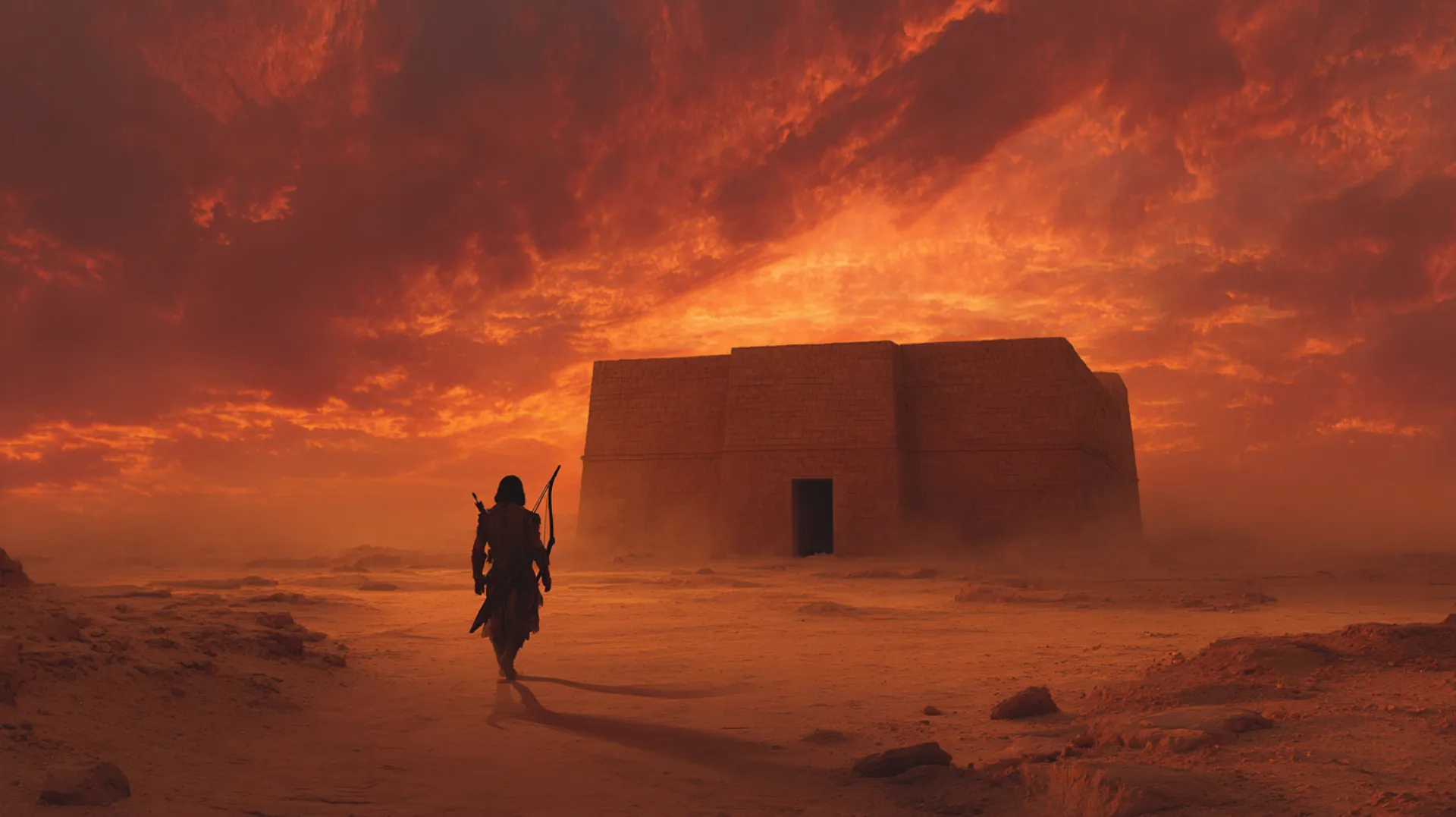
The crack of a hunting bow against a man's face echoes across the Ka'bah courtyard, and in that single impulsive act of violence, the trajectory of early Islam shifts forever.
pre-hijra · 613 – 616 CE
The crack of a hunting bow against a man’s face echoes across the courtyard of the Ka’bah, and in that single, impulsive act of violence, the trajectory of early Islam shifts forever.
It is the sixth year of the Prophet’s mission — roughly 616 CE — and Mecca is a city hollowed out by departure. More than a hundred believers have crossed the Red Sea to Abyssinia, leaving behind perhaps three dozen Muslim men in the shadow of the Ka’bah. The community is smaller than it has ever been, fragile, exposed. And then, in the span of three extraordinary days, two of the most physically imposing and politically significant men in the city declare their faith — and nothing in Mecca will ever be the same.
The Hunter Returns
Hamza ibn Abd al-Muttalib (may Allah be pleased with him) was a man built for the wild places. The uncle of the Prophet Muhammad (peace be upon him), he was renowned across the Hijaz as an archer and hunter, a man who disappeared for days into the desert valleys and returned laden with game. He was also the son of Abd al-Muttalib, the late patriarch of the Banu Hashim — which made him, by blood and by reputation, one of the most respected men in Mecca. His physical strength was legendary. When Hamza walked through the marketplace, men stepped aside.
It was his custom, upon returning from a hunting expedition, to go first to the Ka’bah and perform tawaf before heading home. This was the practice of most Meccans — a gesture of reverence toward the ancient sanctuary that sat at the heart of their city and their identity.
On this particular day, Hamza had been away. He did not know what had happened in his absence. But the women of the Banu Hashim knew, and they were seething.
While Hamza had been tracking game in the desert, Abu Jahl — Amr ibn Hisham of the Banu Makhzum — had stationed himself near the hill of Safa and unleashed a torrent of abuse upon the Prophet. This was not the usual sneering or political posturing. Abu Jahl had been in a foul mood, and he had cursed the Prophet and his ancestors with a viciousness that went beyond anything he had done before. The Prophet had stood in silence, absorbing every word, saying nothing in return. And then Abu Jahl had walked away, satisfied.
The insult was public. The whole of Mecca had witnessed it. And crucially, no man of the Banu Hashim had been present to respond.
For the women of the clan, this was intolerable. It did not matter whether they believed in Muhammad’s message or not. A man of the Banu Makhzum had stood in public and humiliated a son of the Banu Hashim, and no one had defended him. This was a matter of tribal honor — the currency upon which all of Arabian social life was built.
So when Hamza arrived at the Ka’bah, still dusty from the road, his bow slung over his shoulder and his hunting equipment strapped to his back, the women were waiting. They taunted him. What kind of uncle are you? What kind of leader of the Banu Hashim are you, when your own nephew is dragged through the mud and no one lifts a finger? Where is your honor?
Hamza’s blood began to boil. He demanded details. They gave him every word Abu Jahl had spoken. He asked the question that mattered most to a man of his pride: Did others see? Was this public?
All of Mecca saw it, they told him. Everyone.
He did not go home. He did not remove his hunting gear. He marched straight across the courtyard of the Ka’bah to where Abu Jahl sat among his companions, raised his bow, and struck him across the face.
A Declaration Unplanned
What happened next was something Hamza himself had not anticipated. Standing over Abu Jahl, trembling with rage, he heard words come out of his own mouth that he had never planned to say:
How dare you curse my nephew — and I too am a follower of his religion!
The courtyard fell silent. Abu Jahl’s companions from the Banu Makhzum leapt to their feet, ready to retaliate. But Abu Jahl, nursing his wounded face, waved them down. “Leave him be,” he said. “By Allah, today I cursed his nephew like I have never cursed him before.” Even Abu Jahl understood: Hamza’s fury was justified by the codes they all lived by.
But Hamza was now in a crisis of his own making. He had not intended to accept Islam. He had spoken from what the Quran itself describes as hamiyyat al-jahiliyyah — the fierce, tribal pride of the pre-Islamic age. He had declared himself a Muslim in front of the entire Meccan assembly, and he was not sure he believed a word of it.
Scholarly Note
The account of Hamza’s conversion is narrated through Ibn Ishaq’s seerah and preserved in Ibn Hisham’s recension. The detail of his striking Abu Jahl with the bow and his spontaneous declaration of faith is widely accepted among seerah scholars. The Quranic phrase hamiyyat al-jahiliyyah (“the zealotry of ignorance”) appears in Al-Fath (48:26), though its application to Hamza’s initial motivation is a scholarly observation rather than a direct tafsir of that verse.
He returned home that night in a state of confusion. He had declared himself upon the religion of his nephew in a moment of fury. He could not take it back — the humiliation of a public retraction would be worse than anything Abu Jahl had said. But neither could he simply pretend. He did not know if this message was true.
And so Hamza did the only thing left to him. He raised his hands and made a supplication to God: O Allah, You know that I am one of the leaders of the Quraysh. I have now said something that I do not know the truth of. I cannot take it back. If this matter is true, then cause my heart to be guided to it. And if it is not true, then cause me to die right now.
He spent the most miserable night of his life.
Dawn at the Prophet’s Door
The next morning, Hamza went to the Prophet and laid everything bare. He explained what had happened — the anger, the blow, the declaration he had not meant to make. He was honest: he had not intended to convert. He did not know what he believed. What should he do now?
The Prophet stood and began to speak to him. He admonished him, explained the message of Islam, exhorted him toward the truth of la ilaha illallah. We do not have the exact words of this conversation — to invent them would be to put words in the Prophet’s mouth — but we know its outcome. After that single sitting, Hamza ibn Abd al-Muttalib said: “I testify that you are a truthful person. You are speaking the truth. I never want to return to the paganism or the religion of my forefathers.”
What had begun as tribal rage ended as genuine faith. Hamza’s prayer the night before had been answered — not with death, but with the opening of his heart. He would go on to become the greatest warrior in early Islamic history, earning the title Sayyid al-Shuhada — the Master of the Martyrs — at the Battle of Uhud years later.
His conversion sent shockwaves through Mecca. This was the most senior Qurayshi to accept Islam to date — the son of Abd al-Muttalib himself, the brother of Abu Talib the chieftain. Ibn Hisham records that after Hamza’s conversion, the Quraysh were forced to tone down their harassment of the Prophet and the Muslims. They could no longer act with impunity when a man of Hamza’s stature stood on the other side.
The Power of Strategic Conversions
The Prophet’s supplication recorded in Sunan al-Tirmidhi reveals a striking strategic awareness alongside his spiritual reliance on God. Ibn Umar narrates that the Prophet had prayed: “O Allah, bring glory to Islam with whichever of these two men is more beloved to You — Abu Jahl or Umar ibn al-Khattab.” These were the two most powerful enemies of Islam at the time — physically imposing, politically connected, and relentlessly hostile. The Prophet understood that the conversion of a single influential figure could accomplish what years of quiet preaching among the vulnerable could not.
This is not cynicism; it is prophetic wisdom. The early Muslim community was overwhelmingly composed of the young, the poor, the enslaved, and the marginalized. What they lacked was a shield — someone whose social standing alone could create space for the faith to breathe. Hamza provided that shield first. Three days later, Umar would provide an even greater one. Together, they transformed Islam from a persecuted underground movement into a force that could pray publicly at the Ka’bah for the first time.
Three Days Later: The Sword That Changed Direction
If Hamza’s conversion was an earthquake, what followed three days later was the aftershock that reshaped the landscape entirely. Umar ibn al-Khattab (may Allah be pleased with him) — the man whom no one in Mecca believed could ever accept Islam — walked into the house of al-Arqam with a sword in his hand and walked out a Muslim.
But his conversion was not a single moment. It was a series of encounters, each one cracking the wall of his resistance a little further, until the final blow brought it all crashing down.
The first crack had come on a quiet night at the Ka’bah. Umar had gone out looking for his drinking companions and found none of them. Restless, he had wandered to the sanctuary to perform tawaf. There, in the darkness, he heard the Prophet praying alone, reciting Surah al-Haqqa.
Umar crept closer, intending harm. But the words stopped him. As he narrates himself — in a first-person account recorded in the collections of Imam Ahmad — he stood behind the Prophet and listened. The surah’s opening verses struck him with their rhythmic power:
“Al-Haqqa. What is the Inevitable Reality? And what will make you know what the Inevitable Reality is?” (Al-Haqqa, 69:1-3)
Umar was amazed at the composition. And then, silently, he thought to himself: This must be the work of a poet, just as the Quraysh say. The very next verse the Prophet recited answered him:
“It is not the word of a poet — little do you believe.” (Al-Haqqa, 69:41)
Startled, Umar thought: Then perhaps he is a soothsayer, a kahin. And the Prophet recited:
“Nor is it the word of a soothsayer — little do you reflect.” (Al-Haqqa, 69:42)
Then where is it from?
“It is a revelation sent down from the Lord of all the worlds.” (Al-Haqqa, 69:43)
What if he is inventing it?
“And if he had fabricated against Us some false sayings, We would certainly have seized him by the right hand, then We would certainly have cut his life-vein.” (Al-Haqqa, 69:44-46)
Every doubt that flickered through Umar’s mind was answered, in real time, by verses he had never heard before, recited by a man who did not even know he was there. It was, as Umar himself later described it, a conversation between God and his own soul, conducted through the Prophet’s unwitting recitation.
“That,” Umar said, “was the first time Islam entered my heart.”
Scholarly Note
Multiple narrations exist regarding the stages of Umar’s conversion. Ibn Ishaq provides the well-known account involving his sister Fatimah bint al-Khattab and the reading of Surah Taha, while the account of Umar listening to Surah al-Haqqa at the Ka’bah is recorded in the Musnad of Imam Ahmad. Scholars generally reconcile these as sequential events — the Haqqa incident softening his heart first, followed by the encounter at his sister’s house and his final acceptance at Dar al-Arqam. The hadith about the Prophet’s supplication for either Abu Jahl or Umar is recorded in Sunan al-Tirmidhi.
The Sword, the Sister, and the Scroll
But Umar did not convert that night. The seed had been planted, but the old hostility still held. Some time later, Abu Jahl publicly offered a bounty — a hundred camels, red and black, plus a hundred pouches of silver — to anyone who would kill the Prophet. Umar, tempted by the reward and driven by the lingering resentment of his upbringing, strapped on his sword and set out through the streets of Mecca.
He was intercepted by Nu’aym ibn Abdullah (may Allah be pleased with him), a secret Muslim who saw the murder in Umar’s eyes and panicked. Thinking quickly, Nu’aym diverted him: “Before you go after Muhammad, perhaps you should fix your own household first. Your sister and her husband have accepted his religion.”
The deflection worked — but not as Nu’aym intended. Umar, now incandescent with rage at this new humiliation, turned toward his sister’s house. As he approached the door, he heard the murmur of Quranic recitation from within. Khabbab ibn al-Arat (may Allah be pleased with him) — the former slave who had been tortured by his mistress for his faith — had been assigned by the Prophet as their teacher. When they heard Umar’s pounding at the door, Khabbab was hidden away and Fatimah bint al-Khattab concealed the parchment of Quran beneath her skirt.
Umar burst in. He demanded to know what he had heard. They denied it. He lunged at his brother-in-law Saeed ibn Zayd (may Allah be pleased with him), and when Fatimah stepped between them, Umar’s blow struck her instead. Her lip split open. Blood ran down her face.
And then — in a moment that mirrors Hamza’s own turning point — the sight of his sister’s blood broke something inside him. Fatimah and Saeed, bleeding and defiant, declared together: “Yes, we have accepted Islam. Do as you please.”
Their courage disarmed him. He asked, quietly now, to see what they had been reading. Fatimah insisted he purify himself first — even in this early, persecuted stage, the Muslims understood that the Quran was sacred and required ritual cleanliness to handle. Umar washed, took the parchment, and read the opening of Surah Taha:
“Ta Ha. We have not sent down the Quran upon you to cause you distress, but only as a reminder for those who fear Allah.” (Taha, 20:1-3)
Islam entered his heart completely.
Allahu Akbar in the House of al-Arqam
Umar asked where the Prophet was. Saeed, seeing that his eyes had changed entirely, revealed the most closely guarded secret in Mecca: he is in the house of al-Arqam.
Umar arrived at the door still carrying his sword — he had never let go of it. When the Companions inside saw him through the cracks, they trembled. But Hamza, the fresh convert of only three days, spoke with the confidence of a man who had already crossed his own threshold of fear: “Let him in. If Allah wants good, he will accept Islam. And if not, the very sword he carries will be the end of him.”
They opened the door, gripped Umar by both arms, and escorted him before the Prophet. Ibn Ishaq records that the Prophet seized Umar by his collar, pulled him close, and said directly: “O son of al-Khattab, what brings you here? By Allah, if you continue on this path, Allah will destroy you with a punishment.”
Umar’s response came without hesitation: “O Messenger of Allah, I have come to believe in Allah, and in you, and to testify to the truth.”
The Prophet exclaimed Allahu Akbar so loudly that every person in the house of al-Arqam knew what had happened.
The First Public Prayer
What followed was unprecedented. For the first time since the beginning of the Prophet’s mission, the Muslims marched openly to the Ka’bah. Approximately forty of them formed two rows. Hamza led one. Umar led the other. The two newest converts — the two men whom no one in Mecca dared confront — walked at the front, and behind them, for the first time, the believers prayed in public congregation at the House of God.
It was on this day that the Prophet gave Umar the title al-Faruq — “the one who distinguishes truth from falsehood” — because his conversion had allowed the truth to emerge from hiding into the open air.
Ibn Mas’ud (may Allah be pleased with him) would later say, on Umar’s deathbed decades later: “We have remained in honor ever since the day Umar converted. We were never able to pray at the Haram until Umar accepted Islam.”
And Umar, with characteristic boldness, was not content to let the news spread on its own. He went first to Abu Jahl’s house and announced his conversion to his face. Abu Jahl slammed the door and cursed him. Then Umar sought out Jamil ibn Ma’mar, the most notorious gossip in Mecca, and told him the news as a “secret” — knowing full well that within the hour, Jamil would be screaming it through the streets. Which is exactly what happened: Jamil ran through Mecca barely dressed, shouting that Umar had abandoned the religion of his fathers. Umar, walking calmly behind him, gently corrected: “I have not become a Sabian. I have accepted Islam.”
Ubaidullah ibn Jahsh: The Convert Who Turned Away
While the conversions of Hamza and Umar represent the triumph of faith over circumstance, the story of Ubaidullah ibn Jahsh offers a sobering counterpoint. Ubaidullah was one of the original hunafa — pre-Islamic monotheists who had rejected idol worship before the Prophet’s mission began. His father, Jahsh, was connected to the Prophet’s family, and Ubaidullah himself had been among the early emigrants to Abyssinia.
Yet in Abyssinia, surrounded by the Christian culture of the Najashi’s court, Ubaidullah apostatized. He abandoned Islam and embraced Christianity, and he died in that state in a foreign land. His wife, Umm Habiba — Ramla bint Abi Sufyan (may Allah be pleased with her) — refused to follow him. She remained steadfast in her Islam, alone and widowed in a land far from home. Her faith was eventually rewarded when the Prophet sent a marriage proposal through the Najashi himself, making her one of the Mothers of the Believers. The Najashi, who had by then secretly embraced Islam, acted as the Prophet’s representative in the marriage contract and even provided the mahr from his own wealth.
The contrast is striking: Ubaidullah, who had been a seeker of truth before Islam even arrived, lost his way in exile. Umm Habiba, left without husband or family in a foreign kingdom, held firm. Guidance, as the Quran repeatedly affirms, belongs to Allah alone.
The Gathering Storm
The twin conversions of Hamza and Umar — most likely in the month of Dhul Hijjah of the sixth year of the da’wah — confronted the Quraysh with a new and terrifying reality. The bulk of the Muslim community had already fled beyond their reach to Abyssinia. Now two of the most powerful young men in Mecca had joined the very movement they were trying to crush. The situation was slipping out of their control.
Their response, in the seventh year of the da’wah, was to escalate. The clans came together and agreed on the only solution they could imagine: Muhammad must die. They approached Abu Talib one final time with an ultimatum. Hand over your nephew. We will pay whatever blood money you demand. We will even ensure no Qurayshi hand touches him — we will hire an outsider. But if you refuse, we will cut you off entirely.
The boycott they imposed was total: no trade, no marriage, no social contact with the Banu Hashim or the Banu Muttalib. A written treaty was drafted and hung inside the Ka’bah. The entire extended clan of the Prophet — Muslim and non-Muslim alike — was driven from the city into the barren valleys known as the Shi’b of Abu Talib.
For two to three years, they survived on rainwater, wild shrubs, and the secret charity of sympathetic Meccans. Bilal ibn Rabah (may Allah be pleased with him) would later recall that their waste became indistinguishable from that of goats — so meager was their diet. Mut’im ibn Adi, the noble pagan who would earn the Prophet’s enduring gratitude, would periodically load a camel with provisions and send it into the valley under cover of darkness. Hakim ibn Hizam, Khadijah’s nephew, did the same.
The boycott ended through a combination of divine intervention and human conscience. The Prophet informed Abu Talib that God had revealed to him that the treaty inside the Ka’bah had been consumed by termites, leaving only the opening invocation Bismika Allahumma — “In Your name, O Allah.” Abu Talib staked everything on this claim, marching back to Mecca and challenging the Quraysh to open the document. When they did, they found it exactly as the Prophet had described. The pact was annulled.
Scholarly Note
The precise duration of the boycott is disputed. Ibn Ishaq places it at approximately three years; other scholars suggest two years. The account of the termite-eaten treaty is narrated in Ibn Ishaq’s seerah and corroborated by multiple early sources, though the exact sequence of events leading to the boycott’s end — including the roles of Hisham ibn Amr, Zuhair ibn Abi Umayya, and Mut’im ibn Adi in organizing internal opposition — varies slightly between Ibn Hisham, Ibn Sa’d, and al-Tabari.
The Calm Before the Storm
The Banu Hashim returned to Mecca around the tenth year of the da’wah, when the Prophet was approximately forty-nine years old. They had survived the boycott. They had Hamza and Umar at their side. The community, though battered, was intact.
But what awaited them was not relief. It was the darkest passage of the entire prophetic biography — a sequence of losses so devastating that later scholars would name this period the Year of Sorrow. The two pillars that had sustained the Prophet through every trial of the previous decade were about to fall, one after the other: Abu Talib, the uncle who had shielded him with tribal authority despite never accepting the faith, and Khadijah, the wife who had been his first believer, his confidante, his refuge.
The conversions of Hamza and Umar had shown that God could open the most unlikely hearts. The deaths that followed would test whether the Prophet’s own heart could endure what no amount of human strength could prevent.
Quranic References
Continue Your Journey
Cite this Narrative
APA
SeerahQuest. (2026). The Bow Strike and the Unsheathed Sword. *SeerahQuest: The Eternal Narrative*. https://seerahquest.com/chapters/conversion-of-hamza-ibn-abd-al-muttalib Adapted from Yasir Qadhi's Seerah Series, Episode 18.
MLA
"The Bow Strike and the Unsheathed Sword." *SeerahQuest: The Eternal Narrative*, 2026, https://seerahquest.com/chapters/conversion-of-hamza-ibn-abd-al-muttalib. Adapted from Yasir Qadhi's Seerah Series, Episode 18.
Chicago
"The Bow Strike and the Unsheathed Sword." *SeerahQuest: The Eternal Narrative*. Accessed April 3, 2026. https://seerahquest.com/chapters/conversion-of-hamza-ibn-abd-al-muttalib. Adapted from Yasir Qadhi's Seerah Series, Episode 18.
Install SeerahQuest — read chapters offline, anytime.