Beyond the Lote Tree: The Night Journey and the Gift of Prayer
When the Prophet returned from the farthest reaches of creation, from an audience with the Divine that no living being had ever been granted, his bed in Mecca was still warm.
pre-hijra · 616 – 618 CE
The bed is still warm.
That is the detail that arrests the imagination — that when the Prophet Muhammad ﷺ returns from the farthest reaches of creation, from an audience with the Divine that no living being has ever been granted, his bed in Mecca is still warm from where he had lain moments before. The night has barely turned. The stars above the Hijaz have scarcely shifted in their courses. And yet, in the space between one heartbeat and the next, everything has changed.
The Lowest and the Highest
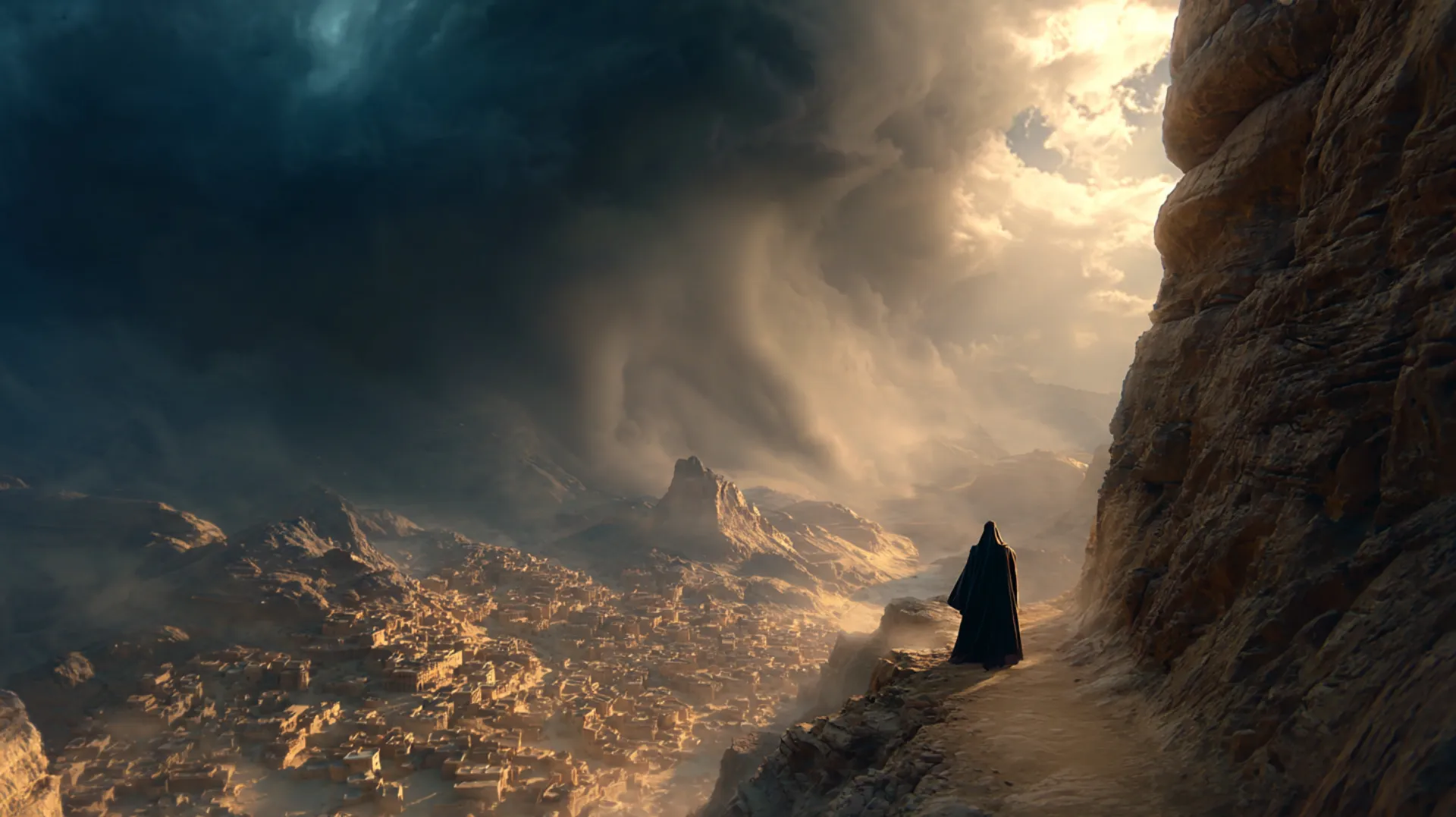
To understand what happens on this night, we must remember what precedes it. The Year of Sorrow has stripped the Prophet of nearly everything. Khadijah (may Allah be pleased with her) — his confidante, his first believer, the woman who wrapped him in a cloak when revelation first shook his body — is gone. Abu Talib, the uncle whose political protection kept the Quraysh at bay for a decade, is gone. The journey to Ta’if ended in blood running down his ankles, stones hurled by street children at the command of chieftains who laughed from their garden walls.
The Prophet is at the lowest point of his earthly mission. Eleven years of preaching, and the believers are a scattered, persecuted handful. Mecca is hostile. Ta’if has rejected him. There is no political ally, no safe haven, no clear path forward.
And it is precisely here — at the nadir — that Allah grants him the zenith.
“Exalted is He who took His servant by night from al-Masjid al-Haram to al-Masjid al-Aqsa, whose surroundings We have blessed, to show him of Our signs.” — Al-Isra (17:1)
The word Subhana — “Exalted” — opens the verse, a word of glorification so emphatic that scholars note Allah is praising Himself for the very act of granting this journey. And the Prophet is called not by his name but by his title: abd, the servant, the perfect worshipper. It is the highest honor the Quran bestows upon him, and it comes at his hour of greatest vulnerability.
The Journey Begins
The most authentic narrations place the Prophet in al-Hatim, the semicircular enclosure adjacent to the Ka’bah — the portion that was originally part of Ibrahim’s rectangular structure but was left open when the Quraysh rebuilt it with insufficient funds. Ibn Hajar reconciles the varying reports by suggesting that Jibreel (peace be upon him) first came to the Prophet’s house, where the roof opened, and then brought him to al-Hatim before the journey commenced.
Scholarly Note
The narrations about the starting point of the Isra come from multiple companions and contain slight variations. In one version in Sahih al-Bukhari, the Prophet says he was “sleeping in al-Hatim.” In another, he describes the roof of his house opening. Ibn Hajar al-Asqalani harmonizes these by proposing that Jibreel first visited the Prophet’s home and then transported him to al-Hatim, where the formal journey began. Both narrations are in Sahih al-Bukhari.
There, the celestial mount al-Buraq awaits — a creature of light whose very name derives from barq, lightning. The Prophet mounts and saddles it, a detail scholars find significant: even in a miracle, Allah links the goal to effort. The sea does not part until Musa strikes his staff. The fruit does not fall into Maryam’s hands until she shakes the palm. And the Prophet does not arrive in Jerusalem by simply wishing it — he rides.
The Isra, the night journey from Mecca to Jerusalem, covers a distance that would take a caravan weeks. Al-Buraq traverses it in moments. At al-Masjid al-Aqsa, the Prophet finds the prophets assembled — Ibrahim, Musa, Isa, and others — and he leads them all in prayer. The imam of the prophets. The seal of the messengers. The son of the Abrahamic line, linking the legacy of Isma’il in Mecca to the legacy of Ishaq in Jerusalem, two sanctuaries bound together in a single night.
Then the ascension begins.
Through the Seven Heavens
The Mi’raj — the mechanism of ascent, the apparatus that carries the Prophet upward through dimensions no human eye has seen — lifts him from Jerusalem into the heavens. At each gate, Jibreel knocks. A voice asks, “Who is it?” Jibreel identifies himself. “Who is with you?” “Muhammad.” “Has he been sent for?” “Yes, he has been sent for.” And the gates open.
At each heaven, a prophet greets him. Adam in the first, surrounded by the souls of his descendants — looking right toward the people of Paradise and smiling, looking left toward the people of the Fire and weeping. Isa and Yahya in the second. Yusuf in the third. Idris in the fourth. Harun in the fifth. Musa in the sixth. And Ibrahim in the seventh, leaning against al-Bayt al-Ma’mur, the celestial Ka’bah directly above its earthly counterpart — so precisely aligned that if it were to fall, it would land upon the Ka’bah of Mecca.
Each prophet welcomes him: “Welcome, O righteous brother, O righteous prophet.” Each encounter is brief in the telling but vast in implication. These are not ghosts or memories. These are the prophets of Allah, alive in their stations, aware, conversant.
And they have things to say.
Conversations Beyond Time
Ibrahim (peace be upon him) has a message for us. Not for the Prophet alone — for us. As recorded by al-Tirmidhi, Ibrahim tells his descendant:
“O Muhammad, convey my salams to your ummah. And inform them that Paradise has beautiful, fertile soil, but it is barren. Its seedlings are: SubhanAllah, Alhamdulillah, La ilaha illallah, and Allahu Akbar.”
Every utterance of remembrance plants a tree in a garden that already has the richest soil in existence. The land is ready. It waits only for us to plant. Ibrahim has seen Paradise. He is telling us what he knows.
Isa (peace be upon him) speaks with the Prophet about the signs of the end times — about Ya’juj and Ma’juj, about his own return. The Quran is quoted in their conversation, a breathtaking detail: a verse revealed in this world is confirmed in the heavens by the very prophet it concerns. And from this celestial exchange, scholars note, flows much of the hadith literature about the end of days. The Prophet’s source, at least in part, is Isa himself, speaking to him face to face beyond the sky.
The Brotherhood of the Prophets
The encounters in the heavens reveal something profound about prophethood itself: it is a single mission across time, not a series of competing religions. Every prophet acknowledges the Prophet Muhammad’s station without resentment or rivalry. They welcome him. They pray behind him. They offer counsel and send greetings to his community.
Even Musa’s tears — which we will encounter shortly — are not born of jealousy but of love for his own people. He weeps because he wished the largest ummah to enter Paradise had been his. It is a positive longing, a competition in goodness, not a grievance. And it is Musa, more than any other prophet, who will play the most consequential role in what happens next — precisely because he has the most experience. Eighty or ninety years of leading the Bani Israel, of knowing intimately what a community can and cannot bear. His counsel will shape the daily rhythm of Muslim life until the end of time.
The scene also reveals the unity of the Abrahamic legacy. The journey begins at al-Masjid al-Haram (the house of Ibrahim and Isma’il), passes through al-Masjid al-Aqsa (the land of Ishaq and his descendants), and ascends to al-Bayt al-Ma’mur (the house of angelic worship). Three sanctuaries, three dimensions of the same truth. As scholars have noted, the Isra wal-Mi’raj links the two great branches of Ibrahim’s family — and gives precedence to Mecca, since the journey both begins and ends there.
The Angel Who Never Smiles
Somewhere in this journey — whether at Bayt al-Maqdis or after the seventh heaven, the narrations do not specify — the Prophet encounters Malik, the guardian of Hellfire. Jibreel instructs the Prophet to greet him. But before the Prophet can speak, Malik initiates the greeting himself — a gesture of deference, of recognizing the Prophet’s superiority.
Malik does not smile. He has never smiled since the moment of his creation, for his assignment is Jahannam, and the weight of that charge has made him permanently somber. Jibreel explains: had Malik ever been capable of smiling for anyone, it would have been for the Prophet. But even that is beyond him.
There is a subtle point here that the scholars draw out. Malik is brought to the Prophet, not the other way around. The Prophet does not visit the gates of Hell. The guardian ascends to pay his respects. It is a deliberate distancing — a way of showing that the Prophet is as far removed from the Fire as the seventh heaven is from the lowest earth. Even the architecture of the encounter speaks.
Sidratul Muntaha: The Boundary of All Things
Then the Prophet rises beyond the seventh heaven, and he sees it: Sidratul Muntaha, the Lote Tree of the Utmost Boundary.
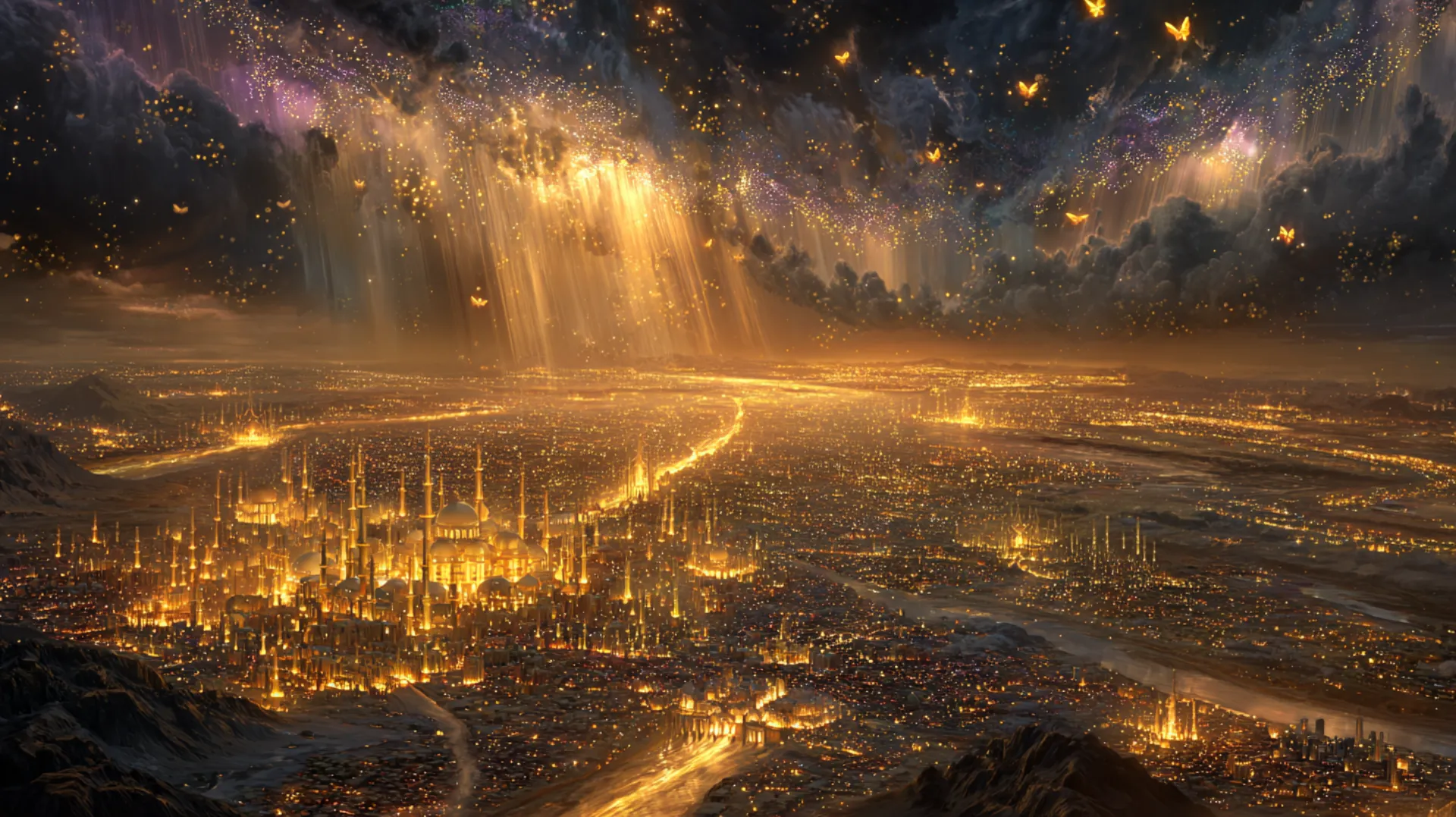
The sidra is a tree the Arabs knew well — a desert species with vast branches that cast wide shade, bearing sweet fruit and giving off a pleasant scent. But this sidra is beyond all comparison. Its fruits are as large as the storage jars of Hajar. Its leaves are like the ears of elephants. And it is alive in a way no earthly tree can be — enveloped in colors the Prophet cannot name, shifting and changing, covered in butterflies made of gold.
“When there covered the Lote Tree that which covered it, the eye did not swerve, nor did it transgress. He certainly saw of the greatest signs of his Lord.” — An-Najm (53:16-18)
The phrase is deliberately mysterious. Allah does not tell us what covered the tree. The Prophet himself says: “There were colors — I do not know what they were.” He is seeing beyond the visible spectrum, beyond the physics of this world. Colors that have no name in any human language. Energy and light from a dimension that does not map onto anything we know.
Scholarly Note
There is a well-known discrepancy regarding the location of Sidratul Muntaha. In Sahih al-Bukhari, the Prophet encounters it after the seventh heaven. In Sahih Muslim, via the narration of Abdullah ibn Mas’ud (may Allah be pleased with him), it is placed in the sixth heaven. Imam al-Nawawi reconciles this by suggesting that the trunk of the tree begins in the sixth heaven while its branches extend to the top of the seventh — making it a tree of cosmic proportions that spans multiple heavens. Qatadah, the student of Ibn Abbas, confirms that the Sidra “finishes in the seventh heaven,” implying it begins elsewhere.
At the base of this tree, four rivers emerge. Two are hidden — the rivers of Paradise, al-Kawthar and Salsabil. Two are visible — the Nile and the Euphrates. The Prophet mentions this almost in passing, yet the implication is staggering: the two rivers that cradled the earliest human civilizations, the waterways around which Mesopotamia and Egypt rose, are not ordinary rivers. They are blessed emanations from the highest reaches of creation, visible to all humanity, flowing through history from the very foot of the tree that marks the boundary of existence.
Here, too, the Prophet sees Jibreel in his true form for one of only two occasions in his life. Six hundred wings. Blocking the entire horizon. Pearls and corals dripping from his feathers. Not a static figure but a living, shimmering reality — the greatest of all angels, revealed in the fullness of his creation at the farthest boundary of the universe.
And here stands al-Bayt al-Ma’mur, the Frequented House, where seventy thousand angels enter each day to worship and never return — an endless procession since the moment of its creation until the Day of Judgment. The mathematics alone stagger the mind. As Allah says: “And none knows the soldiers of your Lord except Him” (Al-Muddathir, 74:31).
Ibn Mas’ud (may Allah be pleased with him) identified these three — Sidratul Muntaha, Bayt al-Ma’mur, and Jibreel in his original form — as the Ayat al-Kubra, the greatest signs referenced in the Quran. If Allah Himself calls them the greatest signs, what could possibly surpass them?
Beyond the Boundary
Then the language of the narrations shifts. Until this moment, the Prophet has always said “Jibreel brought me” or “Jibreel took me.” Now, in Sahih al-Bukhari, the grammar changes to the passive singular:
“Then I was caused to ascend…”
Jibreel is no longer mentioned. The angel who has accompanied the Prophet through every heaven, who has knocked on every gate, who has revealed himself in his full magnificence at the Sidra — he goes no further. This is the boundary. Even the greatest angel in creation stops here.
The Prophet rises alone.
He rises to a level where he can hear the scratching of the divine pen as it writes in the book that Allah keeps above His throne. The pen that was the first thing Allah created. The pen that was commanded to write everything that would occur until the Day of Judgment. There is no angel at this altitude. There is no living creature. There is only the throne, the pen, and the One who commands it.
What happens in this audience, we do not know. The Prophet does not tell us, and the Quran veils it in the most exquisite discretion:
“And He revealed to His servant what He revealed.” — An-Najm (53:10)
A circular statement. Deliberately opaque. What was said between the Creator and His most beloved creation is private — perhaps the most sacred privacy in the history of existence.
Scholarly Note
A widely circulated story claims that the Tahiyyat (the supplication recited in prayer) is a transcript of the conversation between the Prophet and Allah during the Mi’raj — that the Prophet said “At-tahiyyatu lillahi…” and Allah responded “As-salamu alayka ayyuhan-nabi…” This narration is fabricated and has no basis in any authentic collection of hadith. Scholars including Yasir Qadhi have explicitly identified it as a fabrication that should not be attributed to the Prophet.
The Gift of Salah
What we do know is this: the Prophet descends with three gifts. The five daily prayers. The final verses of Surat al-Baqarah. And a divine promise that whoever from his ummah worships Allah without associating partners with Him will ultimately be forgiven and admitted to Paradise.
The last two verses of Surat al-Baqarah occupy a unique station. Some scholars theorize that they are the only passage of the Quran that was not sent down to earth via Jibreel but was given directly to the Prophet in the divine presence — the messenger brought up to receive the revelation rather than the revelation being sent down to him. The Prophet himself said, as recorded in hadith:
“I have been given these from beneath the treasures of the Throne of Allah.”
And he said:
“Whoever recites the last two verses of Surat al-Baqarah at night, they will suffice him.”
But it is the salah — the prayer — that is the centerpiece. Every other commandment in Islam was delivered through Jibreel descending to earth. Zakah, fasting, hajj, the prohibition of intoxicants — all of it came down. Only one commandment was so momentous that the messenger was summoned upward to receive it in person, in the presence of the King of Kings. That commandment is the prayer.
The initial decree: fifty prayers a day. One every fifteen to twenty minutes. A life of near-continuous worship, like the angels who glorify Allah day and night without ceasing. This is what creation was made for.
Then comes the negotiation — and it is Musa who drives it. On the way down, passing through the sixth heaven, Musa asks: “What did your Lord prescribe for your ummah?” When the Prophet tells him fifty, Musa speaks from experience: “Go back to your Lord and ask Him to reduce it. I tested the Children of Israel, and your ummah will not be able to bear this.”
The Prophet looks to Jibreel for a second opinion. Jibreel nods. And so begins the journey back and forth — five times, perhaps nine, the narrations differ — each time the number decreasing, each time Musa insisting it is still too much. Three reasons converge in Musa’s role here: his unmatched experience with a large ummah, his knowledge that such a divine meeting always yields commandments (he himself received the Ten Commandments at Tur Sina), and his station — high enough to counsel, but not so high as Ibrahim, who accepts divine decrees without negotiation.
When the number reaches five, Musa urges one more reduction. The Prophet responds with words that reveal the depth of the encounter:
“I have gone back and forth until I am embarrassed. But I am content and I accept.”
And then a voice — the voice of Allah — calls out to both of them, the only two prophets who have ever had direct divine speech:
“My decree has been established, and I have made things easy for My servants. It is five, but it shall be rewarded as fifty.”
The wisdom of decreeing fifty and reducing to five is layered. It demonstrates Allah’s mercy — He does not wish hardship for His creation. It reveals the original purpose of human existence — near-constant worship. And it establishes the extraordinary weight of each prayer: every salah carries the reward of ten. The Prophet himself, though the reduction applied to the ummah, maintained a personal practice of approximately fifty rak’at daily — the seventeen obligatory, twelve sunnah ratibah, thirteen of tahajjud and witr, and eight of duha — fulfilling the original command in his own life even as the concession stood for his community.
The Return and the Morning After
The Prophet descends. He is shown Paradise and Hellfire. He returns to Jerusalem, mounts al-Buraq, and rides back to Mecca. His bed is still warm.
When morning comes, he faces a choice. He knows what the Quraysh will say. He knows they will mock him, that they will demand proof, that some of the weaker believers may waver. He is, as Aisha (may Allah be pleased with her) later described, visibly distressed — not from doubt, but from knowledge of what the telling will cost.
He tells them anyway. Because that is what prophets do.
The Quraysh erupt. A journey to Jerusalem and back in a single night? They demand he describe the al-Aqsa sanctuary. The Prophet, who had focused on the prayer and the ascension rather than memorizing architectural details, feels a moment of distress — and then Allah lifts Jerusalem before his eyes, and he describes it gate by gate, pillar by pillar, until the questioners fall silent. They cannot deny the accuracy. But they deny the miracle anyway.
It is Abu Bakr (may Allah be pleased with him) who earns his immortal title that morning. When the Quraysh rush to tell him, expecting him to abandon the Prophet, he asks a single question: “Did he say it?” They confirm. Abu Bakr responds: “If he said it, then he has spoken the truth.” From that day, he is al-Siddiq — the one who confirms, the one who believes without hesitation. If he believed in revelation from beyond the heavens, why would a journey to Jerusalem give him pause?
Body and Soul: The Physical Reality of the Journey
A question debated by some early scholars — and revived by certain modernist writers — is whether the Isra wal-Mi’raj was a physical journey or a dream. A small number of tabi’un interpreted the phrase “I woke up” to mean it occurred in sleep. However, the overwhelming consensus of Muslim scholarship across thirteen centuries holds that the journey was physical, in body and soul, in a state of full wakefulness.
The evidence is decisive. Had it been a dream, the Quraysh would have had no reason to find it extraordinary — anyone can travel the world in dreams. The existence of al-Buraq as a physical mount is unnecessary for a dream. The Prophet’s thirst on the return journey, during which he drank water, indicates a waking state. The Quranic phrase Subhana alladhi asra bi-abdihi — “Exalted is He who took His servant” — uses the word abd, which denotes the complete human being, body and soul, not the soul alone. And the challenge posed to the Quraysh — “describe Jerusalem” — only makes sense as a test of a physical witness.
Imam al-Nawawi, Ibn Hajar, and the vast majority of classical scholars affirm the physical nature of the journey. The minority view, while historically noted, does not withstand the weight of the combined textual evidence.
What the Eyes Absorbed
Surah al-Najm preserves the journey in language that shimmers with restraint and power. Allah defends His Prophet against those who would call him a liar or a dreamer:
“He does not speak from his own desire. It is nothing but revelation revealed. Taught to him by one intense in power.” — An-Najm (53:3-5)
And then the extraordinary testimony:
“The eye did not swerve, nor did it transgress. He certainly saw of the greatest signs of his Lord.” — An-Najm (53:17-18)
The Prophet’s gaze held steady. He did not flinch at the Sidratul Muntaha. He did not falter before Jibreel’s six hundred wings. He did not lose himself in the colors that have no name. Ibn Kathir, the great mufassir, wrote that if any other human being had witnessed even a fraction of these signs, he would have returned a madman. But the Prophet came back, lay down, and slept — then rose to face the most hostile audience in Arabia with perfect composure.
In that composure lies a truth about the entire Isra wal-Mi’raj: it was a personal gift. Allah says linuriyahu — “to show him.” Singular. The journey was not performed for the ummah’s benefit, though we inherit its fruits. It was performed for the Prophet, to show him that everything he preached was real. The angels are real. The prophets are alive. Paradise and Hell exist at this very moment. The divine decree is being written. And Allah is above all of it, closer than the pen is to the page.
After the Year of Sorrow, after the stones of Ta’if, after the death of everyone who shielded him — the Prophet needed to know, with the certainty of sight and sound and presence, that none of it was in vain. And Allah gave him that certainty in the most magnificent way conceivable: by bringing him up.
With every difficulty there is ease. And the greater the difficulty, the greater the ease. The Prophet endured the deepest grief a human being can know, and he was answered with an invitation to the throne of God. The proportion is the promise.
Now, carrying within him the memory of colors no human eye has seen, of a tree that marks the edge of all creation, of a conversation veiled even from the angels — the Prophet returns to Mecca with five daily prayers and a mandate to continue. The road ahead leads not upward but outward: to the tribes of Arabia, to a city called Yathrib, to a people who are ready to listen. The search for earthly refuge is about to begin.
Quranic References
Continue Your Journey
Cite this Narrative
APA
SeerahQuest. (2026). Beyond the Lote Tree: The Night Journey and the Gift of Prayer. *SeerahQuest: The Eternal Narrative*. https://seerahquest.com/chapters/isra-wal-miraj-the-night-journey-ascension-and-the-five-dail Adapted from Yasir Qadhi's Seerah Series, Episode 22.
MLA
"Beyond the Lote Tree: The Night Journey and the Gift of Prayer." *SeerahQuest: The Eternal Narrative*, 2026, https://seerahquest.com/chapters/isra-wal-miraj-the-night-journey-ascension-and-the-five-dail. Adapted from Yasir Qadhi's Seerah Series, Episode 22.
Chicago
"Beyond the Lote Tree: The Night Journey and the Gift of Prayer." *SeerahQuest: The Eternal Narrative*. Accessed April 3, 2026. https://seerahquest.com/chapters/isra-wal-miraj-the-night-journey-ascension-and-the-five-dail. Adapted from Yasir Qadhi's Seerah Series, Episode 22.
Install SeerahQuest — read chapters offline, anytime.