Ummi Musa and the Architecture of Divine Speech
A comb slips from a servant's fingers in Pharaoh's palace, and a whispered 'Bismillah' sets in motion a martyrdom that only the final Prophet will remember.
pre-hijra · 616 – 618 CE
The comb slips from her fingers.
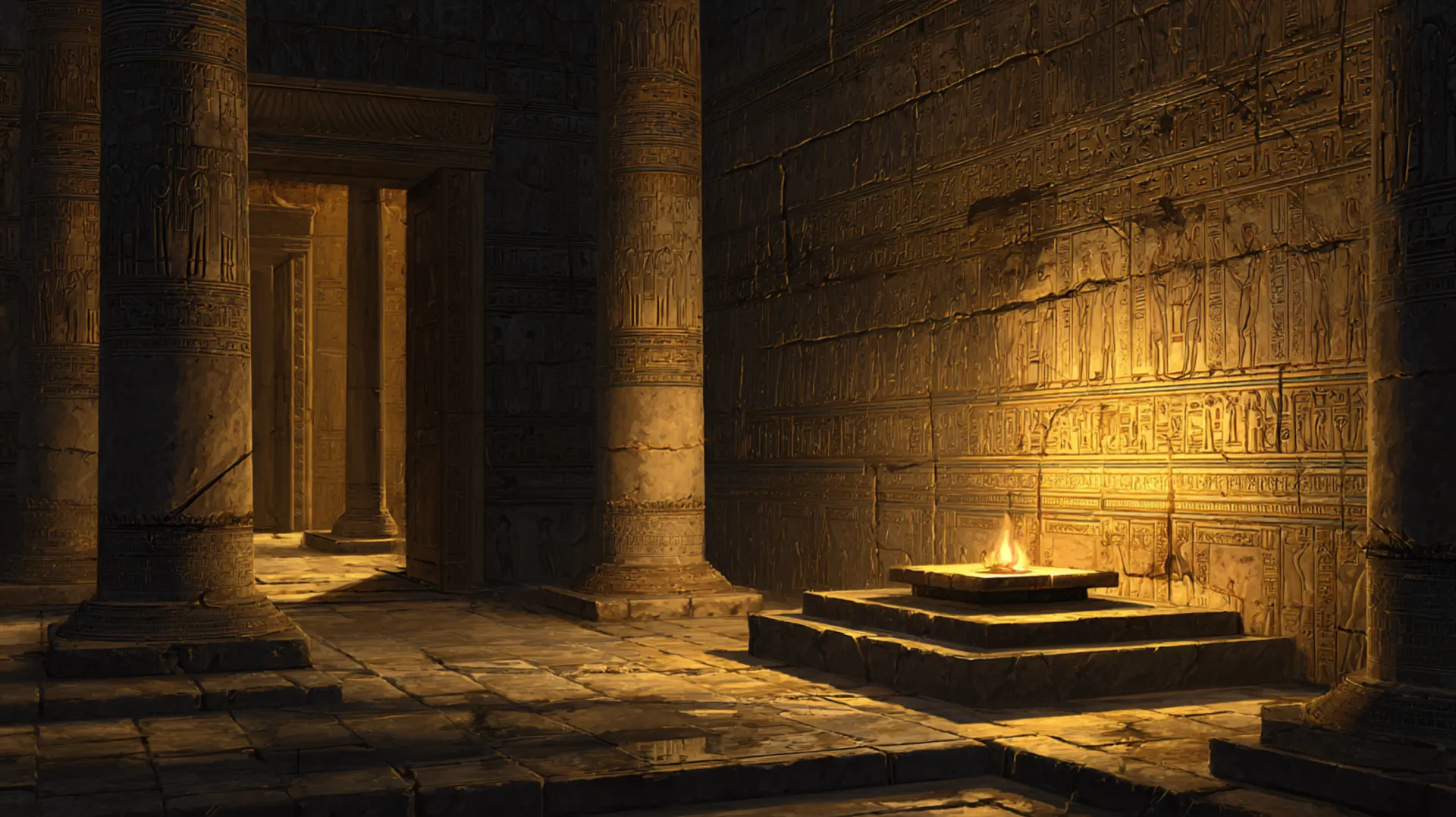
It is such a small thing — a comb, falling to the stone floor of a palace in Egypt, centuries before the Prophet Muhammad (peace be upon him) will walk the streets of Mecca. The woman who drops it is a servant, a hairdresser to the daughter of Fir’aun, and as she bends to retrieve it, a phrase escapes her lips — Bismillah, in the name of God. Not in the name of Pharaoh. Not in the name of any idol that lines the corridors of power. In the name of the One.
The daughter hears it. The daughter tells her father.
And what follows is a story so harrowing, so luminous with faith, that Allah will preserve it not in the scriptures of Musa’s own people — not in the Torah, not in any Jewish tradition — but in the testimony of the final Prophet, narrated to his ummah as a beacon across the centuries. It is a story about what it means to believe when belief costs everything. And it is woven into the fabric of the Isra wal Mi’raj itself, told by the Prophet as part of what he witnessed on the most extraordinary night in human history.
This chapter steps back from the forward motion of the seerah to dwell in the theological depths that the Prophet himself dwelt in — the nature of divine communication, the question of who receives revelation and how, and the luminous, terrifying parallels between his mission and that of Musa, the prophet who wept with jealousy and love when he saw this young messenger passing through the sixth heaven.
The Hairdresser, the Fire, and the Speaking Infant
The story arrives to us through the Prophet’s own narration during the events of the Night Journey. Among the things he witnessed and recounted was the fate of a woman whose name history has not preserved — the hairdresser or seamstress who served in the household of Fir’aun’s daughter. When her monotheism was discovered, Fir’aun summoned her and demanded she recant. She refused.
What followed was methodical cruelty. One by one, her children were brought before her and cast into a vat of boiling oil or fire. Child after child. The purpose was not merely punishment but theater — a spectacle designed to break her will, to force her tongue to utter the words of submission to Pharaoh’s claimed divinity. She watched each child taken from her. She did not break.
Until they reached the last — an infant still nursing at her breast. Here she hesitated. Here the unimaginable weight of what faith demanded pressed against the most primal force in creation: a mother’s love for the child at her breast. She paused.
And the infant spoke.
“Oh my mother, go forth and drop yourself in. Proceed forward. Because this punishment of this world is nothing compared to the punishment of the next.”
She threw herself in.
Scholarly Note
This narration is recorded in the collections of hadith and referenced by Ibn Abbas (may Allah be pleased with him), who commented that there were four who spoke from the cradle as infants: this child of the hairdresser, Isa (Jesus), the companion of Jurayj, and — according to Ibn Abbas’s own interpretation — the witness (shahid) in the story of Yusuf. However, as Yasir Qadhi notes, the identification of the shahid of Yusuf as an infant is Ibn Abbas’s personal derivation and not a hadith of the Prophet. The majority scholarly view does not consider the shahid of Yusuf to have been a baby. And Allah knows best.
What strikes the heart is not only the courage but the anonymity. We do not know her name. We do not know the names of her children. The palace records of ancient Egypt, if they ever noted her existence, have crumbled to dust. The Old Testament does not mention her. The Jewish tradition preserves no memory of her sacrifice. And yet — as the Prophet himself marveled — Allah willed that her story would be carried in the heart of the greatest ummah, narrated by the final Messenger, remembered and honored until the Day of Judgment.
Her sacrifice, her children’s sacrifice, the miracle of an infant speaking theology from the cradle — all of this was shown to the Prophet during or in connection with the events of the Isra wal Mi’raj. It was part of the vast tapestry of signs that Allah unveiled for him on that night, the night that was itself a response to the darkest period of his life.
Wahy: The Architecture of Divine Speech
To understand why these stories matter — why the Prophet encountered them when he did, why they were woven into the Night Journey — we must understand the nature of wahy itself. Divine communication is not a single phenomenon. It is a spectrum, a graduated architecture of contact between the Creator and His creation, and the Prophet Muhammad experienced every level of it.
Ibn al-Qayyim, the great medieval scholar, enumerated seven distinct modes through which revelation came to the Prophet:
The first — and the lowest — is true dreams. This is the only form of inspiration that remains open to humanity after the seal of prophethood. The Prophet experienced true dreams both before and after his prophetic mission, and as Aisha (may Allah be pleased with her) narrated, his dreams would come true like the breaking of dawn.
The second is ilham — the whispering of angels into the heart, a form of inspiration that does not constitute prophethood. And it is here that one of the most fascinating theological questions of the Islamic tradition emerges: the case of Ummi Musa, the mother of Musa.
Allah says in the Quran:
“And We inspired the mother of Musa: ‘Suckle him, and when you fear for him, cast him into the river and do not fear and do not grieve. Indeed, We will return him to you and will make him one of the messengers.’” — Al-Qasas (28:7)
The word used is awhayna — “We inspired.” It is the same root as wahy, the term for prophetic revelation. Does this make Ummi Musa a prophetess?
Were There Female Prophets? The Debate Over Maryam and Ummi Musa
This is one of the most spirited theological debates in the Islamic scholarly tradition, and it is far older than any modern discussion of gender. A number of classical scholars — including Abu al-Hasan al-Ash’ari, the great theologian; al-Qurtubi, the renowned Quranic commentator; and Ibn Hazm al-Andalusi, the literalist jurist — argued that there were indeed female prophets. Their primary candidates were Maryam (the mother of Isa) and Ummi Musa.
Their evidence is not trivial. For Maryam: the angel Jibreel appeared to her directly, Allah says He “chose her above the women of all the worlds” (Al Imran 3:42), and the word wahy is used in connection with divine communication to her. For Ummi Musa: Allah explicitly says awhayna — “We inspired” — using the very vocabulary of prophetic revelation.
The majority position, however, holds that prophethood is restricted to men. The key verse is:
“And We sent not before you except men to whom We revealed, from the people of the cities.” — Yusuf (12:109)
The word rijalan — “men” — is explicit. Those who affirm female prophethood respond with a sharp distinction: this verse uses the word arsalna (We sent), which they associate specifically with risalah (messengership), not nubuwwah (prophethood). They argue that Maryam could be a nabiyyah without being a rasulah, since the verse restricts only the sending of rusul to men.
As for the use of wahy for Ummi Musa, the majority counters that ilham — angelic inspiration to the heart — is a form of wahy in the linguistic sense but does not constitute the wahy of prophethood. Seeing an angel does not make one a prophet, they argue; after all, many Companions saw Jibreel in human form without becoming prophets. Umar ibn al-Khattab (may Allah be pleased with him) saw Jibreel in the famous hadith of Iman, Islam, and Ihsan, and no one claims prophethood for him.
The question remains genuinely open in the tradition. What is agreed upon is that Ummi Musa received a real, divine communication — not a metaphor, not a feeling, but actual guidance from Allah through angelic means — and that she acted upon it with a courage that saved her son and, through him, an entire nation. Whether we call this prophethood or the highest degree of ilham, her station is extraordinary.
The third mode is the direct appearance of the angel in human form. This is what happened frequently in Medina, when Jibreel would appear in the form of Dihya al-Kalbi, the most handsome of the Companions. Aisha would sometimes see the Prophet speaking with what appeared to be Dihya, only to be told afterward that it was Jibreel. This mode was easier for the Prophet to bear.
The fourth — more difficult — was when Jibreel remained in his angelic form and the Prophet entered a state that can only be described as a trance. His eyes would close, his head would lower, and sweat would bead on his forehead even on cold days. The world around him would cease to exist. Aisha witnessed this many times. Once, when Surah al-Ma’idah was being revealed while the Prophet was mounted on a camel, the weight of the revelation was so immense that the camel — an animal capable of carrying hundreds of pounds — had to sit down under the burden. On another occasion, a Companion whose thigh was beneath the Prophet’s head during revelation felt such pressure that he feared his thighbone would crack.
Al-Harith ibn Hisham (may Allah be pleased with him), after his conversion at the Conquest of Mecca, asked the Prophet directly: “How does the revelation come to you?” The Prophet replied that sometimes it came like the ringing of a bell — a loud, overwhelming sound — and that this was the most difficult form. Sometimes Jibreel came in human form, and that was easier.
Scholarly Note
This hadith is recorded in Sahih al-Bukhari in multiple versions. Al-Harith ibn Hisham’s willingness to ask such a probing question illustrates a phenomenon Ibn Umar once described: the senior Companions were often too reverent to ask the Prophet frank questions, and they would welcome it when an intelligent newcomer or Bedouin would arrive and ask what they themselves could not. Al-Harith later died as a shaheed at the Battle of Yarmouk.
The fifth mode was witnessing Jibreel in his original, cosmic form — a being so vast he blocked the entire horizon, with six hundred wings. This occurred only twice with certainty: once at the first revelation of Iqra, and once during the Isra wal Mi’raj.
The sixth, which Ibn al-Qayyim mentions though it remains debated, was direct divine inspiration without the intermediary of any angel.
The seventh — the highest form of communication ever granted to any created being — was the direct speech of Allah, without intermediary, without veil of angel or dream. This happened once, and only once, to the Prophet Muhammad: at the pinnacle of the Mi’raj, beyond the Sidratul Muntaha, in a realm where even Jibreel could not follow.
Musa’s Mountain and Muhammad’s Ascension
It is no accident that Musa features so prominently in the Night Journey. Of all the prophets the Prophet Muhammad encountered in the heavens, it was Musa who wept at the sight of him, Musa who engaged him in conversation about the prayer, Musa who sent him back again and again to negotiate the reduction from fifty to five.
The parallel between the two prophets runs deep, and it was recognized from the very beginning. When Waraqah ibn Nawfal heard the account of Jibreel’s first appearance to the Prophet in the Cave of Hira, he did not say, “This is the angel that came to Isa.” He said, “This is the same keeper of secrets that came to Musa.” The resemblance was structural: both Musa and Muhammad were political leaders as well as spiritual guides, both confronted entrenched systems of tyranny, both led their communities through persecution toward liberation.
But the Isra wal Mi’raj reveals the crucial difference in their stations. Musa’s encounter with Allah took place on Tur Sina — Mount Sinai — on the surface of the earth. When Musa asked to see his Lord directly, Allah replied:
“You will not see Me, but look at the mountain. If it remains in its place, then you will see Me.” — Al-A’raf (7:143)
Allah then lifted the veil between Himself and the mountain. The mountain collapsed. Musa fell unconscious. The creation cannot withstand the unveiled majesty of the Creator in this world.
The Prophet Muhammad, by contrast, was summoned upward. He was not on a mountain; he was beyond the seventh heaven, beyond the Sidratul Muntaha, beyond the point where Jibreel himself said, “If I go one step further, I will be burned.” He rose to a place where he could hear the scratching of the divine pen as it inscribed in the book that Allah keeps above the Throne. He was closer than two bow-lengths. He saw the hijab — the veil of light.
When Abu Dharr al-Ghifari (may Allah be pleased with him) asked the Prophet directly — as recorded in Sahih Muslim — “Did you see your Lord?” the Prophet replied: “There was light. How could I see Him?”
The scholars explain: Allah’s veil is not a veil of darkness, as human veils are. It is a veil of nur — of light so intense that, as the Prophet narrated, “If He were to lift it, the rays of His Face would destroy everything His sight reaches” — which is to say, everything in existence. The Prophet saw the light of this veil. He did not see Allah with his eyes.
Scholarly Note
The question of whether the Prophet saw Allah during the Mi’raj was debated among the Companions themselves. Ibn Abbas (may Allah be pleased with him) is reported in one narration to have affirmed that the Prophet saw his Lord, though another version specifies “he saw Him with his heart” (ra’ahu bi qalbihi), which is a different category of perception. Aisha bint Abi Bakr (may Allah be pleased with her), in Sahih al-Bukhari, was emphatic: “Whoever tells you that Muhammad saw his Lord has told a tremendous lie against Allah,” and she cited Al-An’am (6:103): “Eyes cannot encompass Him, but He encompasses all eyes.” She stated that she was the first person to ask the Prophet about the relevant verses in Surah al-Najm, and he confirmed that the references to “seeing” were to Jibreel, not to Allah. The hadith of Abu Dharr in Sahih Muslim — “There was light, how could I see Him?” — supports Aisha’s position. The majority of scholars hold that the Prophet did not see Allah with his physical eyes during the Mi’raj, though he reached a proximity no other being has ever attained.
The Tyranny of Fir’aun and the Courage of the Unnamed
Why does the Quran return so insistently to the story of Fir’aun? Why does the Prophet, during the most transcendent experience of his life, encounter and then narrate stories from the Pharaonic era?
Because the pattern repeats. Fir’aun’s Egypt was a system — not merely a man but an architecture of oppression. At its center sat a ruler who claimed divinity, who demanded that all worship and loyalty flow upward to him. Around him were the enforcers, the courtiers, the complicit. And at the margins were the believers — slaves, servants, hairdressers — who held to their faith in secret, knowing that discovery meant death.
The Prophet’s Mecca was not Egypt, but the resonance was unmistakable. The Quraysh had not claimed divinity, but they had claimed absolute authority over the sacred — over the Ka’bah, over the pilgrimage, over the religious and economic life of Arabia. Those who challenged this order faced persecution calibrated to their social vulnerability. The weak — Bilal, Khabbab, Sumayyah, Ammar — bore the worst of it, just as the slaves and servants of Fir’aun’s household bore the worst of his.
The hairdresser’s story, then, was not mere history. It was a mirror held up to the believers of Mecca. This is what faith has always cost. This is what faith has always been worth. The infant’s words from the cradle — that the punishment of this world is nothing compared to the punishment of the next — are the same calculus that Sumayyah bint Khayyat made when she refused to recant under Abu Jahl’s spear. The same calculus that Khabbab ibn al-Arat made as his mistress Umm Anmar pressed hot iron to his back.
And there is something else — something the Prophet himself marveled at. The hairdresser’s story was not preserved by Musa’s people. It is not in the Torah. It is not in the Talmud. It was preserved by this ummah, narrated by this Prophet. Allah chose to honor her sacrifice not among those who shared her time and place but among those who would come fourteen centuries later, who would hear her story and weep and take courage from it. Her anonymity in her own era became immortality in ours.
The Visions of the Unseen: Paradise, Hellfire, and the Dajjal
After the divine audience — after the negotiation of the prayers, after the descent back through the heavens — the Prophet witnessed scenes from both Paradise and Hellfire. Whether he entered Jannah or surveyed it from without is a matter of scholarly discussion; some narrations use the phrase “I entered Paradise,” while others say “I looked upon Paradise.” He described tents of pearl and soil of musk.
But it is the visions of punishment that carry the most urgent moral weight, because each punishment was a precise mirror of the sin that earned it:
Those who devoured the wealth of orphans were swallowing coals of fire that passed through their bodies — a literalization of the Quranic warning in Al-Nisa (4:10): “Indeed, those who devour the property of orphans unjustly are only consuming fire into their bellies.”
Those who practiced backbiting were scratching their own faces and bodies with nails of copper — because in life they had scarred the honor and reputation of others.
Those who committed fornication had pure, lawful meat before them but chose instead to eat rotten, infested flesh — because in life they had abandoned what was halal for what was haram.
Those who consumed riba — usury and interest — had bellies so bloated they could not stand, and animals were driven over them, trampling them — a grotesque inflation of the greed that had consumed them.
Those who preached righteousness but did not practice it were cutting their own lips and tongues with scissors of copper — because their tongues had spoken truth that their lives had contradicted.
In each case, the Prophet saw the scene, did not understand it, asked Jibreel, and was told. The pedagogy is deliberate: even the Prophet needed the angel’s explanation. The unseen is not self-interpreting. It requires guidance.
He also saw the Dajjal — the false messiah — and described him with a specificity no previous prophet had offered his people: one eye bloated and deformed, like a rotten grape. A’war — one-eyed. The Prophet said he was telling his ummah something about the Dajjal that no prophet had ever told his people before.
Did the Prophet Physically Travel, or Was It a Dream?
This question has been debated since the earliest generations, though the overwhelming consensus of the ummah across twelve centuries of scholarship is that the Isra wal Mi’raj was a physical journey — body and soul, in a state of wakefulness.
Some early scholars, based on narrations that mention the Prophet “waking up” in Mecca afterward, suggested it may have been a spiritual experience or a dream. But this minority view faces multiple objections:
First, if it were merely a dream, there would be nothing miraculous about it. Anyone can travel to distant lands in dreams. The Prophet would have had no reason to feel anxious about telling the Quraysh, and the Quraysh would have had no reason to mock him.
Second, the physical ride of Buraq — an animal that needed to be mounted, ridden, and tied to a post in Jerusalem — makes no sense in a dream.
Third, the Prophet experienced physical thirst on the return journey and drank water from a caravan’s urn — a detail incompatible with a dream state.
Fourth, the entire dramatic confrontation with the Quraysh — their demand that he describe Jerusalem, his anxiety when he couldn’t remember details, Allah’s miraculous lifting of the city before his eyes — only makes sense if the claim was a physical journey.
In modern times, some progressive or rationalist Muslim writers have attempted to reinterpret the Isra wal Mi’raj as a visionary or dream experience, uncomfortable with the miraculous nature of the event. But as classical scholars have noted, to strip the Night Journey of its physical reality is to strip it of its entire purpose and significance. The Quran itself declares: “Glory be to Him who took His servant by night from al-Masjid al-Haram to al-Masjid al-Aqsa” — Al-Isra (17:1) — using the word ‘abd (servant), which in Arabic denotes the complete human being, body and soul.
The Morning After: Abu Jahl’s Trap and Abu Bakr’s Title
The Prophet woke in the Haram. He sat near the Ka’bah, and his own words — narrated in the first person — reveal a man gripped by anxiety. Allah had commanded him to tell the people what had happened. He knew what their reaction would be. He sat there, heavy with the knowledge of what he must say and the certainty of how it would be received.
It was Abu Jahl — Amr ibn Hisham — who found him first. Seeing the Prophet’s distress, he asked with what must have been barely concealed anticipation: “What is the matter with you? Has anything happened?” The Prophet, who could not tell a lie even to his worst enemy, said yes. Abu Jahl pressed. The Prophet told him: last night, he had been taken from the Haram to Jerusalem and back.
Abu Jahl’s mind raced. Should he mock him now? Or should he wait, gather the Quraysh, and let the Prophet repeat this claim publicly — maximizing the damage? He chose the latter. He began calling out to the people of Mecca: Come forth! There is an announcement!
The people gathered. Abu Jahl stood over the Prophet with the satisfaction of a man who believes he has won. “Tell them what you told me.” And the Prophet told them.
The reactions were varied — some clapped in bewilderment, some put their hands on their heads, some snickered. But then someone who had actually been to Jerusalem asked: “Can you describe it?”
The Prophet began to describe. But he had been there at night, had prayed in the masjid, and had not memorized every street and building. When the questions grew specific, he faltered. He himself used the word kurba — terrified. He had never been so terrified.
And then — as he sat in that terror — Jerusalem rose before his eyes. The entire city, lifted by divine power, materialized behind the house of Aqeel ibn Abi Talib, visible only to him. Every question they asked, he looked at the city and answered. The Quraysh, unable to see what he saw, could only confirm: his descriptions were accurate.
He then mentioned the three caravans he had passed on the return journey — one that would arrive imminently, one that had lost a camel, one whose water urn he had drunk from. While they were still discussing, the first caravan entered Mecca, exactly as described. Abu Jahl’s verdict: “This is clear sorcery.”
Scholarly Note
Ibn Hisham’s seerah contains a passage stating that some Muslims apostatized (irtaddu) upon hearing of the Isra. However, this report lacks an authentic chain of narration (isnad) and is not found in Bukhari, Muslim, or any of the six major hadith collections. It also contradicts the well-established hadith in Sahih al-Bukhari in which Abu Sufyan, questioned by the Byzantine Emperor Heraclius in the seventh year of the Hijrah, stated that no follower of the Prophet had ever left the faith after embracing it. Many scholars therefore consider the Ibn Hisham report unreliable, and no individual Muslim is named as having apostatized during the Meccan period.
Meanwhile, news reached Abu Bakr al-Siddiq (may Allah be pleased with him) through a Qurayshi man who came running: “Do you know what your companion has just claimed? He says he went to Jerusalem and back in a single night!”
Abu Bakr’s response was immediate and luminous in its logic: “If he said that, then it must be true.” The man pressed: “You believe him in such a claim?” Abu Bakr replied: “I believe him in something even more amazing than this. He claims that revelation from above the seven heavens comes to him instantaneously. Which is more extraordinary — a journey to Jerusalem, or that Allah communicates with him directly?”
From that day forward, Abu Bakr carried the title al-Siddiq — the one who confirms the truth, the utterly sincere. It was not a title earned in comfort but in the teeth of public ridicule, when every rational calculation said the claim was impossible and only the deepest certainty of the heart could affirm it.
The Gift in the Darkness
Ibn Kathir, the great exegete, observed that if any ordinary person had witnessed even a fraction of what the Prophet saw that night — the heavens opening, the prophets greeting him, the divine veil of light, Paradise and Hellfire laid bare — he would have woken a madman. But the Prophet returned, went back to sleep, and rose the next morning to face the most hostile audience imaginable with complete composure. As Allah Himself attests in Surah al-Najm:
“The eye did not swerve, nor did it transgress.” — Al-Najm (53:17)
The Isra wal Mi’raj was, at its core, a personal gift from Allah to His Prophet — the most intimate and extraordinary gift ever bestowed upon a created being. It came at the lowest point of his life: after the death of Khadijah, after the death of Abu Talib, after the stones and blood of Ta’if. No indication, no warning, no buildup. Just darkness — and then the most luminous night in the history of creation.
The Prophet himself said, as recorded in Sahih al-Bukhari: “If you knew what I knew, you would laugh little and weep much.” In another narration: “You would leave your wives in their beds and go out to the deserts” — meaning, you would lose your minds with the weight of what is real. But he bore it. He bore all of it — the beauty and the terror, the nearness and the responsibility — and came back to this world to do what prophets do: to tell the truth, regardless of the cost.
And in this, the unnamed hairdresser of Fir’aun’s palace and the Prophet of Allah share something essential. Both were given a truth so heavy that the world could not contain it. Both were asked to hold that truth against every pressure to let it go. And both — the anonymous servant and the Seal of the Prophets — chose the truth, and were honored for it beyond anything they could have imagined.
As the echoes of the Night Journey settle into the consciousness of the small Muslim community, the Prophet faces a new and urgent question. The spiritual consolation has been given; the five daily prayers have been ordained; his station has been confirmed in the highest heavens. But on the ground, in the narrow valleys of Mecca, the political reality has not changed. Abu Talib is dead. Khadijah is dead. The Quraysh are emboldened. And so the Prophet turns his gaze outward — beyond Mecca, beyond the familiar — searching the tribal landscape of Arabia for someone, anyone, who will offer him and his message protection. The search for political asylum is about to begin.
Quranic References
Continue Your Journey
Cite this Narrative
APA
SeerahQuest. (2026). Ummi Musa and the Architecture of Divine Speech. *SeerahQuest: The Eternal Narrative*. https://seerahquest.com/chapters/ummi-musa-and-prophet-musa-wahy-prophethood-and-divine-commu Adapted from Yasir Qadhi's Seerah Series, Episode 23.
MLA
"Ummi Musa and the Architecture of Divine Speech." *SeerahQuest: The Eternal Narrative*, 2026, https://seerahquest.com/chapters/ummi-musa-and-prophet-musa-wahy-prophethood-and-divine-commu. Adapted from Yasir Qadhi's Seerah Series, Episode 23.
Chicago
"Ummi Musa and the Architecture of Divine Speech." *SeerahQuest: The Eternal Narrative*. Accessed April 3, 2026. https://seerahquest.com/chapters/ummi-musa-and-prophet-musa-wahy-prophethood-and-divine-commu. Adapted from Yasir Qadhi's Seerah Series, Episode 23.
Install SeerahQuest — read chapters offline, anytime.