
The Arsenal of Denial
Three of Mecca's most powerful men crept from their beds at 3 a.m. to listen in secret to a voice they had publicly sworn to silence. The Qur'an was doing its work.
pre-hijra · 613 – 616 CE
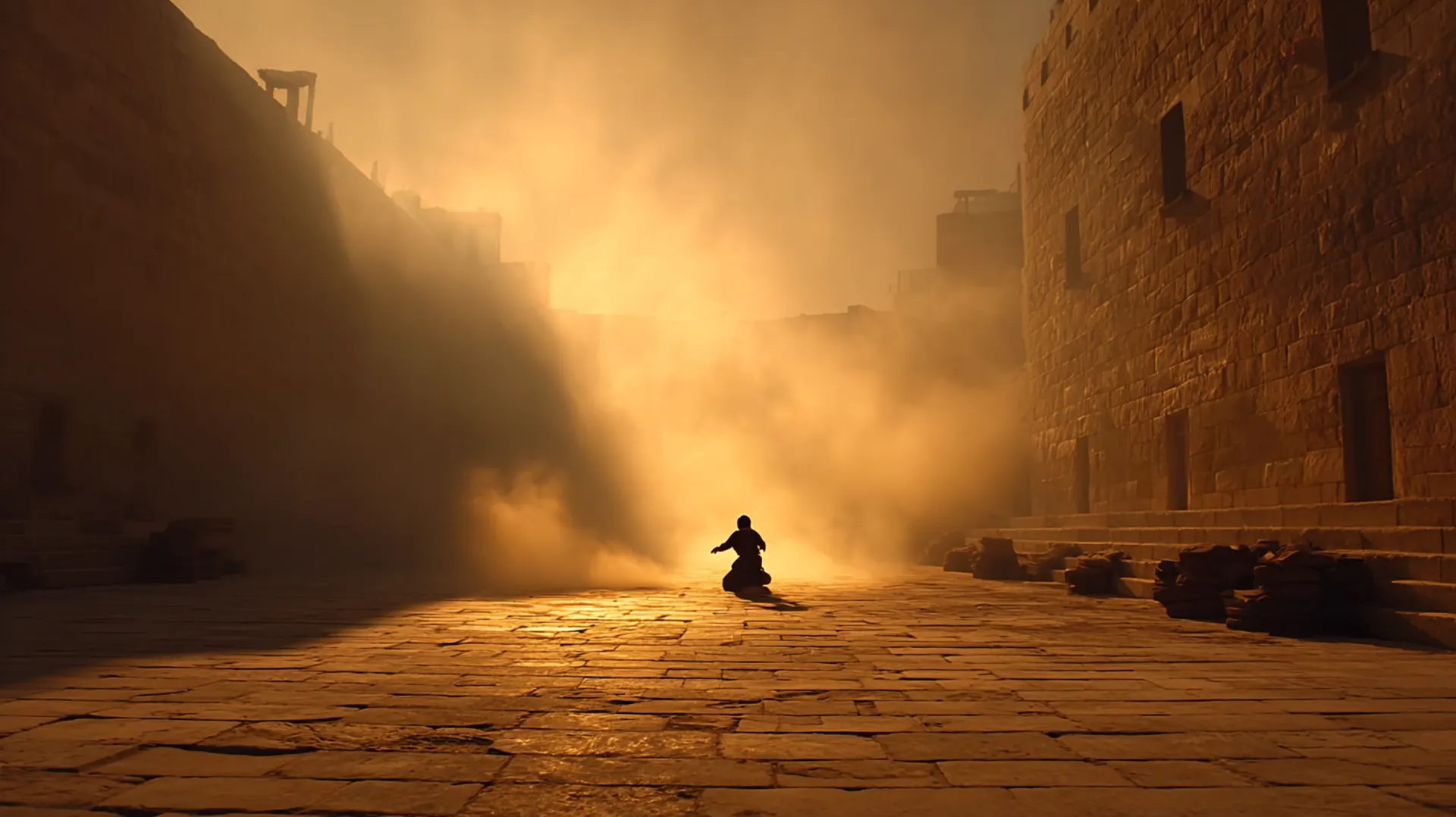
The desert night is silent—a silence so complete that even the wind seems to hold its breath. It is sometime past the third hour, and the alleyways of Mecca lie empty beneath a canopy of stars. But three figures are awake, each crouched in a separate shadow, each straining to hear the same voice. From within the modest walls of a house near the Ka’bah, the recitation of the Qur’an rises into the darkness—unhurried, luminous, unlike anything the Arabic tongue has ever produced. The voice belongs to Muhammad (peace be upon him), standing in his night prayer. And the men listening from the cold outside are not believers. They are Abu Jahl, Abu Sufyan, and Al-Akhnas ibn Shariq—three of the most powerful elders in the city—drawn from their beds by a beauty they dare not acknowledge in daylight.
For three consecutive nights, this scene repeats. For three consecutive nights, these men—architects of the very campaign to silence the Qur’an—cannot stop themselves from returning. And on the morning of the fourth day, they will each be forced to confront a question that no amount of tribal pride can answer: If this is not the truth, why does it pull us from our sleep?
The Campaign Takes Shape
The public proclamation of Islam had changed everything. What had once been a private spiritual movement, whispered in the house of Al-Arqam and shared among a small circle of the faithful, was now an open challenge to the entire social order of Mecca. The Prophet had stood on Mount Safa and declared his message to the assembled clans. Abu Talib, though he never embraced Islam himself, had drawn a line in the sand: he would not hand over his nephew. The Quraysh, accustomed to resolving disputes through tribal negotiation, found themselves facing something unprecedented—a man who could not be bought, could not be intimidated through his protector, and whose message was spreading despite every effort to contain it.
What followed was not a single act of opposition but an organized, multi-pronged campaign. The Quraysh were not fools. They understood that brute force against a member of the Banu Hashim would trigger a blood feud that could tear the city apart. So they turned to subtler weapons first: censorship, ridicule, slander, bribery, and intellectual challenge. Each tactic reveals something profound—not only about the desperation of the Meccan elite but about the nature of the Qur’an itself and the character of the earliest Muslim community.
Drowning Out the Word of God
The first line of defense was simple: if the Qur’an could not be refuted, it must not be heard.
Ibn Abbas (may Allah be pleased with him) narrates that whenever the Prophet raised his voice in recitation before the Ka’bah, the Quraysh would erupt into shouting, screaming, and cursing—cursing both the revelation and the one upon whom it was revealed. The goal was crude but effective: drown out the recitation with noise, create such a hostile atmosphere that no curious listener could approach. Anyone who wished to hear the Qur’an, Ibn Abbas reports, had to pretend indifference, straining to catch the words over the din of the mob.
It was in response to this that Allah revealed in Surah Al-Isra:
“And do not recite your prayer too loudly or too quietly, but seek a way between.” (Al-Isra, 17:110)
The instruction was counterintuitive. The Prophet’s natural impulse was to raise his voice above the chaos, to overpower the shouting with the power of revelation. But Allah directed him to recite in a moderate tone—to trust that the message would reach those whose hearts were prepared, regardless of the volume of opposition.
Scholarly Note
Ibn Abbas’s narration connecting this verse to the Quraysh’s attempts to drown out the Qur’an is recorded in both Bukhari and Muslim. Some scholars, including al-Tabari, note alternative interpretations of the verse relating to the volume of prayer in general, but the connection to the Meccan context of opposition is well-established in the tafsir tradition.
Yet the ban on public recitation created a crisis of conscience among the early believers. Gathered in the house of Al-Arqam—their secret meeting place—the Companions realized that no one other than the Prophet himself had dared recite the Qur’an openly. Someone needed to break the silence.
The Blood of Ibn Mas’ud
Abdullah ibn Mas’ud (may Allah be pleased with him) volunteered.
The other Companions objected immediately. Ibn Mas’ud was not Qurayshi. He was not even Meccan. He came from a Yemeni tribe—a man with no clan protection, no tribal network to shield him from retaliation. In the calculus of seventh-century Arabia, where lineage was everything, he was utterly vulnerable. “We want someone who has family members to help and protect him,” they told him. They wanted a Qurayshi volunteer, someone whose tribal connections would give the Quraysh pause.
But Ibn Mas’ud insisted. “I put my trust in Allah,” he declared. “Allah will protect me.” And he had every right to claim this mission, for he was the supreme Qur’an reciter among the Companions—the man about whom the Prophet would later say, as recorded in multiple collections:
“Whoever wishes to recite the Qur’an as fresh and pure as it was revealed, let him recite it according to the recitation of Ibn Umm Abd [Ibn Mas’ud].”
Ibn Mas’ud himself would later attest that he had taken more than seventy surahs directly from the Prophet’s mouth. The Qur’an was not merely his devotion; it was his identity.
The next morning, he walked to the Ka’bah. He chose the time when the Meccan elite gathered in the shade of the sanctuary for their daily socializing—their version of the afternoon coffee house, the hours of gossip and commerce. He stood at the Maqam of Ibrahim and began reciting Surah Al-Rahman in a voice of extraordinary beauty.
The effect was immediate. People began gathering, drawn by the unfamiliar art of tilawah—the rhythmic, melodic recitation unique to the Qur’an. The Arabs had their poetry, their qasidas with their own cadences and meters. But tilawah was something altogether different: the ghunnahs, the mudud, the elongations and nasalizations that belonged to no human literary tradition. The listeners were mesmerized.
“What is this he’s reciting?” someone asked. And then recognition struck: “This is what Muhammad claims has been revealed to him.”
The spell broke into violence. Some pounced on Ibn Mas’ud, beating him with their shoes—the ultimate gesture of contempt—because there was no tribal consequence for assaulting a man with no tribal protection. They struck him until he could no longer continue. He had not managed to finish even two pages of Surah Al-Rahman.
He returned to the Companions bloodied and battered. They said exactly what they had feared: “This is precisely what we were worried about.” But Ibn Mas’ud’s response was defiant: “By Allah, nothing has increased after today except my contempt for the Quraysh. And I am willing to go and do this again tomorrow.”
The Companions restrained him. Enough had been accomplished—the Qur’an had been heard, and the Quraysh had been forced to confront it in their own gathering place.
Three Men in the Dark
But the Quraysh could not escape the Qur’an so easily. The story of the three nocturnal listeners—narrated by Ibn Ishaq and recorded in al-Tabarani—reveals the extraordinary gravitational pull of the revelation even on its fiercest opponents.
Abu Jahl (Amr ibn Hisham), Abu Sufyan ibn Harb, and Al-Akhnas ibn Shariq were all senior leaders, men in their fifties, elders of competing clans. Because the Prophet recited the Qur’an aloud during his tahajjud prayer in the pre-dawn hours, and because Mecca was a small settlement of fewer than a thousand people where the night was perfectly still, his voice carried through the alleyways to anyone willing to listen.
And these three men were willing. Night after night, each crept from his bed to stand in a separate alley near the Prophet’s house, listening to the recitation in the darkness. On the first morning, they bumped into one another at Fajr time—the moment the Prophet stopped reciting—and each realized with acute embarrassment that the others had been doing the same thing. They made excuses. They agreed not to return.
The second night, the same thing happened. And the third. Finally, mortified at the possibility of being discovered, they swore an oath to one another: no more.
But on the morning of the fourth day, Al-Akhnas went privately to Abu Sufyan and asked him directly: “What is your opinion about what we heard?”
Abu Sufyan, the consummate politician—father of Muawiyah, future founder of the Umayyad dynasty—gave a characteristically evasive answer: “Some of what I heard I understood, and other parts were beyond my comprehension.” He would not commit. He would not let a single phrase escape that might be used against him.
Al-Akhnas then went to Abu Jahl. And here, the mask came off entirely.
Abu Jahl’s response was not about theology. It was not about evidence. It was about tribal competition:
“The Banu Manaf and we have always been in competition with one another. When they fed the pilgrims, we fed the pilgrims. When they gave water, we gave water. When they showed bravery, we showed bravery. Until finally we were like two horses neck and neck at the finish line. And now they come and tell us they have a prophet whom Allah inspires from the heavens. How can we compete with that? By Allah, as long as I live, I will never accept him.”
Scholarly Note
This exchange is reported through Al-Akhnas himself and corroborated by a separate narration in which Abu Jahl makes a nearly identical statement to another individual who had converted to Islam. The consistency of Abu Jahl’s reasoning across two independent reports strongly suggests this was his genuine position. Al-Tabarani records the fuller version of the nocturnal listening incident.
The honesty of Abu Jahl’s admission is staggering. He did not claim the Qur’an was false. He did not argue that Muhammad was deluded. He acknowledged, implicitly, that the message might well be true—but accepting it would mean conceding permanent supremacy to the Banu Hashim. His rejection of Islam was not intellectual but existential: it was rooted in the same tribal pride that had defined Arabian society for centuries.
The Tribal Roots of Disbelief: Why Jahili Pride Was the Real Barrier
Abu Jahl’s confession illuminates one of the deepest themes of the Meccan period: the primary obstacle to faith was not rational doubt but social identity. The Quraysh did not reject Islam because they found its arguments unconvincing. They rejected it because accepting it would have required them to dismantle the entire hierarchical structure upon which their power, prestige, and self-understanding rested.
This is why even Abu Talib, who loved the Prophet more than any other Qurayshi leader, could not bring himself to utter the shahada. To do so would have been to admit that his father Abd al-Muttalib and his grandfather Hashim—the very men whose legacy gave him his authority—had lived and died upon falsehood. The tribal system did not merely organize society; it organized the soul. A man’s worth was measured by his ancestors, and to repudiate their religion was to repudiate them.
The Qur’an addresses this psychology directly and repeatedly. When the Quraysh are confronted with monotheism, their refrain is not “prove it” but “this is not what our fathers practiced.” The argument is not epistemological but genealogical. And it explains why the earliest converts were so often those at the margins of the tribal system—the enslaved, the foreigners, the young—people for whom the existing order offered little and demanded everything.
Abu Jahl’s candid admission to Al-Akhnas is thus not merely a historical anecdote. It is a window into the fundamental human tendency to reject truth when truth threatens identity. The Qur’an would later crystallize this pattern across the stories of every previous prophet: Pharaoh knew Moses spoke truth, but submission would have cost him his throne; the chiefs of ‘Ad and Thamud recognized their prophets’ sincerity, but compliance would have dismantled their social order. Abu Jahl stands in a long line of men who chose pride over paradise.
The Poet Who Could Not Lie
If Abu Jahl’s confession reveals the psychology of rejection, the story of Al-Walid ibn al-Mughira reveals its mechanics—the way a society pressures even its most honest members into denying what they know to be true.
Al-Walid was the chieftain of the Banu Makhzum and the greatest poet in Mecca. He was the Shakespeare of his city, the man who represented the Quraysh in inter-tribal poetry competitions. He was also the father of Khalid ibn al-Walid, who would one day become Islam’s most celebrated military commander—though that future was unimaginable now.
One day, Al-Walid happened to hear the Prophet reciting the Qur’an near the Ka’bah. For the first time, he listened without interruption. And when the recitation ended, he walked away muttering words that would spread through Mecca like wildfire:
“By Allah, I have heard a speech from Muhammad just now—it is neither from the speech of men nor from the speech of jinn. Its foundation is lush, its heights are fruitful, it possesses a sweetness, it carries a grace, and it surpasses everything while nothing can surpass it.”
The panic was immediate. Mecca’s greatest literary authority had just conceded defeat after a single hearing. When word reached Abu Jahl, he went straight to Al-Walid’s house with a message calculated to exploit the one thing the old poet feared more than the truth: public opinion.
“Your people have heard that you praised the Qur’an,” Abu Jahl told him. “They will not be satisfied with you until you say something against it.”
And here the contrast with Abu Talib becomes devastating. When the Quraysh had pressured Abu Talib to hand over his nephew, the old chieftain had stood his ground: “Do as you please, I will not do it.” But Al-Walid buckled. “What do you want me to say?” he asked. “Tell me, and I’ll say it.”
Abu Jahl began cycling through options. Call him a madman. “But he is not a madman, and everyone knows it.” Call him a fortune-teller. “He doesn’t speak like a fortune-teller.” Call him a magician. “He has none of the instruments of magic.” Call him a poet. And here Al-Walid drew a line—not out of integrity toward the Prophet, but out of professional pride: “By Allah, I am the best poet among you, and I am telling you this is not poetry.”
Abu Jahl pressed harder: “We will not be satisfied until you say something.”
Al-Walid asked for time. He paced his house, frowning, thinking, turning options over in his mind. And before he could announce his verdict—before the words even left his mouth—Allah revealed them in the Qur’an, exposing the private deliberations of a man alone in his own home:
“Leave Me alone with the one whom I created alone. And to whom I granted extensive wealth, and children present with him, and spread everything before him, easing his life. Then he desires that I should add more. No! Indeed, he has been obstinate toward Our verses. I will cover him with arduous torment. Indeed, he thought and deliberated. So may he be destroyed for how he deliberated. Then he looked. Then he frowned and scowled. Then he turned back and was arrogant. And said, ‘This is nothing but magic imitated from others. This is nothing but the word of a human being.’ I will drive him into Saqar.” (Al-Muddaththir, 74:11–26)
The precision is breathtaking. Allah describes the frowning, the pacing, the internal struggle—details no one witnessed, not even Al-Walid’s own family. And the verdict Al-Walid finally settled on—“This is a special type of magic”—was the weakest of all the options Abu Jahl had proposed, the one concession Al-Walid’s conscience would allow. Even in his capitulation, he could not bring himself to call the Qur’an the work of a madman or a poet. The best lie he could manufacture was that it was magic—an admission, in its own way, that the Qur’an possessed a power beyond human explanation.
Ridicule, Slander, and the Revelation of Consolation
When censorship and intellectual suppression failed, the Quraysh turned to cruder weapons: mockery and lies.
Abu Jahl became the campaign’s most zealous enforcer. If a convert was a person of social standing, Abu Jahl would shame him: “Are you better than your father? Are you better than your grandfather?” In a culture where ancestral honor was sacred, this was a devastating challenge. If the convert was weak or enslaved, Abu Jahl would simply resort to physical violence.
The ridicule extended to the Prophet himself. During a period when no new revelation came for several weeks, one of the women of the Quraysh—possibly the wife of Abu Jahl—mocked him to his face: “I see that your devil has abandoned you.” The Prophet felt genuine grief at this taunt. And it was then that Allah revealed Surah Al-Duha, one of the most tender passages in the entire Qur’an:
“Your Lord has not abandoned you, nor has He become hateful. And the Hereafter is better for you than the present. And your Lord will give you, and you will be satisfied.” (Al-Duha, 93:3–5)
The Quraysh also mounted a systematic slander campaign, accusing the Prophet of being a madman, a magician, a fortune-teller, a poet—accusations the Qur’an catalogs and refutes. What is remarkable, as the source material notes, is that these same accusations have been recycled by every subsequent generation of critics. The modern academic claim that the Prophet was “sincerely deluded”—that he genuinely believed he was hearing divine voices—is merely the ancient charge of madness dressed in clinical language.
“Say: I have lived a whole lifetime among you before this. Will you not then use reason?” (Yunus, 10:16)
The Qur’an’s defense is elegant in its simplicity: you have known this man for forty years. He showed no signs of madness, no history of poetry, no practice of divination. The discontinuity between his pre-prophetic life and his prophetic mission is itself evidence that the source of the message lies outside him.
Scholarly Note
The identification of the woman who mocked the Prophet during the pause in revelation is uncertain. Some narrations suggest it was the wife of Abu Lahab (Umm Jamil), while others leave her unnamed. Ibn Ishaq does not specify. The connection between this incident and the revelation of Surah Al-Duha is well-established in the hadith literature, including narrations in Bukhari and Muslim, though the precise duration of the pause (fatra) is debated—ranging from a few days to several weeks depending on the report.
Bribery and the Recitation of Fussilat
When mockery failed, the Quraysh tried negotiation. The most famous attempt came through Utbah ibn Rabi’ah, a distant relative of the Prophet from the Banu Abd Manaf—a man of genuine wisdom and relative decency, the same man who would later try to prevent the Battle of Badr and whom the Prophet himself would call “the wise man on the red camel.”
Utbah approached the Prophet at the Ka’bah with a carefully prepared offer. “O my nephew,” he began, invoking the language of kinship and seniority, “you know your status and your lineage in our society.” Then came the loaded questions: “Are you better than Abdullah? Are you better than Abd al-Muttalib?” The Prophet remained silent—not because he could not answer, but because answering would have derailed the conversation into a theological argument the questioner was not prepared to understand.
Utbah then laid out his terms: wealth beyond any Arab’s possession, kingship over the Quraysh (a title they had never bestowed on anyone), marriage to any woman of his choosing. And if the issue was illness, they would hire the finest physicians in Arabia.
The Prophet listened without interrupting. When Utbah finished, the Prophet asked quietly: “Are you done, O Abu al-Walid?” Utbah said he was. “Then listen to me.”
And the Prophet began reciting Surah Fussilat.
Verse by verse, the surah built in power and rhythm. Utbah’s expression changed. His body stiffened. And when the Prophet reached the verse warning of a destruction like that which befell ‘Ad and Thamud, Utbah leapt forward, placed his hand over the Prophet’s mouth, and begged him—by Allah and by the bonds of kinship—to stop.
He returned to the Quraysh assembly visibly shaken. “Leave this man alone,” he told them. “I have heard a speech from him that I have never heard before. I could not comprehend all of it. He is going to have an impact on the world. If the other Arabs destroy him, your hands are clean. But if he prevails, his victory is your victory, and his power is your power.”
The Quraysh dismissed him with their standard verdict: “He has bewitched you, just like he bewitched everyone else.”
The Miracle They Could Not Accept
The sixth tactic was to demand miracles—tangible, spectacular proofs. The Qur’an records their demands in detail: spring a well from the earth, transform the desert into gardens of grapes and dates, split the sky open, bring Allah and the angels before our eyes, turn your house into gold, ascend to heaven while we watch, bring down a physical book from the sky.
Why did Allah not comply? The answer, as the Qur’an itself explains, is threefold. First, He did grant some miracles—most notably the splitting of the moon, referenced in Surah Al-Qamar (54:1–2)—and the Quraysh dismissed them as optical illusions. Second, the greatest miracle was already in their hands: the Qur’an itself, a literary and spiritual phenomenon that their own master poets could not replicate or even adequately describe. Third, Allah knew what the Quraysh themselves proved: that no miracle would satisfy those whose rejection was rooted not in insufficient evidence but in tribal pride.
As recorded in Sahih al-Bukhari, when the Quraysh begged the Prophet to turn Mount Safa into gold, the Prophet made a sincere supplication. Jibreel descended with Allah’s response: “If you wish, I will transform it. But if they reject after that, there will be no second chance.” The Prophet chose mercy over spectacle, preferring to leave the door of guidance open.
“And even if We had sent down to them the angels, and the dead had spoken to them, and We had gathered everything before them face to face, they would still not believe unless Allah should will.” (Al-An’am, 6:111)
No Compromise in Tawhid
The final tactic was the most insidious: the offer of compromise. The Quraysh proposed a religious rotation—one day devoted to the worship of Allah alone, the next to the worship of their idols. It was the ultimate expression of pragmatism, the kind of deal that any politician would consider reasonable.
The response was Surah Al-Kafirun—absolute, unambiguous, and final:
“Say: O disbelievers, I do not worship what you worship, nor are you worshippers of what I worship… For you is your religion, and for me is mine.” (Al-Kafirun, 109:1–6)
And when a formal delegation sat with the Prophet and asked what single condition would end the conflict, Abu Jahl—misunderstanding the word “one” as a negotiable demand—eagerly offered: “One condition? We’ll give you ten!” The Prophet’s answer was the kalima: “La ilaha illallah.” Abu Jahl recoiled, and Allah recorded the Quraysh’s astonishment in Surah Sad:
“Has he made the gods into one God? Indeed, this is a curious thing.” (Sad, 38:5)
The Lineage of Resistance
Beneath all of these tactics—the censorship, the ridicule, the bribery, the demands for miracles, the offers of compromise—lay a single, unifying force: the jahili conception of identity. The Quraysh could not accept Islam because Islam demanded something more radical than a change of worship. It demanded a change of self. To say “La ilaha illallah” was to declare that the hierarchies of blood and tribe, the legacies of fathers and grandfathers, the entire architecture of Arabian social life, were subordinate to a truth that recognized no aristocracy except piety.
This is the deeper meaning of the Qur’anic observation that the Arabs’ idolatry was itself a corruption of the Abrahamic legacy. Ibrahim had built the Ka’bah and supplicated for a prophet to arise from the descendants of Ismail. The very idols the Quraysh now defended had been introduced into a sanctuary originally consecrated to the worship of the One God. The Quraysh were not defending an ancient tradition; they were defending a deviation from one.
And yet, woven through every act of opposition, there are glimmers of the truth breaking through. Al-Walid could not call the Qur’an human speech. Abu Sufyan gave a politician’s non-answer rather than deny what he had heard. Even Abu Jahl’s furious honesty—“How can we compete with a prophet?”—was, in its own tortured way, an acknowledgment that the claim might be real.
The Qur’an was doing its work. Slowly, inexorably, like water finding cracks in stone, it was reaching hearts that the tribal system had armored against it. But the Quraysh were not finished. Having failed with words—with censorship and mockery and bribery and intellectual challenge—they would soon turn to the one weapon they had not yet fully deployed: physical violence against the most vulnerable believers. The enslaved, the foreign, the unprotected—those without the shield of tribal lineage—would bear the first and heaviest blows. The age of persecution was about to begin in earnest.
Quranic References
Continue Your Journey
Cite this Narrative
APA
SeerahQuest. (2026). The Arsenal of Denial. *SeerahQuest: The Eternal Narrative*. https://seerahquest.com/chapters/qurayshi-tactics-against-the-prophet Adapted from Yasir Qadhi's Seerah Series, Episode 13.
MLA
"The Arsenal of Denial." *SeerahQuest: The Eternal Narrative*, 2026, https://seerahquest.com/chapters/qurayshi-tactics-against-the-prophet. Adapted from Yasir Qadhi's Seerah Series, Episode 13.
Chicago
"The Arsenal of Denial." *SeerahQuest: The Eternal Narrative*. Accessed April 3, 2026. https://seerahquest.com/chapters/qurayshi-tactics-against-the-prophet. Adapted from Yasir Qadhi's Seerah Series, Episode 13.
Install SeerahQuest — read chapters offline, anytime.