Hearts Mended, Households Built
On his deathbed, Abu Salama prayed for his wife to find a husband better than himself. She could not imagine who that could possibly be.
2-4 AH · 624 – 625 CE
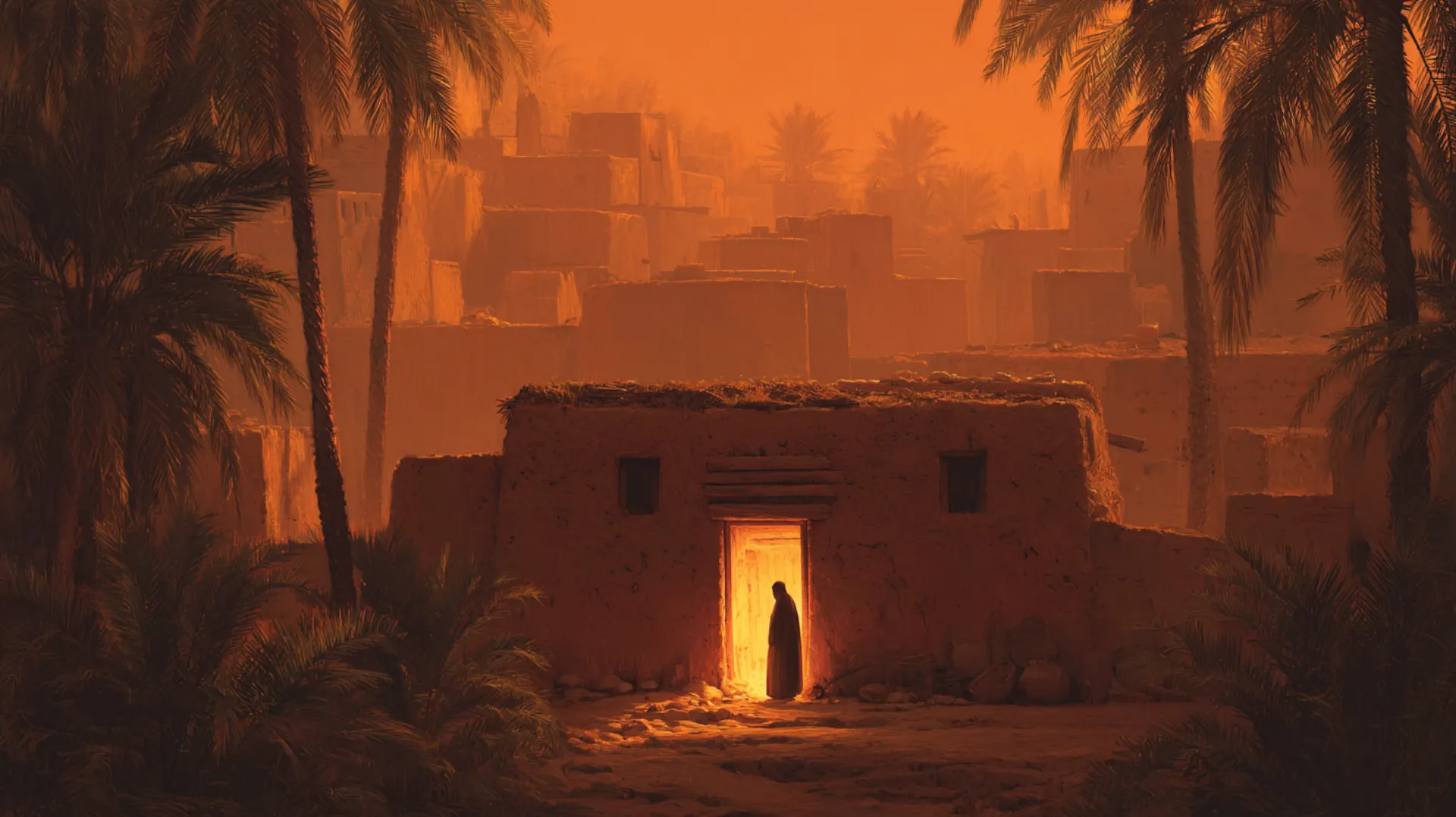
The deathbed is no place for selfishness, and Abu Salama knows it. He lies in his home in Madinah, his body slowly surrendering to the wounds that Uhud carved into him months ago — wounds that healed on the surface but never truly closed beneath. His wife Umm Salama sits beside him, her eyes bright with a love forged across two continents and a decade of exile. She leans close and makes him a proposition: a pact that neither will remarry after the other is gone, so they might be reunited in Paradise. It is a promise she fully intends to keep. Abu Salama looks at her and asks a single question: “Will you obey me?” Of course, she says. She has never disobeyed him. Then he tells her the last thing she expects to hear: After I die, marry someone. And then, with the breath of a man who loves his wife more than he loves the idea of possessing her even in memory, he raises his hands and prays: O Allah, bless Umm Salama with a husband better than me, who will take care of her and never harm or irritate her.
She cannot imagine who that could possibly be.
A Community Bound by Marriage
The fourth year of the Hijrah unfolds against a backdrop of grief and resilience. The catastrophe of Uhud still reverberates through Madinah’s narrow lanes — the seventy martyrs, the Prophet’s own wounds, the archers’ fatal mistake on the hillside. The massacres of Al-Raji’ and Bi’r Ma’una have claimed another seventy of the community’s finest scholars and reciters. The Muslim state is battered, its population diminished, its widows and orphans multiplied.
It is precisely in this context that the marriages of the Prophet Muhammad (peace be upon him) must be understood — not as the indulgences of a powerful man, but as the careful, compassionate stitching together of a community that keeps tearing at the seams. Every marriage in this period carries within it a story of loss, a question of protection, and a quiet revolution in how seventh-century Arabia thought about widows, orphans, and the bonds between families.
To grasp the full picture, we must step back briefly and account for the household as it stands in the third and fourth years of the Hijrah, before tracing the stories that reshape it.
The Household Before Madinah
Khadijah bint Khuwaylid (may Allah be pleased with her) — the first wife, the first believer, the woman whose wealth funded the early mission and whose love sustained the Prophet through the terrifying early revelations — had died in the Year of Sorrow, roughly three years before the Hijrah. For twenty-five years she had been his only wife. Every one of his children was born through her. When she passed, the Companions reported that they did not see him smile for months.
Scholarly Note
All of the Prophet’s children — Al-Qasim, Zaynab, Ruqayyah, Umm Kulthum, Fatimah, and Abdullah — were from Khadijah. This is well established in the biographical literature. Ibrahim, born later from Mariyah al-Qibtiyyah, is the sole exception. The Prophet’s faithfulness to Khadijah for the entirety of their marriage, from age twenty-five to approximately fifty-four, is consistently cited by scholars as evidence against accusations of lustfulness in his later marriages.
Within months of Khadijah’s death, the Prophet married Sawdah bint Zam’ah (may Allah be pleased with her), an elderly widow who had returned from the emigration to Abyssinia after her husband’s death. Sawdah was not young, not wealthy, and not from a particularly powerful clan. She was a believer who needed protection, and the Prophet needed someone to care for his motherless daughters. It was a marriage of mutual mercy.
The nikah with ‘A’ishah bint Abi Bakr (may Allah be pleased with her) was contracted in Makkah but consummated in Madinah in the second year of the Hijrah, as recorded in Sahih al-Bukhari. ‘A’ishah would become one of the greatest scholars of Islam, preserving more hadith and legal rulings than almost any other Companion — but that story stretches across decades, and she deserves, as the sources themselves acknowledge, far more than a passing mention.
By the time the events of this chapter begin, the Prophet’s household consists of Sawdah and ‘A’ishah. Khadijah is buried in the cemetery of Hujun in Makkah. And the community is about to witness a series of marriages that reveal the Prophet’s character — and the character of the women around him — with extraordinary clarity.
Hafsa: The Daughter No One Would Take
The story begins with a father’s wounded pride.
Hafsa bint ‘Umar (may Allah be pleased with her) is young — perhaps nineteen or twenty — and already a widow. Her husband Khunays ibn Hudhafah had been one of the early converts, a man who emigrated to Abyssinia and fought at both Badr and Uhud. At Uhud he was severely wounded and carried back to Madinah, where he died from his injuries shortly after. Hafsa is left alone: no children, no husband, at the prime of her youth, with nothing but grief and her father’s fierce protective instinct.
‘Umar ibn al-Khattab (may Allah be pleased with him) swallows his pride and goes looking for a suitable match. He approaches ‘Uthman ibn ‘Affan (may Allah be pleased with him), who is himself a widower — his wife Ruqayyah, the Prophet’s own daughter, had died around the time of Badr. ‘Uthman is noble, wealthy, pious, and single. The offer seems perfect.
‘Uthman asks for time to think. Days pass. Then he returns with a quiet refusal: “I think I should not get married at this stage.”
‘Umar is stung. He reads the refusal as a rejection of his daughter. Gathering himself, he goes to Abu Bakr al-Siddiq (may Allah be pleased with him). Abu Bakr listens — and says nothing at all. He does not return for days. No answer, no explanation, just silence. ‘Umar later admitted that Abu Bakr’s silence hurt him even more than ‘Uthman’s refusal.
What ‘Umar does not know is that the Prophet has already mentioned Hafsa to both men, consulting them — seeking istisharah, advice — about the possibility of marrying her himself. Neither Abu Bakr nor ‘Uthman can reveal the Prophet’s confidence, and neither knows what to say to the bewildered father standing before them.
According to some biographical sources, ‘Umar even went to the Prophet to express his frustration. The Prophet responded with words whose meaning ‘Umar would not grasp until later: “Hafsa will marry someone better than ‘Uthman. And ‘Uthman will marry someone better than Hafsa.”
The proposal came directly from the Prophet. ‘Uthman, for his part, would marry another of the Prophet’s daughters — Umm Kulthum — earning him the title Dhun-Nurayn, the possessor of two lights. And Abu Bakr, relieved, came to ‘Umar afterward and explained: “The Prophet had mentioned Hafsa to us. I could not inform you of his secret, and I did not know what to tell you.” Then, with characteristic generosity: “Had the Prophet not proposed for her, I would have accepted.”
Scholarly Note
The account of ‘Umar offering Hafsa to ‘Uthman and Abu Bakr is found in Sahih al-Bukhari (5122). The detail about the Prophet consulting both men before proposing is mentioned in various books of Rijal and biographical dictionaries of the Companions, though Ibn Ishaq’s main narrative does not include it in detail. The principle of istisharah (consultation) in personal matters, even by the Prophet, is consistently highlighted by scholars commenting on this episode.
Hafsa brought to the Prophet’s household a personality as vivid as her father’s. ‘A’ishah herself said that Hafsa was her primary rival among the co-wives — “the daughter of Abu Bakr and the daughter of ‘Umar, they are like their fathers’ daughters.” Hafsa was bold, literate (one of the very few women of her era who could read and write), and deeply devout. When tensions arose in the household — and they did, as they do in any marriage — and the Prophet either considered or briefly issued a divorce, the angel Jibril intervened with a command to take her back, describing her as sawwamah qawwamah: a woman who fasts constantly and prays constantly, and who would be his wife in Paradise.
“Take her back, for she is sawwamah qawwamah, and she shall be your wife in Jannah.”
Her piety, in the end, outweighed everything else. It is a lesson the sources draw out explicitly: righteousness can save a marriage when nothing else will.
Hafsa’s legacy extended far beyond her lifetime. When ‘Umar ibn al-Khattab was assassinated and the caliphate was temporarily without a successor, Hafsa took custody of the original mushaf — the first compiled copy of the Qur’an, assembled under Abu Bakr’s direction. She kept it safe until ‘Uthman needed it for his standardized copies, and she held it until her death in either 41 or 45 AH.
Hafsa and the Preservation of the Qur'an
The role of Hafsa in preserving the Qur’an is one of the most remarkable and underappreciated episodes in Islamic history. When Abu Bakr commissioned the first compilation of the Qur’an into a single written volume after the Battle of Yamama — in which many huffaz (memorizers) were killed — the completed mushaf was kept by the Caliph. It passed from Abu Bakr to ‘Umar. When ‘Umar was stabbed by Abu Lu’lu’ah and died before naming a successor, there was a brief interregnum during which no caliph held authority. Hafsa, as ‘Umar’s daughter and a literate wife of the Prophet, took possession of the mushaf.
When ‘Uthman later undertook the monumental project of producing standardized copies to send across the expanding Muslim lands, he had to request the mushaf from Hafsa. She lent it, the copies were made, and she kept the original until her death. The fact that the most important physical document in Islamic civilization passed through the hands of a woman — and that this was unremarkable to the Companions — speaks volumes about the real status of women in the earliest Muslim community.
Hafsa died in Madinah and was buried in Baqi’ al-Gharqad. Marwan ibn al-Hakam, then governor of Madinah, led her funeral prayer.
Zaynab bint Khuzayma: The Mother of the Poor
If Hafsa’s story is one of spirited resilience, the story of Zaynab bint Khuzayma (may Allah be pleased with her) is one of quiet, almost invisible compassion — the kind that leaves barely a trace in the historical record precisely because the woman who embodied it died before the world had time to notice.
Zaynab was not from the Quraysh. She belonged to the Banu Hilal, a tribe of Najd, and her path to the Prophet’s household wound through a series of marriages that placed her at the center of early Islamic sacrifice. According to one report, she had been married to Tufayl ibn al-Harith ibn ‘Abd al-Muttalib, a cousin of the Prophet, who divorced her. She then married his brother ‘Ubaydah ibn al-Harith — the same ‘Ubaydah who, alongside Hamzah and ‘Ali, fought in the famous mubarazah (single combat) at Badr and was fatally wounded, his leg severed in the duel.
Scholarly Note
The details of Zaynab bint Khuzayma’s previous marriages are among the most contested in Seerah literature. Some sources name her previous husband as ‘Abdullah ibn Jahsh (killed at Uhud), while others identify ‘Ubaydah ibn al-Harith (killed at Badr). Ibn Hajar al-‘Asqalani discusses these conflicting reports in Al-Isabah. The uncertainty stems from the fact that Zaynab died so early in the Madinan period that few detailed accounts of her life were preserved.
What is not contested is her character. Even before Islam, Zaynab was known by the title Umm al-Masakin — Mother of the Poor. She fed the hungry, sheltered orphans, and gave what she had to those who had nothing. That this reputation preceded her conversion speaks to a natural goodness that Islam only deepened.
When her husband was killed, Zaynab found herself in Madinah with no family, no tribal network, and no one to provide for her. She was from Najd; she had no relatives in either Makkah or Madinah. The Prophet married her sometime in the third year of the Hijrah, and she lived as his wife for only a few months — some sources say three, others five, still others eight — before she passed away in Rabi’ al-Awwal of the fourth year.
She was the only wife besides Khadijah to die during the Prophet’s lifetime, and she was the first of his wives to be buried in Baqi’ al-Gharqad. If you visit the cemetery today, the nine graves of the Mothers of the Believers stand in a row, and Zaynab’s is the first — because she was the first to arrive.
Her story is brief, but it crystallizes one of the central purposes of the Prophet’s marriages: the protection of women who had sacrificed everything for the faith and had no one left to turn to.
There is, however, a remarkable footnote to Zaynab’s story that illuminates the extraordinary web of kinship in early Islam. Her mother — whose name is not always recorded — had five daughters, and the marriages of those daughters read like a roster of Islamic history’s greatest figures. Two of them became Mothers of the Believers: Zaynab herself, and her half-sister Maymunah bint al-Harith, who would marry the Prophet years later. A third daughter was Umm al-Fadl, wife of al-‘Abbas ibn ‘Abd al-Muttalib and mother of the great scholar ‘Abdullah ibn ‘Abbas. A fourth was Lubabah al-Sughra, who married al-Walid ibn al-Mughirah — making her the mother of Khalid ibn al-Walid, the Sword of Allah. And the fifth was Asma’ bint ‘Umays, who married Ja’far ibn Abi Talib, then Abu Bakr al-Siddiq, then ‘Ali ibn Abi Talib, bearing sons to each of them.
This single mother-in-law — unnamed, unheralded — produced a family tree that includes two wives of the Prophet, the mother of Ibn ‘Abbas, the mother of Khalid ibn al-Walid, and a woman who was wife to three of the most towering figures in Islamic history. The scholars call her the most noble mother-in-law in the history of mankind, and it is difficult to argue.
Umm Salama: The Widow Who Said No
And now we return to the deathbed where this chapter began.
Abu Salama (may Allah be pleased with him) — ‘Abdullah ibn ‘Abd al-Asad, cousin of the Prophet from his mother’s side — was one of the earliest converts. He and Umm Salama had emigrated twice: first to Abyssinia, where they lived under the protection of the Najashi, and then to Madinah, where Umm Salama earned the distinction of being the very first woman to make the Hijrah. Their journey to Madinah had been harrowing: when they attempted to leave Makkah together, Umm Salama’s clan forcibly separated her from her husband and infant son, keeping her in Makkah while Abu Salama traveled on alone. For nearly a year, she would go out every morning and weep at the edge of the city, until her people relented and released her. A man named ‘Uthman ibn Talhah, not yet a Muslim, was so moved by her plight that he escorted her all the way to Madinah.
Abu Salama fought at Uhud and was severely wounded. He recovered partially but never fully, and he died from his injuries a few months later. It was on his deathbed that he taught Umm Salama the hadith that would define the rest of her life — a hadith he had learned from the Prophet himself:
“Never does any calamity strike anyone, and he is patient at that and says: Allahumma ajurni fi musibati wakhlufni khayran minha (O Allah, reward me for this affliction and replace it with something better) — except that Allah will give him something better than what was taken away.”
As soon as Abu Salama died, Umm Salama remembered the hadith. She said it. But even as the words left her lips, her heart whispered: Who could possibly be better than Abu Salama?
The answer came in stages. After her ‘iddah (waiting period) was complete, Abu Bakr al-Siddiq proposed. She declined. The first man of the Ummah after the Prophet — and she said no. Abu Salama still held her heart. No one, she believed, could replace him.
Then the Prophet himself came to her house and proposed directly. Even then — even with the Messenger of Allah standing before her — Umm Salama did not simply accept. She laid out three concerns with the precision of a woman who had spent years navigating the complexities of exile and loss:
First, she said, I am a woman of intense jealousy, and you already have wives. I fear my jealousy will displease you, which will displease Allah.
Second, I am no longer young. She was in her mid-thirties — older than ‘A’ishah and Hafsa by more than a decade.
Third, I have children. Four of them. Whoever marries me takes on their care.
The Prophet’s responses reveal the man behind the mission. To her jealousy, he said he would pray to Allah to remove it from her heart. To her age, he offered a gentle joke: “I am afflicted with the same calamity as you” — meaning, I am not twenty years old either. And to her children, he said simply: Iyaluki iyali — “Your family is my family.”
Umm Salama married the Prophet in approximately the fourth year of the Hijrah. She would prove to be one of the wisest of his wives, most famously at the Treaty of Hudaybiyyah, when the Companions were paralyzed by frustration and the Prophet was uncertain how to break the impasse. It was Umm Salama who counseled him: do not negotiate further — simply stand up, shave your head, and sacrifice your animal. They will follow your actions when they will not follow your words. He took her advice, and she was right.
She lived to be nearly ninety, dying in 59 AH — one of the last of the Mothers of the Believers. Abu Hurayrah (may Allah be pleased with him) led her funeral prayer, and she was buried in Baqi’ al-Gharqad beside the women who had shared her extraordinary life.
And the du’a of Abu Salama — O Allah, bless her with a husband better than me — was answered in a way that neither of them could have imagined on that quiet, grief-soaked afternoon in Madinah.
Jabir’s Choice: A Different Kind of Marriage
Not all the marriages of this period belonged to the Prophet. One of the most touching stories comes from a teenager named Jabir ibn ‘Abdullah (may Allah be pleased with him), whose father ‘Abdullah ibn ‘Amr had been martyred at Uhud, leaving Jabir — barely seventeen — as the sole guardian of seven sisters.
The story unfolds on the return journey from the expedition of Dhat al-Riqa’, when the Prophet noticed a lone figure straggling far behind the army on the oldest, weakest camel in the caravan. It was Jabir, his shoulders bowed under the weight of grief, debt, and the crushing responsibility of a family he did not know how to feed.
Scholarly Note
The dating of the Ghazwah of Dhat al-Riqa’ is disputed among scholars. Ibn Ishaq places it in the fourth year of the Hijrah, shortly after Uhud, which is the chronology followed here. However, al-Bukhari and others argue it occurred after Khaybar (7 AH). One of the key pieces of evidence for the earlier dating is Jabir’s own account: he mentions that his father had recently died at Uhud and that the Prophet did not yet know he was married, suggesting the expedition took place not long after Uhud. See Ibn Hajar’s discussion in Fath al-Bari.
The Prophet called out: “Who is that in the back?” Jabir identified himself, and the Prophet asked why he looked so sad. Jabir poured out his situation — his father’s death, the debt, the sisters, the worthless camel.
Then the Prophet asked: “Are you married?” Jabir said yes. “To a young woman or a previously married woman?” Jabir said he had married a thayyib — an older, experienced widow.
The Prophet teased him gently: “Why didn’t you marry a young girl? You could play with her and she with you, you could make her laugh and she could make you laugh.” Jabir’s answer was disarming in its maturity: “O Messenger of Allah, I wanted to marry someone who would take care of my sisters — not add another one their age whom I would also have to look after.”
The Prophet affirmed his choice: “You have done right.”
What followed was an extended, intimate conversation between the most important man in Arabia and a grieving teenager — a conversation in which the Prophet dismounted, rode Jabir’s broken-down camel (which, after a touch and a Bismillah, became the fastest camel Jabir had ever seen), and then embarked on an elaborate, affectionate negotiation to buy the animal. Starting at one dirham, Jabir haggled his way up to forty — and then, upon arriving in Madinah, discovered the Prophet’s true intention. When Jabir came to deliver the camel and collect his payment, the Prophet had the money weighed out generously and then said: “Oh Jabir, did you think I would cheat you? Take the money and take your camel.”
The entire exercise — the bargaining, the teasing, the ride — had been a stratagem to give a proud young man financial help without making him feel like a charity case. As recorded in Sahih al-Bukhari, Jabir narrated this story in the first person, and Ibn Hajar al-‘Asqalani noted that more than a hundred legal and ethical benefits can be extracted from this single hadith.
The Fiqh of Jabir's Camel: Marriage, Markets, and Prophetic Wisdom
The Hadith of Jabir is one of the foundational texts in Islamic commercial law (Fiqh al-Buyu’). From the negotiation over the camel, scholars derive rulings on the permissibility of bargaining, the validity of conditional sales, the ethics of giving gifts disguised as transactions, and the principle that both buyer and seller should part satisfied. But the hadith is equally rich in its social teachings.
The Prophet’s question — “Why didn’t you marry a young girl?” — is not a criticism but a prompt, designed to let Jabir articulate his reasoning. When Jabir explains that he chose experience and maturity over youth because his sisters needed a caretaker, the Prophet validates the decision without qualification. This exchange demolishes any notion that one type of marriage is universally superior: the best marriage depends on the circumstance.
The Prophet’s advice to Jabir not to rush home but to let word of the army’s return reach his wife first — so she could prepare herself and he could arrive to a welcoming home — reveals a remarkable frankness about marital intimacy. The Prophet is acting as a surrogate father, offering the practical guidance that Jabir’s own father would have given had he survived Uhud.
The Wisdom in the Weaving
Step back from the individual stories and a pattern emerges. Hafsa: a young widow of a martyr, her father desperate to find her a protector. Zaynab bint Khuzayma: a woman with no family at all, known only for her generosity to the poor, married for a few months before death took her. Umm Salama: a veteran of two emigrations, a mother of four, a woman whose intelligence and counsel would shape the course of Islamic history. Jabir’s unnamed wife: an older widow chosen not for romance but for the practical wisdom a shattered family needed.
In none of these cases is the driving motive what a modern cynic might assume. The Prophet married Hafsa to honor a martyr’s family and to bind the community’s leadership closer together. He married Zaynab to shelter a woman who had no one. He married Umm Salama to care for a family left destitute by Uhud and to gain a counselor whose wisdom would prove indispensable. And he encouraged Jabir’s unconventional choice because he understood that love takes many forms, and that sometimes the most loving thing a seventeen-year-old can do is choose stability over infatuation.
The early Muslim community carried no stigma about widowhood or remarriage. A divorced or widowed woman was not damaged goods; she was a person in need of partnership, and the community mobilized to provide it. Abu Bakr proposed for Umm Salama. ‘Umar sought matches for Hafsa. The Prophet himself consulted his closest companions before making proposals. Marriage was not a private indulgence but a communal act — a way of weaving broken threads back into the fabric of a society under siege.
And hovering over all of these stories, still to come, is the marriage of Zaynab bint Jahsh — the Prophet’s cousin, whose story would occasion the revelation of the laws of hijab and raise questions that scholars and critics would debate for fourteen centuries. That story belongs to another chapter. But its shadow already falls across the Madinan landscape, a reminder that the Prophet’s household was never merely domestic. It was, in every sense, a theater of revelation.
The expulsion of the Banu Nadir is about to shatter whatever fragile calm remains in Madinah. A plot against the Prophet’s life — a boulder poised above his head as he sits beneath a wall — will be exposed by divine warning, and the siege of fortresses will begin. The marriages that have just woven the community together will be tested by the unraveling of its most dangerous alliance.
Quranic References
Continue Your Journey


Cite this Narrative
APA
SeerahQuest. (2026). Hearts Mended, Households Built. *SeerahQuest: The Eternal Narrative*. https://seerahquest.com/chapters/marriages-of-the-prophet-in-medina Adapted from Yasir Qadhi's Seerah Series, Episode 52.
MLA
"Hearts Mended, Households Built." *SeerahQuest: The Eternal Narrative*, 2026, https://seerahquest.com/chapters/marriages-of-the-prophet-in-medina. Adapted from Yasir Qadhi's Seerah Series, Episode 52.
Chicago
"Hearts Mended, Households Built." *SeerahQuest: The Eternal Narrative*. Accessed April 3, 2026. https://seerahquest.com/chapters/marriages-of-the-prophet-in-medina. Adapted from Yasir Qadhi's Seerah Series, Episode 52.
Install SeerahQuest — read chapters offline, anytime.