The Hour That Changed Urwa: Emissaries, Fury, and the Unraveling of Quraysh
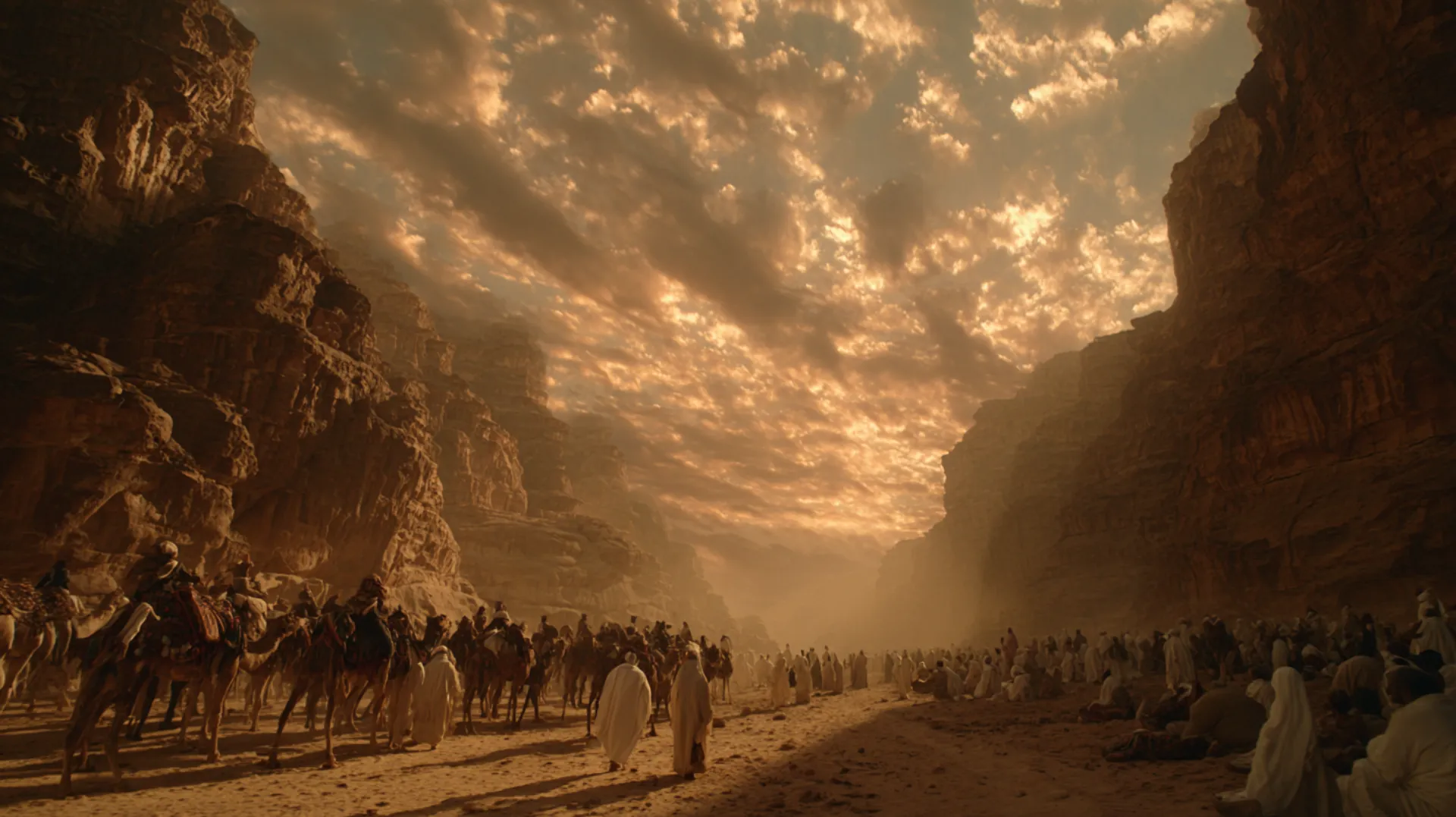
A Thaqafi chieftain entered the Muslim camp expecting to find a rabble of strangers. One hour later, he told the Quraysh he had never seen devotion like this — not in the courts of Caesar, Kisra, or the Najashi.
6 AH · 628 CE
The scabbard strikes before the word is spoken. In the dust-hazed camp at Hudaybiyyah, a Thaqafi chieftain reaches for the beard of the Prophet Muhammad (peace be upon him) — a gesture of fraternal negotiation among Arab leaders — and a blade’s pommel cracks against his knuckles. The blow comes from behind a veiled helmet, and the voice that follows is low, trembling with fury: Get your hand away from the beard of the Prophet before the hand is cut off from its owner. The chieftain freezes. He knows that voice. It belongs to his own nephew.
This is the moment that will shatter Urwa ibn Mas’ud’s understanding of the world. He has entered the Muslim camp at Hudaybiyyah expecting to find a ragtag collection of tribal misfits — men whose loyalties could be purchased or frightened away. He will leave it having witnessed something he has never seen in the courts of Caesar, Kisra, or the Najashi: a devotion so absolute that it terrifies him.
The Neutral Broker: Budayl ibn Warqa and the First Attempt at Peace
Before any official emissary crossed the dusty no-man’s-land between the Muslim encampment and the Quraysh positions, a third party stepped forward. Budayl ibn Warqa, chieftain of the Khuza’ah tribe, was neither Muslim nor Qurayshi. His people inhabited the territories around Mecca, and he carried the weight of a man who wanted no blood spilled on land he considered home.
Budayl approached the Prophet’s camp and spoke plainly: “Ya Muhammad, I have just come from the other side of Hudaybiyyah, and I have left the sons of Ka’b ibn Lu’ay and Amir ibn Lu’ay armed to the teeth.” The invocation of those ancestral names — the legendary forefathers of the Quraysh — was deliberate. This was Budayl’s way of saying: The full might of the Quraysh awaits you. Do not be hasty.
The Prophet’s response was the same message he would repeat to every emissary, every negotiator, every challenger who stood before him during those long days at Hudaybiyyah. It was a message of stunning clarity: “We have not come to fight. Rather, we have come to show honor to the house of Allah.” And then the harder edge: war had damaged the Quraysh, and it had damaged the Muslims. If they wished peace, he was ready. If they wished war, he would fight until his head was severed from his neck and Allah’s decree was fulfilled.
Budayl carried this message back to the Quraysh. Ibn Ishaq records what happened next: the foolish among them refused even to listen. “We have no reason to hear you,” they said. “We know exactly why he’s here.” But the people of intelligence — and there were some among the Quraysh who still possessed it — said, “Let him speak.”
When Budayl relayed the Prophet’s offer, he added his own counsel: “O Quraysh, you are being hasty with this man. Your anger is getting the better of you. He has not come to fight. He has come to visit this house, honoring its sanctity.”
The Quraysh’s response crystallized the impasse that would define the entire negotiation: “By Allah, we will never allow him to enter Mecca, and the Arabs will say that he had the better hand over us.” This was not strategy. This was not theology. This was pride — raw, tribal, unyielding pride. The fear that other Arabs would perceive them as weak became the immovable object against which every subsequent negotiation would crash.
Scholarly Note
The precise chronological ordering of the emissaries at Hudaybiyyah is a matter of scholarly reconstruction. As Dr. Yasir Qadhi notes, “So many scholars have attempted to reconstruct who went first, who went second, because really, in the end of the day, we don’t know.” The sequence presented here — Budayl, then Urwa, then Khirash, then Hulays — represents one plausible reconstruction among several. Ibn Ishaq, al-Waqidi, and later historians provide overlapping but not always consistent accounts.
The Eighty Who Surrendered: A Miracle Before the Negotiations
Before the diplomatic back-and-forth began in earnest, a dramatic incident set the tone for everything that followed. Eighty armed Qurayshi fighters attempted a surprise attack on the Muslim camp — a pre-dawn raid designed to kill and flee, a strike-and-vanish operation that could have left hundreds dead.
But the Muslims were prepared. Their scouts detected the approaching force, and in a remarkable tactical maneuver, the 1,400 pilgrims surrounded the attackers and forced their surrender without a single drop of blood being shed. The Prophet then commanded every one of the eighty men to be released and sent back to Mecca unharmed.
The significance of this moment cannot be overstated. By every legal and moral standard of the ancient world — and, indeed, of the modern one — the Prophet had every right to execute or imprison men who had attempted a surprise military attack on a sleeping camp. Instead, he chose mercy. And in doing so, he made a statement louder than any battlefield victory: We are here for peace.
Allah references this incident directly in Surah Al-Fath:
“And He is the One who held back their hands from you and your hands from them in the valley of Mecca, after He had given you victory over them.” — Al-Fath (48:24)
The verse contains a subtle but profound double blessing. Allah stopped their hands from harming the Muslims — the surprise attack failed. But He also stopped the Muslims’ hands from harming them — because had even one of those eighty men been killed, the entire peace process would have collapsed before it began. Hudaybiyyah, which would prove to be one of Islam’s greatest victories, would never have happened.
Surah Al-Fath: The Conquest That Wasn't a Conquest
One of the most common misconceptions among Muslims who have not studied the Seerah in depth is the assumption that Surah Al-Fath refers to the Conquest of Mecca. The word fath does mean “conquest” or “opening,” and when Muslims say “the Fath” without qualification, they typically mean the conquest of Mecca in 8 AH. But Surah Al-Fath — all of it — was revealed on the road back from Hudaybiyyah, not after the fall of Mecca.
The opening verse — “Indeed, We have granted you a manifest victory” (Al-Fath 48:1) — refers to the Treaty of Hudaybiyyah itself. This was bewildering to the Companions at the time, many of whom felt the treaty was a humiliation rather than a triumph. The Quran’s insistence on calling it a “manifest victory” (fathan mubina) was itself a kind of revelation — not just of divine text, but of divine perspective. What looked like defeat to human eyes was, in the calculus of Providence, the beginning of the end for Quraysh paganism.
The subsequent two years would prove the Quran right. The cessation of hostilities allowed Islam to spread at an unprecedented rate. Tribes that had been afraid to approach the Muslims now sent delegations. The trickle of conversions became a flood. By the time the Quraysh violated the treaty two years later, the balance of power had shifted so dramatically that Mecca fell almost without resistance.
Urwa ibn Mas’ud: The Man Who Changed His Mind in an Hour
The arrival of Urwa ibn Mas’ud al-Thaqafi as the Quraysh’s first serious emissary introduced a figure of considerable stature into the drama. Urwa was not Qurayshi — he was the chieftain of the Banu Thaqif, the dominant tribe of Ta’if, Mecca’s sister city in the highlands. But his mother was Qurayshi, his loyalties lay firmly with the Meccan establishment, and he had the diplomatic credentials to prove it: he had personally visited the courts of the Roman Caesar, the Persian Kisra, and the Najashi of Abyssinia.
Urwa began his mission by establishing his bona fides with the Quraysh. “Am I not a father to you? Am I not a son to you?” he asked, invoking his half-Qurayshi blood. He recited his resume — past reconciliations, averted conflicts, debts of gratitude. The Quraysh affirmed him at every turn. Satisfied, he crossed the line into the Muslim camp.
What followed was a masterclass in failed persuasion — and accidental conversion.
Urwa opened with accusations. He challenged the Prophet: “What is really the matter with you? You break the ties of kinship. You bring a group of people we don’t know — who are these strangers? You break the sanctity of the Haram.”
The Prophet responded with calm precision: “I have only come to fulfill the ties of kinship, not to break them. I have come to change the religion of my people to a better religion. I want them to be better.”
Then Urwa made the mistake that would change him. He looked around the Muslim camp — at the Aws, the Khazraj, the scattered converts from a dozen smaller tribes — and saw, through his tribal lens, nothing but a motley collection of strangers with no binding loyalty. “By Allah,” he said to the Prophet, “I don’t see around me men that I recognize. These seem to be a medley, a hodgepodge of different people who will run away from you and leave you at the earliest chance possible.”
From Urwa’s worldview, this was logical. He had lived his entire life in a world where loyalty meant blood, where you fought for your tribe because your tribe was your identity. He could not fathom what bound an Aws tribesman to a Khazraji, or a Qurayshi exile to a Yemeni farmer. The concept of a community united by faith rather than genealogy was literally invisible to him.
He was about to see it.
”Go Suck on the…”: Abu Bakr’s Fury
The moment Urwa declared that the Muslims would abandon their Prophet at the first sign of danger, a voice erupted from the crowd — a voice so crude, so shockingly vulgar, that it silenced the entire assembly. And it came from the last person anyone would have expected: Abu Bakr al-Siddiq (may Allah be pleased with him), the gentlest, most soft-spoken man in the Muslim community.
The phrase Abu Bakr hurled at Urwa was an obscene insult directed at al-Lat, the chief idol of Urwa’s own tribe, the Thaqif. It is recorded faithfully in the books of Seerah, and its vulgarity is such that it defies polite translation. The essence was a command to perform a degrading act upon the private anatomy of the goddess he guarded.
Urwa was stunned. “Who said that?” he demanded. When told it was Abu Bakr ibn Abi Quhafah, Urwa restrained himself — but only because Abu Bakr had once lent him money to pay off a debt, and the code of the Arabs demanded that such a favor be repaid, even if only by swallowing an insult.
What this explosion revealed was the depth of the Companions’ protective fury. Abu Bakr — the man known for his tenderness, his weeping during prayer, his unfailing gentleness — went from zero to white-hot rage in an instant, not because he had been insulted, but because the loyalty of the Muslims to their Prophet had been questioned. The Prophet did not rebuke him for the outburst. The silence was its own verdict.
Scholarly Note
The incident of Abu Bakr’s vulgar rebuke of Urwa is recorded in Sahih al-Bukhari (2731, 2732) and other major collections. Scholars note that the Prophet’s silence constitutes a tacit approval (taqrir), indicating that while such language is ordinarily inappropriate, extreme circumstances involving the defense of the Prophet’s honor may constitute a rare exception. This is understood as precisely that — an exception, not a license for general vulgarity.
The Nephew’s Sword: Mughira ibn Shu’ba
The second shock came when Urwa, following the Arab custom of grasping a fellow leader’s beard during conversation, reached for the Prophet’s beard. Each time he did so, a sword handle struck his hand — gently at first, then harder, then hard enough to bruise. Finally, a voice rang out: “Get your hand away from the beard of the Prophet before the hand will be cut off from its owner.”
The armored figure was Mughira ibn Shu’ba (may Allah be pleased with him) — Urwa’s own nephew, the son of his brother. Mughira’s backstory made the confrontation even more charged. Before Islam, he had been a bandit and a highway robber, a man whose crimes had nearly dragged the entire Thaqif tribe into a blood feud. When he finally embraced Islam, the Prophet accepted his conversion but refused his stolen wealth: “As for your Islam, we will accept it. But as for your money — we cannot accept any of that.”
Mughira had rebuilt himself from nothing. Now he stood as the Prophet’s personal bodyguard, and when his own uncle dared touch the Prophet’s beard, tribal loyalty meant nothing. Urwa, recognizing his nephew’s voice, spat back: “Oh traitor! Are you still not basking in your deceit?” — a reference to the old scandal of Mughira’s criminal past. Mughira could not answer that charge. It was true. But the deeper truth was that the man who had once been a bandit was now willing to cut off his uncle’s hand to protect the Prophet.
”I Have Visited the Kings”: Urwa’s Testimony
When Urwa returned to the Quraysh, the man who walked back was not the man who had walked in. Something had broken open inside him during that single hour in the Muslim camp. And the words he spoke to the assembled Quraysh leaders constitute one of the most extraordinary passages in the entire Seerah — extraordinary precisely because they come from an outsider, a pagan, a man with no theological reason to be impressed.
“O people, I have visited the kings and entered the palaces of Caesar of Rome, and Kisra of Persia, and the Najashi of Abyssinia. And by Allah, I have never seen any king being shown respect the way the Companions of Muhammad show respect to Muhammad.”
Then the details poured out — details no Companion would have thought to record, because to them, this behavior was simply normal:
“By Allah, he did not even spit except that one of them caught that spit before it touched the ground and rubbed it on his face and body. And never did he wash himself with wudu except that they nearly fought one another to catch those drops of water. If he commanded them something, they raced to be the first to fulfill it. When he spoke, they all lowered their heads and their voices, and none of them would look at him directly, out of awe and respect.”
This was not the report Urwa had planned to deliver. He had gone in expecting to confirm his suspicion that the Muslims were a disorganized rabble. Instead, he had witnessed a phenomenon that exceeded anything in his considerable diplomatic experience. Neither the Byzantine emperor, surrounded by his court in Constantinople, nor the Sasanian king of kings in Ctesiphon, nor the Najashi in his Abyssinian palace, commanded this kind of devotion.
And then the devastating pivot. The man who had told the Prophet that his followers would abandon him now told the Quraysh the opposite: “I have measured them for you, I have absorbed them for you. Know that if you wish the sword, they will give you what you wish.” He continued: “I have seen a group — they don’t care what happens to them if their companion is harmed. Even the women amongst them would never hand him over, no matter what the cost.”
His advice was blunt: “Take my counsel. I fear that you will not be able to win over him.” And then, softening: “He is a man that has come to this house wishing to honor it, with sacrificial animals, and instead he is being deprived and denied and prevented.”
The Quraysh’s response was cold: “If only someone else besides you had said this, Ya Aba Ya’fur.” The subtext was clear: We thought you were on our side. You’ve gone soft. But their refusal to listen did not change what Urwa had seen. The seeds of his own eventual conversion to Islam had been planted in that single hour.
Khirash and Hulays: The Diplomacy Continues
The Prophet next sent his own emissary into Mecca — Khirash ibn Umayyah of the Khuza’ah tribe, mounted on the Prophet’s own camel, al-Tha’lab, a beast the Quraysh would recognize immediately. The message was unmistakable: I send you my personal envoy on my personal mount. I want peace.
The Quraysh’s response was mob violence. They surrounded Khirash, hamstrung the Prophet’s camel, and nearly killed the envoy himself. Only the intervention of another Khuza’i man in Mecca prevented bloodshed. Khirash was sent back without so much as a conversation.
Then came al-Hulays ibn Alqamah, chieftain of the Banu Kinana, the largest of the Ahabish — the tribal confederates who formed the bulk of the Quraysh’s military strength. Hulays volunteered to go assess the Muslim camp for himself.
The Prophet recognized him from a distance and instantly understood the man’s psychology. Hulays’s tribe was known for venerating sacrificial animals — the decorated camels and sheep that pilgrims dedicated to the Ka’bah for distribution among the poor. The Prophet commanded the Companions to bring out their hundreds of sacrificial animals and parade them through the valley through which Hulays was approaching.
Hulays never even entered the camp. He saw the valley filled with decorated camels, their garlands and markings unmistakable. He saw the Muslims in their white ihram garments, chanting the talbiyah: Labbayk Allahumma labbayk. He saw the animals thinning from hunger because the Quraysh’s blockade had cut off their grazing. And he turned around.
When he reached the Quraysh, his verdict was absolute: “It is not permitted to prevent these animals from reaching their destination, nor to prevent these pilgrims from visiting the House of Allah.”
The Quraysh’s response was racist contempt: “Who are you? You’re just an ignorant Bedouin. Our mistake was sending you.” At which point Hulays swore by Allah that none of the Ahabish — the entire confederate alliance — would support the Quraysh any further. In a single stroke, the Quraysh lost roughly half their military strength. First the Thaqif had walked away after Urwa’s experience. Now the Ahabish.
The coalition was crumbling. And the Prophet had not drawn a single sword.
Abu Basir and the Community That Changed the Treaty
The treaty was eventually signed — its painful terms, the return of Abu Jandal, the erasure of “Rasulullah” from the document, all of it. The Companions departed Hudaybiyyah in a state of profound distress that would only lift when Surah Al-Fath was revealed on the journey home. But the treaty’s most remarkable consequence was still to come.
Abu Basir was a Muslim convert living in Mecca, affiliated with the Khuza’ah tribe. He was the first person to test the treaty’s most controversial clause — that any man who fled Mecca for Medina must be returned. Abu Basir escaped to Medina, and for a few days, the Prophet said nothing. He did not patrol the city’s borders; enforcement was not his obligation under the letter of the agreement.
When two Qurayshi emissaries arrived demanding Abu Basir’s return, the Prophet honored the treaty. He told Abu Basir: “These two men have come to take you, and you came knowing the treaty that we signed. I will not be treacherous. Return to your people.” Abu Basir pleaded, as Abu Jandal had pleaded before him. He received the same answer: “Allah will make a way out for you.”
What happened next was swift and brutal. On the road back to Mecca, Abu Basir befriended one of his escorts, admired the man’s sword, asked to examine it — and killed him with it. The second escort fled back to Medina in terror. Abu Basir followed, entering the mosque to announce his return. The Prophet did not address him directly. Instead, he spoke into the air — a statement that was simultaneously a lament and a coded instruction:
“What a great warrior he is — if only he had someone else to help him.”
Abu Basir understood. He could not stay in Medina — the Quraysh would send more men, and the Prophet would be obligated to hand him over again. But the Prophet had not told him where to go. Abu Basir fled south, establishing a small encampment on the coastal road near Jeddah — squarely on the Quraysh’s trade route to Syria.
Abu Jandal, the son of Suhail ibn Amr himself, soon escaped and joined him. Then ten more. Then twenty. Then seventy. Within months, eighty Muslim fighters had congregated in a settlement that owed no allegiance to Medina and was bound by no treaty. They did exactly what anyone might have predicted: they attacked every Qurayshi caravan that passed.
The irony was devastating. The Quraysh had insisted on the clause preventing Muslim men from settling in Medina. They had not anticipated that those same men, denied refuge with the Prophet, would form an independent armed community on the most vulnerable stretch of the Quraysh’s commercial lifeline. The very clause designed to weaken the Muslims had created a threat far worse than anything Medina itself posed.
Within a year and a half, Abu Sufyan himself sent a delegation to Medina — not demanding, but begging — the Prophet to take these men in. “By the rights of kinship,” the message read, “please take these people and put them in Medina.” The Quraysh, who had insisted that no Muslim man be allowed to settle in Medina, were now pleading for exactly that.
The Prophet sent word to Abu Basir to bring his community to Medina. But Abu Basir, who had suffered a wound or illness, died before the message reached him. He was buried at the coastal camp he had founded. Abu Jandal — the son whose chains had rattled across the floor of Hudaybiyyah, whose pleading had brought tears to every Muslim eye — led the remaining fighters home to Medina.
Scholarly Note
The story of Abu Basir is recorded in Sahih al-Bukhari (2731, 2732) as part of the extended Hudaybiyyah narrative. Scholars note that the Prophet’s adherence to the literal terms of the treaty — he did not enforce the return clause himself but complied when the Quraysh came to enforce it — demonstrates a principle in Islamic jurisprudence: one may follow the letter of a treaty even when it appears to contradict its spirit, so long as one does not violate its explicit terms. The formation of Abu Basir’s independent community was not a violation of the treaty, since those men were neither in Medina nor under the Prophet’s direct authority.
Urwa’s Epilogue: The Shaheed of Ta’if
There is a coda to Urwa ibn Mas’ud’s story that must be told, even though it belongs to a later chapter of the Seerah. In the ninth year of the Hijrah — years after Hudaybiyyah, after the conquest of Mecca — Urwa traveled to Medina and embraced Islam. He was the first of the Thaqif elders to do so, and he was eager to return to Ta’if and call his people to the faith.
The Prophet warned him: “I am afraid for you. I know your people.”
Urwa was confident — too confident. “Ya Rasulullah,” he said, “if I am sleeping, they would never wake me up.” He meant that his status among the Thaqif was so exalted that they would never harm him.
He returned to Ta’if. He began preaching. He was met with cursing, insults, and a venom he had never imagined his own people capable of. He retreated to his home, heartbroken. The next morning, at Fajr, he climbed to his roof, called the adhan, and began to pray.
An arrow struck him. He fell from the rooftop into the ravine below and died as a martyr.
When the news reached the Prophet, he said: “The likeness of Urwa is like the man of Yasin” — a reference to the believer in Surah Ya-Sin (36:20-27) who came running to his people, crying, “O my people, follow the messengers!” — and was killed for it. That man’s final words, as the Quran records them, were not of bitterness but of longing:
“If only my people knew how my Lord has forgiven me and placed me among the honored.” — Ya-Sin (36:26-27)
The chieftain who had once mocked the Muslims as a “hodgepodge” of strangers died calling those strangers’ God from a rooftop in the mountains of Ta’if. The hour he spent in the Muslim camp at Hudaybiyyah had changed the trajectory of his soul.
The Turning of the Tide
What Hudaybiyyah reveals, when viewed from the vantage of these emissaries and encounters, is a victory won not by the sword but by the sheer gravitational force of conviction. Every person who entered the Muslim camp — Budayl the neutral broker, Urwa the skeptical diplomat, Hulays the tribal chieftain — left it changed. Not because the Prophet argued them into submission, but because what they witnessed among the Companions was something no argument could manufacture: a community bound by something stronger than blood, stronger than tribe, stronger than the fear of death.
The Quraysh’s coalition did not collapse on the battlefield. It collapsed in the hearts of the men sent to assess the enemy. And the treaty’s most punitive clause — the forced return of Muslim refugees — did not weaken Islam. It created Abu Basir’s coastal community, which strangled Qurayshi commerce until the Quraysh themselves begged for its dissolution.
In the next chapter, we will step back to the moment that preceded these negotiations — the terrifying hour when the Prophet believed Uthman ibn Affan had been killed inside Mecca, and fourteen hundred men placed their hands in his and swore an oath beneath a desert tree that they would not flee, even unto death. That oath — the Bay’ah al-Ridwan — was the furnace in which the resolve of Hudaybiyyah was forged, and it is the reason the Quraysh, when they heard of it, trembled in their houses and decided, at last, to negotiate.
Quranic References
Continue Your Journey
Cite this Narrative
APA
SeerahQuest. (2026). The Hour That Changed Urwa: Emissaries, Fury, and the Unraveling of Quraysh. *SeerahQuest: The Eternal Narrative*. https://seerahquest.com/chapters/abu-basir-suhail-and-the-treaty-of-hudaybiyah-community Adapted from Yasir Qadhi's Seerah Series, Episode 64.
MLA
"The Hour That Changed Urwa: Emissaries, Fury, and the Unraveling of Quraysh." *SeerahQuest: The Eternal Narrative*, 2026, https://seerahquest.com/chapters/abu-basir-suhail-and-the-treaty-of-hudaybiyah-community. Adapted from Yasir Qadhi's Seerah Series, Episode 64.
Chicago
"The Hour That Changed Urwa: Emissaries, Fury, and the Unraveling of Quraysh." *SeerahQuest: The Eternal Narrative*. Accessed April 3, 2026. https://seerahquest.com/chapters/abu-basir-suhail-and-the-treaty-of-hudaybiyah-community. Adapted from Yasir Qadhi's Seerah Series, Episode 64.
Install SeerahQuest — read chapters offline, anytime.