The Camel That Would Not Rise
The camel kneels on the plain of Hudaybiyyah, and the Prophet tells his stunned Companions: the One who stopped the elephant has also stopped her. What follows will test their faith more than any battle.
6 AH · 628 CE
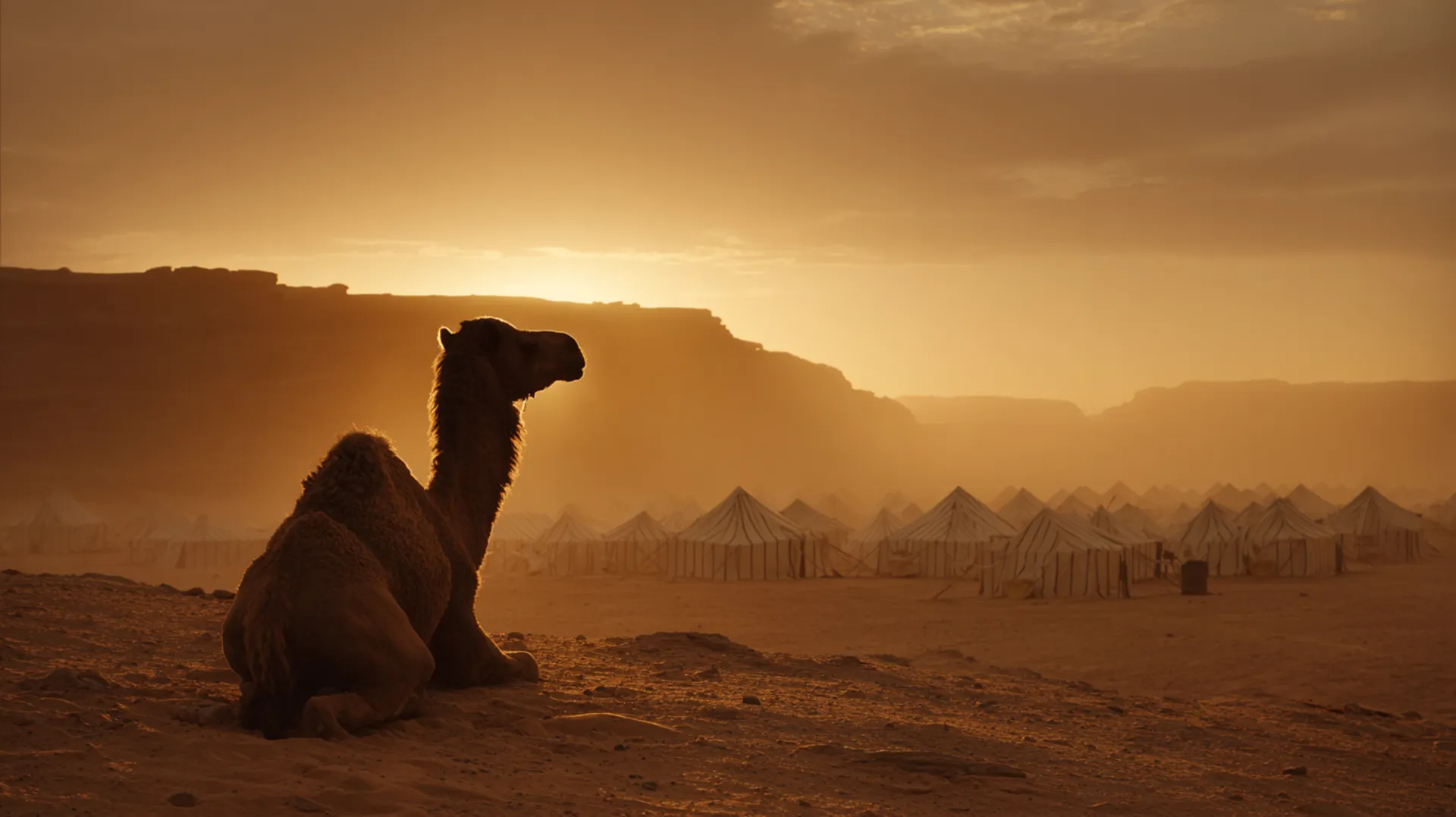
The camel kneels. Not from exhaustion—Qaswa is strong, sure-footed, a creature who has carried the Prophet Muhammad (peace be upon him) through desert storms and midnight retreats without once refusing her rider. Yet here, on the dusty plain of Hudaybiyyah, twenty kilometers from the city that haunts every Muhajir’s dreams, the camel simply folds her legs beneath her and will not rise. The Companions shout the old command—hal, hal—their voices sharp with frustration. They have bled through a valley of thorns to get here. They have detoured around Khalid ibn al-Walid’s cavalry. They are so close to Mecca they can almost taste the dust of the Haram. And the camel will not move.
“Qaswa has become stubborn!” someone mutters.
The Prophet’s response silences them all: “Qaswa has not become stubborn, and neither is that in her nature. Rather, the One who stopped the elephant has also stopped her.”
The elephant. Abraha’s elephant, decades before, halted at the very threshold of Mecca by divine command. The parallel is unmistakable. God has drawn a line in the sand, and everything that follows—the negotiations, the heartbreak, the treaty that will look like surrender and prove to be the greatest victory Islam has yet known—begins with a camel that refuses to stand.
A Dream, a Sacred Month, and a March Toward Mecca
It begins, as so many turning points in this story do, with a dream.
Sometime during the sixth year of the Hijrah, the Prophet sees himself in a vision: he is circling the Ka’bah in the white garments of ihram, and then shaving his head—the act that signals the completion of Umrah. For ordinary men, dreams are the flotsam of sleep. For prophets, they are revelation. He interprets the vision as a divine command: it is time to return to Mecca, not as a conqueror but as a pilgrim.
The timing he chooses is exquisitely deliberate. He waits until the first day of Dhul Qa’dah—the very opening of the sacred months, those four periods in the Islamic calendar when all of Arabia, by the ancient covenant of Ibrahim, is bound to lay down arms. Dhul Qa’dah, Dhul Hijjah, Muharram, and then the solitary Rajab: for one-third of the year, the highways are supposed to be safe, the pilgrims inviolable, the swords sheathed.
“Indeed, the number of months with Allah is twelve months in the register of Allah from the day He created the heavens and the earth; of these, four are sacred.” — At-Tawbah (9:36)
The Prophet’s message to the Quraysh is encoded in every detail of his departure. He leaves Madinah on a Monday, the first of the sacred month, wearing ihram, leading seventy sacrificial camels garlanded and consecrated for the poor of Mecca. He is not marching to war. He is walking to worship. And every Arab who sees this caravan will understand exactly what it means.
Scholarly Note
The date of departure—1st Dhul Qa’dah, 6 AH—is one of the rare points of near-unanimous agreement among classical seerah scholars. Ibn Ishaq, al-Waqidi, and Ibn Sa’d all concur. The number of Companions is consistently reported as approximately 1,400 in Sahih al-Bukhari and other major collections.
The announcement goes out to the Muhajirun, the Ansar, and the surrounding Muslim Bedouin tribes. The Muhajirun and Ansar respond immediately—these are men who have not seen Mecca in six years, men whose hearts ache for the black stone and the circling crowds and the scent of home. But the Bedouins around Madinah make excuses. Our properties, they say. Our families. We cannot leave.
The Qur’an strips their pretenses bare:
“Those who remained behind of the Bedouins will say to you, ‘Our properties and our families occupied us, so ask forgiveness for us.’ They say with their tongues what is not in their hearts.” — Al-Fath (48:11)
Their real fear, Allah reveals, was darker: they believed the Prophet and his followers would never return alive. They imagined a slaughter on the road to Mecca and wanted no part of it. And in their cowardice, they forfeited something they could never reclaim—the honor of being counted among the people of Hudaybiyyah, a rank second only to the veterans of Badr in the hierarchy of the Companions.
The Sacred Months and the Law of Ibrahim
The institution of the sacred months (Ashhurul Hurum) predates Islam, rooted in the Abrahamic tradition that the Quraysh claimed to uphold. For centuries, these months guaranteed safe passage for pilgrims and traders across the Arabian Peninsula—a kind of divinely mandated ceasefire that sustained both the spiritual economy of the Haram and the commercial economy of the caravan routes.
But the pre-Islamic Arabs had corrupted this institution through a practice called nasi’—the postponement or swapping of sacred months to suit military convenience. If a tribe wanted to wage war during a sacred month, they would simply declare it to be a different month and delay the sanctity to a more convenient time. The Qur’an condemns this manipulation as “an increase in disbelief” (At-Tawbah 9:37).
It was not until the Farewell Pilgrimage (Hajjatul Wada’) that the Prophet announced the calendar had finally cycled back to its original Abrahamic order, and he forbade any further tampering. From that day forward, the sacred months have remained fixed.
The Prophet’s decision to depart on the first of Dhul Qa’dah was therefore a masterstroke of moral positioning. By entering the sacred month in ihram with consecrated animals, he placed the Quraysh in an impossible dilemma: to stop him would mean violating the very Abrahamic covenant on which their entire claim to custodianship of the Ka’bah rested. It was a gamble—but a gamble grounded in the deepest principles of Arabian honor.
The Detour Through Thorns
At Dhul Hulayfah, the miqat of Madinah, the Prophet prays two rak’ahs, dons his ihram, and consecrates the seventy camels. Then he dispatches a quiet intelligence operation: a man named Busr ibn Safwan al-Khuza’i, chosen precisely because he is unknown to the Quraysh. Busr is a Muslim, but his tribe, the Khuza’ah, is officially neutral. He can walk into Mecca without raising suspicion, gauge the Quraysh’s reaction to the Prophet’s departure, and report back.
The precaution is characteristic. Throughout the seerah, the Prophet’s trust in God never translates into recklessness. He sends scouts, he posts lookouts around the column of 1,400, he dispatches contingents to investigate unidentified riders on the horizon. When a group of horsemen is spotted near Ghayqa, he sends men to verify whether they are a Quraysh vanguard. It turns out to be a false alarm—but the vigilance never relaxes.
Busr returns at Asfan, roughly midway between Madinah and Mecca, and the news he carries is grim. The Quraysh have heard of the Prophet’s march. They have armed themselves. They have donned their leopard skins—the traditional garb of war. They have brought their women and children to the front lines as a display of total commitment. And they have sent Khalid ibn al-Walid with a cavalry force to block the main road into Mecca at a place called Ghumaym.
The Prophet’s anguish is palpable. “Woe to the Quraysh,” he says. “War has consumed them.” And then, in words that reveal the private heartbreak of a man forced to fight his own people:
“What would they lose if they let me and the other Arabs deal with each other? If the Arabs defeat me, they get what they want. And if I prevail, the honor will be theirs—for I am one of them.”
Scholarly Note
This statement is recorded in multiple seerah sources and reflects a recurring theme in the Prophet’s approach to the Quraysh. Ibn Ishaq and al-Waqidi both preserve versions of this address. The Prophet’s explicit preference for peace over confrontation with his kinsmen is one of the strongest pieces of evidence against the characterization of early Islam as inherently militaristic.
He gathers the Companions and presents his assessment: since Khalid blocks the direct route, perhaps they should strike at the allied tribes who have sent forces to support the Quraysh. But Abu Bakr al-Siddiq (may Allah be pleased with him) offers a different counsel: “O Messenger of Allah, you left your house intending only the House of Allah. You did not intend war. Let us proceed toward the Ka’bah as we planned, and we will fight only if they force us to fight.”
The Prophet accepts Abu Bakr’s position immediately. “Let us go forth, in the name of Allah.” His willingness to change course based on consultation—shura—is not weakness. It is the mark of a leader who understands that a plan embraced by all will be executed with far greater conviction than one imposed from above.
Now comes the hard part. To avoid Khalid’s cavalry, they need an alternate route—one that bypasses the main highway entirely. A guide is found who knows a path through a valley choked with thorns and volcanic rock. The 1,400 pilgrims file into this natural gauntlet, their bare feet bleeding against the sharp ground, their ihram garments snagging on every branch. It is brutal, exhausting, demoralizing.
The Prophet encourages them with a promise: “No one shall pass through this valley except that all of his sins will be forgiven.” The pain becomes penance. The bleeding becomes purification.
But there is one exception. “Except the man with the red camel.” Somewhere at the back of the column, a Bedouin is calling out that he has lost a red camel—more concerned with his animal than with the spiritual opportunity unfolding around him. When the Companions find him and urge him to seek the Prophet’s intercession, his response is chilling: “Searching for my camel is more beloved to me than going to your companion for forgiveness.” It is a small, devastating portrait of hypocrisy—a man physically present among the faithful but spiritually a thousand miles away.
The Plain of Hudaybiyyah
By nightfall, they emerge from the valley onto the plain of Hudaybiyyah—a flat expanse on the road between Jeddah and Mecca, named for a crooked tree (hadbah) that bent over an old well. In our time, the place is called al-Shumaisi, visible as a road sign about twenty kilometers before Mecca on the Jeddah highway. Here, the camel kneels.
And here, the water runs out.
The well of Hudaybiyyah is nearly dry—just a thin film at the bottom, nowhere near enough for 1,400 men and their animals after a day of bleeding through thorns. The Companions lower a bucket with what little water remains. The Prophet takes it, rinses his mouth, and spits the water back into the well. He places some of his arrows into the bucket and lowers it again. And the water begins to gush—rising so fast that the men in the well have to scramble out to avoid drowning. The entire camp drinks. The animals drink. For as long as they remain at Hudaybiyyah, the water never fails.
Then the Prophet makes an announcement that will define everything that follows:
“I swear by the One in whose hands is my soul, the Quraysh will not ask of me any condition in which the signs of Allah are respected except that I will give them that condition—as long as we avoid bloodshed.”
It is a blank check for peace. And the Companions need to understand this, because the conditions that are coming will test every fiber of their faith.
Suhail ibn Amr: The Quraysh’s Sharpest Tongue
The Quraysh send a series of emissaries, but the deadlock does not break until they dispatch their most formidable negotiator: Suhail ibn Amr. He is a member of the Quraysh’s inner council—not a messenger but a plenipotentiary, authorized to make binding decisions. He is called Khatib al-Quraysh, the Orator of the Quraysh, and his reputation for eloquence is so fearsome that Umar ibn al-Khattab (may Allah be pleased with him) had once asked permission to cut out his tongue after Badr to silence him permanently.
The Prophet had refused. “I am a prophet, and we have not been commanded to mutilate people.” And then he had added, with the quiet prescience that marks so many of his statements: “Perhaps one day he will say something that will please you.”
When the Prophet sees Suhail approaching, he takes the man’s name—Suhail, from the root meaning “ease”—as a good omen. “Allah has made things easy for you,” he tells the Companions. “Suhail has come.”
Scholarly Note
The practice of drawing positive omens from names and events (fa’l) is established in the Sunnah, as distinct from the prohibited practice of drawing negative omens (tiyarah). The Prophet explicitly endorsed seeking good signs while forbidding superstitious pessimism. The conditions for a valid fa’l are: (1) it must be positive, and (2) it must be attributed to Allah’s will, not to the object or event itself. See Bukhari 5754 and Muslim 2223.
The negotiations begin. The Prophet dictates; Ali ibn Abi Talib (may Allah be pleased with him) writes.
“Bismillah ar-Rahman ar-Rahim.”
Suhail objects. “I don’t know this ‘ar-Rahman.’ Write it the way we write: Bismik Allahumma.”
The Prophet concedes. It is only a letterhead.
“This is what Muhammad, the Messenger of Allah, has agreed to with Suhail ibn Amr—”
Suhail objects again. “If we believed you were the Messenger of Allah, we would not have prevented you from the Ka’bah nor fought you. Write: Muhammad ibn Abdullah.”
The Prophet’s response is firm but measured: “By Allah, I am the Messenger of Allah, even if you deny it.” Then he instructs Ali to erase “Messenger of Allah” and write “Muhammad ibn Abdullah.” Ali refuses—his love for the Prophet will not let his hand perform such an act. So the Prophet takes the document himself and scrubs out the words with his own hand.
It is a moment of extraordinary humility. And it is a moment that reveals the Prophet’s strategic clarity: the title on a piece of leather changes nothing about the truth. What matters is the substance of the agreement—and the avoidance of blood.
The Chains of Abu Jandal
The conditions Suhail dictates are punishing. No Umrah this year—the Muslims must return and come back the following year for only three days. A ten-year ceasefire. Both sides may form alliances with other tribes. And then the clause that cuts deepest: any man who leaves Mecca to join the Muslims must be returned. But any Muslim who leaves Madinah to rejoin the Quraysh will not be sent back.
The Companions erupt. How can they return a Muslim fleeing persecution? Every Muhajir in the camp knows what it means to escape Mecca in the night, to leave family and fortune behind for the sake of faith. This condition strikes at the very heart of their identity.
And then—at the precise moment this clause is being debated, before Ali has even written it down—they hear the sound.
Metal on stone. The clinking of chains.
A figure stumbles into the camp from the direction of Mecca. He is emaciated. His wrists are raw and shackled. The marks of whips and beatings are visible across his exposed chest. He is screaming: “O Muslims! O Muslims!”
It is Abu Jandal—the younger son of Suhail ibn Amr.
Abu Jandal’s story is one of the seerah’s most agonizing subplots. His older brother Abdullah had already defected to the Muslim side at Badr, sneaking away from the Quraysh army and fighting against his own father. The humiliation had driven Suhail to lock Abu Jandal in a dungeon, where he had been chained and tortured for nearly four years—starved, beaten, ordered to renounce his faith. He had figured out how to escape the physical cell, but with no money, no mount, and every face in Mecca knowing him as Suhail’s son, escape to Madinah was impossible.
Until now. When Abu Jandal heard that the Muslims were camped just outside the city, he saw his chance. He broke free and dragged his chains across the desert to Hudaybiyyah, not knowing that his own father was sitting across from the Prophet, negotiating the very clause that would seal his fate.
Suhail turns to the Prophet. His voice is cold. “This is the first man to whom this condition applies. Return him.”
The Prophet tries everything. He asks Suhail to make an exception. He asks him to gift Abu Jandal as a personal favor. Three times, four times, he pleads—and in the entire seerah, there is no other recorded instance of the Prophet pleading this way with an adversary. Suhail will not budge. “If you refuse, then there is no treaty.”
Mikraz, Suhail’s companion, offers a compromise: Abu Jandal will be returned, but he will not be tortured again. It is a thin mercy.
Abu Jandal cries out to the camp: “O Muslims, will you return me to the polytheists while I have come to you as a Muslim? Do you not see what they have done to me?”
The Prophet addresses him directly. His voice, one imagines, carries the weight of a man who sees a larger design behind an unbearable moment:
“Be patient, O Abu Jandal, for Allah will make a way out for you and a means of relief.”
Umar, unable to contain himself, walks up to Abu Jandal. He tells him to be patient—and then, with his eyes, he gestures meaningfully toward the sword at his own hip. The message is clear: you came from their side; if you were to act, that would be your affair, not ours. But Abu Jandal cannot bring himself to draw a blade against his own father. He is led back to Mecca in chains.
The Personal Tragedy of Suhail ibn Amr
Suhail ibn Amr’s story is one of the seerah’s most complex character arcs. At Hudaybiyyah, he is the implacable enemy—the man who refuses to let the Prophet write “Messenger of Allah,” who demands the return of his own tortured son, who insists on conditions that humiliate the Muslim community.
Yet the Prophet had seen something in him years earlier. At Badr, when Suhail was a prisoner of war housed in the Prophet’s own home, and Umar asked to cut out his tongue, the Prophet not only refused but predicted: “Perhaps one day he will say something that will please you.”
That prophecy was fulfilled. Suhail converted after the conquest of Mecca, and the sources describe him as the most devout of the late converts—the most given to prayer, fasting, and charity. When the Prophet died and news reached Mecca, it was Suhail who stood before the wavering Meccans and delivered a sermon so powerful it prevented mass apostasy in the city. He echoed Abu Bakr’s famous words from Madinah: whoever worshipped Muhammad should know that Muhammad has died, but whoever worships Allah should know that Allah is ever-living and does not die.
Umar, hearing of this sermon, reportedly said: “This is what the Prophet meant.”
Suhail later joined the Muslim armies in Syria and died as a shaheed. The man who had once refused to let the word “Messenger of Allah” be written on a treaty spent his final years in the service of that very message. As recorded in various seerah sources, the Prophet himself had told the Companions at the conquest: “He is a man of intelligence and honor, and he is too intelligent to remain ignorant of Islam.”
The Treaty Is Signed—and the Sky Falls
The treaty is written. Abu Bakr, Umar, Uthman ibn Affan, and Ali witness it on the Muslim side. The terms are stark: no Umrah this year, a ten-year truce, the return of Muslim defectors, the right of both parties to form independent alliances. To every Companion present, it feels like capitulation.
Umar approaches the Prophet. “Are you not truly the Messenger of Allah?” Yes. “Are we not upon the truth and our enemy upon falsehood?” Yes. “Then why should we accept humiliation in our religion?” The Prophet’s answer is measured: “I am the servant of Allah and His Messenger. I will not disobey His command, and He will not let me down.”
Umar, still burning, goes to Abu Bakr and repeats the same questions. Abu Bakr’s reply is identical—and sharper: “Hold fast to what he says, for I bear witness that he is the Messenger of Allah.”
Later, Umar would say: “I kept giving charity and fasting and praying and freeing slaves because of what I had said that day, out of fear that my words had been sinful.”
Then comes the command that nearly breaks the camp. The Prophet tells the Companions to shave their heads and sacrifice their animals—the rites that end the state of ihram. They are to perform these rites here, at Hudaybiyyah, without ever reaching the Ka’bah. Without completing the Umrah they had traveled weeks to perform.
No one moves.
The Prophet repeats the command. Still, no one moves. It is not defiance—it is grief so deep it has become paralysis. These men cannot bring themselves to accept that the journey is over.
The Prophet enters the tent of his wife Umm Salamah (may Allah be pleased with her) and tells her what has happened. Her counsel is remarkable in its simplicity: “Go out, and without speaking a word to anyone, sacrifice your camel and shave your head. When they see you do it, they will follow.”
He does exactly this. He steps out, slaughters his camel, and calls for a barber. The spell breaks. The Companions rush to follow—some of them shaving so vigorously in their haste that, as the narrations record, they nearly cut each other.
Inna Fatahna Laka Fathan Mubeena
The caravan turns north toward Madinah. The mood is funereal. And then, somewhere on the road home, the revelation descends—an entire surah, Al-Fath, “The Victory”:
“Indeed, We have given you a clear victory.” — Al-Fath (48:1)
Victory? The Companions are stunned. They have been turned away from the Ka’bah, forced to return a tortured Muslim to his tormentor, compelled to erase “Messenger of Allah” from their own treaty. How is this victory?
Umar, the same man who had questioned the treaty hours earlier, asks: “Is this truly a victory, O Messenger of Allah?” The answer comes back: “Yes.” And Umar’s response is instantaneous, total: “Allahu Akbar.”
The surah continues, confirming the Prophet’s original dream:
“Certainly has Allah shown to His Messenger the vision in truth. You will surely enter al-Masjid al-Haram, if Allah wills, in security, with your heads shaved and hair shortened, not fearing anyone.” — Al-Fath (48:27)
The dream was true. It simply was not for this year.
Scholarly Note
The famous exchange between Umar and the Prophet regarding the dream is recorded in Sahih al-Bukhari. When Umar asked, “Did you not tell us we would perform tawaf?” the Prophet replied, “Did I tell you it would be this year?” This exchange is significant theologically: it demonstrates that the Prophet’s personal ijtihad (interpretive judgment) regarding the timing of the dream’s fulfillment was subject to correction by revelation, while the dream itself—being divine communication—was infallible. Scholars have extensively discussed this distinction between prophetic ijtihad and direct revelation (wahy).
The Victory Within the Victory
Ibn Shihab al-Zuhri, the towering scholar of the Tabi’un generation, would later say: “There was no victory given to Islam before Hudaybiyyah that was greater than Hudaybiyyah itself.” His reasoning was devastatingly simple: the ten-year truce allowed Muslims and pagans to mix freely for the first time—to trade, to travel, to talk. And when they talked, Islam spread faster than any sword could carry it. “Not a single intelligent person heard about Islam,” al-Zuhri said, “except that he entered it.”
The numbers tell the story. At Hudaybiyyah, the Prophet had 1,400 followers. Two years later, at the conquest of Mecca, he would march with 10,000. The treaty that looked like defeat had been the dam breaking.
It forced the Quraysh to treat the Muslims as equals—because treaties are only written between equals. It freed the Prophet to deal with the remaining threat of Khaybar, which fell within a month. It allowed him, for the first time, to begin writing letters to the rulers of the world—to the Caesar of Rome, to the Kisra of Persia, to the Muqawqis of Egypt—announcing Islam on the global stage. And it planted the seed of doubt in the hearts of the Quraysh’s own best minds. Khalid ibn al-Walid, Amr ibn al-As, Uthman ibn Talha—men who had fought against Islam at every turn—would look at the treaty and see the unmistakable trajectory of history. Within months, they would cross over to the Muslim side.
The camel had knelt for a reason. The One who stopped the elephant had also stopped Qaswa—not to end the journey, but to redirect it. What the Companions experienced as a closed door was, in the geometry of divine planning, the opening of every door that mattered.
And Abu Jandal? The young man dragged back to Mecca in chains would not remain there long. Within months, he and another escaped Muslim named Abu Basir would establish an independent settlement on the coastal road between Mecca and Syria, intercepting Quraysh caravans until the Quraysh themselves begged the Prophet to take these men into Madinah. The very clause Suhail had demanded—the return of Muslim defectors—became the instrument of the Quraysh’s commercial ruin. Abu Jandal, the son Suhail had tried to cage, led the camp back to Madinah in triumph.
The road from Hudaybiyyah leads next to a series of confrontations that will test the treaty’s limits—and reveal, through the stories of Abu Basir and the emissary Urwa ibn Mas’ud, just how deeply the Companions’ devotion to their Prophet unsettled even the most hardened enemies of Islam.
Quranic References
Continue Your Journey

Cite this Narrative
APA
SeerahQuest. (2026). The Camel That Would Not Rise. *SeerahQuest: The Eternal Narrative*. https://seerahquest.com/chapters/suhail-ibn-amr-abu-jandal-and-the-treaty-of-hudaybiyyah Adapted from Yasir Qadhi's Seerah Series, Episode 63.
MLA
"The Camel That Would Not Rise." *SeerahQuest: The Eternal Narrative*, 2026, https://seerahquest.com/chapters/suhail-ibn-amr-abu-jandal-and-the-treaty-of-hudaybiyyah. Adapted from Yasir Qadhi's Seerah Series, Episode 63.
Chicago
"The Camel That Would Not Rise." *SeerahQuest: The Eternal Narrative*. Accessed April 3, 2026. https://seerahquest.com/chapters/suhail-ibn-amr-abu-jandal-and-the-treaty-of-hudaybiyyah. Adapted from Yasir Qadhi's Seerah Series, Episode 63.
Install SeerahQuest — read chapters offline, anytime.