
The Pledge Under the Tree
The hours stretch like a wound that will not close. Somewhere beyond the scrubland, Uthman ibn Affan has vanished into Mecca — and he has not come back.
6 AH · 628 CE
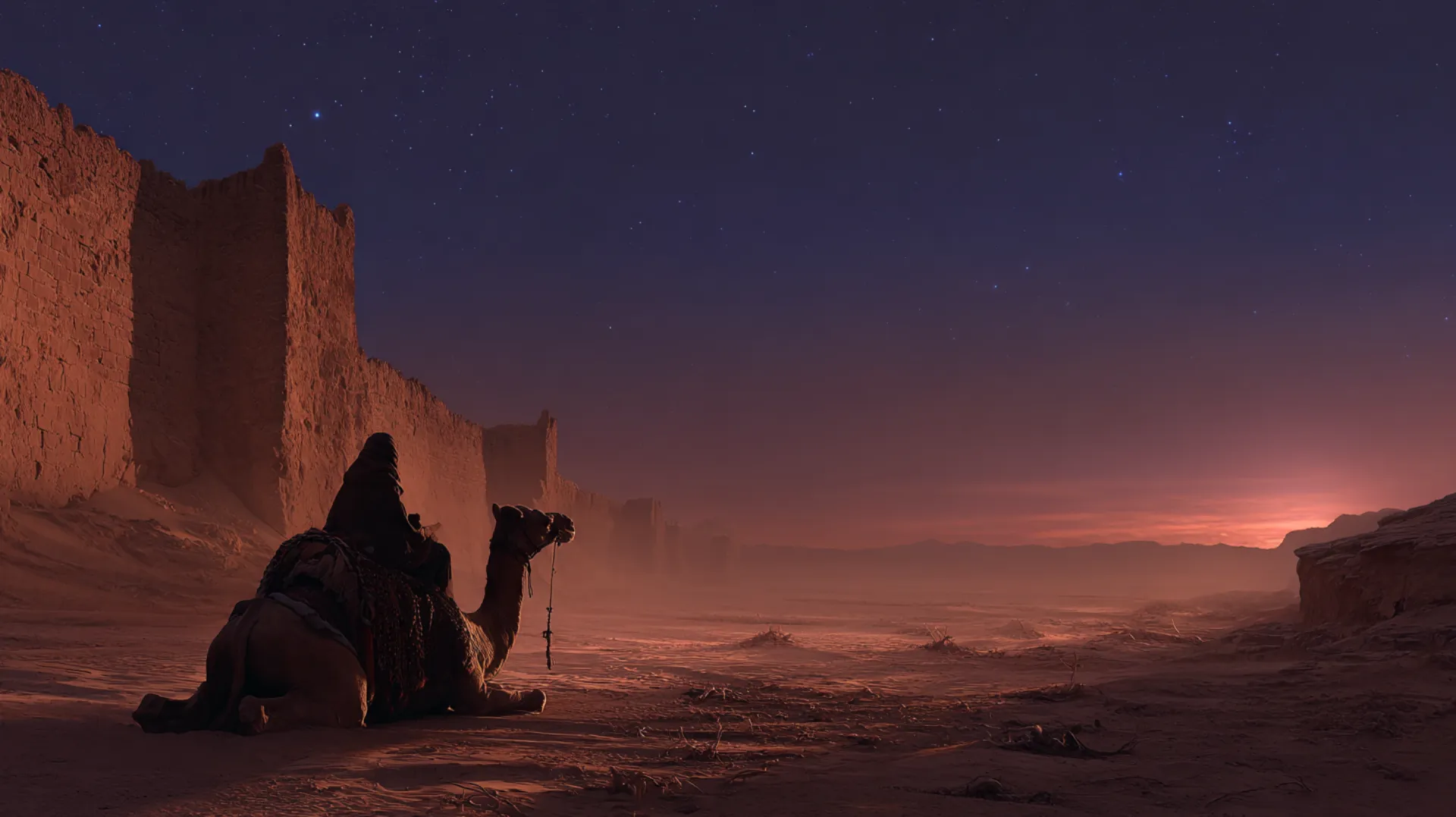
The hours stretch like a wound that will not close. Somewhere beyond the scrubland and the low acacia trees, beyond the last visible ridge where the road bends toward the sanctuary city, Uthman ibn Affan (may Allah be pleased with him) has vanished into Mecca — and he has not come back.
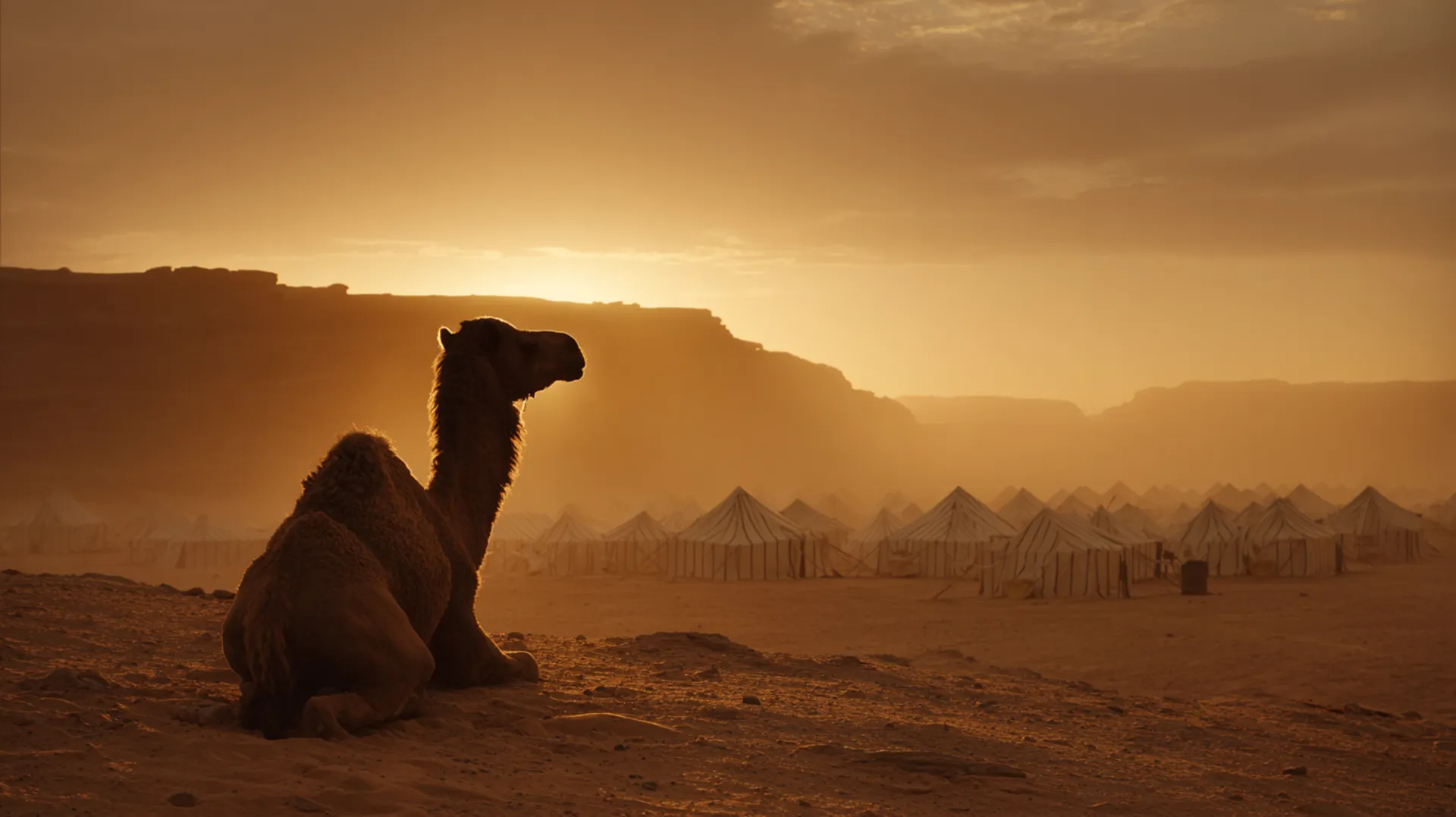
It is the sixth year of the Hijrah. Fourteen hundred Muslims sit in the dust of Hudaybiyyah, a barren plain twenty kilometers west of the city they ache to enter. They have come unarmed, dressed in the simple white garments of pilgrims, their sacrificial animals marked and garlanded. They have come for worship, not war. And now the sun is slanting toward Asr, and the man they sent as their emissary — a nobleman of the Quraysh’s own blood, a man whose tribal connections should have guaranteed his safety — is hours overdue.
One voice says it first, quietly: What if they killed him?
Then another voice repeats it, louder. Then another. And the rumor gathers mass like a stone rolling downhill, until by the time the shadows lengthen across the plain of Hudaybiyyah, it has hardened into something that feels like certainty.
The Silence Before the Storm
To understand the weight of that silence — the hours without word, the growing dread — we must understand why Uthman was there at all.
He was not the first envoy the Prophet Muhammad (peace be upon him) had dispatched. Before Uthman, the Prophet had sent Khirash, a man of the Khuzaah tribe, whose people carried deep roots in Mecca’s history. The Khuzaah had once expelled the Jurhumites and seized custodianship of the Ka’bah itself; their first chieftain, Amr ibn Luhay al-Khuzai, is historically credited — or blamed — for introducing idolatry into the Arabian Peninsula. In the Islamic period, the tribe had allied itself with the Prophet’s cause, making Khirash a natural choice for diplomacy.
But diplomacy requires two willing parties. The Quraysh hamstrung Khirash’s camel and surrounded him with menace. He barely escaped with his life. The message was clear: Mecca’s leaders were in no mood for conversation.
So the Prophet turned to Uthman ibn Affan — and the choice was deliberate, almost surgical in its precision. Uthman was not merely a Companion; he was Qurayshi aristocracy. His father Affan was a first cousin of Abu Sufyan, making Uthman and Muawiyah ibn Abi Sufyan second cousins. He could walk into the council chambers of Mecca’s elite not as a foreign petitioner but as family. If anyone could penetrate the wall of Qurayshi pride, it was this soft-spoken, dignified man whom the Prophet had twice given his own daughters in marriage.
Scholarly Note
The precise familial relationship between Uthman and Abu Sufyan is clarified in multiple sources: Affan and Abu Sufyan were first cousins, making Uthman and Muawiyah second cousins. This Umayyad kinship network was precisely what made Uthman the ideal envoy — he could appeal to tribal solidarity even as he represented the Muslim community.
The Prophet gave Uthman two missions. The first was public: negotiate with the Quraysh leaders for the Muslims’ right to perform Umrah. The second was quieter, more tender: if Uthman managed to enter Mecca, he was to seek out the secret converts still trapped in the city — men and women in chains, enduring persecution — and tell them that Allah was aware of their suffering, and that relief would come soon.
Uthman met his uncle Abu Sufyan. He met the other chieftains — Safwan ibn Umayyah and the rest. One by one, they gave the same answer, almost in the same words: Let not the Arabs say that they had the upper hand over us. Let not the Arabs say we were forced to let them in. It was not theology that drove them. It was pride.
The negotiations dragged. Perhaps each leader demanded his own audience — half an hour here, forty-five minutes there. Perhaps there were deliberations among the Quraysh themselves, arguments behind closed doors about how far to push, how much to concede. The sources do not record the details. What they record is the result: Uthman did not return for what may have been the better part of an entire day.
The Pledge Under the Tree
When the rumors finally crystallized into collective conviction — Uthman must be dead; if he were alive, he would have returned; they would not keep a man of his stature prisoner — the Prophet’s response was immediate and absolute.
He declared that the Muslims would not leave until they had exacted justice. They would fight.
The arithmetic of this declaration is staggering. Fourteen hundred pilgrims, travel-weary, their animals exhausted, their water running low. They carried whatever weapons a caravan might bear for self-defense — not the full armor and war-horses of a prepared army. Against them stood the Quraysh in their own city: rested, armed, supplied, and outnumbering the Muslims by at least three to one. To pledge battle in these circumstances was to pledge, in all human probability, one’s own death.
A crier went out across the Muslim encampment with extraordinary words: Jibreel — the Ruh al-Qudus, the Holy Spirit — had descended to the Prophet, and the Prophet was calling every believer to come forward and swear an oath of allegiance. The pledge was specific: they would not flee. They would stand and fight, and if they had to die, they would die on that ground. There would be no turning back.
The Prophet sat beneath a tree — one of many scrubby trees dotting the plain of Hudaybiyyah — and the Companions came forward, one by one. Each man placed his hand in the Prophet’s hand, clasped it, and swore the oath. Fourteen hundred souls. Even at twenty or thirty seconds each, the process would have taken well over an hour, the Prophet sitting with his back against the trunk, the desert light shifting around him as man after man stepped forward to embrace what looked, by every earthly calculation, like certain death.
All came except, it is reported, one hypocrite, who crouched behind his camel to avoid being seen. But Allah, as the Quran would later reveal, exposed what was in every heart.
The Spiritual Rank of Bay'ah al-Ridwan
The pledge sworn that day became known as Bay’ah al-Ridwan — the Pledge of Divine Pleasure — because of the extraordinary Quranic verse that followed:
“Indeed, Allah was pleased with the believers when they pledged allegiance to you under the tree, and He knew what was in their hearts, so He sent down tranquility upon them and rewarded them with an imminent victory.” — Al-Fath (48:18)
The Arabic word radiya — “was pleased” — gives the pledge its name. Ridwan is divine pleasure, and for Allah to declare His pleasure with a specific group of people, by name and occasion, in His eternal Book, is a distinction of almost unfathomable weight.
The Prophet reinforced this with explicit promises. As recorded in Sahih Muslim, he declared that no one who swore the Bay’ah al-Ridwan would ever enter the Fire of Hell. And at the moment of the pledge itself, he told them plainly: “You are the best people on earth right now.”
In the hierarchy of honor among the Companions, the participants of Bay’ah al-Ridwan occupy the second highest collective rank — surpassed only by the veterans of Badr. Above both groups stand individual figures: the ten Companions promised Paradise by name. But as a collective body, only Badr surpasses Ridwan.
The Quran’s praise does not stop at pleasure. Allah says He knew what was in their hearts — a divine attestation that their courage was genuine, not performative. He sent down sakinah, tranquility, upon them. And then the most astonishing verse of all:
“The Hand of Allah was over their hands.” — Al-Fath (48:10)
The physical act was simple: each Companion placed his hand upon the Prophet’s hand. But Allah declares that His own Hand was above theirs — that in swearing allegiance to the Messenger, they were swearing allegiance to God Himself. For Sunni theology, this verse is among the most powerful endorsements of the Companions’ collective integrity, and it forms a cornerstone of the belief that the Sahaba are worthy of the highest respect.
The numbers tell their own story. At Hudaybiyyah, there were 1,400 Muslims. Two years later, at the conquest of Mecca, there were 10,000. As Ibn Hisham observed, commenting on the words of the great scholar Ibn Shihab al-Zuhri: the peace that followed Hudaybiyyah allowed Islam to spread through conversation rather than confrontation, and in those two years, the Muslim community grew more than it had in the previous nineteen years combined.
Uthman’s Honor
When every Companion had sworn the oath, the Prophet performed an act of breathtaking tenderness. In front of all fourteen hundred witnesses, he placed his own left hand forward and said: This is for Uthman. Then he clasped it with his right hand and took the oath on Uthman’s behalf.
Think about what this means. The Companions had the honor of placing their hands in the Prophet’s hand. Uthman ibn Affan had a greater honor still: the Prophet himself stood in Uthman’s place, represented Uthman with his own body, and swore the pledge as Uthman’s proxy. The Messenger of God became, for that moment, Uthman’s stand-in before God.
This act would echo through the centuries, becoming a shield against every slander hurled at the third caliph. The exchange recorded in Sahih al-Bukhari between Abdullah ibn Umar (may Allah be pleased with them both) and a Kharijite agitator from Egypt crystallizes the point with devastating clarity. The man came seeking ammunition against Uthman, asking three loaded questions:
Did Uthman flee at Uhud? Yes, Ibn Umar replied — but Allah revealed in Surah Aal Imran that He had forgiven those who turned back that day.
Was Uthman absent at Badr? Yes — because the Prophet himself commanded him to stay in Medina to tend to his dying wife Ruqayyah, the Prophet’s own daughter. He was counted among the Badris by prophetic decree and given a share of the spoils.
Was Uthman missing at Bay’ah al-Ridwan? Ibn Umar’s answer was withering: What a fool you are. The entire Bay’ah only happened because of Uthman. And the Prophet used his own hand to take the oath on Uthman’s behalf.
“Go back to your people,” Ibn Umar told the man, “and tell them what I have told you.”
Scholarly Note
This narration is recorded in Sahih al-Bukhari. The Kharijite movement, which ultimately assassinated Uthman during his caliphate, represents the earliest sectarian challenge to the Companions’ collective honor. Ibn Umar’s systematic rebuttal demonstrates how the earliest Muslim scholars defended the Companions’ reputations using Quranic evidence and prophetic precedent. The theological principle at stake — that criticizing those whom the Prophet explicitly honored is tantamount to questioning the Prophet’s own judgment — remains a foundational element of Sunni creedal theology.
The Tree and Its Afterlife
As for the tree itself — the tree that Allah mentions in His Book, the tree under which the most consequential oath in early Islamic history was sworn — it presents a curious epilogue that illuminates a tension running through Muslim civilization to this day.
Jabir ibn Abdullah (may Allah be pleased with him), who had a remarkable memory for the geography of the Prophet’s life, could point out the exact tree. But most of the Companions could not. The plain of Hudaybiyyah was covered with scrubby growth, and one tree looked much like another. Return a year later, and the landscape had shifted just enough to make certainty impossible.
Yet within a decade or so of the Prophet’s death, the Bedouins and newer converts had selected a tree — whether the right one or not — and begun venerating it. They built a small mosque beside it. Some rubbed their backs against its bark, seeking blessing. When the scholar Sa’id ibn al-Musayyib, one of the greatest of the Tabi’un and the son of a man who had himself sworn the Bay’ah al-Ridwan, heard about this, his response was sharp: My father was there, and you’re telling me these people know better than the Sahaba?
The matter reached Umar ibn al-Khattab (may Allah be pleased with him), and his response was characteristically decisive. He ordered the tree — or rather, the tree the people had chosen to venerate — cut down and removed. It was not the tree that troubled him. It was what the tree would become.
Scholarly Note
The report of Umar ordering the tree cut down is recorded in the Musannaf of Abd al-Razzaq with an authentic chain of narration. This incident has become a key reference point in discussions about the Islamic approach to sacred sites and the prevention of practices that could lead to shirk (associating partners with God). Scholars differ on the broader implications: some take a strict position against visiting any historical site for spiritual purposes, while others, including many contemporary scholars, distinguish between visiting sites for historical reflection and education versus visiting them for tabarruk (seeking blessing from physical objects). The majority position permits visiting historical sites with the correct intention while prohibiting veneration of physical objects or locations beyond the three sacred mosques of Mecca, Medina, and Jerusalem.
The logic was prophetic in its foresight. If people were already rubbing their backs on a tree during the lifetime of Umar — a man whose very presence in a room commanded obedience — what would happen in a hundred years? In five hundred? The entire history of human religion suggested the answer: the tree would become a shrine, the shrine would become a temple, and the temple would become an idol. Every false god in human history began as something real — a righteous person, a sacred memory, a genuine miracle — inflated by generations of unchecked emotion until it eclipsed the God it was meant to honor.
The Return of Uthman and the Arrival of Suhail
The crisis resolved itself with an anticlimax that carried its own drama. Word reached the Quraysh that the Muslims had sworn an oath of battle, and the effect was electric. As al-Bayhaqi records in his Dala’il al-Nubuwwah, the Quraysh trembled. Fourteen hundred exhausted pilgrims, armed with little more than faith and the willingness to die, had terrified the mightiest tribe in Arabia. The Quraysh expedited Uthman’s return.
When the Muslims saw him approaching, some remarked with undisguised envy: How lucky Uthman is — he must have performed tawaf around the Ka’bah while we sit here in the dust. The Prophet knew better. “I do not think he would do tawaf while we have not,” he said quietly, reading in Uthman’s character what others could not.
And indeed, when a Companion half-jokingly asked Uthman if he had satisfied himself with the Ka’bah, Uthman’s reply carried the weight of absolute loyalty: What an evil thought you had of me. Did you think I would perform tawaf while the Messenger of Allah is still outside?
The Quraysh’s fear, however, demanded a response more structured than simply releasing an envoy. They sent Mikraz ibn Hafs first — a hasty choice, a man without a real plan. The Prophet assessed him instantly and told the Companions that this was a bad man and that nothing would come of it. The negotiations stalled almost immediately.
Then, from the distance, a more consequential figure appeared. Three men approached, and at their head walked Suhail ibn Amr — orator of the Quraysh, member of their ruling council, a man whose eloquence had once so enraged Umar ibn al-Khattab that Umar had asked permission to cut out his tongue.
The Prophet saw Suhail and smiled. “Suhail has come,” he said. “Sahula alaykum amrukum” — your matter has been made easy for you. The name Suhail derives from the Arabic root sahula, meaning ease. The Prophet drew from this a good omen — al-fa’l — linking the man’s very name to the hope that the impasse would finally break.
The Islamic Concept of Good Omens (Al-Fa'l)
The Prophet’s wordplay on Suhail’s name opens a window into an often-misunderstood aspect of Islamic theology: the concept of al-fa’l, or positive omens.
As recorded in Sahih al-Bukhari, the Prophet explicitly rejected all superstition and negative omens — black cats, broken mirrors, unlucky numbers — declaring that belief in such things constituted a form of shirk (associating partners with God). But he then added: “I like al-fa’l.” When asked what he meant, he explained: “A good word or a good phrase that someone hears.”
The conditions are precise. First, the sign must be positive — there is no such thing as a legitimate negative omen in Islam. Second, it must be linked to Allah — it must reinforce trust in God’s plan, not replace it with magical thinking. A good omen, properly understood, is nothing more than optimism in God dressed in the clothing of coincidence. It is the believer’s natural inclination to read the world as a place governed by a merciful Lord, to see in a rainbow after prayer not a magical sign but a reminder that the One who paints the sky has heard the supplication of the heart.
The Prophet’s reading of Suhail’s name was exactly this: not a prediction based on linguistics, but a declaration of trust in Allah wrapped in the beauty of Arabic wordplay. And as it happened, the reading proved accurate — Suhail’s arrival did indeed break the deadlock that had paralyzed negotiations for days.
Suhail: The Enemy Who Would Become a Saint
Suhail ibn Amr was no mere messenger. He was a member of the Quraysh’s Nadi — their parliamentary council — a man delegated with real authority to negotiate and bind his people to terms. He was also a man carrying deep personal wounds.
Years earlier, at Badr, Suhail had been captured and brought as a prisoner of war into the Prophet’s own house — an act of hospitality toward a captive that has no parallel in the annals of military history. One of the Prophet’s wives, seeing the great orator of the Quraysh with his hands bound to his neck, had blurted out in shock: You should have killed yourself rather than let me see you like this — a slip born not of cruelty but of the cognitive dissonance of seeing a titan humiliated. The Prophet had rebuked her sharply: Are you taking sides against Allah and His Messenger?
It was at Badr, too, that Umar had asked to cut out Suhail’s tongue, and the Prophet had refused — not only on principle (“I am a prophet, and we have not been commanded to mutilate people”) but with a quiet prophecy: “Perhaps one day he will say something that will please you.”
That day was still years away. But when it came, it would vindicate every ounce of the Prophet’s patience.
Suhail’s personal stake in these negotiations ran deeper than politics. His eldest son, Abdullah ibn Suhail, had secretly converted to Islam and — in a stroke of audacious cunning — had volunteered for the Qurayshi army marching to Badr, only to slip away on the first night and join the Muslim ranks. He fought against his own father’s people. The shame of it had scarred Suhail’s reputation in Mecca.
And then there was Abu Jandal, the younger son. When Abdullah fled, Abu Jandal’s sympathies became obvious, and Suhail had responded with a father’s fury twisted by tribal honor: he locked Abu Jandal in a dungeon, chained him, ordered his servants to deprive him of food and water, and tortured him for four and a half years — from Badr until this very moment at Hudaybiyyah.
It was this man — wounded father, proud orator, implacable negotiator — who now sat across from the Prophet to write a treaty. And it was his arrival that would trigger one of the most heartbreaking scenes in the entire Seerah, a scene that would test the faith of every Muslim present to its breaking point.
But that scene — the clanging of chains in the distance, the cry of Ya al-Muslimin!, the father turning to the Prophet and saying This is the first one this condition applies to — belongs to the next chapter of this story.
The Architecture of a Victory No One Recognized
What had happened at Hudaybiyyah? On the surface, nothing that looked like triumph. The Muslims had not entered Mecca. They had not performed their Umrah. They had sworn an oath to fight and then not fought. Their envoy had returned safely, deflating the very crisis that had produced the most sacred pledge in their history.
Yet Allah called it a victory — fathan mubinan, a manifest, clear, unmistakable victory. When Surah al-Fath descended upon the Prophet during the journey home, its opening verse — “Indeed, We have given you a clear victory” (Al-Fath 48:1) — stunned even Umar, who asked incredulously: Is this a victory? The Prophet confirmed it, and Umar’s doubt evaporated in an instant, replaced by the certainty that only divine revelation can produce.
The victory was not military. It was strategic, spiritual, and — as history would prove — demographic. The treaty that Suhail would negotiate, for all its seemingly humiliating terms, would create something the Muslims had never had: peace. And in peace, Islam could speak. In peace, people could hear. In peace, the message could travel on its own merits rather than at the point of a sword. As Ibn Shihab al-Zuhri would later observe: “There was no victory given to Islam before Hudaybiyyah greater than Hudaybiyyah itself, because the people were at peace with one another, and they would mix and talk and mention Islam. And not a single intelligent person heard about Islam except that he entered it.”
The fourteen hundred who knelt under a tree in the dust of Hudaybiyyah, ready to die for a cause that seemed lost, could not have known that their willingness to sacrifice everything was the very thing that would make sacrifice unnecessary. They had offered their lives, and Allah had given them back something greater: a future in which the world would come to them.
The terms of that future — the bitter clauses, the agonizing compromises, and the sound of chains dragging across desert stone — awaited them in the negotiations to come.
Quranic References
Continue Your Journey
Cite this Narrative
APA
SeerahQuest. (2026). The Pledge Under the Tree. *SeerahQuest: The Eternal Narrative*. https://seerahquest.com/chapters/hudaybiyah-bayah-al-ridwan-and-surah-al-fath-the-pledge-unde Adapted from Yasir Qadhi's Seerah Series, Episode 65.
MLA
"The Pledge Under the Tree." *SeerahQuest: The Eternal Narrative*, 2026, https://seerahquest.com/chapters/hudaybiyah-bayah-al-ridwan-and-surah-al-fath-the-pledge-unde. Adapted from Yasir Qadhi's Seerah Series, Episode 65.
Chicago
"The Pledge Under the Tree." *SeerahQuest: The Eternal Narrative*. Accessed April 3, 2026. https://seerahquest.com/chapters/hudaybiyah-bayah-al-ridwan-and-surah-al-fath-the-pledge-unde. Adapted from Yasir Qadhi's Seerah Series, Episode 65.
Install SeerahQuest — read chapters offline, anytime.